
Measurements at the Machine or in the Climate-Controlled Room: Where Is the Line?
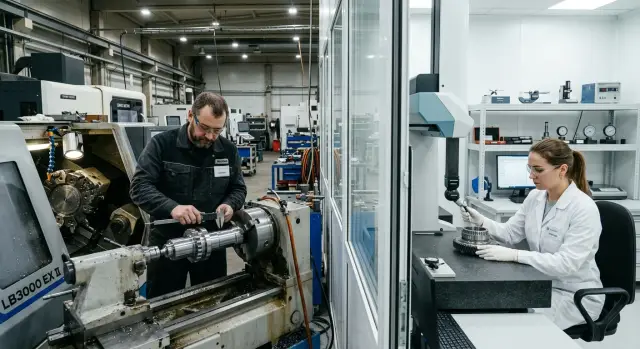
Measurements at the machine and in a climate-controlled room serve different purposes: we break down speed, error risk, and tolerance requirements for typical parts.
Where the debate starts
The debate does not begin with the measuring tool, but at the moment when the same part gives two different numbers. At the machine, the operator sees a dimension within tolerance, but after moving it to the climate-controlled room, the inspector gets a different result. Both may be working carefully. The conditions are simply different now.
This happens all the time. The part has just come off the machine and has not cooled down yet. After unclamping from the chuck, internal stress changes a little. A film of coolant or fine chips remains on the surface. Even the force of a hand during measurement can sometimes add a few microns. For a loose tolerance, that is a minor issue, but for a tight fit, it is already a reason for a dispute.
That is why the question of “measurements at the machine or in the climate-controlled room” almost never comes down to finding one correct place. Usually, it is a choice between two tasks. The first is to understand quickly what is happening with the process right now. The second is to get a calm, repeatable result that will not change in half an hour and will not cause an argument during acceptance.
In serial production, checking at the machine often saves the batch. The operator notices a size drift earlier and has time to adjust the offset before scrap starts to build up. But the same habit becomes a problem when the tolerance is tight. For a precision bushing, shaft, or fit location, rushing creates false confidence: the part is still warm, and the number on the gauge looks better than it will after the temperature evens out.
There is also the opposite side. Extra transfers also cost money, even if that is not always obvious right away. The part has to be removed, carried over, waited on, measured, and the result brought back to the shop floor. While it moves between the machine and the inspection room, the machine often waits for a decision. In series production, these pauses quickly turn into lost time.
The boundary usually depends on the tolerance and the condition of the part. If the tolerance band is wide, checking at the machine often gives everything needed for the job. If the tolerance is tight, the part temperature, the stability of the conditions, and the repeatability of the measurement come to the foreground. The same micrometer in two places can show not only different numbers, but also a different meaning for the result.
How the two measurement locations differ
The machine and the climate-controlled room serve different purposes. Near the equipment, the question is whether machining can continue, whether the size has drifted, and whether a correction is needed. In the inspection room, the goal is to get a result that another inspector and the next shift will repeat.
Conditions at the machine are always harsher. The part is often still warm after cutting. Chips, leftover coolant, vibration from nearby equipment, and simple rushing all affect the measurement. Even a good micrometer in that environment gives a larger spread if the surface has not been cleaned properly or if the part is measured immediately after removal.
The climate-controlled room offers a different level of inspection. It is easier there to keep the temperature stable, clean the part, let it cool down, and perform several measurements without rushing. That is why differences between readings are usually smaller. If two people check the same diameter under the same conditions, the results will be closer to each other.
But the speed difference is significant. At the machine, the answer is needed within a minute. Otherwise, you may produce several more parts with the same offset. In the inspection room, nobody works at that speed: the part is prepared for inspection, measured in several points, and the result is recorded. That is the right approach for acceptance, but not the best one for an operational decision.
In practice, these two places do not compete; they divide the work. At the machine, checking is quick and frequent. In the inspection room, checking is calmer and stricter. On CNC lines, this split usually reduces scrap: the operator notices drift earlier, and inspection gets a more even and understandable result.
How tolerance determines the place of inspection
The choice of inspection location is usually dictated not by habit, but by tolerance. If the dimension is simple and the tolerance band is wide, the operator can check it right after machining and quickly understand whether the batch can continue. This is often how overall length, an outside diameter for rough assembly, or dimensions are checked where a few hundredths do not change how the part works.
When the tolerance gets small, the conditions can no longer be ignored. The temperature of the part, the machine, the tool, and the gauge itself begin to influence the result noticeably. For a part with a tolerance of just a few hundredths of a millimeter, the difference between a warm blank at the machine and a cooled part in the room leads to a completely different conclusion.
Special caution is needed with long shafts, thin-walled bushings, and parts after a finishing pass. They quickly pick up heat from the chuck, from hands, and from coolant. On a short, solid part, this may have almost no effect, but on a long, thin one the difference is already obvious.
Fit surfaces and reference diameters almost always require a calmer check. If a bearing will be installed on that dimension, the assembly will be centered by it, or the alignment of the next operation will depend on it, an error of one or two hundredths can easily turn into scrap or extra fitting.
The simple rule here is this: the tighter the tolerance, the less room there is for rushing. For operational control next to the machine, it is enough to check the dimensions needed to keep the process on track. For the dimensions that determine the fit, geometry, and final accuracy of the part, it is better to wait for a stable temperature and measure where conditions do not fluctuate during the shift.
How to choose the measurement location
Start with the drawing. Not every dimension affects the result equally. If a certain dimension prevents the part from assembling into a unit, creates play, or causes a tight fit, it is better to mark it immediately as a mandatory item for stricter control. Other dimensions are often enough to check on the shop floor so production does not slow down.
The next question is the part temperature after machining. If the blank has just come off the machine and is noticeably warm, measurement accuracy can easily drift even with a good instrument. For coarse and medium tolerances, that is usually acceptable. For tight fits, it is already a risk.
After that, choose not the most accurate place in general, but the place for the specific task. For current control, you need a fast gauge and a clear measuring method that the operator can repeat in the same way every time. For final acceptance, stable conditions, a clean reference, and several repeat measurements matter more.
Finally, this rule needs to be written down. If the procedure is not fixed, every shift worker does it differently: one measures right after machining, another waits half an hour, a third uses a different gauge. Then people are no longer arguing about the part size, but about whose measurement should be considered correct.
The simplest approach is a clear one: dimensions used to control the process are checked at the machine, while dimensions with a small tolerance and a high risk of dispute go to separate inspection. If the first part of a new setup shows a difference between the shop-floor measurement and the acceptance measurement, that is a good sign that the checking procedure should be reviewed before series production starts.
Where speed wins
In terms of speed, inspection at the machine almost always wins. The operator gets an answer immediately, while the part is still in process and the setup can be corrected without an extra pause. This is especially important for the first part: check the dimension, make the correction, and do the next pass.
If the part is taken to the climate-controlled room, time is lost not only in the measurement itself. It has to be removed, labeled, carried over, sometimes cooled down, and wait its turn. Then the result has to be brought back to the shop floor. In a busy shift, that whole cycle can easily take 20-40 minutes.
There is another loss as well: re-clamping. While the part is removed from the machine and carried to a separate station, the job essentially stops. If something needs to be corrected after the measurement, the part is mounted back in the chuck or fixture, the reference is checked, and only then does machining continue. On a small batch, that is already a noticeable pause, and on a large batch these pauses build up quickly.
Fast inspection at the machine is especially useful after setup, after a tool change, and between roughing and finishing passes. At those moments, the main thing is to understand quickly whether the process is under control. The climate-controlled room rarely wins here. Its strength is not speed, but repeatability.
Where mistakes happen most often
Mistakes happen in both places, but their nature is different. At the machine, errors happen faster because the conditions are worse. In the inspection room, they are noticed later because the process has already moved on.
Mistakes at the machine
The main problem is the warm part. After machining, the metal has not yet reached a stable temperature, and even a difference of a few degrees changes the result on tight tolerances. For rough checking, this is sometimes acceptable, but for the final decision the risk is too high.
There are also simpler causes. A little dirt on the micrometer jaws, the probe, or the part itself immediately ruins the measurement. One stuck chip can add hundredths of a millimeter, and the operator will start adjusting the tool offset for no reason.
Another common mistake is using the wrong reference surface. One time the size is measured from the chuck stop, another time from a different surface. The spread seems like a machine problem, although the real cause is the checking method. If the reference changes every time, comparing results is simply pointless.
Another typical mistake is looking at only one cross-section and drawing a conclusion about the entire part. That makes it easy to miss ovality, taper, or local deviations after the finishing pass. For shafts and long fit surfaces, this is common: the micrometer reading looks within tolerance, but the part behaves badly during assembly.
Mistakes in the climate-controlled room
The room is cleaner, quieter, and more temperature-stable, but that does not eliminate mistakes. The most common problem is too much time between machining and inspection. While the part was transported, waited, and stood in line, the process at the machine had already changed. The control showed the problem too late, and the batch had already grown.
There is another trap too: stable conditions can create a false sense of complete reliability. The inspector sees a neat result and considers the matter closed, although without a link to what was happening at the machine during the shift, it is easy to miss tool wear or a gradual thermal drift in the process.
The best option is not to choose one place instead of the other, but to divide the roles. At the machine, you catch quick deviations and keep an eye on the process. In the room, you confirm the final dimension where the tolerance does not forgive rushing.
A few typical situations
A batch of simple bushings after turning usually does not wait for the climate-controlled room. If the operator needs to know quickly whether the diameter is staying within the tolerance band, the part is measured at the machine. For a bushing with an ordinary working tolerance, that is enough if the measurement is done with the same tool, in the same way, and on a clean surface.
The picture is different with a housing that has precise fits. After machining, the metal is still warm, and the fit holes and faces can show extra microns. If the part is meant for a bearing, a guide, or a precision bushing, it is usually cheaper to wait 20-30 minutes and check it under stable conditions than to scrap the entire housing later.
A long shaft is especially awkward for rushed inspection. After roughing, it may show one size, and after finishing and cooling, another. If the shaft is long and thin, it also bends under its own weight. At the machine, it is useful to watch the overall trend and see whether the diameter has drifted after the pass. But the final inspection of such a part is often better done after a pause, on supports, and without rushing.
The first part of a new program and a stable series also need different approaches. For the first part, it is better to check more dimensions, let the part equalize in temperature, and look separately at the strictest locations. In production, inspection is usually simpler: if the process is stable, some dimensions are logically checked right at the machine, while other dimensions are periodically confirmed in the inspection room.
A short check before measuring
Before any measurement, it helps to pause for half a minute and answer one question: do you need a fast working answer or a final confirmation of the size. Half of the disputes on the shop floor start exactly because these two tasks are mixed together.
A minimal check is simple:
- make sure the part is not too warm for the required tolerance;
- clean the part and the measuring tool;
- check which reference surface is specified on the drawing;
- decide whether this result is needed for process correction or for acceptance.
If the dimension affects a bearing fit, alignment, clearance in an assembly, or the joint with another part, rushing is rarely justified. If it is a working dimension the operator needs for current correction, checking it at the machine usually solves the task faster and more cheaply.
A simple example: a machinist removes a part, quickly checks the outside diameter, and sees that the size has drifted by several hundredths. That is enough to correct the next part. But the first part should be sent for final inspection after cooling, especially if the tolerance is tight.
What to do in practice
The most practical approach is to split inspection into two levels right away. At the machine, check what helps keep the process on size here and now. In the climate-controlled room, confirm the final result where the tolerance does not forgive heating, a difference in reference, or rushing.
It is better to put this into a simple inspection card. Then the operator, setup technician, and quality control team all follow the same rule instead of relying on memory. Such a card usually needs just four items: which dimension is checked, who measures it, with which gauge, and at which stage of the route.
It is also worth highlighting dimensions that should always go through calm inspection only. These are usually precision fits, critical diameters, the relative position of surfaces, and parts that heat up noticeably after machining. The rule for the first part is also simple: perform an operational check at the machine, then confirm the part under stable conditions. If both results behave predictably, the series can then be supported with faster shop-floor control and periodic cross-checks.
There is one more practical point: sometimes the problem is not the measurement location, but the process itself. If the machine holds size unevenly because of heat, backlash, vibration, or unstable setup, moving almost all inspection to the machine is pointless. It will help you see the deviation faster, but it will not remove the cause.
If the inspection route or the process itself is still being set up, it is better to discuss these things in advance. For EAST CNC customers, this is often decided at the equipment selection stage, during commissioning, and in service support. This is especially useful when it comes to CNC lathes and parts with strict tolerances.
A good sign is simple: the operator understands what is checked at the machine every hour, and the inspector knows what goes to the climate-controlled room and why. When this rule is written down and followed by every shift, there are fewer disputes and the batch runs more smoothly.