
Master Sample for Repeat Parts: When It Saves Time
A master sample for repeat parts helps you launch a batch faster if you record dimensions, tolerances, photos, and a simple change history in advance.
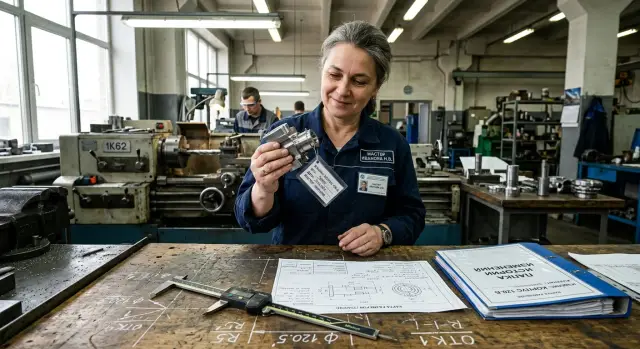
Why a batch stalls without a reference
A repeat batch rarely fails because of one big mistake. Usually the shop loses time on small things: someone is looking for an old drawing, someone else is digging up the setup tech’s notes, and someone is arguing about the part version. In the end, the team checks the same things all over again, even though they already solved them in the previous run.
On paper, the part seems the same. In practice, details almost always come up. On the first batch, someone may have slightly changed a chamfer, shifted the measuring base, or left a different allowance so the part would pass inspection on the CNC machine more consistently. If that is not obvious right away, people repeat the long path from scratch: trial blank, measurement, program adjustment, another trial.
Memory is not something to rely on here. People usually remember the general flow of work, but not dozens of exact details. After two or three months, very few people can confidently say which diameter had to be tightened by 0.02 mm, which radius was sensitive, and on which operation the first defect appeared. Even an experienced operator often remembers not the fact itself, but their version of what happened.
Because of this, extra work starts in several places at once. Setup takes longer than it should, quality control has to agree on disputed dimensions again, the first parts more often go to rework or scrap, and a new employee depends on verbal explanations from coworkers.
This becomes especially annoying on repeat orders for auto parts, construction equipment, and other serial metalworking jobs. A part may look identical, but one dimension sits right on the edge of tolerance and another depends on a specific base. If that point is missed, the first piece may still pass, but by the tenth one the variation will show up.
That is why a master sample for repeat parts is often more useful than yet another file with scattered notes. It removes arguments at the start of work. People see not only the drawing, but also the real part from which the batch was already launched without unnecessary questions.
You do not need expensive software for this. In most shops, a simple setup is enough: the sample itself, a short card with notes, the date of the last successful run, and a few photos with key dimensions. This system costs less than a mistake on the first shift and works faster than trying to reconstruct the history from memory.
When a master sample really saves time
A master sample is not needed for every part. It works well where the shop keeps producing the same item in small batches: 20 pieces today, 15 more in a month, then another repeat next quarter. In that kind of work, what gets lost is not the drawing, but the small work agreements that make the first run slow.
Most often these are simple but demanding parts: bushings, flanges, shafts, adapters, and housings with several reference faces. The drawing is clear enough, but at the machine questions start right away: which dimension should be checked first, where is the best base, which chamfer is enough, and where is exact reference needed. A good sample clears up part of that in just a few minutes.
The benefit is especially noticeable when the operator changes. One person remembers that for a part, the whole contour is not the key point, but the fit and the distance between two surfaces are. Another sees only the drawing and wastes time on extra checks. If an approved sample is nearby, the new operator understands faster what must be repeated exactly and where the tolerance is wider.
Another typical case is when an order returns after several months. During that time, the operator, setup person, tooling, or even the material from a new batch may have changed. The drawing usually stays, but the memory of the previous corrections is gone. The sample preserves the real result that already worked for both production and inspection.
Usually the system pays off if the part is repeated in small batches without a fixed rhythm, has several dimensions where defects are often found, different operators work on the same order, and the first setup costs more time than storing one sample and a short card.
But do not turn the idea into bureaucracy. If the order is one-off, the part keeps changing from batch to batch, or it is a prototype, a master sample will only add confusion. It is needed where the design is already stable and the part is truly repeated.
A normal setup is simple: one approved sample, a brief inspection note, and a clear change history. If, after a pause, the shop takes this set and quickly gets the first good part without extra calls and approvals, the system is working.
Which dimensions to record on the sample
There is no point in marking everything on the sample. When there are too many notes, the setup person or inspector spends extra minutes and still looks only for the dimensions that matter for assembly. For a repeat run, it is better to keep only the dimensions that determine whether the part can be placed, assembled, or checked in the first minutes.
Start with the basic dimensions: outer and inner diameters, overall length, distance between supporting surfaces, length to a step, groove, thread, or hole. A number by itself without a reference base often does not help much. A note like "from face A to the step" or "from base B to the center of the hole" is much more useful than a dimension without a reference.
For turned parts, a few groups of dimensions are usually enough:
- fit diameters for a bearing, bushing, seal, or coupling;
- lengths from the base face to working steps;
- depths of holes, grooves, and recesses;
- slot widths and their reference to the base;
- chamfers and radii if they affect assembly.
Fit dimensions should be highlighted separately. If one diameter creates an interference fit and the neighboring one only needs to pass through, they should not be treated as equally important. On a master sample, the diameters and lengths that immediately create a defect are usually the ones to mark: the part does not seat, sits crooked, rubs against the next assembly, or does not reach the stop.
Chamfers, radii, and depths are often treated as minor details, and that is a mistake. A small chamfer decides whether the part will go into assembly without burrs. A radius that is too large on a transition can prevent a tight fit. A shallow groove may keep a retaining ring from seating. If such an element affects operation, it should be marked as clearly as the main diameter.
Tolerances do not need to be written everywhere, only where an error immediately affects how the part works. Usually these are fit diameters, lengths to stop faces, coaxial areas, and depths that define the position of another part. The rest can stay in the drawing if it does not interfere with assembly or affect service life.
It is also useful to mark the first inspection surfaces separately. Most often these are the base face, support diameter, working plane, thread, or groove. If the inspector sees them right away and quickly compares them against the sample, the whole check goes more smoothly.
What to keep next to the part
A master sample by itself does little if there is no short and clear part history next to it. After a couple of months, people only remember the general idea: "we have made this part before." But which stock it was turned from, which revision it was, and where the most sensitive dimension was, is usually forgotten.
Next to the sample, it is better to keep not a thick folder but a small set that can be checked in a minute. For most repeat parts, a general-view photo, two to four close-ups of problem areas, a card with the part number, revision, and date, plus a short note on material, blank stock, and fixture are enough if without them it is easy to start the wrong part.
Photos are best taken against the same background and from the same angle. Then the difference between revisions is immediately visible. Close-ups are not for reporting; they are for risk areas: an unusual chamfer, groove, thread, fit, stop surface, or a surface that must not be touched after the finishing pass.
On the card, write only what helps prevent mistakes at the start. The part number, revision, and date are the minimum. If the design changed, add one short line about the nature of the change. For example: "R3 - increased neck length by 0.5 mm." That is already enough to avoid pulling up the old file and repeating the old setup.
It is better to list the material and blank stock without abbreviations if the shop can easily mix up similar items. For a turned part, that might be the material grade, bar diameter, blank length, and, if needed, the finished part weight. Small details like that save time for the foreman, storekeeper, and quality control.
If the result depends heavily on a specific setup, that should be written down clearly too. Short notes like "check runout after the second setup" or "use the soft jaws from set 14" are often more useful than a long instruction.
And one more simple thing: leave a note nearby about what must not be changed. One sentence works better than five vague phrases. For example: "do not reduce the radius," "do not move the base," "do not change the grinding allowance." Those small details are often what break repeatability.
The history can be stored very simply: the sample in a labeled container, a paper card next to it, and the same folder on the shared drive with the same name. If repeat orders come only every few months, that is usually enough.
How to build the system in one day
It is better to start with storage, not with a spreadsheet. If master samples are kept in different drawers, people waste time searching and still take the wrong part. Choose one shelf, one cabinet, or at least one labeled drawer near the area where repeat setups are usually prepared.
Then give each part a simple code. It should match what is already used in the drawing, routing, or order. If the part has versions, add the revision right into the code, for example 154-02-R1. Then the operator and inspector can immediately see that this is not just a similar part, but the correct version.
What to keep with the sample
The sample itself is best stored together with a tag and a card. The tag should be attached not to the part surface itself, but to the bag, box, or holder, so the working references and finished areas are not damaged.
The card usually needs only five items:
- part code and revision;
- approval date for the sample;
- who checked it;
- the dimensions checked first;
- a note on material, blank stock, or fixture if it affects setup.
Do not try to put the entire drawing on the card. For a repeat part, it is better to keep only the dimensions that most often cause the first piece to fail: fits, length from the base, finished diameter, groove depth, thread, runout, or coaxiality. Everything else stays in the normal documentation.
The change history can be kept without a complex system. One paper folder and one spreadsheet on a computer are enough. The spreadsheet should hold short entries: date, what changed, why, who approved it, and where the new sample is stored. The old card should not be thrown away. Mark it as archived so that three months later nobody argues about why the dimension changed.
To begin with, test the system on one part that is repeated often. If, after one or two runs, people quickly find the sample, read the card without calling the technologist, and do not mix up revisions, then the process is already working. After that, it can be rolled out to other parts.
Example: a repeat order after three months
Three months later, an order came back for a batch of 120 identical bushings. The part had already been made, but by then the machine fixture had been changed, and some setup notes were scattered across different folders. If the run is restarted only from old notes, the first shift goes not into cutting, but into figuring out what the previous setup person actually meant.
This time, a master sample was kept next to the process sheet. It marked the base diameter, overall length, the length from the stop to the collar, and the groove width. A simple card was there too: the date of the previous order, the material, the tool number, tool overhang, corrections for two operations, and a short note that on the last batch the feed had to be shifted slightly on the finishing pass.
With the sample, the first setup took about 40 minutes. The operator loaded the blank, positioned the tool, cut the first trial part, and immediately compared it with the reference using a caliper and micrometer. The first check already showed that the collar was 0.15 mm too long. The reason was found quickly: the previous batch used a different stop.
Without the sample, the same start would have looked worse. The old notes might say the collar length was 18 mm, but it would not be clear from which base it was measured after flipping the part. On paper the dimension exists, but at the machine there is still one extra question. Because of small details like that, the team makes more trial parts and argues longer about whether it is a recording mistake or a new problem.
Most often, discrepancies show up in three places:
- on the fit diameter, where hundredths matter;
- on the length from the working base, not from a convenient edge;
- on small elements such as a chamfer or groove.
The sample is useful not because it replaces the drawing. It removes doubt at the start of the shift. When the part returns after several months, people no longer remember the small corrections, and paper rarely keeps them in a clear form.
If a short change history is kept next to the sample, the team sees not only the nominal value, but also the previous deviations. That is why the first good piece is obtained sooner, and the risk of repeating an old mistake is noticeably lower.
Where mistakes happen most often
Even a good master sample loses value if the shop just stores it "for memory." The problem is usually not the part itself, but the work process. One person measured from one base, another from a different one, and after a few months nobody remembers which number is correct.
The most common mistake is not writing down the base from which the dimensions are taken. On the drawing, a length of 42 mm looks clear, but in production there is always one question: from which surface should it be measured? If that is missing from the card, two setup people get different results and both are sure they are right.
Storing similar parts in one box without labels causes just as many problems. From the outside, they may differ by only a few millimeters, or by the chamfer or fit. When the order comes back after three months, an employee picks up the "almost same" part, and the error goes straight into the machine setup.
Another common failure is when the sample is changed after a correction, but the card is left old. If the radius, hole, or length has already been fixed on the part, but the old numbers are still written next to it, the shop is setting itself up for extra runs and repeat inspection.
Photos do not solve everything either. A picture helps identify the part visually, but it does not answer simple questions: which dimension is kept tight, where variation is allowed, and what is checked first. A photo without numbers is only useful until the first argument.
Another issue is history kept in one employee’s personal notes. While that person is there, the system still works. As soon as they go on vacation, get sick, or leave, the reasons for the changes, the old sample version, and the inspection sequence disappear with them.
Warning signs are usually easy to spot:
- different employees name different base surfaces;
- the part has been reworked, but the card does not mention it;
- the sample is recognized only by photo or "by eye";
- nobody can quickly say which version is the latest.
A reliable system does not require expensive software. Clear labeling, a paper or simple digital card, and a shared folder that the whole shift can access are enough. Then a repeat run goes by facts, not by memory.
A short check before startup
Before the first blank, it is worth spending 3-5 minutes on the same check each time. Those minutes often save half a shift, especially if the batch is repeated not every week, but every few months.
A master sample helps only when it is checked before startup, not after the first bad parts. First make sure the part number and revision on the card, in the drawing, and on the sample itself match. If the sample has an old marking, it is better to stop right away and clarify everything before the run.
Then there is no need to remeasure the whole part. Usually three or four dimensions are enough - the ones that determine fit and how the assembly works. That may be the outer diameter, overall length, base dimension, groove depth, or thread. On a turned part, the error is more often hidden in such places than in secondary dimensions.
Photos also help if they are taken for practical use, not for a report. From the photo, the operator can quickly see which side the part was installed on, which surface was used as the reference, and what the finished sample looked like. One wrong flip in the chuck can create scrap even with the correct program.
Before startup, a short checklist is enough:
- verify the part number and revision;
- check the most important dimensions;
- open the setup and orientation photo;
- make sure the card is stored with the sample;
- review the latest change before starting the batch.
The last point is often skipped. And that is a mistake. Sometimes the change is tiny: the radius was altered, the chamfer was removed, the length was shortened by 0.2 mm. If that is not written down next to the part, the shift will take the old sample as correct and repeat the old version.
The simplest rule works best: the sample, the card, the photo, and the latest change note are stored together in one place. In a bag, box, or folder by the machine - it does not matter. If the documents are kept separately, confusion is almost guaranteed.
In practice, that is already enough for a repeat run to go smoothly from the first part instead of the third attempt.
What to do next
Do not try to cover the whole archive at once. Start with the parts that the customer repeats most often. That is where a master sample has the clearest effect: the setup person spends less time on the first run, and there are fewer disputed questions about dimensions.
Next, it is useful to assign the process to one responsible person. That does not mean only that person works with the samples. Their job is simpler: make sure that after a change to the drawing, fixture, or machining process, a new mark, date, and short explanation appear next to the part about what exactly changed.
For a start, a simple plan is enough: choose 10-20 repeat items, create a folder or paper envelope for each one, assign one person to update the reference sample, and once a month review the parts where size, tolerance, or version gets mixed up most often. If a form takes the team more than a minute to fill out, it is better to simplify it or remove it.
The system should live in the shop floor, not in a nice spreadsheet that nobody opens. If the operator needs three files, two chats, and a call to the technologist, they will still work from memory. One sample, one card, and one short change history is much more reliable.
If you are also reviewing the shop layout and equipment, EAST CNC materials on east-cnc.kz can be useful as a practical reference. The company blog has industry news, equipment overviews, and practical metalworking tips.
A good sign of a simple system is this: a new employee understands it in 10 minutes, and an experienced setup person does not argue with it because it truly saves time. If that is not the case, the rules should be shortened and kept only where the team uses them every day.
FAQ
What is a master sample in simple terms?
It is an approved part that the shop uses to check a repeat production run. It helps people quickly remember not only the drawing dimensions, but also the real shop-floor details: which base was used for measuring, where defects were already found, and what must not be changed.
Which parts really benefit from a master sample?
Use it for repeating parts that are made in small batches and come back after pauses. It brings the most value where first setup usually takes longer because people argue about the base, fit, groove, chamfer, or revision.
When does a master sample only get in the way?
Do not create one for one-off jobs, prototype parts, or parts that change with almost every batch. In those cases the sample becomes outdated quickly and only confuses people at the machine.
Which dimensions should be recorded on the sample first?
First mark the things without which the part cannot be placed, assembled, or checked properly. Usually these are fit diameters, overall length, lengths from the base face to steps, groove and hole depths, slot width, thread, and runout if it affects operation.
Do all drawing tolerances need to be listed on the sample?
No, there is no need to copy every tolerance from the drawing. Keep only the dimensions where an error immediately causes a problem: the part does not seat, sits crooked, does not reach the stop, or fails the first inspection.
What should be stored next to the master sample besides the part itself?
Keep a short card nearby with the part number, revision, date, material, and blank stock. Add a couple of photos of the problem areas and one or two notes about the fixture or setup if they help avoid repeating an old mistake.
How can similar parts and their versions be kept from getting mixed up?
Give the part one clear code and add the revision right away, for example at the end of the designation. Then keep the sample, card, and photos under that same code in one place so the operator does not choose a 'similar' part by eye.
Who should update the sample and change history?
Usually one person responsible for updating the record after a change to the drawing, fixture, or process is enough. That person does not do all the work alone; they just make sure the new revision, date, and short explanation are placed with the sample immediately.
How can you check the sample before a repeat run in a few minutes?
Before the first blank, verify the part number and revision, then check three or four of the most sensitive dimensions. After that, look at the setup photo and the latest change note so you do not restart the old version.
Where do shops most often make mistakes with this system?
Most often people do not write down the measuring base, keep similar parts in one box, or change the sample without updating the card. Another common problem is storing the history in one employee’s personal notes. Once that person is away, the shop goes back to memory.