
Macros for a Family of Parts: When They Help
Macros for a family of parts reduce routine work on CNC machines but make error tracing harder. We explain when macros truly help and when separate programs are safer.
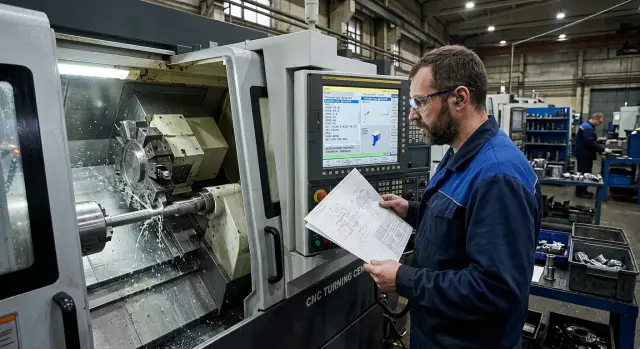
Why similar parts still take a lot of time
Similar parts almost never reduce to a single program. The base, the tools and the general machining logic are the same. But change the diameter, length or groove position, and the programmer opens the file again, edits dimensions, checks passes and rechecks safe approaches.
On CNC lathes this is a common story. In a family of bushings only a couple of dimensions may change, but those changes shift transition points, the length of the finishing pass, the cut-off position, and sometimes the cutting modes. Visually the parts look almost identical, but the program is already different.
That's why macros for a family of parts seem like a logical solution. Still, the shop often lives by a simpler scheme: a separate file for each modification. At first that’s convenient. After a month the folder contains "bushing_42", "bushing_42_new", "bushing_42_final" and several other versions with minor edits.
The problem isn’t just the number of files. Every manual edit adds the risk of missing a dimension. The programmer may change the outer diameter and forget the groove length. Or update a size in the roughing cycle and leave the old value in the finishing cycle. Such mistakes aren't always immediately visible, especially if the part is simple and the operator trusts a familiar program.
It’s also hard for the operator. When old and new versions sit side by side they’re easy to mix up. One wrong file selected, and the machine cuts the part to the previous size. For a small batch you lose time stopping and finding the cause. If a batch has already started, you can ruin blanks and upset the whole schedule.
This is particularly painful in serial production. Time is spent not on geometry but on small checks, comparing versions and the constant fear of forgetting something. So even very similar parts often take more hours than expected at the start.
At this point the programmer usually stops thinking about another file version and looks for a way to control the whole set of dimensions more carefully.
Where macros really save time
Macros are most useful where parts share machining logic but differ in sizes. The route doesn't change: face, roughing pass, finishing pass, groove, chamfer. Only the numbers change. In that situation macros for a family of parts often save time already on the first series.
One template can cover several nearby size variants. The programmer writes and verifies the general logic once, then substitutes parameters for each part. Instead of five or ten almost identical files you keep one program and a clear table of values.
Typically you change outer or inner diameter, the length of the machined section, chamfer size, finishing allowance, and sometimes groove depth or cut-off point. In other words, the process stays the same and the set of sizes inside that process changes.
In practice this saves hours, not minutes. If a batch has 8–12 similar parts, manually editing each program easily eats up half a day. You copy code, change sizes, check transitions and reread the toolpath. With a macro the programmer removes repetitive pieces and works only with variables.
This is especially noticeable on CNC lathes where different orders run in a shift. Today you need one bushing length, tomorrow another, the day after the diameter and chamfer change. Without a macro the program is often rewritten almost from scratch. With a macro you change a few values and run the same template.
When the benefit is most visible
Savings are greatest in serial production with frequent size changes. That's common in shops that make batches to order rather than running a single part for months. There macros remove routine work and even out the workflow.
If a company constantly handles different series on CNC lathes, it's more convenient to debug the base once and then quickly adapt it to the next order. Here a macro justifies its complexity. While the part shape stays the same and only sizes change, a regular program almost always loses on time.
When it’s better to keep a regular program
A regular program wins where parts only look similar on paper. If not only diameters and lengths change but also the order of operations, a macro quickly becomes confusing. Then the programmer isn't just substituting numbers but describing branches: to groove or not, do a second pass or not, call a different tool or change the datum.
This happens all the time in practice. One order needs a bushing with a single groove and a short chamfer, the next order is a similar part but with a different face cut position, a different allowance and another sequence of passes. Formally it's one family, but the machining logic differs. For CNC lathe programming such a set of conditions is usually worse than two or three separate programs.
A macro gets in the way when the route changes from batch to batch. If the technologist rearranges operations, adds a control pass or removes finishing every run, conditions and exceptions pile up in the code. After a month even the author spends extra time remembering why the machine should follow a particular branch.
An operator reads such code with even more difficulty. A regular program is opened and the operator almost immediately understands which tool runs first, where roughing starts, where finishing is, and where a size or safe retract error might appear.
With a long macro it's more complicated. To check one size the operator sometimes has to step through several conditions and variables. A single sign error in a line can remain hidden and only show up on one variant of the part.
A separate program is also more convenient for a quick pre-run check. It's easier to open, compare with the drawing, discuss with the setup technician and fix without risking other parts in the same family. Yes, you end up with more files. But finding an error often takes ten minutes instead of an hour.
If differences between parts affect the process rather than just numbers, a simple program is almost always safer and clearer in operation.
How to tell if a macro suits you
A macro makes sense not when parts are merely "similar" but when they differ by only a few dimensions. If you have the same bushing but different length, outer diameter and groove width, a single parametric program often replaces many nearly identical files. If each new part requires a different fixture, tool or operation order, a regular program is usually simpler.
First check what must remain unchanged in machining. The setup datum, tool set, machining logic and operation sequence must be stable. In CNC lathe programming this is a useful filter: if the datum changes from part to part, macros add risks rather than saving time.
There’s a simple quick check. If 2–5 dimensions change rather than the whole geometry, if the operator loads the part identically each time, if tools and offsets don't need repeated reassembly, and the family includes at least 10–15 variants, a macro already looks reasonable. Even better if one person can explain without long instructions which parameters to enter and in what order.
Also consider scale. For three parts a macro often doesn't pay off. A programmer will spend more time on logic, checks and protection against bad input than on three regular programs. For dozens of similar positions the picture changes. Macros for a family of parts then deliver real savings, especially if the department regularly gets repeat orders with the same shapes and new sizes.
Be honest about who will change parameters during a shift. If an experienced programmer does it, requirements differ. If an operator enters numbers between batches, the demands are different: input fields should be short and clear — length, diameter, depth, allowance. The more hidden dependencies between variables, the higher the chance of errors in macros from one wrong number.
Imagine a simple case. For a family of bushings you only change length and fit diameter. A 0.5 mm error will scrap a batch. If that same parameter also controls the cut-off point, you’ll see the problem right on the machine. If one wrong number can damage a tool or ruin blanks, add constraints in the code or keep a regular program.
After this check: few variables, a large family and clear input rules even at the end of a shift — a macro fits.
How to build a macro step by step
A good macro rarely starts from a blank sheet. It’s much easier to take an already working program for a single part and turn it into a template. This reduces risk because you change only the places that really need to change.
First split operations into two groups. One contains constant things: tool calls, safe approaches, roughing and finishing logic, cut-off and retract points. The other contains variables: outer diameter, length, bore depth, groove width. For a family of bushings this is convenient because the cutting route is often the same while dimensions vary by variant.
Next, name the parameters so they’re understandable without guesswork. If the control doesn’t support letter names, leave a table at the top: #100 - outer diameter, #101 - length, #102 - inner diameter. In a month this will save more time than it seems. Most macro errors come not from math but from confusion over parameters.
Then set bounds for each value. Diameter should not go below a minimum, length must not exceed the stroke, allowance must not be negative. If an operator enters a wrong number, the program should stop immediately, not halfway through a cycle.
A few basic rules usually suffice. Don’t accept empty or zero values where they don’t belong. Check min and max for each size. Compare sizes with machine and tool capabilities. Block start if a formula produces negative depth or an extra pass. Always show a clear error message.
Run the code on the two extreme part variants: the smallest and the largest. If the program works only at the middle value, it’s not ready. First verify toolpath in simulation, then do a dry run and only after that cut metal.
When everything goes well, save one working example with comments. Keep not only code but a set of verified parameters. For a macro this is the best insurance: a new programmer or setup tech immediately sees how a correct run should look.
Example with a family of bushings
A macro suits a simple family of bushings made of the same steel, loaded the same way and machined from the same datum. Suppose the part zero is the left face and the cutting logic stays the same. Only three things change: outer diameter, length and chamfer size.
Variants might be: a bushing with 32 mm diameter and 40 mm length, one with 36 mm diameter and 55 mm length, and one with 40 mm diameter and 70 mm length. Chamfer size also varies but everything else stays constant.
Material is the same, tool is the same, the pass order is the same: roughing, finishing, face cut-off, chamfer. In this situation macros for a family of parts work well because the programmer doesn’t rewrite the whole cycle but changes a few parameters.
Writing three separate programs wastes time on checks too. Even a simple turning operation can take 20–30 minutes per variant if you carefully verify sizes, approach points and retractions. Three programs can total about one and a half hours.
One macro for the same bushings is often put together in 40–50 minutes if the machining structure is already clear. After that adding a new size takes a couple of minutes: the operator or programmer simply enters diameter, length and chamfer. For short series this is a noticeable difference.
But there’s a limit where a macro starts to hurt. Imagine a fourth bushing in the series needs a groove, and a fifth requires a different finishing insert. Formally the parts look alike, but the machining logic is different. If you add new conditions, branches and special routes to the same macro, it quickly becomes hard to read. Errors in macros often appear there: one parameter left without bounds and the tool goes where it shouldn’t.
For a simple family of bushings the rule is usually: while only sizes change, the macro saves time. When the route changes, regular programs are safer and clearer.
Where programmers most often make mistakes
Macro mistakes usually hide in small details rather than complex math. The programmer uses the wrong sign once and the tool goes the wrong way. Or a dimension is treated as millimetres when a calculation expects a radius, and the whole logic breaks.
On a turning part this looks everyday. For one bushing someone enters outer diameter as 42, for another the operator enters allowance with a minus sign and the macro doesn’t validate input. The program doesn’t fault but removes too much metal.
Problems often start where nobody set basic limits. If a macro accepts diameter, length, groove depth or pitch it must immediately check min and max. Without that a typo like 80 instead of 8 turns a setup into a risk for the tool, chuck and part.
Another common mistake is mixing everything in one place. Separate geometry, cutting modes, service variables and temporary calculations into blocks. When a size, feed, pass counter and transition flag sit in one line, the code gets unreadable. In a week even the author is lost.
Nested conditions are similar. Two levels of IF are usually manageable. At the fourth level the programmer spends time finding the right branch, not processing the part. If logic grows, split it into clear sections instead of building a labyrinth of conditions.
Without comments a macro ages fast. Variable #103 doesn’t explain itself. A comment should answer: what to enter here, in what units and what range is allowed. Mark dangerous spots too, for example sign changes, diameter-to-radius conversions and places where the program changes cutting mode.
Dangerous code is often obvious: meaningless variable names, no input range checks, a variable changing role mid-program, conditional jumps that are hard to follow and comments that are empty or too general.
In CNC lathe programming such mistakes rarely look serious in the editor. On the machine they quickly become scrap, lost time and long debugging. The simpler the macro structure, the easier it is to verify before the first run.
What to check before the first run
Treat a macro for a family of parts as a new program, not an improved copy of an old one. One wrong variable can send the tool into the chuck, into the allowance or into empty air, and the first part will show it fast.
First reconcile the drawing and the parameter table. Every size the operator or programmer enters must have a clear meaning: length, diameter, groove depth, pitch, allowance. If the drawing gives a size by diameter and your calculation uses radius, the error is easy to miss. The same applies to signs, units and tolerances.
Check three things in a row: does each parameter match the drawing, are there hidden calculations that change the meaning of the entered value, and can another person understand each variable without explanations.
Then verify the machine datum: zeros, tools and offsets. Make sure the program calls the tool that’s actually in the turret, not its previous number from the last setup. On CNC lathes X-offset mistakes are common, especially when one segment is calculated by diameter and another by radius. Another common issue is a shifted part zero after chucking or a change in tool overhang.
A dry run is not a formality. Run the program on extreme family values: shortest and longest parts, minimum and maximum diameters, the variant with the deepest pass. This shows where the tool goes on every condition branch. Watch approach, retract, safe points, cycle returns and distance to the chuck as well as cutting.
If the route looks odd anywhere, don’t hope it will "work itself out" on the part. Macro errors often live in transition logic rather than formulas.
One more often-missed thing: log who and when changed parameters. A setup log, a note in the operation card or a comment in the program saves hours later. In two days no one remembers why a variable became 18.5 instead of 15.
What to do next
If you want to adopt macros, don’t start across the whole shop at once. Take one simple family where sizes change predictably and the base machining logic barely moves. A good first step is bushings with the same operation sequence but varying length, diameter and groove width.
This start quickly shows the real picture. You’ll see how much time a macro saves preparing new programs and where it introduces extra risk. If you start with ten different parts, errors mix and the experiment is less useful.
Next assemble a single parameter table. It’s tedious but necessary. One programmer will call length #101, another will use #120 for the same meaning, and in a month no one remembers where to change what. Agree in advance which variables are geometry, which are modes and which are processing options.
Use clear names in the documentation. Even if the control only supports numbers, people read meaning, not numbers. When the table clearly says "outer diameter", "length" or "bore depth", checks go much faster.
Appoint one person responsible for versions, verification and release to production. This step is often underestimated. If everyone owns versions, actually no one does. One specialist should keep the reference version, review edits, record changes and decide which program goes to the machine.
If you’re also choosing a CNC lathe for such tasks, discuss not only the machine but how production around it will run. For serial processing this affects results more than it seems. At EAST CNC you can discuss equipment selection, supply, commissioning and service so macros don’t live separately from real production.
After that it’s simple: pick one part, build a parameter table and run the first test cycle on a safe blank. Then you’ll see whether to expand the approach.
FAQ
When is a macro for a family of parts really needed?
A macro makes sense when the machining route stays the same and you only change dimensions. If a family of parts uses the same setup, tools and operation order, a single parameterized program is usually more convenient than many nearly identical files.
For which parts does a macro fit best?
It works best for bushings, rings and similar parts where length, diameter, chamfer or groove size vary. If the shape and cutting logic remain the same, a macro significantly reduces preparation time.
When is it better to keep separate programs?
Use separate programs when the process itself changes. If different tools, fixtures or operation sequences are required for different parts, a macro quickly becomes confusing and harder to verify.
How many parameters should you include in the macro?
Usually you should expose only the dimensions that change often and do not break the cycle logic. At the start 2–5 parameters are reasonable – for example length, outer diameter, inner diameter, chamfer and groove depth.
Is it worth making a macro for a small series?
For three similar parts a macro often doesn't pay off. If you already have 10–15 variants and orders repeat, it typically saves hours on edits and checks.
Where do errors most often appear in macros?
Most errors come from signs, units and hidden dependencies between variables. Another common issue is changing a size in one place and forgetting the linked calculation elsewhere.
How to make a macro understandable for an operator and setup technician?
Start with a clear variable table: label each input, specify units and acceptable ranges. Add checks for minimums, maximums and obviously dangerous values so the machine stops before cutting instead of during the cycle.
What should be checked before the first run?
Before cutting, compare the drawing with the parameter table, check zeros, tools and offsets. Run the program in simulation and do a dry run at the family’s extreme sizes, not only at the nominal value.
Who should change parameters in the macro?
If an operator enters parameters, keep fields simple: length, diameter and allowance. The fewer hidden formulas and double meanings in variables, the lower the risk of scrap from a single typo.
How to start implementing macros in the shop?
Take one working program for a simple part and turn it into a template. Initially choose a family with the same setup and tools so you quickly see the benefits without drowning in conditions.