
Machining Parts for Hydraulic Cylinders Without Rework
Machining hydraulic cylinder parts often fails at operation handoffs. We show how to link turning, honing, threading and inspection to avoid rework.
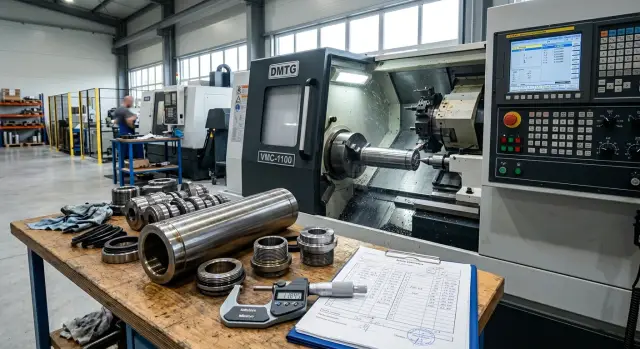
Why rework accumulates along the route
Rework rarely starts with a big mistake. Usually it's a small detail at the start of the route: a poor choice of base, too little allowance left, or a part sent on without an intermediate check. The next operation doesn't correct that slip — it locks it in.
This is especially visible in machining hydraulic cylinder parts. After turning a part must keep geometry for honing, after threading it must assemble correctly, after inspection it must not return to rework because of a wrong measurement method. If one step has the wrong base or allowance, the problem quickly travels through the chain.
The first failure often appears between operations, not inside one of them. The turner meets their dimension, the hone operator gets a hole with drift, the inspector sees a deviation at the finish though the root cause was one or two steps earlier. That's how tolerances get lost: each operation alone looks fine, but together they don't add up.
Long sleeves, threaded caps and seats for seals, rods with threaded sections and ground surfaces, and pistons with grooves and external diameters show this fastest. Dimensions there are interdependent, and an error in one area almost always affects another.
The problem is often the routing approach itself. Routes are written as a list of operations: turning, drilling, boring, honing, threading, inspection. On paper it looks logical. In practice you must look at risks: where the part loses stiffness, where the base changes, where clamping or heat will shift dimensions.
If you don't account for that in advance, the processing route for hydraulic cylinders starts to accumulate rework like a snowball. From the outside it looks like a set of random defects, but the cause is almost always one: operations weren't linked together.
What to lock in before starting a batch
Before the first part you should "freeze" not only the drawing but the route itself. Rework in hydraulic cylinder parts often starts before the cutter: the process engineer, setup technician and inspector interpret bases, allowances and the moment a size is considered finished differently.
First, fix the reference surfaces for every operation. This is critical for sleeves, caps and rods. If a part is mounted on one base for a turning operation and then on another for the next, coaxiality and lengths begin to drift even with good machine setup. In the operation card indicate explicitly from which surface a dimension is taken and how the operator confirms the setup.
Next, specify allowances per operation, not as a single number for the whole part. After rough turning there should be a clear reserve for finishing, grinding or honing. If that reserve isn't written down, one area will remove too much and the next won't be able to correct it.
Separate dimensions after turning and after honing. This is a common weak point in documentation. People leave only the final diameter and surface finish and don't describe the intermediate state. As a result, the hone operator works blind. If after turning the hole is already nearly final, the hone won't fix the geometry properly. If the allowance is too large, the operation drags and increases tool wear.
Threads and fits should be checked before the run, not after the first assembly complaints. Verify thread pitch and class, engagement length, undercuts, tolerance fields for fits, nearby radii and grooves, and the method for measuring these zones. Small details here easily become a string of identical defects.
Also set inspection points on the route. For machining hydraulic cylinder parts this isn't a formality. Decide in advance which sizes are checked after roughing, which after finishing, and which before sending to the next area. If inspection appears only at the end, rejects are detected too late.
A normal practice is simple: before launching a batch the process engineer, foreman and QC check one trial part together using the inspection card. At this stage it's easier to correct a turned size than to disassemble an entire batch over one incorrect base or a missed allowance.
How to build a route without extra rework
A route for a sleeve, cap or rod should follow one simple logic: each operation prepares the next, not fixes its mistakes. Problems usually begin not at the finish but at the first setup, when people choose a convenient clamping base instead of the one that the assembly will rely on.
Start by choosing the base that the part will use through the whole route. If the base changes from setup to setup, runout, thread drift and misaligned fits grow. For sleeves that's often the outer diameter and the face; for caps — the seating collar and support face. The idea is to base from surfaces that later determine assembly.
The route is usually arranged like this:
- First perform rough turning and remove the main stock.
- Leave a consistent allowance for finish machining and honing the inner hole.
- After geometry stabilizes, machine fits, faces and grooves.
- Cut threads when the part won't move from heavy stock removal.
- After transitions that affect assembly, check dimensions and form immediately.
Rough turning shouldn't chase a perfect surface. Its job is simpler: remove stock without overheating and without inducing extra stress. If you come too close to the finish size at this step, there won't be allowance left for honing. Then the operator will try to save the hole by changing parameters, while the real problem is in the route.
For sleeves this is especially important. The internal diameter after turning is not brought to zero tolerance. Leave a clear allowance for honing so the process can remove small ovality, improve surface finish and reach the final size calmly, without rush.
Threads are often rushed. They are cut too early, then the part is re-clamped, heated or flipped, and coaxiality is lost. If a thread relates to a fit or a face, finish the surfaces that determine it first, then cut the thread.
Don't postpone inspection to the end. After rough turning check the basic diameters and runout. After finish passes check coaxiality, lengths and fits. After honing measure size, form and roughness. This order usually saves more time than any hurry at the machine.
Where turning creates future defects
A lot of rework starts not at honing or assembly, but earlier — at the turning operation. If too much stock is removed in one pass, the metal can distort and the size will change after finishing. Outwardly the part may look normal, but the route will begin to fall apart.
Most often the problem comes from two things: a wrong base and rushing the finish pass. For hydraulic cylinder parts this is critical. In sleeves, caps and rods the working surfaces are linked, so loss of coaxiality between bases immediately affects fits, seals and the unit's service life.
If a part needs flipping, check runout before the flip, not after. Otherwise you may chase a size for a long time without noticing the axis has already shifted. Then the next operator sees a "strange" allowance, tries to even it out and only increases the scrap.
What is most often missed on the turning operation
Don't leave a worn tool for the finish pass. An old insert can still hold a rough size but produces a torn surface, shifts geometry and gives unstable repeatability from part to part. For hydraulic cylinders that false economy is costly: one saved insert can turn into a series of parts that fail inspection.
Another frequent mistake is not to specify the size that must be left for honing. If the turning stage leaves allowance "by eye," the hone operator gets either too little material or too much. In the first case there's nothing to correct geometry with. In the second, processing time and the risk of going out of tolerance increase.
In practice a simple order helps. Set allowance per operation, not by the operator's memory. Keep the basing logic for working surfaces consistent. Check runout before each flip. Change tooling before the finish pass when wear is visible. Record the size left for honing directly in the routing card.
On CNC lathes, some of these checks can be embedded in the standard setup. When the route is thought through in advance rather than patched on the fly, the sleeve and cap reach inspection without unpleasant surprises.
Why honing doesn't fix previous mistakes
Honing is often considered a soft, nearly harmless operation. In reality it quickly reveals everything the route did wrong earlier. If after boring there is a random allowance, the hole already wanders in straightness, and the documentation mixes sizes before and after processing, the sleeve will almost certainly go to rework.
For honing assign a real, not formal, allowance. Too small won't remove traces of the previous operation. Too large will lengthen the process, heat the part and shift the dimension. If the hole already has taper or waves after turning and boring, the hone doesn't always correct that. Sometimes it just makes the surface look better while the geometry remains bad.
Confusion with sizes happens constantly. In the route card, on the sketch and in the inspection card there should be distinct control points: the size before honing and the size after it. If after boring you expect 79.92 mm and after honing 80.00 mm, write that down. Otherwise the operator holds one size and the inspector checks another, and the batch drifts between shifts.
Honing must be evaluated not only by diameter. For a hydraulic cylinder straightness of the hole and surface roughness matter at least as much. If the diameter is in tolerance but the axis wanders, the seal will work at an angle. If the surface is too rough or too smoothed, oil behavior will differ from assembly expectations.
Usually four actions are enough: first check the actual allowance after the previous operation, then clearly separate in documents the size before honing and the final size, measure not only diameter but straightness along the hole length, and finally check roughness together with geometry rather than separately.
Put honing closer to the finish. After it don't send the part to operations that scratch the surface, create burrs, or require heavy re-clamping. Threads, cross-holes, rough washing and careless handling easily ruin what the hone just finished.
Where threads and grooves break assembly
Threads and grooves are often seen as quick operations. Because of that they're placed in the route without space for checking, and problems are found at assembly: the cap doesn't thread on, the seal is cut by a burr, or the part sits with a tilt.
The first mistake is simple: people check only the diameter and forget pitch and thread class. For external and internal threads that can make parts look acceptable individually but fail together. The same happens when the thread is cut on a surface that will later move due to another operation or re-clamp.
Grooves for seals and locking elements also do not forgive inaccuracy. If depth is off even a little, the ring either won't seat or will work with excessive interference. Lead chamfers also cause problems: without a decent chamfer the thread catches an edge, the assembler uses extra force and a tear appears on the first assembly.
A separate risk is burrs near sealing zones. After threading and grooving they are often removed hastily. As a result a sharp edge remains that cuts the seal during installation. People then look for a problem in the seal material, although the issue is in the metal.
The working order here is simple: stabilize base surfaces and sizes first, then cut threads and grooves, and immediately perform a local inspection. Check not only the tool-based size but an actual mating fit. For caps and sleeves a trial assembly on a control part quickly shows where pitch, chamfer or groove depth are off.
Such a check takes a few minutes but often saves a whole batch from rework and repeated assembly.
How to build inspection into the route
Don't put inspection at the end of the route. If you measure only the finished part, the shop gets not the cause of the defect but a ready rework. It's much cheaper to catch size drift at the points where it appears.
The first point is incoming blank inspection. Immediately check allowance, straightness, hardness, surface condition and basic places for mounting. If a sleeve blank already has axial drift or too small an allowance, honing won't fix it — it will only reveal the problem later when time and money are spent.
After rough machining you need quick checks of basic sizes. Not a full protocol but the dimensions that affect the next setup: outer diameter, length, runout, size for basing, rough hole diameter. That way the operator and engineer immediately see whether to proceed or stop.
For holes split inspection into two steps. Before honing measure geometry after boring or drilling: diameter, ovality, taper, straightness. After honing check the final size, roughness and form along the length. If you measure only after honing you won't know whether the drift started at boring or during finishing.
Keep threads and fits separate from the general dimension sheet. They have their own common failures: flattened thread peaks, pitch drift, burrs in grooves, too tight or too loose fit for seals. On caps and rod parts these small details often break assembly even when main dimensions are within tolerance.
Convenient inspection points are: incoming blank, after rough turning or boring, before honing, right after it, and also after threading and fit machining. This route doesn't overload with measurements but gives a clear picture for each risky area.
One more rule often ignored: record the cause of deviation immediately. Not at the end of the shift, not after the batch. If the foreman sees a taper in a hole, they note which operation it appeared on, on which machine, with which tool and after which setup. Then it's clear what to correct: basing, mode, tooling or the blank itself.
In production work this is especially useful. Each subsequent operation receives a part with a known state, not a hidden surprise.
Example route for sleeve and cap
If you process the sleeve and cap as two separate parts, defects often surface only at assembly. It's better to build the route so both parts are linked from the start by common bases and clear control points.
For the sleeve the usual order is: first turn outer bases, faces and seating surfaces. Do not finish the internal diameter to final size; leave allowance for further finishing. After removing the main metal check runout, straightness and wall thickness reserve. When the geometry stabilizes, finish the hole and perform honing. Immediately after that inspect diameter along the length, ovality, taper and surface cleanliness.
This order looks longer than trying to do everything in one pass, but it usually saves time. If a sleeve distorted after rough turning, it's better to see this before honing, not after.
The cap is handled with a different logic. It's more convenient to process it referenced to the fit in the sleeve and to the thread if the thread affects assembly or the seal position. First make the reference face and seating diameter, then internal surfaces and grooves, and only after that cut the thread in the same base. Otherwise the thread may be acceptable alone but misaligned relative to the face.
A mid-process pairing of the parts is useful. Before final assembly check the sleeve and cap for fit, stop depth, axial clearance and thread position. A few hundredths difference in fit can still be handled individually, but together it will tilt the seal.
Final inspection should look not only at size. You need form and surface condition. If the hole is in tolerance but a wave remains after honing, or a burr is left at the groove on the cap, the assembly will go together but will not last.
Errors that repeat most often
Rework rarely starts from a single big mistake. Usually it's collected along the way: on the first operation they take a convenient base, on the next they save on allowance, and inspection is left to the end. On paper everything looks fine, but at assembly the hydraulic cylinder parts no longer fit as required.
Such machining of hydraulic cylinder parts doesn't forgive small things. If size, hole form and thread position live separately from one another, the defect doesn't show immediately but at the most expensive point — after several operations or in testing.
The same mistakes repeat most often. Threads are cut too early, then the part is finish machined or taken to another operation with a new base and the thread shifts relative to the seating and face. Too little allowance is left for honing so the hone no longer fixes taper or ovality and only smooths the surface. People measure diameter in two sections only, and taper or "barrel" shapes pass along the route. Inspection is placed only at the end and finds not one bad part but a whole batch. Finally, bases change between operations and tolerances are not recalculated, so each operation passes separately but the overall geometry drifts.
On sleeves this is very visible. After turning the inner allowance was minimal, then they quickly honed to the required roughness. The part looks finished but the form stayed bad. The seal works at a tilt and the problem surfaces only after assembly.
With caps the story often differs. They cut the thread and groove first, then flipped the part and finished the seating diameter from another base. As a result the thread, face and seating no longer share one axis. The offset may be small, but for a hydraulic cylinder a few hundredths can be enough to cause leakage or accelerated wear.
The simplest way to avoid accumulating rework is: first fix the bases for the whole route, then leave an honest allowance for finishing, and place inspection after operations that can actually shift size and form. That way defects are seen early and the batch doesn't drag extra hours and material behind it.
What to check before starting a batch
When the route is set correctly the shop doesn't spend a shift hunting for the cause of defects. For hydraulic cylinder parts this is especially noticeable: one inaccurate base or an extra 0.02 mm of allowance quickly pulls rework through the next operations.
Before launch go through a few simple points:
- each setup has its assigned base and the foreman knows which surface to hold size from;
- allowance for honing is written as a number in the routing card, not kept "in the setup tech's head";
- threads, grooves and fits are done after operations that give the part stable sizes;
- inspection exists not only at the end but between transitions where errors typically grow;
- for the first part it's predefined what to measure: diameter, coaxiality, thread pitch, roughness, distance between support faces.
If even one point sounds vague, stop and fix the route before starting. It's cheaper than correcting a batch after honing or assembly.
The next sensible step is a short teardown of the first part right at the machine. The process engineer, setup technician and inspector should look at the same route and immediately mark where the size begins to drift. Often the problem isn't the operation itself but that after turning the part is re-mounted without a clear base and repeatability can't be maintained.
If the shop selects equipment for such parts, it's useful to discuss not only the machine model but the route, tooling, clamping method and inspection points. EAST CNC supplies CNC lathes and machining centers for metalworking and helps with selection, delivery, commissioning and service, so these questions can be resolved together with actual process requirements.
A good practice is simple: first approve the route on a single part, then test it on a small batch, and only after that ramp up volume. That order usually saves more time than any urgent rework.
FAQ
Why does rework often appear only at assembly?
Because the fault often starts earlier and travels quietly along the route. The turner holds their dimension, the hobbing/honing operator does their pass, and the inspector sees the defect only at the end, even though the base or allowance was wrong one or two steps earlier. If you link operations with a common base and place inspections between steps, you catch such problems before assembly.
How to choose a base for a sleeve or cap?
Use as base the surfaces that later define the assembly. For a sleeve this is usually the outer diameter and the face; for a cap — the seating collar and the support surface. Don't change the base without a clear reason. When a part moves from one base to another, coaxiality, lengths and threads begin to drift even with a normal setup.
What allowance should be left for honing?
Don't leave allowance "by eye." Record it in the routing card for each operation and check it on the first part. Too small an allowance won't allow correcting ovality or taper. Too large will lengthen processing time, heat the part and increase tool wear.
When is it best to cut threads on hydraulic cylinder parts?
Threading is usually done after basic surfaces, fits and faces are finished. Then the part won't move after heavy material removal or re-clamping. If you cut threads too early, they can shift relative to the seating or face later.
What to check after rough turning?
Immediately check base diameters, length, runout and the size used for the next setup. For a hole it's useful to check not only diameter but also form if further boring or honing follows. This way you quickly decide whether the part can go on or needs adjustment.
Why doesn't honing fix earlier mistakes?
Because honing doesn't fix coarse routing errors. If after turning or boring the hole already has taper, waviness or axis drift, honing often only improves surface appearance. For honing to work properly, give it a real allowance and document both the size before honing and the final size after it.
How to embed inspection in the route without overloading?
Don't move all inspection to the finish. Place checks where the part changes base, receives a finish size, or goes to an operation that can't correct previous errors. For these parts it's usually enough to inspect the blank on receipt, measure after rough machining, check before honing, after it, and after threading or groove cutting.
What should be checked on the first part before starting a series?
Verify bases, allowances, size before and after honing, threads, fits and measurement methods. The process engineer, setup technician and inspector should understand these the same way. If any point is vague, don't start the batch. Fixing the route on the first part is cheaper than reworking a batch later.
Why check sleeve and cap together before final assembly?
Because parts may pass individual operations correctly but not fit together. A small deviation in fit, end clearance or thread position often shows only when mating the parts. A trial fit quickly reveals where the pitch, chamfer, stop depth or coaxiality went wrong.
When should you stop a batch and fix the route?
Stop immediately when a dimension starts drifting between operations and the cause is unclear. Don't wait until the end of the shift hoping the next operation will fix it. Record which machine, which tool and after which setup the deviation appeared. That helps identify whether to correct basing, mode, tooling, or the blank.