
Machining energy consumption: where extra power is going
Machining energy use often rises not because of cutting but due to chillers, compressors and idle warm-up. We'll show where the losses hide.
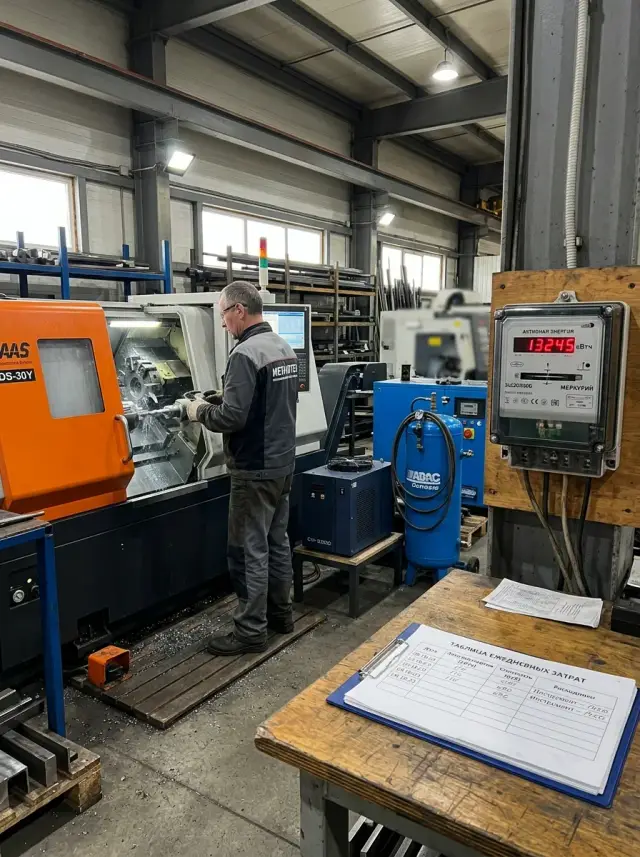
Why the electricity bill rises unnoticed
The shift bill rarely depends only on how much power the machine draws while cutting. The nameplate gives one number, but in the shop kilowatt-hours also add up when no cutting is happening. So energy consumption in machining is almost always higher than it seems if you only look at the spindle.
The most common mistake is counting only the load during part processing. Yes, consumption is noticeable then. But the total bill comes from everything that runs alongside the machine and often longer than the cycle: hydraulic power units, pumps, lubrication systems, work area lighting, extraction, chillers and compressors.
A machine can cut metal 25 minutes an hour while auxiliary equipment runs the full 60 minutes. A chiller doesn't care whether the operator is adjusting or not. A compressor doesn't stop because of a gauge check or a tool change. Thus, CNC electricity consumption is not just cutting power but the sum of all modes, including idle time.
Short stops are rarely taken seriously. But five 6-minute pauses in a shift are already half an hour when the cell hardly produces parts while the meter keeps running. If there are several machines like that, losses quickly become noticeable even without major breakdowns.
There is another quiet source of consumption — idle warm-up. Operators often start machines well in advance just in case. If a machine, chiller and air supply run an extra 40–50 minutes a day, that adds up over a month even if it doesn't feel like much.
This directly hits the cost of metalworking. A part carries not only cutting time but also a share of waiting, warm-up, compressed air and cooling expenses. The shorter the batch and the more pauses between operations, the stronger this effect.
Usually the picture is simple: the machine cuts less time than it is considered occupied, chillers and compressors run with few pauses, and short stops are not recorded even though they accumulate daily. In areas with CNC lathes and machining centers, this is especially visible. If you count only the nameplate power, real shift consumption can be underestimated by tens of percent.
Where extra consumption hides in the shop
A machine uses electricity not only while cutting. Often the main bill builds up in hours when the operator waits for the next blank, changes a tool, or keeps equipment on with no real work. So energy consumption rises even when the cell looks calm.
The spindle gives the most visible peak, but over the shift it doesn't always consume the most. While cutting runs, coolant pumps, hydraulic units and lubrication systems run nearly without pause. Each unit alone doesn't take much, but over 8–12 hours the sum becomes significant.
Most extra consumption sits in the same places: the coolant pump runs longer than needed, hydraulics hold pressure even while waiting, the lubrication system follows a rigid schedule, and the spindle idles too long before a batch starts or after an operation ends.
Chillers are a separate story. They are easy to underestimate because they run quietly with no sharp spikes. But a chiller does not distinguish between work and wait: if it is on, it keeps temperature. Over a full shift that background consumes far more than one hour of observation suggests.
The compressor often draws extra power too. The issue is not only compressed air use but leaks. One loose fitting or an old line makes the compressor start more often and hold pressure longer. If the pneumatic network is set with an extra pressure margin, consumption rises further.
Between batches losses are especially painful. The machine may not produce parts, yet power is consumed by screens, drives, cooling, pumps and standby circuits. If a shift has five or six such pauses, they easily become another paid hour with no output.
On cells with CNC lathes this shows up quickly: cutting may take, for example, 60 percent of the shift while equipment still runs in full or near-full mode the rest of the time. Thus, looking only at the nameplate is not enough. It's much more useful to identify which subsystems run always and which cannot "rest" during pauses.
How idle warm-up changes cost
Full warm-up is not always necessary. It's justified after an overnight stop, a cold morning, a weekend or a long pause when the spindle, oil and hydraulics have cooled. For precision work it is also logical: the machine must reach working temperature so the first parts are within size.
But the habit of running the machine idling for 30–40 minutes before every job almost always costs money. After a short break for lunch, a shift change or a small setup, units are often still warm. In those cases a long idle warm-up doesn't help — it just burns electricity and takes productive time.
Simple example: if a machine in standby and light idle consumes 6 kW, then 10 minutes equals about 1 kWh and 40 minutes about 4 kWh. That difference is small per start but is 3 kWh per start. If it happens twice per shift, one machine loses 6 kWh. On a cell of 10 machines that becomes a noticeable expense line.
There is a second loss. While the machine is "warming up" it is not cutting metal. If an operator leaves equipment idling before lunch, repeats it after the shift change, and runs another long warm-up after setup, an hour of productive time can be lost in a day. That affects metalworking cost as much as the electricity bill.
Startup rules that work
Operators should have a short, consistent checklist rather than ad hoc "by eye" procedures. Simple rules usually suffice:
- after a pause of up to 15–20 minutes a separate warm-up is not needed — a normal check is enough;
- after a stop of 20–90 minutes a short 5–10 minute cycle can be used for precision or high-speed operations;
- after overnight stops, weekends or in a cold shop follow the manufacturer's warm-up cycle for the model;
- after a setup look at the duration of the stop and component temperatures, not just the fact of the setup;
- record start time and the first acceptable part so losses are visible in minutes.
Post these rules at the machine. If operators have one clear standard, excessive idle warm-up quickly stops being routine. If equipment is new or modes are disputed, confirm the startup order with the supplier's service team. For EAST CNC machines this can be done during commissioning and subsequent service.
How to calculate consumption step by step
If you use only the nameplate power the number almost always comes out below reality. Consumption includes not a single machine but the whole bundle around it: chiller, compressor, coolant pump, chip conveyor, extractor and even equipment turned on with the line out of habit.
Start with a simple table for each workstation. For a CNC lathe this is especially useful: the machine may actively cut for 20 minutes while auxiliaries draw power the whole shift.
First list everything that is turned on with the machine in a typical day. Then record consumption by shifts — from a separate meter or at least the line meter. Next mark how much time was spent cutting, waiting, setting up and warming up. Convert kWh to money at your tariff and calculate the cost per hour and the energy per part.
If there is no individual meter, manual logging by shift will do. The key is not to pick one lucky day. Gather data for 5–7 shifts to see an average picture.
Then split machine time by modes. This often changes conclusions more than the tariff itself. One hour of active cutting and one hour of waiting give different value, but both may look similar on the electricity bill.
Simple example: a machine with peripherals consumed 96 kWh over the shift. The shift lasted 8 hours and the tariff is 26 tenge per kWh. Electricity for the shift cost 2,496 tenge, so the cell hour cost is 312 tenge. If the shift produced 24 parts, energy added 104 tenge per part. If 2 hours were spent on warm-up and waiting, those losses become significant.
After calculation compare cells. One cell may have long cutting and low energy per part; another may have short processing but many pauses, restarts and idle time. Numbers make this clear quickly.
This accounting is needed not only for old machines. Even a new machine yields an expensive part if a chiller and compressor run all day unnecessarily.
Example from a typical shift
Take a typical cell: two CNC lathes, one chiller and one compressor. The shift starts at 8:00 but the foreman powers the cell at 7:00 to make sure everything is warmed. Cutting actually starts at 8:00 or later.
Use round numbers for the calculation: each machine draws about 9 kW when cutting and 4 kW idling; chiller 2.5 kW; compressor without leaks averages 4 kW. Batch size for the shift — 40 parts.
If the cell is started 15 minutes before work, consumption looks like this: 6.5 hours of cutting on two machines give 117 kWh. The chiller for that time takes 16.25 kWh, the compressor 26 kWh. A short normal warm-up adds another 3.6 kWh. Total roughly 163 kWh per batch.
Now add overlooked items. An early start 45 minutes ahead adds 10.9 kWh. After a setup one machine warms 40 minutes instead of 10, adding about 2 kWh. There's a small leak in the pneumatic line, so the compressor draws 5.5 kW instead of 4 kW most of the shift — that adds about 12 kWh over 8 hours.
The result is different: not 163 but almost 188 kWh. At a tariff of 48 tenge per kWh the energy for one batch costs 9,024 tenge instead of 7,824 tenge. The difference — 1,200 tenge per shift for one cell.
For 40 parts this changes the energy part of cost from 196 to 226 tenge per part. Simple fixes save about 30 tenge per piece: start the cell closer to the start time, fix the air leak and reduce warm-up after setup to the real minimum.
Such amounts are easy to miss because no single expense seems large. But together they significantly raise machining energy consumption and the cost per part increases even with the same program and output.
Mistakes that hide losses
Energy consumption in machining is often calculated too roughly. As a result the shop sees a high bill but doesn't know where extra power goes.
First mistake — use the machine's nameplate power as real consumption. The nameplate shows the upper limit, not typical shift use. Cutting, feeding, pausing and warming have different numbers. Without measurements with current clamps or a meter you can err by tens of percent.
Second mistake — count only the machine. In practice chillers, compressors, pumps, extractors or coolant systems usually run nearby. One machine may look economical until you add the cell's peripheral consumption.
Third mistake — mix working consumption with waiting consumption. If a machine cuts 20 minutes an hour but the rest of the time runs with subsystems on, money goes somewhere you don't expect. Idle warm-up, waiting for a technician, long tool changes and pauses between batches must be counted separately.
Common signs of a problem:
- the compressor starts too often;
- you hear hissing in the pneumatic lines;
- filters haven't been cleaned in a long time;
- the chiller runs almost without pauses;
- a new machine is run under old rules.
The last point is often underestimated. The shop buys a new machine but keeps old operating habits: the same warm-up, the same startup intervals and the same operator habits. That's a bad idea. A new machine can have different drives, different automation and different air and cooling consumption.
This recalculation is always needed, especially after fleet updates. When commissioning a new CNC lathe check not only the spindle but also how the shop chiller and compressor behave. Otherwise losses remain hidden and appear only on the monthly bill.
Quick cell check
When people estimate machining energy they often focus on cutting and overlook background consumption. Yet background draws up faster than it seems. You can find most extra consumption in one shift without complex tools.
Start with a simple log for one day. Note when the machine actually makes parts, when it idles warming, when it waits for setup or an operator. In many shops this step reveals machines idling 20–40 minutes in the morning and then warming again after a long pause.
Check the compressor separately. If the cell barely consumes air but the compressor still starts often, the cause is usually leaks or excessive pressure. That mode is easy to miss: the noise is familiar, the gauge moves slowly and the meter spins all day.
Five quick checks are enough:
- how many minutes pass from machine start to the first part in the morning and after lunch;
- how long the compressor runs without real pneumatic demand;
- how often it tops pressure when consumers are almost closed;
- what stays on during long pauses: chiller, pumps, extraction, coolant supply;
- whether operators have a clear rule for when to put the machine in standby and when to warm up again.
The most common mistake is simple: people treat each pause as small. But the day consists of such small things. If a machine idles 30 minutes unnecessarily, the compressor runs idle 2 hours and the chiller isn't switched off for lunch, extra consumption noticeably raises the cost of metalworking.
If the cell runs two shifts, also check the handover. Equipment is often left on by habit. Better to record a safe standby procedure for each machine type and post it at the workstation. Then decisions follow a clear rule, not the operator's mood.
What can be reduced without harming production
People often try to save in risky places. Changing feed, speed or cooling without calculation is dangerous. But energy consumption usually grows from things that don't affect output directly: extra warm-up, air leaks, dirty filters and auxiliaries running unnecessarily.
The first thing to review is idle warm-up. In many shops machines are switched on too early and left without work for 30–60 minutes. If equipment reliably reaches working condition in 10–15 minutes, the rest only adds to the electricity bill. Measure actual warm-up times for each machine group and fix a standard in the shift routine.
Compressed air also eats money. A compressor can run almost without pauses not because the cell consumes much air but because the network leaks through joints, hoses and old fittings. Another common mistake is excessive pressure. Even a small reduction to the needed level often saves noticeably without harming pneumatic tools.
A reserve comes from startup sequencing. If machines, compressors, chillers and ventilation are all turned on at once in the morning, the network gets a sharp load spike. In reality some of that equipment is needed later, not immediately. Staggered startup reduces that peak and prevents running auxiliaries early out of habit.
There are very simple measures: clean filters on schedule, don't delay heat exchanger cleaning, check standby modes for machines and peripherals, and turn off what is not needed for the shift. A dirty filter or clogged heat exchanger may not look serious, but then chillers and fans run longer and harder. The same applies to standby modes: a machine, pump or conveyor between operations does not always need full working mode.
A good rule: eliminate empty consumption first, then consider stricter savings. For CNC lathes and their auxiliaries this is usually the safest way to lower cost per part without risking accuracy, lifespan or shift rate.
Where to start next
Don't try to audit the whole plant at once. Take one cell for a week and record only what is easy to check: when machines are turned on, how long they idled warming, when the compressor and chiller ran, and how many parts the cell produced. This start is simpler than a full shop audit and quickly gives an honest picture.
Machining energy consumption is clearer on a small scale. If you look only at the total bill losses mix together: some for cutting, some for waiting, some for auxiliaries. On one cell it's easier to see where consumption is unnecessary and where it's normal.
Then pick the most obvious loss and remove it first. Usually it's not complicated. Most often money leaks into too-long warm-up, a compressor running with few pauses, or a chiller set with too much margin.
Keep the approach simple: record the current cost per hour of the cell, calculate cost per part under the old regime, change only one factor and after a week measure the same figures again. Don't change everything at once — if you cut warm-up, reconfigure the compressor and shift the startup schedule simultaneously, you won't know which action produced the effect.
Talk in money, not only kilowatts. It's easier for a cell foreman to argue "the hour became 900 tenge cheaper" or "per part cost is down 3–5%" than abstract energy numbers. Those figures are easier to present to management and production.
If you're selecting a new machine ask the supplier not only about nameplate power but about working and standby consumption, and about chiller, compressor and service requirements. EAST CNC can discuss these questions in advance: the company supplies CNC lathes, machining centers and production lines and supports selection, commissioning and service. That helps estimate future cell costs by real operating modes, not just general claims.
Start with one cell on Monday. By next Monday you'll have numbers for hour cost, cost per part and at least one identified source of extra expense.
FAQ
What most often causes extra electricity consumption on a cell?
Most often money is spent not only on cutting but on background modes. The chiller, compressor, coolant pump, hydraulics and lubrication can run nearly the whole shift even when the machine waits for a blank or setup.
Why can't you estimate consumption using only the machine's nameplate power?
The nameplate shows the maximum, not the typical shift consumption. Real usage changes across cutting, waiting, setup and warm-up. Measure kWh by shifts and relate them to parts produced.
Do you need to warm up the machine before every batch?
No. Full warm-up is justified after overnight stops, cold mornings, weekends or long pauses when spindle, oil and hydraulics have cooled. After short stops a basic check or a short cycle is usually enough.
How do you tell if idle warm-up is too long?
Compare the time the machine is turned on with the moment the first acceptable part is produced. If the machine reliably reaches working condition in 10–15 minutes but is kept idling for 30–40 minutes, the extra time only raises the bill and wastes machine time.
What should be included in the calculation besides the machine itself?
Count not just the machine but the whole bundle around it. Typically include the chiller, compressor, coolant pump, hydraulic power unit, lubrication, chip conveyor, extraction and everything turned on together with the line.
How to quickly check if the compressor is pulling too much?
Watch how often the compressor tops up pressure when the cell is hardly using air. If you hear hissing at fittings, see frequent starts, or keep a pressure reserve, the network is leaking air and drawing extra electricity.
Why does the chiller affect cost so much?
Chillers run quietly and are easy to underestimate. They keep temperature during pauses, so over a full shift and month that constant background can add substantial consumption.
How do short pauses between operations hit the cost per part?
Because a pause doesn't stop the meter. Several 5–6 minute stops per shift quickly become 30–60 minutes when parts aren't produced but the machine, chiller and compressor still draw power.
What can be reduced without risking quality and accuracy?
First remove empty consumption. Typically you can safely reduce unnecessary warm-up, find air leaks, lower excessive pressure, clean filters and switch off auxiliary systems during long pauses without harming quality.
How to start accounting if there is no individual meter for each machine?
Take one cell and collect data for 5–7 shifts: time of startup, first part, minutes of cutting, waiting and warm-up, compressor and chiller operation. Then calculate cost per hour and per part and change only one factor at a time.