
Machining Cast Pump Housings: How to Choose the First Datum
Machining cast pump housings starts with the first datum: it determines coaxiality, flatness, stock allowance, the process route, and the stability of the entire series.
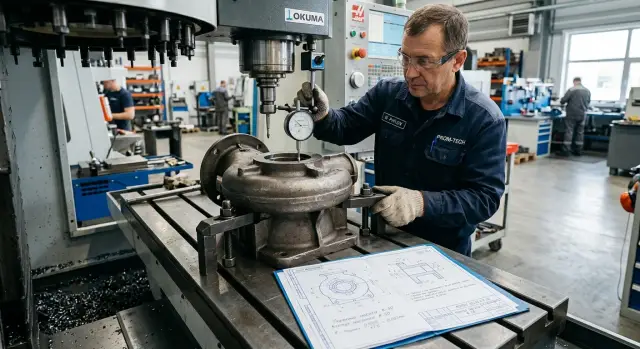
Why the first datum determines the result
A cast housing almost never has a surface you can trust without checking. One pad looks flat but causes tilt. Another supports the part better, but shifts the axis of the future boring operation. So the first setup is not just a convenient way to place the part on the table. It defines the starting plane, the direction of the axes, and how the stock allowance will be distributed in the next operations.
If the datum is chosen badly, the machine will then repeat someone else’s geometry very accurately. For a pump housing, that is especially noticeable. You usually need to hold the fits for the bearing, seal, cover, and flange, as well as the relative position of the channels and fastening holes. All of this is connected through the first datum system.
An error in the casting rarely shows up as an obvious defect already in the first operation. More often it hides. The housing is clamped on an uneven cast pad, a small tilt appears, and in the next operation the hole is bored along that already tilted axis. The boring itself may come out clean and on size. But after the part is turned over, it turns out that the second bore is no longer coaxial, and the mating face has shifted in height.
The chain is simple: the first setup defines the support and axis direction, the boring, milling, and drilling are built from that axis, and after repositioning the part is already oriented by the machined surfaces. The initial shift gets locked in and passes into every next part.
That is why a mistake at the start of the series is more dangerous than it seems. Even a 0.1 mm shift rarely stays a small local issue. It repeats on ten, fifty, and one hundred housings until the problem is noticed during assembly, by seal leakage, or by uneven wear.
On a single part, you can still save it with fitting. In production, the cost is higher: machine reset, fixture changes, batch sorting, and repeat inspection. That usually costs more than calmly choosing the first datum before the run.
A good first datum does not have to be the prettiest surface on the casting. It must provide stable support, clear geometry, and enough allowance for finishing operations. If that is missing, the whole route through the housing starts drifting from the very first setup.
What to use as the first datum on a pump housing
The first datum on a cast housing has to do two jobs at once: hold the part securely and tie the machining route to the working geometry. If you rely on a random outer pad, the housing may sit comfortably, but then the bores, the cover seating face, and the bearing or seal fits start to wander.
First, look for a surface where the stock allowance is readable without guesswork. It should be rigid enough so the housing does not rock or spring under clamping. For a cast part, that is often the split face, a flange, or a large support pad. But you can only use them if they are truly linked to the working dimensions.
A convenient surface is a bad choice if it does not guide the axis of the future fits. In a pump housing, almost everything comes down to two things: where the axis of the main bores will run and how the reference plane will sit. So the first datum is evaluated not on its own, but together with the future bores, end faces, and split face. If the datum lives on its own, coaxiality will later have to be chased through setup adjustments instead of a proper machining scheme.
Before choosing, check four simple questions. Is there a consistent allowance on the surface? Does it hold the part without tilt? Is it connected to the fit axis and the assembly face? And does the casting draft pull the part to one side?
Draft angle is often the source of mistakes. By eye, the pad looks straight, but after it sits on the supports, the housing turns slightly. The shift may be small, but on a long bore it already creates a noticeable offset. In production, that small issue quickly turns into either consistent scrap or constant manual shimming. Both are bad.
A normal first datum choice usually looks like this: you take a surface that helps reveal the working axis, not just clamp the part. If the housing has a split face with even allowance and it is geometrically close to the axis of the two main fits, that is a strong option. If the split face is rough and the casting wanders, while the flange has a more honest allowance, it makes more sense to start from the flange and separately check how it holds coaxiality and flatness of the housing.
When machining cast pump housings, the first datum almost always decides whether the route will be calm or stressful. It is better to spend an hour measuring the blank and planning the supports than to correct every second part on the machine later.
How the datum affects coaxiality and flatness
The first datum does more than just help clamp the housing. It tells the machine where to “see” the part and which surface to use as the starting point for dimensions. In cast pump housings, that immediately affects two areas: the axis of the bores and the finished faces for the cover, flange, or connection point.
If the datum is only loosely connected to the working surfaces on the drawing, the boring axis shifts together with the whole route. On the first operation, the housing may look fine. But later it turns out that the bore is no longer where the cover, pipes, or the other half of the assembly expect it to be.
This is especially common in housings where two holes must be coaxial. The machine will honestly machine them according to the chosen datum, but the datum itself may be wrong for the part design. Then the axes will be coaxial only in the setup coordinates, not in the coordinates of the finished housing.
Flatness has a similar story. When the housing is seated on a rough cast surface with wide variation, the stock allowance on the finishing face starts to vary. In one place the cutter removes too much, in another there is almost no material left. The face can be brought to size, but in some areas the allowance will be too thin, and in others there is a risk of cutting into cavities or casting skin.
The same thing happens with fastening and dowel holes. Their coordinates rarely live separately. They have to fit the cover, the mating part, and the assembly after repair. If the first datum shifts the housing even by fractions of a millimeter in the wrong direction, fasteners can sometimes still be forced into place. Dowel pins do not forgive that. They immediately show that the dimension chain has drifted.
When the mistake becomes expensive
The worst situation does not appear on the first operation, but near the end. After boring, milling, and drilling, the housing seems ready, but the cover sits crooked, the nozzle shifts away from the pipe axis, and the bearing unit needs fitting. The reason is often the same: the first datum was chosen by the surface that was easy to clamp, not by the surface that actually holds the part geometry.
A simple example: a cast housing has a support foot and a cover face. The foot is easier to fixture because it is wider and more stable. But if the drawing ties the boring axis to the cover face, using the foot as the first datum almost always adds unnecessary risk. Any casting tilt turns into axis shift, uneven stock, and hole drift.
The closer the first datum is to the surfaces from which the main dimensions are defined, the shorter and calmer the route becomes. It is easier to maintain coaxiality, easier to get a flat face, and fewer surprises show up during assembly.
How to choose the first datum step by step
You do not choose the first datum based on the easiest clamp. You choose it based on which surfaces and axes must later line up on the finished housing. If the drawing places tight tolerances on bores, the flange, and the mating face, the route should be built from those elements.
First, break the drawing into working features. Mark the hole axes, the cover faces, the seal areas, and the surfaces from which dimensions are taken. After that, it becomes clear what actually works on the part and what remains just secondary casting geometry.
Then inspect the casting itself. On the drawing everything looks straight, but the blank follows its own rules: one wall may shift, another may sag, and the allowance may vary by a couple of millimeters. For the first setup, you are looking not just for a large pad, but for an area with enough stock and a repeatable seating condition.
Usually the real choice comes down to two or three options. For example, you can sit on the outer cast belt, on the flange, or on the rough housing face. Each option is better checked not by eye, but with one simple question: after the first setup, will there still be enough material to finish all important surfaces?
Short check sequence
- Mark on the drawing the surfaces that define the geometry of the finished housing.
- Find stable contact areas with enough allowance on the casting.
- For each option, estimate what dimensions you will have after the first setup.
- Check the second setup: is it easy to hold the part, and can you reach coaxiality without rushing?
- Verify the choice on several castings from the batch, not just on one especially good part.
A good first datum almost always gives a simple second setup. The part does not have to be chased in position, shims do not change from housing to housing, and the bores come out without fighting for the remaining allowance.
A small example. A housing has a mating face and two bores that must stay coaxial. If you start from a crooked but wide cast side only because it is easy to clamp, the second setup may give you a nice face but shift one bore off axis. If, instead, you create the reference face and support belt in the first setup for further locating, the second pass becomes much more predictable.
The final check is the most honest one. Take not one, but three to five castings from the real batch and run the chosen scheme through them. If it works only on the straightest part, the series will fall apart quickly. If the allowance, clamping, and second setup behave the same across different housings, the locating scheme is correct.
Example on a housing with two bores
Imagine a cast pump housing with a split face, a side flange, and two bores that must lie on the same axis. On the drawing, everything looks simple. On the part after casting, it is more complicated: the flange may be tilted, the allowance may vary, and the outer surfaces do not always tell you where the correct geometry is.
A common mistake looks like this. The first setup is done on the flange because it is convenient to clamp the housing there. In that same setup, the first bore is machined or prepared. The problem is that after casting, the flange is often uneven and does not live on the same axis that the part needs in service.
Then the housing is repositioned, this time oriented by the machined flange, and the second bore is made. On paper, the route seems logical. In practice, one bore shifts relative to the other, and coaxiality starts to drift. On assembly, this shows up quickly: the shaft runs tighter, the cover seats unevenly, and during checking the question arises which surface was actually the main one.
If you first create the support plane from the split face, the picture changes. This surface is often better suited as the first datum because it gives a more stable seat and depends less on local flange distortion. After that first operation, the next setup holds the housing more calmly.
The route is often built like this:
- on the first setup, create a clean support plane from the split face;
- on the second, seat the housing on that plane and fix the side position;
- then machine the flange and bores from one clear datum;
- if possible, machine the two coaxial bores in one setup.
This approach is not just for the sake of a neat process sheet. It reduces manual fitting during assembly and removes part of the argument at acceptance. The technologist, operator, and inspector measure the housing in one logic, not each from their own convenient surface.
This is especially important in series production. One good housing can still be saved by changing the cutting conditions or making a small correction. Ten identical housings with the wrong first datum create a system error, and it repeats from part to part.
If the part raises doubts, ask yourself a simple question: which surface better holds the position of the future axis, not which is more convenient for the first clamp. In a housing with two bores, the answer often starts with the split face, not the flange.
Where mistakes happen most often
Problems in production often start with a simple decision: the first datum is chosen because the housing is easy to clamp there. For setup work, that is indeed convenient. For dimensions, it is not. If the surface does not drive the dimension chain, the error from the first setup later passes into bores, faces, and mating surfaces.
On a pump housing, this shows up quickly. An outer pad may seem flat and accessible, but the working dimensions are controlled by the axis of the fit bores and the mating face. If you do not start from those surfaces, or from geometry connected to them, coaxiality is lost from the very beginning. The operator may carefully carry out every step, but the route will still lead to scrap.
Another common mistake is looking only at one successful casting. It is easy to decide from that part that the datum is correct. But a cast housing is rarely repeated perfectly. On the next part, casting skin, a local underfill, shrinkage cavities, or metal shift appear, and the support works differently. That is why the first datum should be checked not on the best part, but on several castings with real variation.
Before series production starts, check four things separately:
- where the datum has stable metal without a weak skin;
- whether there is enough allowance in the area of the future finishing cut;
- whether the support lands on a shrinkage cavity or underfill;
- whether the datum holds the same position on several castings.
Another issue is shims. They are often used to rescue a bad first setup. The housing rocks, the support does not seat, the dimension drifts, and there is a temptation to slip in a gauge, plate, or foil. That is not a solution, but camouflage. Shims add randomness. They helped on one part and created a new tilt on another.
No less trouble comes from too little allowance after roughing. If the datum is chosen badly, rough machining already removes stock unevenly. On the finishing pass, one side barely clears the casting skin, while the other side cuts too deep into size. In that situation, flatness and bore quality start depending not on the machine, but on luck.
For cast housings, that is especially dangerous because the defect rarely stays local. A bad first datum damages not one dimension, but the whole dimension chain. If the datum does not guide the part along the working geometry from the start, it is better to review the setup immediately than to fix the series later through adjustments and selective scrap.
Quick check before starting the series
One trial housing often tells you more than a long discussion at the machine. If the part rocks even slightly on the first setup, the series will almost always drift in dimensions, and the problems will appear during finishing.
First, check the support itself. The housing should sit firmly on rigid points, without rocking and without being pulled into place by the clamp. If the clamp is straightening the part instead of just holding it, the datum was chosen with risk.
Then look at the allowance. On the faces and holes that define the housing geometry, there needs to be an even reserve for machining. When you have 0.3 mm on one side and 2 mm on the other, that is not a small issue. Such a shift quickly shows up in both flatness and hole axis position.
Before the series, a short check is enough:
- the housing sits stably on the supports and does not rock with a light push by hand;
- there is enough allowance on the base faces and main holes after the first setup;
- the second setup rests on already machined surfaces without searching for position;
- inspection after roughing catches the shift before finishing;
- the setup technician and inspector understand the support points, clamp points, and control points in the same way.
After the first housing, it helps to measure a few dimensions that will immediately reveal datum shift: the distance between the machined face and the cast wall, runout in the bore, and parallelism of the support face. If one of these dimensions is already off on the trial part, do not expect the batch to fall into tolerance on its own. Usually the variation only grows.
For the second setup, you do not just need a machined surface, but a clear support that can be repeated on every part. The setup technician must see where the part seats, and the inspector must check the same points in the same way. If one person uses the lower pad as the datum while another takes the side wall, the dispute will come later, after some parts are already ruined.
This quick check saves a lot of time. Sometimes it is better to stop at the first trial housing and correct the locating scheme than to later revise the whole series because of a shift that could have been caught in ten minutes.
What to do before series production starts
Once the first datum is chosen, the next step is to bring the drawing, the actual casting, the fixture, and the inspection plan into one scheme. If even one of these elements works separately, the series quickly turns into extra trimming, repeat setups, and arguments between the shop and quality control.
It is better to gather the technologist, setup technician, and inspector around one casting. In that review, it becomes immediately clear whether there is enough allowance on the base faces, whether casting drafts interfere with clamping, whether the tool can reach the first cut, and from which surfaces coaxiality and flatness can really be measured. On paper, the route almost always looks cleaner than it does at the machine.
The machine itself should be evaluated not by the catalog, but by the setup. A vertical machining center is convenient for top faces and top holes, but side bores often require extra repositioning. A horizontal machining center often wins on housings with several related holes: it is easier to maintain coaxiality and clear chips from cavities. A 5-axis machine is justified where the geometry is complex and every new setup raises the risk of error.
Before the pilot batch, check a few more things:
- whether the machining datums match the way the part will later be inspected;
- whether the fixture holds the casting without tilt and without resting on casting irregularities;
- whether the most precise holes can be made in one setup, or at least without losing the reference;
- whether there is enough space for the tool, probe, and post-process measurement.
And one more thing that is often postponed for no good reason: commissioning and the service plan are better defined before the series starts, not after the first stop. During launch, you check not only the machine geometry, but also real work on the housing: how chips flow, whether the size shifts after warm-up, how the fixture behaves on the second and third part, and how long inspection takes.
If you are choosing equipment for such parts, it is useful to discuss not only axis travel and power, but the entire machining route. EAST CNC has this approach built into its work: the company supplies CNC lathes and machining centers for metalworking, and also helps with selection, commissioning, and service. For cast housings, that is a sensible approach, because the result depends not on one machine model, but on how it handles the first datum, the trial batch, and stable series production.
FAQ
Why can’t you just use the most convenient surface as the first datum?
Because a convenient clamping surface does not guarantee the correct geometry. If the surface is not tied to the bore axis and the mating face, you will get accurate machining in the wrong coordinates. The machine will faithfully repeat that shift in all following operations. In series production, even a small error quickly becomes a recurring defect.
What is usually used as the first datum: the split face or the flange?
Usually the part starts from the split face if it provides stable support and is close to the working geometry of the housing. It often holds the future axis better than the outer flange. But there is no universal answer. Look at the actual stock allowance, support rigidity, and how that surface relates to the seats, cover, and flange.
How can you quickly tell whether the datum holds the housing without tilt?
Place the housing on the supports and check whether it rocks without clamping. If the clamp is not just holding the part but pulling it into position, the datum is already risky. Then measure the allowance on the future finishing surfaces. If it changes a lot from side to side, the datum is seating the part with a shift.
How does the first datum affect the coaxiality of two bores?
It defines the direction in which the machine will build both axes. If you started from a skewed surface, both bores may come out clean and on size, but no longer where assembly expects them. The calmest option is to machine the two coaxial bores in one setup, when the part design allows it.
Why does the first datum affect the flatness of the mating face?
Flatness suffers because the stock allowance varies. On one side the tool removes too much, on the other it barely clears the casting skin. As a result, the face may be brought to size on paper, but it ends up weak in metal or creates sealing problems with the cover and gasket.
What should you do if the casting varies noticeably from part to part?
Check the scheme not on one good-looking part, but on several castings from the batch. If the datum works only on the best blank, the series will quickly fall apart. Look right away at where the metal is stable, whether the allowance is sufficient, and whether the support falls on shrinkage cavities, draft, or underfill.
Can a bad first datum be fixed with shims?
It’s better not to rely on them. Shims add randomness: on one part they help, on another they create a new tilt. If the housing does not seat properly on the supports, rethink the datum or the fixture. That will save more time than constant manual fitting.
Which dimensions should be checked on the first trial housing?
Take several simple dimensions right after roughing. Usually the distance to the cast wall, runout of the bore, and parallelism of the machined face are enough. If the shift is visible on the first part, do not wait for finishing. Stop and correct the datum scheme.
What should you do if the stock after roughing is uneven?
Do not push the series forward by inertia. Uneven stock usually means the part sat with a shift or the datum is poorly tied to the working surfaces. Review the first setup, the supports, and the sequence of operations. Otherwise, on the finish pass one area will come to size too early, while another will still be on the casting skin.
Who should agree on the first datum before series production starts?
Bring the technologist, setup technician, and inspector together around one casting. They should all understand the same points: where the support is, where the clamp is, and from which surfaces the part will be measured. If the shop bases the housing on one logic and inspection measures it on another, the dispute will come only after scrap. It is better to align this before the series starts.