
Machining Bronze and Brass: How to Maintain Size Without Burrs
Machining bronze and brass requires a sharp cutter, steady feed and chip control. We review tool geometry, cutting regimes and techniques that keep size.
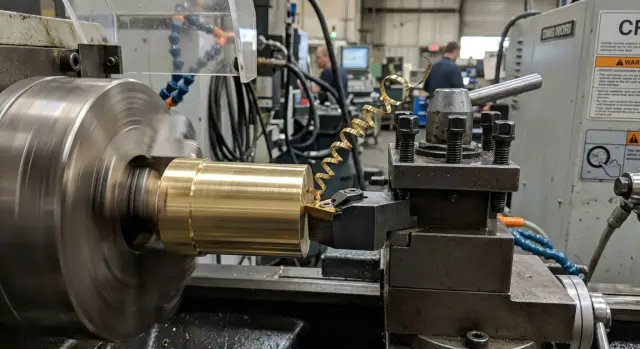
Why size drifts on bronze and brass
When turning bronze and brass, size rarely changes "by itself." Usually three things happen: the cutting edge stops cutting cleanly, the alloy builds up on the tool, and the cutting forces shift more than expected after one adjustment in the program.
On the shop floor it looks familiar. The first part is in tolerance, and the second has the diameter off by a few hundredths. Often the machine isn’t to blame. After the first pass the edge has heated, a small buildup appears, and the effective geometry of the insert changes. The insert may still look OK, but it cuts differently.
Soft non‑ferrous alloys don’t forgive a dull edge. Instead of a clean shear the tool begins to push and rub the metal. The workpiece moves slightly away from the cutter and then partially springs back. In external turning this often produces a larger diameter than calculated. Later the buildup breaks off, cutting changes again, and the size jumps the other way.
A burr and torn surface appear for the same reason. The metal is not sheared cleanly but pulled and torn at the tool exit. If feed is too low the tool rubs rather than cuts. If speed is wrong, buildup grows faster. If the insert is chosen for steel rather than non‑ferrous alloys, the surface frequently looks smeared with shiny streaks and torn areas.
Early signs are usually obvious:
- the second part consistently measures +0.02 or +0.04 mm
- a fine burr appears on the edge
- chips change from neat to torn or overly long
- the surface shows shiny smeared streaks
A single parameter tweak can shift size more than expected. Slightly increasing feed or speed changes temperature, cutting force and the behavior of the buildup on the edge. Bronze and brass react quickly. So size is controlled not by a table but by a simple trio: sharp geometry, clean cutting and parameters where the tool cuts, not smears, the metal.
How bronze and brass differ in practice
People often put these alloys side by side, but they behave differently. The same program can produce different size, surface finish and edge appearance on the first part already.
Brass usually machines easier. Chips evacuate more readily, tool load is lower and size holds with less tuning. But brass often forms a burr on exit—especially on holes, thin collars and small grooves.
Bronze is tougher. It loads the edge more and exposes weaknesses in the holder, chuck or tool overhang sooner. If the setup has any tendency to vibrate, bronze will reveal it before brass. Where brass still gives a smooth surface, bronze may already leave ripples and shift size in the last hundredths.
Alloy grade also changes behavior. Leaded brass or bronze cuts softer and more forgivingly; the chips break better. Lead‑free grades often behave drier and harsher: the tool rubs more, the edge heats faster and burrs appear more easily. If you change grade and keep the old parameters unverified, surprises are likely.
On thin‑walled parts the difference is greater. A thin bronze bushing may spring after a pass: the tool removed metal, load dropped and the wall relaxed slightly. A part measured immediately after machining and the same part measured a few minutes later can show different values.
If you move from brass to bronze, don’t trust the previous settings. First observe how the edge behaves on the first passes: check for ringing, ripples, burr growth on the exit and size loss on thin walls after a repeat measurement. With brass you often fight burrs; with bronze you fight edge loading, vibration and springback.
Choosing tool geometry
Often the issue is not a "weak" machine but too dull or coarse geometry. If the edge pushes the metal instead of cutting, size drifts and a burr appears on exit.
Non‑ferrous alloys usually prefer a sharp edge without heavy hone. A universal insert made to withstand heavy steel cuts often just rubs on brass and leaves a trace. You will notice this quickly: cutting forces rise, the surface dulls and size drifts from pass to pass.
A positive rake helps. The tool enters softer, chips flow easier and the part is less pushed off. This is especially noticeable on thin‑walled bushings and small diameters. But overly aggressive geometry is not always safe: on interrupted cuts or harder bronze the edge can chip.
People often err with nose radius. A large radius smooths the tool mark but on a thin part it also pushes more to the side. That leads to taper and ovality. If the wall is thin or the operation is a finish pass, it’s usually safer to start with a smaller radius than to choose an oversized insert "just in case."
Chip evacuation matters too. For brass and many bronzes it’s better when the front face of the insert is smooth and the chipbreaker not too aggressive. If chips don’t leave freely and start rubbing the part, both finish and repeatability suffer.
Choose the insert grade for the specific alloy and job, not by habit. Brass often prefers polished carbide inserts made for non‑ferrous metals. Bronze varies: one grade cuts calmly, another wears the edge faster. For roughing pick a tougher grade, for finishing a sharper one.
If in doubt between two inserts, usually the one that cuts easier wins. On non‑ferrous alloys it typically produces fewer surprises in size.
Setting parameters without excessive trials
Size usually shifts not because the material is "difficult" but because of the setup order. If you start with speed, then hunt for feed and depth, the tool can begin to rub. The edge heats, the surface glazes and size wanders. A stepwise setup is almost always faster than random tweaks.
Start with allowance and set depth of cut. Depth should let the tool remove material confidently, not skim the surface. If the finish pass is too light the tool may run along a hardened layer or follow a previous pass. On the part you’ll see size float by hundredths and the cutting sound goes dry.
Next pick feed. Too low a feed on brass and bronze gives a deceptively nice finish, but the tool often rubs rather than cuts. It’s better to choose a moderate feed and inspect chips and the edge after a short pass. If the chips are uniform, with no buildup, and the surface is clean, you’re near the right regime.
Raise speed only after that and in small steps. Don’t jump immediately. Increase a little, make a short trial pass, then check size, surface and the edge. This approach is usually quicker than several full re‑setups.
A convenient sequence:
- set depth to match the real allowance
- choose a feed where the tool cuts, not rubs
- raise speed one step
- make a short trial pass
- measure the part at the same location
Measure always in the same place with the same instrument. If you check a bushing at the face once and then toward the middle next time, you’ll get confusion. For the first part one control zone of 10–15 mm is usually enough to judge if the machine holds size and if burrs grow.
Change only one parameter at a time. If you raise speed, lower feed and reduce depth simultaneously, you won’t know which action moved the size. In the shop this rule saves more time than you think. Even on a good CNC lathe the logic is the same: one step, one measurement, one correction.
What to check in clamping and setup
For non‑ferrous alloys size often drifts because of fixturing. Any looseness shows quickly: surface chatter appears, diameter wanders and the tool starts tearing material.
First check the rigidity of the whole chain. Chuck, collet, arbor and the workpiece must hold without tilt. If you overclamp a thin brass bushing it becomes oval in the jaws. After release the part relaxes and the measured size differs from the in‑chuck reading. Use the minimum clamping force that holds the part securely.
Next check tool overhang. Long overhang of the tool or boring bar almost always adds spring. On bronze this shows quickly: a ringing sound, rough surface marks and size drifting between parts. Often it’s simpler to shorten overhang a few millimeters than to chase size by corrections.
Verify how the workpiece seats. If the part sits slightly differently in the chuck each time, stability is impossible even with good parameters. On short bushings and rings this small detail immediately produces scatter in length and diameter.
Another common mistake is measuring a hot part. You see extra hundredths, make a correction, and after cooling the part is undersize. This occurs regularly on thin bronze and brass parts. If in doubt, let the part cool and re‑check with the same instrument.
Removing burrs and preserving the edge
A burr on bronze and brass usually forms for two reasons: the tool rubs instead of cutting, or the tool exits the edge at an unfavorable angle. The edge isn’t sheared cleanly but smeared and torn. On non‑ferrous alloys this is visible early: size may still be OK while the edge is already ruined.
On the finish pass leave a small allowance and use a truly sharp insert. Even a tiny chip or buildup on the edge will smear the metal. Such a small defect quickly produces a noticeable burr.
Don’t take feed to an extreme. Very low feed seems safe but often makes the tool rub, heat the part and increase burrs. Reduce feed gradually and watch chips, the surface trace and the actual edge.
What to check on the machine
- where the tool exits at the end of the pass: into a chamfer, into allowance or directly onto a finished edge
- whether chips stick to the insert after the first parts of the run
- if the cutting sound becomes rasping when the tool starts to rub
- whether the drawing allows a small chamfer or a light pass on the edge
If the tool exits directly onto a finished edge a burr is almost inevitable. It’s better to plan the last trajectory so the tool leaves in an area where the edge is already removed or there is still a small allowance. This works especially well on faces and holes.
Don’t leave chip buildup until the end of the shift. Stop, inspect the insert, remove the deposit and, if needed, replace the insert—then the series runs smoother. A few minutes here often save long manual deburring later.
If the drawing allows, a small chamfer or a very light skim pass across the edge solves the problem better than abrasive handwork. Manual finishing easily shifts size, especially on small bushings, thin collars and short fits.
Shop example: a simple brass bushing
In the shop we turned a simple brass bushing with an OD of 32 mm and a short length. The diameter looked fine: size held in tolerance almost from the first run. The issue was on the face. After cutoff and finish pass a thin burr remained that had to be removed by hand.
The operator first reduced speed, the usual reaction. The burr decreased a bit but the surface immediately lost its sheen. Instead of a clean shine a matte mark appeared and size started to wander more. For brass this is common: when cutting becomes too soft the edge no longer shears properly and begins to rub.
They then changed approach, not just parameters. A sharper insert with positive geometry was fitted and tool overhang shortened. Previously the tool visibly sprung on the final touch, though it was not obvious externally. With less overhang the tool behaved steadier and the face stopped fuzzing on exit.
They also revised the finish allowance. Instead of an excessive margin they left about 0.1–0.15 mm per side. That was enough for the finish pass to take a consistent layer rather than clean up random marks from roughing. OD repeatability improved noticeably from part to part.
The final pass was done with the same sharp tool: OD first, then the face without pause or extra re‑entry. Feed was slightly reduced, but speed returned to the normal working range. In this scheme the edge did not smear the metal on exit and the burr almost disappeared.
Manual dressing was no longer needed. On such parts problems usually start not with exotic parameters but with small things: a slightly dull insert, long overhang and too large a finish allowance.
Common mistakes that spoil size
Size on bronze and brass drifts more often because of work habits than the alloy itself. These materials machine relatively easily, so any small issue quickly shows on diameter and edge.
The first common mistake is using a universal insert and expecting a clean finish. On brass and many bronzes a dull or heavy geometry rubs the metal rather than cutting it. Diameter begins to wander, the surface dulls and a burr grows on the edge.
The second mistake is changing multiple parameters after the first reject. If a part goes out of size, change one parameter at a time and note the result. Otherwise the run quickly becomes a set of guesses.
The third mistake is long tool overhang on a small part. The tool slightly deflects and the machine shows one value while the micrometer shows another. In external turning this often produces taper or wandering size; in boring the problem is usually worse.
Fourth mistake is rushing to measure. The operator measures a hot part, sees extra hundredths and immediately corrects. After cooling the workpiece is undersize. On a thin bushing or ring it’s easy to lose the tolerance.
Another source of rejects is chips. If they don’t leave the cutting zone they rub the finished surface and tear the edge on exit. Then it seems the regime is at fault, while the real cause is chip evacuation, coolant flow or insert chipbreaker geometry.
If size drifts, stop and check four things:
- is the insert geometry suitable for non‑ferrous alloys?
- is the tool or boring bar overhang excessive?
- did the part cool before measurement?
- do chips evacuate away from the surface rather than sliding on it?
This short check often saves more time than making another trial part. It’s a boring habit, but it keeps size stable from the first part to the end of the run.
Quick pre‑run checklist
Before starting a batch do a short check. It takes a few minutes and saves material, time and nerves.
- Inspect the cutting edge under good light. If there is adhered metal, a small chip or dulling, the finish pass will smear size and leave a burr.
- Reduce needless tool overhang. The shorter the overhang, the calmer the cut and the lower the chance the tool will deflect on the finish pass.
- Check the workpiece in the chuck or fixture. It should sit rigidly without noticeable runout or tilt after clamping.
- Compare allowance to the operation. Too small a finish allowance often won’t remove the trace of roughing; too large a allowance overloads the tool and shifts size.
- Measure the first part the same way you will measure the whole series: same datum, same points, same gauge.
The last point is often underestimated. The operator measured one place and the inspector another and the dispute starts on the first part. If a brass bushing has a chamfer and a short land, agree in advance where the dimensional control will be.
It helps to write down the first part result at the machine: size before correction, size after correction and the actual finish allowance. That note will save time on the next run.
If any checklist item raises doubt, don’t start the series. It’s far cheaper to correct tool overhang or re‑clamp the workpiece than to sort a box of parts that went out by two–three hundredths.
What to do next at your shop
Don’t change everything at once. Start by building a simple map of regimes for the bronze and brass grades you encounter most often. For each item a short note is enough: material, diameter, depth of cut, feed, speed, finish allowance and resulting size.
Next to that write the working tool geometry—separately for roughing and for finishing. After a couple of shifts such notes save more time than another round of trial runs.
It’s easier to check the shop on a typical part. Don’t take a complex job with thin walls, grooves and tight tolerances immediately. Choose a simple bushing or pin where you can easily see how the tool behaves and where a burr appears.
A good verification routine: choose one repeatable part, make 10 pieces in a row without ad‑hoc adjustments, measure them at the same points and note on which part deviation began. Watch not only the numbers: if part 1 and 10 are within tolerance but the edge on the last parts already tears, the regime is still unstable.
If deviation grows from part to part, don’t guess. First check feed, then speed, then edge condition and only after that the fixturing. When three things are changed at once the cause is lost.
If you need help selecting a machine, tooling and a launch for non‑ferrous alloys, you can contact EAST CNC. The company operates in Kazakhstan as the exclusive official representative of Taizhou Eastern CNC Technology Co., Ltd. and assists with selection, supply, commissioning and service of CNC lathes for metalworking.
A good outcome looks simple: size holds, the edge is clean and the operator doesn’t tweak corrections after every second part. If the tenth part repeats the first, you can run the series with confidence. If not, change one parameter and run the same ten parts again.
FAQ
Why does the second part often come out slightly oversize?
Most often the cutter edge already cuts differently after the first part. A buildup forms, cutting forces change, and the tool starts to push the metal slightly more. On external turning this often results in a positive diameter shift.
Where do burrs on brass and bronze come from?
Usually the tool does not cut the edge cleanly but drags the metal on exit. That happens with a dull or built-up edge, too low feed, or when the tool exits directly onto a finished edge.
How does bronze behave differently from brass in machining?
Brass usually machines easier and holds size more calmly, but it more often leaves a burr on exit. Bronze loads the cutting edge harder, reveals vibration sooner, and more readily shifts size on thin walls.
Which insert is better for bronze and brass?
For finishing non‑ferrous alloys a sharp polished carbide insert with positive geometry is often best. A universal insert made for steel frequently rubs the surface and gives a smeared finish instead of a clean cut.
What nose radius should I use on a thin‑walled bushing?
On a thin part it’s safer to start with a smaller nose radius. A large radius flattens the tool trace but also pushes more to the side, which can produce taper, ovality and size shift.
How do I start setting cutting parameters without wasting parts?
Start by setting depth of cut to match the actual allowance, then choose a feed where the tool truly cuts rather than rubs. Raise speed only after that and in small steps, checking size and the cutting edge each time.
Why shouldn’t I measure a hot part right away?
Because a thin part still holds heat after the pass and can read a few hundredths larger. If you correct immediately, the cooled part may end up undersize.
What to check in the fixturing if size is unstable?
Check clamping force, tool overhang and the workpiece seating. An overclamped bushing becomes oval in the chuck; a long tool overhang springs and lets diameter wander.
Do I need to change parameters when switching bronze or brass grades?
Yes. Even similar‑looking grades cut differently: one grade may break chips easily, another may heat the edge more and form burrs faster. Don’t rely on previous settings without verifying.
How to quickly tell that a run will be stable?
Make about ten consecutive parts without ad‑hoc adjustments and measure the same point with the same instrument. If size doesn’t drift, the run is likely stable and you can start the series.