
Machining Aluminum Housing Parts Without Distortion
Machining aluminum housing parts requires precise metal removal and clamping. We'll explain how to avoid thin walls warping after unclamping.
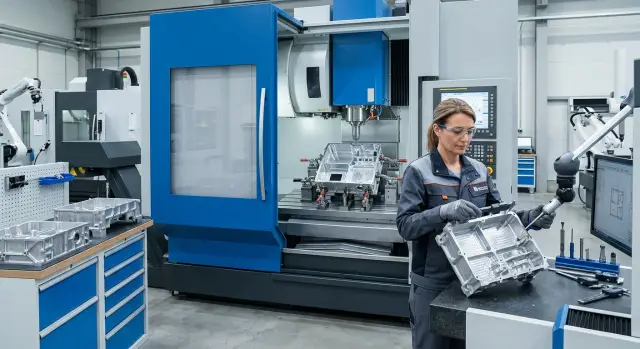
Why thin walls warp after unclamping
When clamped, a housing part often looks flat even though stresses are already present inside. The clamp pulls reference faces against supports, the walls spring slightly, and in-machine measurements can read as acceptable. But once the clamp is removed that temporary shape disappears and the part moves to where the material's elasticity and residual stresses pull it.
This shows up especially quickly with aluminum. It's softer than steel, walls bend more easily and just as easily spring back once the load is removed. If a wall is thin, even a small misalignment on a support or a few hundredths of extra clamping pressure is enough for the part to fall out of size after unclamping.
Uneven metal removal makes the effect worse. While there is still mass around a pocket the part keeps stiffness. But if one side is heavily lightened and the other still has material, stiffness becomes uneven. On the next pass the thin wall starts to behave independently from the rest of the housing: it is affected by remaining metal, local heating and differences in thickness between sides.
A typical scenario is a deep pocket where one wall was almost finished too early while the adjacent one was left thick. In the fixture everything still looks acceptable. After unclamping the thin side moves first, and flatness, parallelism or the distance between walls shifts.
Two sources of movement
The result is often the same but the causes differ. The first is the clamp itself: the part is bent, held, then released. The second is internal stresses in the stock or left from previous operations: you removed a layer, the balance changed, and the shape moved even with careful fixturing.
In practice these causes usually combine. The workpiece already contains internal stress and a rigid clamp adds its effect. So a part may shift immediately after unclamping and then change again after the next operation.
If the shape changes significantly after partial clamps are removed, first check the support scheme and clamping force. If movement repeats from step to step even with light clamping, examine the allowance distribution, the machining sequence and the stock condition. For thin walls the problem rarely has a single cause.
Where geometry usually moves first
When machining aluminum housings, movement almost never occurs uniformly across the whole part. There are typically a few zones where the metal loses stiffness earlier than elsewhere. If these aren't identified in advance the part can look fine in the fixture and be out of tolerance after unclamping.
Problems most often start on long thin walls, in wide open pockets, on thin bottoms after deep pocketing and near ribs, bosses or local thickenings.
A long wall moves first because it acts like a spring. While the part is clamped the supports and the surrounding mass hold the shape. Once nearby material is removed or the clamp is released the wall springs back. This shows up immediately in the size: the plane is no longer as flat, and parallelism and straightness deteriorate more than expected.
A wide open pocket gives a different effect. From the outside the housing still looks stiff, but inside there's a large void and the contour begins to act independently. It's especially tricky when the pocket is wide and the webs at the edges are narrow. After removing the last millimeters the external dimension can change almost immediately, although everything seemed stable during cutting.
A thin bottom behaves its own way in a deep pocket. While there's still metal under it the surface holds. When the bottom is nearly finished it begins to deflect from cutting forces and heat. Later the part cools, stresses redistribute and flatness changes after removal from the table. An operator measuring right after machining and again half an hour later often gets different values.
Near ribs and local thickenings geometry changes less obviously but more insidiously. Thick and thin zones cool differently. A rib may hold shape while an adjacent wall pulls and slightly disturbs the plane. The change appears not across the whole surface but as a patch or strip near the thickness transition.
Most rejects come from combinations of thin features rather than a single thin spot. For example, a housing with a deep pocket, a long side wall and a thin pocket bottom can pass in-fixture checks but after unclamping the wall springs outward, the bottom lifts slightly and the distance between datum faces is altered. These zones should be checked first, not only the overall part envelope.
How to stage metal removal
If the bulk removal is done only from one side the housing often holds its size in the fixture but then shifts after unclamping. Aluminum cuts easily but quickly reveals internal stresses. It's better to plan the machining so the part loses mass evenly.
Roughing should be split between sides. Remove a significant volume from the top, flip the part and remove a comparable volume from the opposite side. The same rule applies to pockets, windows and external faces. When metal is removed roughly symmetrically walls are less pulled and the datum lasts longer.
Allowances should also be planned. Walls, pocket floors and datum planes need dedicated stock for the next stage, not a leftover based on "what turned out." If one wall has a lot of stock left and the neighbor almost none, the finishing pass won't correct the part behavior. It will only reveal the imbalance.
A practical step sequence
A simple sequence usually helps. First square the blank and obtain rough datums. Then remove the large volume of metal in several passes, avoiding close-to-size cuts. After that leave an even semi-finish allowance and only at the end take a thin final cut.
One heavy pass may look faster on paper, but in practice it heats the cutting zone more, loads the walls more and often leaves uneven material distribution. Three moderate passes typically produce better results for both size and form. For deep pockets it's especially better to step down gradually than to open the entire cavity at once.
Final cuts should be a thin uniform layer. A good sign is when the finishing pass no longer corrects the part but only polishes the surface and brings the dimension to size. If one side has 0.2 mm left before finish and the other 1 mm, the part will almost certainly move after unclamping.
In practice the rule is simple: if you machine an aluminum housing with thin walls and a thin pocket floor, do not finish the pocket in one go while the external contour is still heavy and unbalanced. Remove part of the volume first, leave a stable allowance, machine the opposite side, and then go to semi-finish and finish. This order usually adds a few minutes but can save hours of rework.
How to choose support points and clamping
Choose datum supports not where it's easiest to bring the tool, but where the part actually holds its shape. These are usually thicker pads, ribs, bosses around holes or the external contour with section reserve. If a support is placed under a thin wall it will deflect even before the first cut and the size will move after unclamping.
Also avoid applying clamp force near weak zones. A jaw or clamp next to a thin wall often produces a flat-looking part in the machine and poor geometry at inspection. It's far more reliable to transmit the load through a massive area and leave the thin zone free of excessive pressure.
Soft jaws are useful where a standard clamp touches the part at two or three random points. They are machined to the blank's form so the part sits straighter. If the shape is complex, additional supports, locating pads and thin shims help. Only place them under rigid zones, not under areas that are already prone to movement.
A simple rule: the thinner the wall, the further the clamp should be from it. Sometimes it's better to spend an hour making simple tooling than to chase hundredths on every part.
Before starting check a few things. The part must sit on all supports and not rock. A feeler should not pass under datum pads that require firm contact. After lightly tightening the clamp an indicator should not show significant shift. On re-clamping the part should return to the same position.
A common recurring case: a housing with a deep pocket and two thin side walls. If clamped by the outer contour near the pocket the walls are pulled inward. If supports are moved to a thick floor and clamping force is transmitted through bosses or lugs, the part holds shape much better. On CNC machining centers and turning centers this mistake is frequent: people tighten harder when they need to clamp more accurately.
Machining order that minimizes risk
For aluminum housings the machining order often matters more than cutting parameters. If you start with a deep pocket or immediately bring a thin wall to size, the part may only hold shape while clamped. After unclamping it can move by tenths or more.
First produce the datums and surfaces that will be used for inspection. This might be the bottom plane, a side datum and a couple of registration points for re-fixturing. While the part is still stiff these surfaces are easier to get true and then use without constant adjustments.
Next remove the bulk metal more evenly rather than from one side. If the pocket is deep, don't clear the entire volume from the top and leave a heavy external mass. It's calmer to remove metal in stages and avoid creating a clear imbalance of stresses across walls and floor.
A helpful sequence is: rough all thin zones with allowance, pause, inspect, and only then finish.
After a large removal don't immediately continue. The part needs to cool. Aluminum heats quickly and measuring a hot part is misleading. If the housing is noticeably warm, 10–15 minutes of waiting is often better than another pass.
At this stage check dimensions and form not only on main planes but also where walls have become thin. If the geometry already moved in the fixture, postpone the finishing pass. First understand where the part pulls and whether the clamp is over-tightened.
Finish cuts are done last when the housing has survived roughing, cooled and revealed its real condition. Often a small allowance, for example 0.3–0.5 mm per side, is kept so the final pass removes minimal metal and doesn't upset the wall again.
Compare in-fixture and post-unclamp measurements. If the part measures perfectly in the fixture but the plane shifts or the pocket changes after unclamping, the problem is usually not the tool. Look at machining sequence, supports and clamping force.
Example: housing with a deep pocket
Take an aluminum housing 220 x 160 mm with a 48 mm deep pocket. After roughing around the perimeter a wall 3–4 mm thick remains. On the machine the size still holds, but after unclamping the long wall moves inward by 0.12–0.18 mm. For such a housing this is common.
The cause is usually not one finishing pass but the metal removal scheme. If almost all volume is removed only from the pocket side, the external contour still holds stiffness while the thin wall loses support. Stresses change unevenly and pull the wall inward. While clamped the clamps hide part of the movement. After unclamping the housing relaxes and the geometry shifts.
This case is better handled in two setups. In the first setup don't finish the pocket. Leave 0.8–1.2 mm on the walls and 0.3–0.5 mm on the bottom. If the pocket should be 48 mm deep, first remove only to 36–40 mm. Then unclamp the part, let it cool and perform an intermediate measurement on the table or with an indicator along the long wall. This measurement often saves the blank. If the wall already shifted by 0.07 mm, in the second setup you must change not only the allowance but also the clamping.
In the second setup the clamp point matters. If the clamp is near the thin wall it locally squeezes the housing and the finished size looks good only under load. Move the clamp to a thicker boss or a corner with larger section and support the pocket floor; the result changes. On the same part the post-unclamp movement often drops to 0.03–0.05 mm.
The workflow here is simple: in the first setup remove the main volume but leave a noticeable allowance on the thin wall. Then unclamp and check after cooling. In the second setup clamp through thick zones rather than near the pocket. Make the finishing pass on the wall with small cuts, not a single deep pass.
This example shows the point: a thin wall is usually moved not by the cutter alone but by one-sided metal removal combined with poor clamping. Changing both conditions at once makes the housing hold shape more consistently.
Mistakes that cause movement
Most of the time parts move not because aluminum is the material but because of the operation sequence. A small mistake in clamping or allowance distribution quickly becomes a plane skew, hole ovality or a wall tilt after unclamping.
One frequent cause is removing the entire allowance from one side in a single cycle. Metal balance is lost and the housing pulls to one side, especially if pockets and thin webs are already present. The part behaves much calmer when allowance is removed in stages and more symmetrically.
Clamping itself often ruins the part. If you press on a thin wall it deflects during setup and after releasing the load it doesn't return to the measured position. On the machine everything looked fine but at inspection the size changed. This story is very familiar for housings with deep pockets.
Another mistake is a long finishing pass on a hot part. Aluminum heats quickly and dimensions shift at that moment. If you perform a long finish immediately after roughing without a pause you can get a nice surface and poor geometry.
Datum mistakes happen even on stable series. The part is flipped, re-fixtured or a new datum is taken and work continues without verification. A small shift in setup plus residual stress yields noticeable movement where it was not expected.
A quieter mistake is checking geometry only in the fixture. It's convenient but deceptive. The clamp holds the housing in a shape it helped create. Therefore some dimensions should be checked after unclamping and sometimes after a short pause to let the part cool.
Warning signs look like this: the size changes only after removing the part from the table, one wall is consistently thinner than its neighbor, the plane settles after the second setup, or a re-measure 10–15 minutes later differs from the first. If you see these signs, don't try to fix the part by increasing clamp force. Instead revisit the support scheme, split the allowance into more passes and add post-unclamp inspection. Usually that saves the housing from scrap.
Short checklist before finishing
Holding size in the clamp doesn't mean much. Geometry often moves at the final stage when the operator rushes to take the finishing cut and immediately send the housing to inspection.
Before finishing, pause for a couple of minutes and run a short check. It's simple but this is exactly where thin walls are caught that later cannot be corrected.
Look at the remaining allowance for the final pass. If one side has noticeably more metal than the other, the finishing cut will pull the wall to one side. Check loaded areas: for a deep pocket, thin ribs and a bulky nearby boss, remove metal so the load changes evenly rather than only from one side. Re-evaluate how the part is held. Clamp should press on thick rigid areas, not on a thin shelf or near a pocket edge.
Let the part cool. Aluminum heats quickly and sizes can change by several hundredths while the housing is still warm. Always take at least one control measurement after unclamping. Otherwise you may accept the shape that the clamp enforced as the real geometry.
In practice this is straightforward. Suppose pockets are done and only finishing remains for planes and walls. If one wall is almost to size and the neighbor still has a lot of allowance, don't run the finishing cycle over the whole part. First even out the allowance where mass is still uneven, then loosen the clamp, let the housing rest and only after that measure.
A good sign before finish is: the part sits calmly on supports, the clamp doesn't bend it, temperature is stable and the post-unclamp check nearly matches the machine reading. If a difference already exists at this stage the finishing pass will not fix it. It will only lock the error in place.
What to do next in your shop
If you regularly see movement when machining aluminum housings, don't start by buying new tooling. First identify the parts where movement happens most often and build a simple map: where walls move, after which operation it shows, and on which fixture the problem is worse.
Usually at this stage it becomes clear that the cause is not a single thing. On one part movement comes from excess removal on one side, on another from weak support under the pocket floor, on a third from an aggressive finish after a rough roughing pass.
Next, walk the shop and check a few items. List 5–10 parts where thin aluminum walls move most often. Compare the actual machining route with the drawing and tolerances. Check whether axis travel is sufficient to place the part without doubtful overhangs and transitional fixtures. Assess the rigidity of the machine and tooling for your wall thicknesses, pocket depths and removal volumes. Note where the operator must manually adjust parameters to hold geometry.
Such analysis sobers things quickly. Sometimes the issue is not cutting data at all but that the part is placed in universal jaws when it needs proper support and predictable clamping.
If the question moves beyond process order into machine selection, discuss real parts rather than catalog promises. EAST CNC takes this practical approach: the company helps with consultation, selection, supply, commissioning and servicing of metalworking machines, and on the east-cnc.kz blog publishes equipment overviews and machining tips.
A sensible starting goal is simple: take one problematic part, rebuild the route, check supports and clamping, then compare deviation before and after. One such review usually benefits a shop more than long discussions about why aluminum moved again.