
A Machine with Extra Axis Travel: When You Need It, and When You Don’t
We explain when a machine with extra axis travel helps you prepare for future parts, and when it only raises the price, weight, and space requirements.
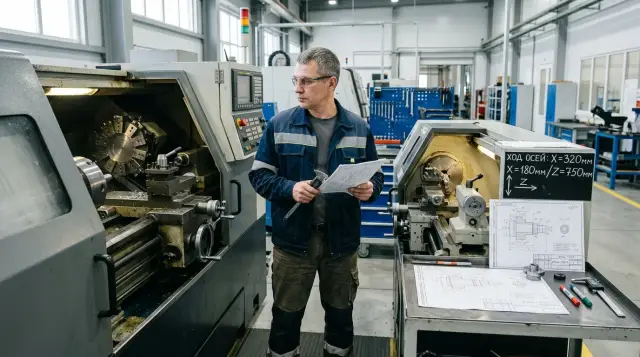
Why the question of extra travel comes up right away
This question appears in the first few minutes of the selection process. The buyer does not want to hit the limit in a year and have to come back for a replacement. So the idea seems simple: if you buy a bigger machine now, things will be calmer later.
The logic is understandable, but it does not always work. Extra axis travel is useful only when there are already future parts, fixtures, and a clear production plan for it. In every other case, a larger machine looks like a reliable solution only on paper.
The main confusion starts when axis travel is treated as direct value. Nominal travel is not the same as the real working space for the part. Some of that space is taken by the chuck, vises, tools, safety zones, and the way the workpiece is mounted. So an extra 150–200 mm does not mean much on its own if the part already fits comfortably in the working area.
Extra millimeters quickly turn into extra costs. A larger machine is usually more expensive, takes up more space, and may require a different layout in the shop. In a quote, the difference may seem small at first, but then delivery, installation, maintenance access, and the simple fact that a larger machine takes up floor space every day are added to the price.
Planning only for future growth also often makes the choice harder. Management thinks about new orders, the technologist builds in a reserve, and in the end the shop keeps making the same parts for two more years. The money is already spent, the space is occupied, and there is no return.
It is more useful to look at the current part range and the near-term plan, not an abstract “someday.” If you have drawings for future parts, know the workpiece sizes and the clamping method, the reserve can be calculated calmly. If growth is still only an idea, there is no point paying extra for a larger size.
When selecting CNC machines, this is especially clear. At EAST CNC, this choice usually starts not with the maximum size, but with the real production task: what parts are already in use, what is planned for the near future, and how much space the shop can give to the equipment.
What axis travel actually means in practice
When X, Z, or Y is listed in the specifications, it is not the size of the part, but the limit of the machine’s movement. That difference matters. Many people see the number 500 mm and think a 500 mm part will definitely fit. In practice, the useful range is almost always smaller.
On a lathe, the X-axis is linked to the cross movement of the cutting tool and the machining diameter, while the Z-axis is the machining length along the spindle. On a machining center, X, Y, and Z are usually checked to understand the working area in length, width, and height.
Even if the part fits by size, that still does not mean it can be machined comfortably and safely. The chuck, jaws, vise, fixture, rotary table, tool, and the required clearance for tool approach all take away part of the travel. Sometimes a very noticeable part.
A simple example: a 300 mm workpiece seems suitable for a machine with 320 mm of Z travel. But the chuck takes up part of the length, the tool needs approach and retract space, and drilling, boring, or cutting off requires even more allowance. In the end, a 300 mm part often needs noticeably more travel than 300 mm itself.
The same story applies to the X-axis. On a lathe, it is risky to look only at the maximum diameter. You need to account for chuck size, tool overhang, turret position, and safe distance so nothing is hit during tool changes and rapid moves.
The maximum axis value matters, but the working range matters too. If the machine only reaches the required point right at the edge of its travel, it will be awkward to use. The operator has a harder time setting up the part, the tool may not have a proper approach, and some operations will require extra repositioning.
So axis travel is better read not as the answer to “what part can it take,” but as the answer to “what part can it take together with the fixture, the tool, and a reserve for normal work.” That kind of calculation helps you understand whether you need a machine with extra travel or whether a more compact model is enough.
When a larger travel is truly needed
A larger travel is needed not just in case, but for a specific job. If you can already see that future parts will be bigger, extra travel helps you avoid buying a second machine a year later. In that case, you are paying not for empty space, but for the ability to work normally with future orders.
A common situation looks like this: the part changes only a little, but the length or height grows by 80–150 mm. On paper, that seems minor. On a machine, the difference quickly becomes noticeable, because you need space not only for the part itself, but also for clamping, tool approach, and safe retract after the operation.
Where extra travel really helps
Sometimes the part itself hardly grows, but everything around it changes. A long tool, a tall chuck, a nonstandard fixture, or a rotary table eats into the working area. This usually affects the Z-axis the most. If such tooling is already part of the plan, it is better to account for it now than to work on the limit later.
Extra travel is also useful where production runs change often. Today the shop makes small housings, next week longer shafts or larger flanges. When travel is selected without reserve, operators start moving the part, changing the base, and looking for workarounds. Work slows down, and the risk of scrap rises.
It also makes sense to choose a machine with a reserve when new orders are already visible in the numbers. For example, if you currently make parts up to 420 mm long and customers are already sending requests for 520–560 mm, the reserve looks reasonable because it is based on real dimensions, not on the thought that it “might come in handy.”
The rule of thumb is simple: if growth in part size and tooling can be confirmed by drawings, a technical brief, or repeated requests, a larger travel is justified. If there is no such data, it is better not to overpay.
When extra reserve only raises the price and takes up space
A large travel feels like a calm choice: let there be a reserve, in case larger parts come later. In reality, that reserve often remains unused. If a shop makes parts of almost the same size for three, five, or seven years, the extra working area does not add value every day.
That happens in serial production. A company steadily turns bushings, flanges, or housings within one size range. Drawings change rarely, and new orders still fit the same format. In that case, a “future-proof” machine is paid for now, even though there is no real work for that reserve.
The extra cost is felt not only in the machine price. A larger model takes more space in the shop, and that quickly becomes a practical problem. You need to keep walkways open, leave access for maintenance, make room for the cabinet, chips, pallets, and loading. When floor space is limited, one oversized machine becomes more of a burden than it looks in a catalog.
Often it is more sensible to invest the difference not in empty millimeters, but in what the operator uses every day: the right chuck, a proper coolant system, convenient fixtures, a chip conveyor, commissioning, and service.
There is also a less obvious downside. Work is not always convenient with extra empty volume. It takes longer to reach the machining zone, cleaning takes more time, and setup moves more slowly. On long travels, the machine spends extra seconds on idle moves. That may be minor on one part, but in a series those losses add up.
A simple example: a shop produces parts up to 180 mm long and does not plan to move into larger housings. It is offered a model with noticeably more Z travel because it “might come in handy.” If space is tight and the budget is limited, it is more logical to choose a compact machine and put the difference toward options that are needed every day.
A reserve makes sense when there is a clear scenario behind it. If there is no scenario, extra axis travel becomes expensive empty space on the shop floor.
How to calculate the required travel
It is better to start not with the machine catalog, but with the largest part you truly plan to make. Do not use a rare “someday” order. Look at the real plan for the next 1–2 years.
The most common mistake is simple: people calculate only the part dimensions. But the machine does not work with an empty blank — it works with the blank together with the fixture, the tool, and a reserve for safe approach.
A simple calculation sequence
- Take the drawing of the largest part and note the maximum dimensions along the axes that will be used. For a milling machine, this is usually machining length, width, and height. For a lathe, it is usually diameter and length.
- Add space for clamping. A 400 mm part rarely uses exactly 400 mm of travel. The chuck, jaws, vise, fixture, or setup also takes space.
- Add tool approach and safe clearance. The tool needs entry into the material and exit from the cutting zone.
- Compare the result not only with the nominal travel, but also with the real working area. Some of the travel may be consumed by the chuck, column, table, fasteners, or a long tool.
The simple formula is: part size + fixture + approach + safe reserve = minimum required travel. After that, you can leave a reasonable reserve. Usually 10–20% is enough, not a “twice as much” margin.
Example: there is a part 420 mm long. The chuck and clamping add another 90 mm. Tool approach and safe retract take 40 mm. That means you already need about 550 mm on the relevant axis. If the machine has 560 mm of travel, the reserve is almost zero. If it has 650 mm, work is more comfortable. If it has 900 mm, it is worth checking whether you are overpaying for an unnecessarily large working area.
This is how questionable options are filtered out. The idea of buying a machine with extra axis travel feels safe, but it is better to calculate from the parts, not from the feeling that it “might come in handy.”
An example of choosing for future parts
The shop turns bushings and flanges every day. The parts are short, the production run is steady, and the current CNC lathe covers almost all tasks. Length is not a problem: the working travel is enough, the tool approaches without extra maneuvers, and the operator does not have to think about travel limits.
Then a new request comes in. The customer no longer wants bushings, but a shaft that is noticeably longer than the usual parts. On paper, the difference seems small. In reality, the machine may run into the Z-axis travel limit before normal work even begins. Part length is not the whole calculation. You also need space for the chuck, tool overhang, safe approach, and a little reserve so you are not working right at the edge.
Suppose the shop currently makes parts up to 180 mm long, and the new shaft is 380 mm long. The current model works comfortably with the first group of parts, but it cannot handle the second. Formally, the machine is almost suitable; in practice, it cannot take the new order.
The first temptation is obvious: buy the biggest machine in the line and forget about the issue for years. That solves the problem, but it also brings extra costs with it. A larger machine needs more space around it, is harder to fit into the existing area, and is often excessive for the same bushings and flanges that pay the bills every day.
In this case, the middle option looks better. Not the maximum travel, but a sensible reserve. If the new shaft needs a working range of about 500–550 mm on Z including the fixture, there is no reason to jump straight to a machine with a meter of travel. A model with that reserve covers the new order without taking up unnecessary space.
Before choosing in this example, it is enough to check three things: the full part length including clamping and tool approach, the real diameter of the future shaft, and the space in the shop for maintenance, loading, and chip removal.
That approach gives you a calm reserve without overpaying. The shop does not buy a machine for “someday,” but chooses one for the real work that is already visible on the horizon.
Mistakes when buying
The most common mistake is simple: people choose a larger model because it feels like it can only be better. In reality, more axis travel almost always means not just a higher price tag. Mass, floor space, space requirements, and sometimes the length of idle moves all increase. If your parts are compact and repeat from batch to batch, the extra working area is simply costing money.
The second mistake happens when only the size of the part itself is considered. Suppose a housing is 450 mm long. The buyer sees that number and decides a small reserve will be enough. But the part does not work in the air. You need a vise or chuck, clamps, a plate, the tool, safe clearance, and room for approach. In the end, axis travel must account not only for the blank, but for all the tooling around it.
People also often get future orders wrong. They buy a machine with extra axis travel for a part that is not yet in production, not in drawings, and not even on the timeline. That is a weak reason for an expensive purchase. If the hypothetical order is not backed by numbers, it is better to calculate two scenarios: the current part range and the real plan for the next year.
There is also a more practical problem: the workflow around the machine is forgotten. The blank still needs to be loaded, removed, turned around, sometimes fed as a long bar, or a chip conveyor installed. You also need access for setup and service. It happens that the machine fits into the shop on paper, but working next to it becomes inconvenient in the first month.
If you are deciding how to choose a CNC machine, check four things: the maximum part size including fixtures, the real orders for the near term, the tool path including approach and retract, and the free space around the machine for loading and maintenance.
It is better to buy a machine for real work with a sensible reserve than out of fear of missing one rare order.
Quick checks before ordering
Before placing the order, it is useful to pause for a moment and check not the catalog, but your real work. The mistake is usually the same: people look only at the part size and forget everything that holds, cuts, and feeds that part into the machining area.
First, make a list of the parts your shop will make not only now, but over the next 1–2 years. If new housings, flanges, or long shafts are in the plan, that should be considered right away. If there are no such plans and the part range hardly changes for years, a machine with extra axis travel may simply be the more expensive choice.
Then ask yourself a few direct questions. What is the maximum size of the blank, not the finished part? How much space do the chuck, fixtures, tools, and safe clearances add? Is there enough room in the shop not only for the machine, but also for maintenance, loading, and material supply? Is there at least an approximate plan for new parts in the near future?
The blank is almost always larger than the part on the drawing. Machining allowances, clamping length, tool overhang, and the movement needed for positioning all get added to it. Because of that, a 300 mm part sometimes requires a noticeably larger working range.
Space in the shop is no less important. A machine can only be placed against the wall on paper. In real work, you need a passage for the operator, access to the units, space to remove chips, and room to bring in blanks or handle a long bar or a finished part.
A small example: a company makes bushings and small flanges, but in six months it wants to take on larger housings. If this is already being discussed with customers, extra travel is justified. If it is just a general hope, it is better to size the machine for current work and keep only a moderate reserve.
What to do next
Do not buy a machine based on the feeling that it should be “future-proof.” First, put everything you work with now and everything you realistically plan to launch over the next 2–3 years into one file or a simple table.
Usually a few lines are enough: part dimensions, material, batch size, fixture type, whether a rotary table is needed, and which tool has the largest overhang. Next to that, note the travel reserve not as “a lot more,” but in millimeters. That way you will immediately see where a real reserve is needed and where a machine with extra axis travel will only raise the price.
After that, compare 2–3 models, not just one. Look not only at the machine’s axis travel, but also at the overall size, weight, foundation requirements, loading convenience, and total cost of ownership. Sometimes a model with slightly more travel costs much more, takes up more space, and gives you nothing for your parts.
A simple example: if a 280 mm part is machined in a vise and effectively needs 430–450 mm on one axis including approach and the tool, a machine with 500 mm of travel may already cover the task. Moving to 700 mm only makes sense when you have clear future orders, not an abstract thought that it “might come in handy.”
Then show your calculation to the supplier using your own parts. Do not ask for a “suitable machine” in general terms. It is better to send drawings, photos of the fixtures, blank dimensions, and a list of operations. Then the check will be based on the working area, not on a general description.
If you want a second opinion, you can discuss the task with EAST CNC, the official representative of Taizhou Eastern CNC Technology Co., Ltd. in Kazakhstan. The company supplies CNC lathes and machining centers and helps with selection, commissioning, and service. It is better to have that conversation with a table and part examples already prepared: that makes it easier to choose a machine without overpaying for unnecessary travel and without the risk of running out of space later.