
Machine Unloading: Forklift, Crane, and Pre-Start Mistakes
Unloading a machine requires a precise sequence: assess the site, choose between crane or forklift, check rigging and avoid load tilt.
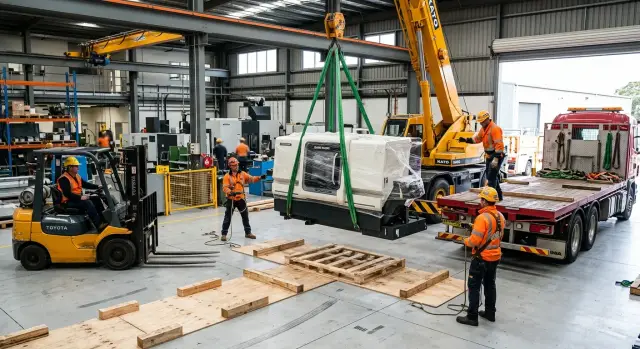
Where problems begin
Most unpleasant surprises appear not after commissioning, but earlier — while the machine is still on the truck or hanging on slings. One wrong lift angle, a sharp jerk from the forklift or trying to drag equipment through a tight opening can produce damage that shows up later in mechanics and geometry. In fact, it all started at unloading.
Often the most vulnerable-looking parts aren’t the ones that suffer. They damage not only packaging and paint. A tilt during lifting bends covers, pulls fasteners, shifts protective parts and overloads assemblies that aren’t designed for a side impact. From the outside it looks minor. A few days later you find that a door closes with effort, a cable duct is warped, or the base no longer sits as level as it should.
Another common cause of problems is poor preparation of the site. The truck arrives on time, the crane is booked, people are on site, and then you find the floor at the gate is weak, a turn lacks width, or a height difference prevents smoothly rolling the machine to its installation point. In workshops this is a usual story, especially when the route is checked by eye. For heavy equipment a couple of centimeters can decide everything.
Hurrying only makes things worse. The crew wants to remove the machine faster, the driver rushes to free the area, and no one properly checks the center of gravity. The machine’s center of gravity rarely sits where it’s convenient for people. If this is ignored, the load begins to tip already in the air. Then slings are tightened on the spot, the forklift jerks, the crane operator tries to catch the balance, and the risk multiplies.
Usually it starts with four simple mistakes: not verifying weight and lifting points against the passport, choosing equipment with almost no lifting margin, not checking the route from the truck to the installation spot, and starting work without a single person in charge of the whole operation.
In deliveries of metalworking equipment this repeats constantly. While the machine hasn’t been switched on, it seems nothing serious happened. But these early mistakes later cause downtime, extra costs and disputes over who damaged the equipment.
What to check before the truck arrives
Problems often begin not at the unloading itself but a day before. The truck is already on the way, and the shop doesn’t have precise data on the machine’s weight, lifting points and the narrowest passage width. Then the crane stands idle, the forklift waits, time runs out and the risk grows.
Start by collecting accurate machine data. You need not an estimate like about 4 tonnes, but the mass in packaging, dimensions, center of gravity and allowed lifting points. On CNC lathes and machining centers the lifting points often differ even between similar models. If you pick slings by eye, you can shift the machine, dent a cover or damage the base before installation.
Before the truck’s arrival, verify several things in advance:
- the actual mass of the machine including packaging, pallet and any fixtures inside;
- the lifting scheme from the manufacturer or supplier;
- the height and width of gates, doors, passages and turns along the entire route;
- the allowable load on the floor, ramp and the temporary stopping area.
Measurements are better taken with a tape measure, not from memory. People often forget protrusions, columns, cable trays and a sharp turn at the gate. The machine may fit by width but fail by turning radius. If the route is long, mark in advance places where equipment can stop and correct the load position.
Check the floor not across the whole shop but along the movement path. A weak spot may be at the entrance, on an old patch of screed or on a ramp. If a heavy machine is moved on a pallet truck, trolley or forklift, the load concentrates on a small area. One bad patch of floor can ruin the entire operation.
Clear the route to the installation spot. Remove pallets, crates, boxes, cables, oil and everything that obstructs the view. If the machine won’t be installed immediately, set aside a flat area where it can stand without tipping.
And one more rule that often saves the day: assign one person in charge. This person meets the truck, checks the lifting scheme, gives commands to riggers and stops the work if they see a risk. When three people give instructions at once, mistakes are almost inevitable.
When to use a forklift and when a crane
Choosing between a forklift and a crane depends not only on the machine’s mass. It’s important to look at the entire path of the load: where it sits on the trailer, how it can be hooked, whether there is enough height and where it needs to be placed immediately after removal.
First compare the machine’s mass with the lifting capacity of the equipment, but don’t go tight. If the machine weighs 4 tonnes, taking a forklift or crane rated at the same 4 tonnes is risky. You need a margin because slings, spreader bars, packaging and an offset center of gravity also affect the load. For cranes the margin is especially important when the boom works with outreach. The further the boom, the lower the actual capacity.
A forklift suits when the machine is near the edge of the trailer, has clear support points, and after removal it needs to travel a short distance over even floor. Yet mistakes happen here too. Short forks may not reach the support zone and the machine begins to nose forward. If the lift height is insufficient, the load won’t come out of the bed smoothly and people start jerking it up. That’s an extra risk.
A crane is needed in other situations: when the machine sits deep on the trailer, the sides prevent inserting forks, or the load must be lifted and then lowered almost vertically. This is common for heavy CNC lathes. A forklift may be suitable on paper but simply won’t reach the load without dangerous tilting.
Before choosing equipment check four parameters: the machine mass with packaging and lifting fixtures, the center of gravity and sling points, fork length and lift height, and for a crane — the distance to the trailer and the boom outreach.
A simple rule: if you need to take a machine off a truck and immediately move it a few meters over smooth floor, you usually use a forklift. If the load sits deep, must be lifted over the trailer sides or the site doesn’t allow close approach, it’s safer to call a crane. A mistake at this stage usually costs more than an extra hour waiting for the correct equipment.
How to prepare the rigging
Without proper rigging the unloading often goes off-plan before the first lift. The problem is usually not the crane or forklift, but small details: a worn sling, a wrong hooking point, lack of protection under sharp edges.
Start with the machine passport and the slinging scheme. This is not a formality. On heavy equipment the center of mass rarely sits where it appears, and a single mistake in the hooking point easily causes tilt the moment the load leaves the trailer.
What to check before lifting
Inspect slings, shackles and spreader bars before starting, not while the machine is already suspended. Look for tears, kinks, signs of overheating, cracks, stripped threads, bent pins and wear at contact points. If any element causes doubt, replace it immediately.
Check the working load limit of each element. On site there may appear to be suitable gear, but it can lack margin by mass or by leg length. Then slings take too sharp an angle and the load on each leg rises sharply.
Do not attach rigging to covers, doors, cable ducts or other outer parts. They keep their shape but not the machine’s weight. Hook only to the factory eyebolts and points indicated in the passport.
If a sling touches an edge, corner or unfinished cut, place protection beneath it. Thick pads, angle guards or wooden blocks will do. This simple measure often saves a sling from being cut when it tightens.
What to have at hand
Prepare wooden blocks for temporary support, shims of varying thickness, sling protectors and notes for hooking points before starting. When these are at hand, the crew doesn’t fumble during a lift or search for a proper timber at the last moment.
In practice this works well for heavy machine introductions. At EAST CNC they usually prepare the spot for lifting gear and a set of shims before the truck arrives. That saves time and makes the lift calmer.
The unloading sequence
Unloading starts not at the lift moment, but while the machine still sits on the truck. If you skip the initial checks you can get a hidden impact to the body, a tilt during the lift or damaged guides before the machine reaches the shop.
First inspect packaging, pallet, corners and tie-down points. Look for dents, torn film, fork marks, cracks in the crate, drips and load shift. Record anything suspicious immediately, before removing fastenings.
External restraints must be removed only when the rigger has given the command and the equipment is ready. If you loosen tie-downs too early, the machine can shift even on level ground. This is a frequent mistake, especially when everyone wants to free the bed faster.
Make the first lift only a few centimeters. This is enough to see how the machine hangs on the slings without risking a large height. Don’t move it sideways or suddenly increase the height at that stage.
On the trial suspension check for tilt. If the machine pulls forward, back or to an angle, stop the lift and correct slings, the spreader bar or hooking points. A small tilt at the start can later turn into dangerous swinging.
Lower the machine onto prepared shims rather than directly on the floor. It’s easier to remove slings, bring in rollers or transfer equipment and then calmly move the load through the shop. Shims also protect the lower part of the base from impact with the concrete.
At this stage don’t argue about the sequence. If the rigger asks to stop and re-set the slings, it usually saves hours and often prevents costly repairs. For heavy CNC lathes such a pause is almost always better than one extra risky lift.
Common mistakes
Many problems appear not at the first startup but while the machine still hangs on slings or stands on forks. Mistakes at those moments are expensive: covers bend, geometry shifts, the base cracks, and sometimes people nearby get hurt.
One frequent error is trusting the weight on the consignment note and not verifying the actual configuration. Papers may show the weight of the base machine, but a chuck, chip conveyor, cabinet, packaging, fixtures or separate units may already be added. As a result the forklift is chosen with almost no margin, and that margin disappears before the lift.
Working with forks at random causes no less trouble. If forks are set too narrowly the center of gravity shifts and the machine begins to tip forward or to the side. From the outside this looks harmless, but during sharp braking or a turn the equipment can easily lose stability.
Another typical mistake is removing transport locks too early. Until the machine stands on the prepared place and is leveled, these items protect moving parts from excess travel and shocks. If you remove them on the street, on the ramp or right after taking the machine off the truck, moving parts are loaded too soon.
People are often left too close to the load. Someone walks beside it, someone tries to adjust a sling by hand, someone stands in the turning zone to guide the crane operator. This is a bad habit. The load may swing a few centimeters and that’s enough for an injury.
A separate mistake is dragging the machine by chain across the floor when it should be moved by its proper method. This scratches the base, tears fastenings, damages the floor and creates jerks which equipment tolerates worse than a slow controlled lift. If the site is tight, plan rollers, a pallet truck with adequate capacity or the route in advance.
The rule is simple: before every action the team must understand the mass, lifting points, the route and the danger zone. If any point is unclear, it’s better to stop for ten minutes than to fix the machine for a month.
Workshop example
A lathe arrived on a low-bed trailer. On paper everything looked calm: weight known, installation spot prepared, crew on site. The problem appeared at the gate during the height check.
The opening was higher than the machine, but there wasn’t enough clearance for a safe lift. If they had tried to remove the load with a crane and carry it inside in one move, the top could have hit the gate frame. Such impacts happen before commissioning, and later owners search for causes of tilt, cracks in covers or altered geometry.
The crew didn’t rush. They first took the machine off the trailer with a crane and carefully set it on blocks outside. It took time, but the load didn’t hang in an awkward position near the opening.
Then they brought it into the shop with a forklift. Before that they leveled the route with steel plates because there was a height difference and a soft patch at the entrance. Without the plates the forklift wheels could have caused a tilt and the machine would have shifted a few centimeters sideways.
The blocks proved useful again. They are handy for a short pause when you need to correct slings, check clearances and reassess the route. If you lower the load directly to the floor, you often lack space later to safely insert forks or reset the rigging.
All this preparation added about an hour. On paper that looks like an extra delay, but in fact they traded that hour for no impact against the opening, no sling failures and no rushing at the gate. For unloading heavy equipment that’s the usual price for calm work.
The takeaway is simple: check the route not only by width but also by height, floor slope and the points where the equipment will change its mode of movement. Sometimes a forklift or crane is chosen not by the number in the passport, but by where free space actually ends.
Inspection before installation
After unloading don’t rush to push the machine against the wall and prepare it for startup. First do a short inspection. Those 5–10 minutes often save a long repair, disputes over acceptance and repeated moves inside the shop.
Start with the body. Inspect the bed, covers, doors, windows, corners and the underside of the frame. There should be no dents, impact marks, misaligned doors or gaps that were not present in the shipping photos. If the body looks twisted or one support clearly sits higher, don’t proceed further.
Then check transport locks and attachment points. Bolts, plates, shackles and other units that secured moving parts during transport should be in place and look intact. A torn fastener almost always means the machine received a jolt during transit or unloading. In that situation take photos and note the issue rather than hoping it will straighten later.
Also inspect cables, hoses and sensors. They are often pinched by straps, a forklift tine, a roller or the edge of a pallet. Even if the insulation isn’t cut, a pinched cable later causes intermittent errors that are hard to trace. Pay special attention to the lower area, the rear of the machine and places near doors and moving parts.
The floor under the machine must be dry and level. A puddle of oil, water or coolant under the base is a reason to stop and find the source. An uneven floor is another common problem. If the machine is placed on a sloped spot or on debris under the supports, a correct installation later becomes impossible.
Don’t press the equipment too close to the wall. A CNC lathe needs clearance not only for operation but also for service: opening the cabinet, reaching lubrication points, removing panels, checking hoses and accessing the rear. In shops this is often overlooked and the machine is moved again later.
If you find any defect, document it immediately. Take wide and close-up photos, mark the location in the acceptance report and don’t remove transport fixtures prematurely. Such a check before installation usually saves more time than any rush.
What to do after unloading
When the machine already stands on the floor it seems the hardest part is over. In practice now it’s important to document its condition so you don’t later argue with the carrier, riggers or service. Take photos from all sides, photograph the packaging, sling points, transport locks, impact marks, dents, paint chips and any drips.
Attach these photos to the acceptance report. In the report note the date, time, truck number, visible remarks and signatures of those responsible. Even a small defect should be recorded immediately. After moving the machine inside the shop it’s hard to prove where a defect occurred.
Don’t rush to unpack all boxes and sort small parts. First check the delivery contents against the documents: what came with the machine, what ships separately and what is not yet on site. Confusion often starts with small items — a chuck, jaws, cables, supports, tooling, documentation or components in separate packaging. If something is missing, it’s better to notice it before the packaging goes to waste.
For a short check, five items are usually enough:
- photos of the overall condition and any remarks;
- an acceptance report with noted damages;
- verification of the kit before unpacking small parts;
- confirmation of the installation point;
- agreement on the date for leveling and first startup.
After that you need order, not hurry. Who will level the machine, who connects power, who is responsible for commissioning and when the first run will take place. If these aren’t agreed immediately, the equipment may stand idle for days and later disputes will arise about who should have done the next step.
If EAST CNC handles the delivery, it’s useful to send photos after unloading and confirm the actual installation spot. The company east-cnc.kz provides delivery, commissioning and service, so at this stage it’s convenient to quickly review the unloading scheme, access to the equipment and the date specialists will depart.
And finally: until the service gives confirmation, don’t remove transport elements at random or apply power just to check. One hasty step after unloading often costs more than an extra 20 minutes for photos, paperwork and kit verification.
FAQ
What should I check before the machine arrives?
First, find out the exact weight of the machine in its packaging, the lifting points and the slinging scheme. Then measure the entire route with a tape: gates, turns, height, narrow spots and floor condition. If the route isn’t checked in advance, problems will start while the truck is still there.
When to use a forklift and when to use a crane?
Look not only at the weight but also at where the load is located and how it will be taken off. A forklift is suitable if the machine can be safely lifted with forks and moved a short distance over even floor. Use a crane when the load sits deep on the trailer, the sides prevent fork access, or a careful vertical lift through an opening is required.
Can I rely only on the weight from the paperwork?
No — that’s not enough. The consignment note often lists the weight of the base machine without packaging, fixtures and attached units. Verify the mass with the machine passport or the supplier, otherwise your equipment choice may leave no safety margin at lift-off.
Why make a trial lift of a few centimeters?
It shows how the machine hangs on the slings without raising it to a dangerous height. If the load tilts forward, back or to one side, the crew can stop, adjust the slings or change the lifting arrangement before the tilt turns into dangerous swinging.
Why is a single person responsible for the unloading needed?
One person should issue commands and stop the operation if they see a risk. When several people shout instructions to the crane operator, riggers and driver at once, the team loses order and mistakes appear faster.
What mistakes most often damage a machine during unloading?
Most damage affects the machine itself rather than the packaging. Wrong lifting points, forks set too narrowly, early removal of transport supports and jerks during movement cause tilting, dent covers and overload components that aren’t designed for side impacts.
Is it safe to stand next to the machine during lifting?
People must not stand near the load or try to adjust slings by hand while it’s suspended. Even a steady lift can cause a few centimeters of swing, enough to injure someone. Keep everyone out of the danger zone and move the load only by commands, not by hands.
When should transport fixtures and supports be removed?
Don’t rush. These elements secure moving parts during transport and protect them from unnecessary shocks. Remove them only after the machine is in its place and you have verified the body and fastenings are intact.
What to inspect right after unloading?
Inspect the bed, doors, covers, windows, cables, hoses and the lower part of the frame. Check for dents, misalignment, leaks and pinched wires. If anything looks wrong, photograph it and note it in the acceptance report immediately.
What to do after unloading and before the first start?
Take photos from all sides, record any remarks in the acceptance report and check the delivery contents before discarding packaging. Then confirm the installation spot and agree who will level the machine, connect power and perform commissioning. Until the service team gives the go-ahead, don’t power up or remove parts at random.