
Machine Supply Contract: What to Check Before Prepayment
Machine supply contracts often hide disputed points: service, spare parts lead times, training, and on-site work. Here’s what to check.
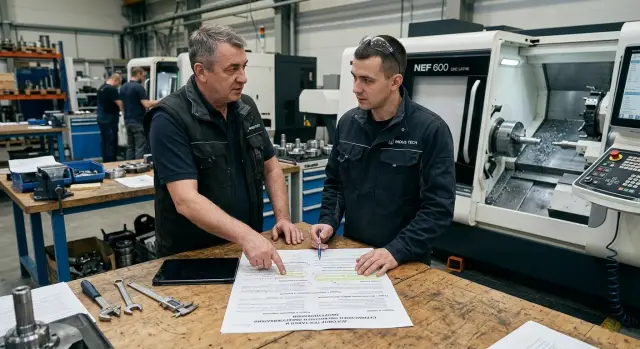
Where disputes begin after the advance payment
A dispute rarely starts because of the machine itself. More often, the problem is that the buyer spends a long time comparing price, power, tooling, and shipping time, while skimming the service terms. While the choice is being made, it seems that the main thing is to buy the right model. After prepayment, it turns out that the parties have different ideas about who does what next.
In the quotation, the machine itself is usually clearly visible: the model, configuration, price, sometimes packaging and delivery. But the quotation almost never explains the whole path to the first part. On-site commissioning at the customer’s facility, connection, geometry check, test run, CNC operator training - all of this is often left “by default.” And each side understands “by default” in its own way.
The most common disagreements happen in four places:
- what counts as delivery: the machine arriving, unloading, or being ready for work
- whether CNC machine service is included in the price or paid separately
- how long the training lasts and who exactly is trained
- when the supplier must deliver spare parts if a problem is found during startup
Another trap is timing. For the buyer, the delivery date often means the day the machine is already cutting metal. For the supplier, it may mean the date it arrives at the warehouse, crosses the border, or is delivered to the workshop. The difference seems like a formality only on paper. In reality, it means lost shifts, idle staff, and delayed orders.
For companies that manage a project end to end, these stages are usually separated: consultation, selection, delivery, commissioning, and service. EAST CNC works that way. But if the machine supply contract does not break these stages down by deadlines and responsibilities, a dispute is almost inevitable even when the relationship is otherwise good.
The most unpleasant moment comes not before payment, but after the equipment arrives. The machine is already in the workshop, the space is occupied, contractors are waiting, and production is under schedule pressure. At that point, the customer suddenly learns that training is not included in the price, startup will be scheduled in two weeks, and a separate procedure applies to spare parts. The money is already gone, and time starts costing more than the discount that was negotiated at the start.
What exactly is included in the supply
The same machine name does not mean the same supply package. In the contract and specification, it is better to record not only the model, but also the exact configuration: the CNC system, spindle power, turret or tool magazine type, chip conveyor, hydraulic unit, coolant system, safety components, and agreed options. If this is missing, after prepayment you may easily hear: “that option was considered separate.”
For a “machine supply contract,” the model name alone is not enough. You need a full list of what the customer will actually receive at the site, not a vague phrase like “machine in standard configuration.” The word “standard” means different things to different suppliers.
The small items that can stop startup for a day or two are most often missed:
- a set of jaws, mandrels, or tool holders
- cables, pendant, pedals, sensors, and interface modules
- software licenses, if they are needed for operation or diagnostics
- a document package for commissioning, acceptance, and maintenance
Tooling and accessories should be listed separately. If the supplier promised a starter kit, list it piece by piece: how many holders, which mandrels, whether there is a chuck, collet block, probe, set of wrenches, filters, and measuring tools. Otherwise, the dispute starts from nowhere: the supplier thinks it provided the “minimum for setup,” while the workshop expects a full kit for the first shift.
Consumables for the first startup are also better added to the specification. Oil, coolant, filter elements, grease, belts, fuses, and similar items are inexpensive compared with the machine itself, but without them commissioning is often delayed. If the supplier does not provide them, the contract should clearly state what the customer must prepare before the service engineer arrives.
Documents are also part of the supply if you want to start and maintain the machine properly. Agree in advance on the language of the manuals, electrical diagrams, error list, lubrication chart, spare parts catalog, and CNC guide. A Russian version is needed not “if possible,” but as a required item. Otherwise, you may end up on site with only a short quick-reference sheet, while the full documentation remains in a foreign language.
If the deal involves a CNC lathe or machining center supplied with commissioning and service, it is useful to separate two things: what the customer receives as ownership and what the engineer brings only for the work. That simple clause often removes half the disputes before shipping.
What work the supplier does at your site
The biggest share of disputes starts not because of price, but because of vague wording. In a machine supply contract, the phrase “commissioning is included” means almost nothing unless you spell out what exactly the supplier does and what the customer must prepare.
If the supplier promises a full cycle, like EAST CNC, that is convenient. But even then, it is better to break the work into stages and tie them to deadlines, responsibilities, and acceptance reports.
Break the work into stages
First, separate unloading, moving within the workshop, installation, and commissioning. These are four different tasks, and each has its own risk.
For example, a truck delivers a CNC lathe to the site. The driver thinks the job ends at the gate. The supplier thinks the customer will find a crane. The customer believes all of this is already included in the price. An hour later, the machine is sitting outside, and the installation crew is waiting for equipment. If the contract says nothing, such delays are hard to assign to anyone’s fault afterward.
Write it down clearly:
- who organizes unloading;
- who provides the crane, forklift, slings, and rigging;
- who is responsible for moving the machine inside the workshop;
- who places the machine in position and levels it;
- when commissioning starts and how many days it takes.
After that, it is much harder to argue.
Fix the conditions on your side
The supplier cannot start the equipment if the site is not ready. That is why the contract annex should list the requirements for the foundation, anchors, power supply, grounding, air, lighting, and free space around the machine. If a certain concrete thickness or compressed air pressure is required, let the supplier state it in numbers.
It is also useful to add a simple acceptance procedure. After unloading, the parties sign one report. After installation, a second. After commissioning and the test run, a third. On the customer side, the signature should be made by a specific person by position or by power of attorney, not just “any employee.”
Another common omission is consumables and auxiliary work. Who connects the coolant system, who fills the oil, who brings the cable, who removes the packaging, who takes away the crates. These small things often eat up a day or two.
The more precisely you describe the on-site work, the less likely you are to lose a week between delivery and the first part.
How to describe post-startup service
After startup, problems often begin not because of the failure itself, but because of silence. The machine is down, the workshop is waiting, and the customer has no clear answer: who to call, where to write, and whether service is available on weekends. The contract needs one clear contact channel: phone, email, and a responsible person on the supplier’s side. State the hours for receiving requests and a separate procedure for emergencies.
It is also better to include the first response time in the machine supply contract. A phrase like “quickly” does not help when the line has already stopped. It is much better to write something specific: the service responds within 2 hours during working hours, and for an emergency stop provides an initial diagnosis the same day.
If the supplier helps remotely, that should also be described without vague language. State the format of support: phone call, video, photos of the unit, error log, connection to the CNC system. Also record who on the customer’s side must be at the machine during such a check.
Remote support often solves simple faults, but only if both sides already know the process. Otherwise, the engineer asks for one thing, the operator sends another, and the downtime lasts longer. It is useful to list right away what the customer sends with the request:
- machine serial number
- error code and a photo of the screen
- a short video of the fault
- contact person on site
A separate clause is needed for an engineer visit. Write down when the supplier no longer advises by phone but comes to the site: for example, if remote checks did not help, the machine will not start after basic actions, or the fault is related to safety. The visit deadline should also be specific: 24, 48, or 72 hours, taking into account the region and logistics across Kazakhstan or other CIS countries.
A common dispute arises around payment. Warranty work and paid visits should be separated directly in the contract text. Warranty usually covers fixing a factory defect, replacing a faulty unit, and the engineer’s labor. Paid items usually include a visit after misuse, incorrect connection, damage to consumables, or a repeat visit if the staff did not prepare the machine for inspection.
At EAST CNC, the service description includes maintenance, but even then it is better to list the service composition point by point. Then after startup you will have not a general promise, but a clear process to follow if downtime occurs.
What to write about spare parts and deadlines
After startup, the dispute usually begins not because of the machine price, but because of a simple part that stops production. If the contract has no exact list and deadlines, every failure turns into a message thread asking, “is this even included?”
It is better to add an annex to the machine supply contract with a list of parts that are critical for operation. This is not the full spare parts catalog, only the items without which the machine cannot work or quickly loses accuracy. For a CNC lathe, such a list often includes sensors, drives, control boards, spindle components, pumps, belts, chucks, and consumables if startup is impossible without them.
It is more convenient to divide the parts into groups and write the time from request to shipment for each. A single phrase like “within a reasonable time” does not help.
- stock items from the supplier - for example, 1-3 business days
- factory-order parts - for example, 30-60 calendar days
- rare units with production confirmation - a separate deadline after approval
- consumables - a separate short deadline, if they are promised in stock
Separate standard and urgent delivery. That removes a lot of unnecessary disputes. In the standard mode, the supplier works with the base timeline and standard price. In urgent mode, the contract should answer three questions: what the maximum shipping time is, whether there is an express surcharge, and who pays for expedited delivery.
Another common gap is part replacement. Supplying a spare part and installing it are not the same thing. If a drive fails, the customer needs to know who installs it: the supplier’s service team, a local contractor, or the customer’s own mechanic. For each group of parts, it is better to state clearly who performs the replacement, how much time is allowed for a site visit or remote assistance, and who signs the report after the machine is checked.
In practice, it looks simple. A workshop in Kazakhstan waits 12 days for a control board because the deadline was counted “from the invoice payment date,” while the customer thought it was “from the request date.” One line in the contract removes that dispute in advance.
If the supplier manages the full cycle, like EAST CNC, it is helpful to request a table right away: part, time from request to shipment, urgent delivery option, who installs it, who accepts the work. Such a document is faster to read than a long two-page section.
How to arrange training without disputes
Training disputes usually begin with one short phrase in the contract: “the supplier trains the staff.” For a CNC machine, that is not enough. The operator, setter, and mechanic need different knowledge, so in a machine supply contract it is better to separate training by group rather than write it in one line.
Operators need startup, program loading, tool offset setting, first-part control, and safe shift operation. Setters need a deeper block: adjusting cutting parameters, offsets, tool changes, work after a stop or changeover. Mechanics need their own scope: daily inspection, lubrication, basic diagnostics, common alarms, and the process for contacting CNC machine service.
Next comes the exact time frame. Do not write “training during commissioning”; write how many days, how many hours per day, and how many shifts are covered by the supplier. If the training happens only during on-site commissioning at the customer’s facility, say that directly. Otherwise, the supplier may show the startup once, while the workshop expects full preparation over several shifts.
Also describe the program separately. A simple 1-2 page annex is enough: topics, sequence, machine model, CNC control version, number of people in the group. If a second stage is needed after a week of work, it is better to record that at once. That reduces disputes when the staff faces its first real changeover.
Training materials are also often forgotten. The contract should answer a simple question: who provides the blanks, cutting tools, measuring tools, and material for test runs. If the blanks are provided by the customer, specify their sizes and quantity. If the supplier brings a training kit, list it separately. Otherwise, the training falls apart on the first day.
It is also better to measure the end of training by result, not by words. Usually, conditions like these are enough:
- the operator starts the machine independently and makes the first acceptable part;
- the setter makes working corrections and changes the tool without the supplier engineer’s help;
- the mechanic demonstrates basic maintenance according to the procedure;
- the parties sign a report or protocol with dates, topics, and participant names.
Without this, a dispute is almost inevitable. One side thinks training was completed, the other believes they were just shown the machine for half an hour.
Example: a workshop bought a machine and lost a week
A small workshop paid an advance for a CNC lathe and expected to start it almost immediately after delivery. In the email exchange, everything looked simple: the machine was on its way, an engineer would come, and the operators would be trained on site. But in the contract itself, the details were vague.
The supplier delivered the machine on time. That is where the easy part ended. On site, no one had decided in advance who would provide the truck crane or forklift, who would handle unloading, and who would pay for the vehicle’s downtime if unloading was delayed. The truck arrived in the morning, but the machine was only taken off by evening. One day was lost right away.
The next day, the engineer began commissioning, but another weak point emerged. The operator had worked on a different CNC system before and did not know the menu, screen logic, or basic setup procedure on this control. Training had been discussed informally, but the contract did not say how many hours the supplier would provide, who exactly would be trained, or how the training would end. In the end, the engineer showed the basics and left, and the workshop spent another two days figuring things out on its own.
Then a sensor failed. Not an expensive part, but without it the machine stopped. A third dispute came up: the customer expected a quick replacement, but the supplier had not promised a specific deadline. The contract had no spare parts delivery time, no rule on whether that item was in stock, and no service response time. The workshop lost almost a week not because of a major failure, but because of one empty line in the documents.
In a machine supply contract, one precise clause often resolves such disputes in advance. For example, it can be written like this:
- the supplier lists in writing the work to be performed at the customer’s site
- the customer prepares the location, power supply, foundation, and unloading equipment in advance
- the supplier specifies the training duration and number of employees
- for critical spare parts, the parties fix the shipping time and the service response time
If that clause had been in the contract, the dispute would not have reached phone calls and mutual complaints. The workshop would have had a simple plan: who does what, on which day, and at whose expense.
How to check the contract step by step
Start not with the price, but with one table. Put the commercial offer, specification, contract, and all annexes into it. Each row should contain one item: machine model, options, tooling, delivery, commissioning, training, service, consumables, spare parts. If the same thing is named differently, a dispute is almost ready.
Then go through the whole path of the deal to the machine’s first working day. A machine supply contract is often read only up to payment, while the problems begin later: who connects the machine, who checks accuracy, who trains the shift, who signs the reports, and from which day the warranty starts.
It is convenient to move stage by stage:
- delivery: who is responsible for packaging, unloading, rigging, and installation;
- site preparation: who provides electricity, air, coolant, and who checks workshop readiness;
- startup: who performs commissioning at the customer’s facility and how many days are allocated;
- training: how many people are trained, how long CNC operator training lasts, and what confirms completion;
- service: who comes in case of a breakdown, whose expense the travel is, and what the spare parts delivery times are.
For each stage, ask three direct questions: who, when, and at whose expense. If the text contains vague words like “by agreement of the parties,” “within a reasonable time,” or “if necessary,” ask for exact deadlines and a clear list of tasks. The phrase “the engineer arrives within 5 business days” is useful. The phrase “service is provided promptly” means almost nothing.
Also compare the documents against each other. A common situation looks like this: the specification includes CNC machine service and training, the contract describes them in one line, and the acceptance certificate later states that the customer has no claims. After signing, it is hard to prove the scope of the promised work.
The same is true for the warranty. If it starts from the shipping date and your startup happens a month later, part of the warranty period will already be gone before the machine even starts working. It is better to tie the warranty to commissioning or to the commissioning acceptance report, if the supplier participates in startup.
A good contract can be read without calling the sales manager. It makes it clear what will happen from delivery to the first startup, and who is responsible for each step.
Mistakes before prepayment
Most problems begin not after a breakdown, but before payment. People read the price, shipping time, and configuration, while leaving service, training, and on-site work at the level of email exchanges or verbal promises. Then it turns out that the machine supply contract simply does not contain that information.
The first mistake is believing phrases like “spare parts usually arrive quickly” or “the engineer is always available.” The contract needs not general promises, but specifics: who receives the request, how quickly the supplier responds, how long common parts take, which units are in stock, and which are ordered.
The second mistake is signing a contract without an exact list of work on the customer’s side. On-site commissioning at the customer’s facility is often understood differently. One supplier includes only startup and axis checks. Another takes responsibility for leveling the machine, connection, test parts, and handover by report. If this is not described, the dispute will start on the engineer’s arrival day.
If a company claims a full cycle of work, like EAST CNC, it is better to see that cycle not in a presentation, but in a contract annex. That is calmer for both sides.
What is often missed
Training is also often described too vaguely. Phrases like “training the staff” are not enough. You need to separate who is trained and in what: operator, setter, technologist, shift supervisor. It is also worth specifying the topics: basic operation, tool setup, program work, daily maintenance, actions in an emergency stop.
Another common mistake is not checking the downtime conditions and repeat engineer visit. For example, the machine arrived, but the workshop is not ready with air or power. Who pays for the extra day, accommodation, and second visit? If the machine stops three days after startup, does the supplier come under warranty or send an invoice? These things are better settled on paper.
Vague wording also creates risk. Be careful with phrases like:
- “if necessary”
- “within a reasonable time”
- “by agreement of the parties”
- “training in the standard scope”
- “service upon the customer’s request”
Such phrases are convenient before payment and inconvenient after it. A good contract says in simple words: what is included, who does it, in what time, and at whose expense. If that is missing, prepayment becomes a lottery.
Quick check and next steps
Before prepayment, it is better to spend 30 minutes on one master list than to argue for weeks over emails and reports later. A good machine supply contract should answer simple questions without guesswork or verbal promises.
First, verify the subject of supply itself. The exact model, configuration, options, list of consumables and spare parts, and the document package must match in the contract and annexes: passport, manual, wiring diagrams, spare parts list, reports, and warranty terms. If even one option is named differently in the quote and the specification, that is already a reason to stop and recheck the text.
Then check the service. The phrase “service support is provided” does not solve anything if there are no deadlines next to it. The contract needs clear limits: how many hours the supplier takes to respond to a request, how many days it takes to approve a visit, and what spare parts delivery times it accepts for common items and rare units. For CNC machine service, this is not a formality. One delayed sensor or drive can stop a shift.
Look separately at startup and training. On-site commissioning at the customer’s facility should be described by tasks, not by one line. Who connects the machine, who checks geometry, who performs the test run, who signs the interim reports. The same applies to CNC operator training: how many days it lasts, for how many employees, on what equipment, and what counts as completion.
A short checklist before signing looks like this:
- compare the model, options, spare parts, and document list across all annexes;
- confirm service response times, engineer visit times, and spare parts delivery times;
- check which work is included in startup at your site;
- request the training program and the form of reports for each stage;
- collect one list of questions and go through it with the supplier point by point.
It is better to do this check in one file. On the left, your question; on the right, the exact contract or annex clause that answers it. If there is no answer, ask for it to be added. If the supplier promises something only verbally, treat it as not yet existing.
When comparing offers for CNC lathes, it is useful to discuss this list directly with the people who handle not only delivery, but also startup and service. That is especially relevant with EAST CNC, because the company handles selection, delivery, commissioning, and service maintenance of machines. In practice, that makes the conversation much easier: you are checking not general words, but specific deadlines, work, and documents you will receive before and after startup.