
Machine shift-closing checklist: 5 points without paperwork
A machine shift-closing checklist helps you leave the work area clean, note faults, hand over tool condition, and avoid wasting morning time on guesswork.
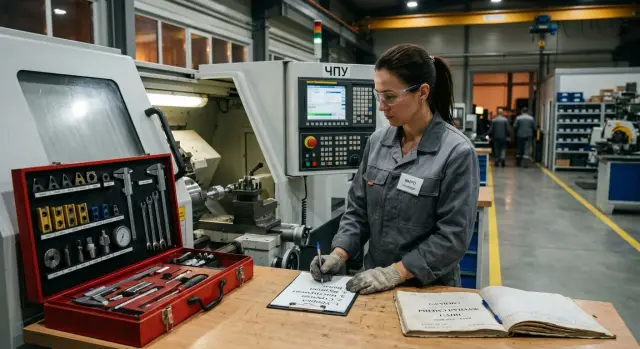
Why the next crew loses time in the morning
Morning downtime rarely starts with a major breakdown. Usually the reason is much simpler: chips were left on the machine, the coolant in the tray is dirty, there is a sticky film near the chuck, and an unfinished blank is lying by the door. Instead of starting up quickly, people first clean the area, then try to understand what condition the machine was actually handed over in.
Most of the time is not spent cleaning, but guessing. If nobody left a short, clear note, the morning shift has to sort it out on the spot. Why is there a different insert installed? Was the last part accepted, or was it only removed for checking? Was the tool offset changed yesterday or earlier? Why is the coolant level lower than usual? Was the alarm cleared by mistake, or is there already a real fault?
Usually the morning is ruined by the same small things: chips in the work area and near the chuck jaws, coolant residue on the guides and floor, a dirty window or sensor, an unmarked blank or fixture. Each small issue can easily turn into downtime. Chips under a jaw cause runout, and the first part goes to scrap. If coolant was not topped up in the evening, the machine may cut unevenly in the morning or stop during warm-up. If a cracked tool was left in place, the operator wastes time chasing a strange sound before finding the cause.
On the shop floor it looks ordinary. The evening shift is rushing to finish the plan and leaves “just five more minutes of work.” In the morning, those five minutes stretch out. One person cleans the cutting zone, another looks for the right holder, a third calls the supervisor and asks whether the first part can be started without another size check. While they do that, the machine sits idle.
That is why the shift-closing checklist is not for reporting. It is there so the next crew does not have to guess. When the work area is clean, consumables are topped up, and the note is written in one sentence, startup goes smoothly. The morning begins with a part, not an investigation.
What should be left after the shift
After a proper shift close, the machine should not be left with a “perfect picture,” but with clarity.
First, the area must be clean and safe. Remove chips, wipe up coolant spills, and keep the path to the cabinet, chuck, loading area, and service points clear of bins, blanks, and rags. Cleanliness is not about appearances. On a clean machine, it is easier to notice a fresh leak, loose fastener, or damage that would be easy to miss in the evening.
Next, there should be a clear trace of the last job. The next crew should be able to tell in half a minute which part was run last, whether the batch is finished, where the cycle stopped, and whether the machine can be started right away. If the operator changed the mode, adjusted a dimension, or removed the part after a trial pass, that should be noted too. Then the handover does not turn into a guesswork conversation at the panel.
Tool searches are no less frustrating. When inserts, keys, holders, gauges, and fixtures are in their places, the shift starts immediately. On a CNC lathe, one lost key or micrometer can easily eat up 15–20 minutes and sometimes delay the entire startup.
Another essential result of the shift is a short note about anything that did not feel normal. A new noise, vibration, a blinking error, rising heat, or having to reset an alarm again should be written down right away. By the end of the shift, memory gets unreliable fast. In the morning, nobody remembers exactly when the drive beeped, in which mode it happened, or whether it had happened before.
That note speeds up the daily inspection. The setter and the operator do not look everywhere at once, but at a specific point. This saves time and reduces the risk of starting a machine with a known problem.
Five shift-closing steps
The last 10 minutes of a shift often decide how the next morning begins. A proper close does not require a stack of papers. Five short actions are enough.
-
Remove anything that could delay startup. Clear chips from the work area, clean the tray, and wipe the spots where coolant and dirt collect. There is no need to make everything spotless as if for an audit. You just need a clean area where the clamp, part, and tool are visible.
-
Check what the machine will start the next batch with. Look at the tool: is it intact, has wear gone too far, are the required positions in place? Quickly check the clamping and the remaining blanks. If three pieces are left, it is better to say so now than make the morning shift figure it out at startup.
-
Record where you stopped. One short note is enough: the last operation, the part or batch number, and the size of the last good part. For example: “Operation 20, shaft 39.98 mm, part good.” That single line often saves 15–20 minutes because people do not have to remeasure everything.
-
Mark any unusual behavior separately, even if the machine was still running. If there was a signal on the panel, if an axis moved in jerks, or if the spindle made an unusual sound, it should be left not “in your head,” but in a note for the next shift. A small fault in the morning almost always looks bigger, because nobody knows when it started.
-
Before leaving, say one simple thing: what can be started right away and what should not be touched until it is checked. Sometimes one sentence is enough: “The first part can be started, but insert No. 4 is near the end of its life.” That is more useful than a long report because people get a clear decision.
The normal standard looks exactly like this: clean it, check it, write it down, warn the next crew, hand it over. If shifts work at this pace every day, the morning starts with startup, not chaos.
How to keep records without extra paperwork
Too many notes do not save a shift. They only hide the useful information among repeats, old comments, and vague wording. For machine handover, one short form per shift is enough.
One sheet or one screen works better than a notebook, sticky notes, and verbal comments on the way to the locker room. If there is only one record, the next crew immediately sees what happened, when it started, and what the operator has already done.
What to write in one form
The form should take only a couple of minutes. Keep only four fields in it:
- the time when the fault or deviation was noticed
- the machine unit where it happened
- a clear symptom
- what was done before the end of the shift
That is usually enough. There is no need to turn the note into a report. The sentence “19:25, coolant pump, louder than usual, feed was not stopped, supervisor informed” is more useful than a long half-page explanation.
Write in simple words. Not for an engineer from another city, but for the people who will approach the machine in the morning. If someone in the shop says “electrics,” another says “electrical cabinet,” and a third says “cabinet,” confusion starts in the morning. It is better to agree once on the names: “electrical cabinet,” “chuck,” “coolant supply system,” “guard door.”
The worst records are things like “the machine is acting up” or “there is an issue with the axis.” From those, you cannot tell urgency, risk, or whether a part can be started. You need a short but clear wording: “after warm-up, a sharp sound appeared on the X axis,” “the door does not close on the first try,” “a mark remained on the part after the third blank.”
Do not repeat the same note in different places. If the operator wrote it in the log, repeated it on a paper by the machine, and also told the replacement verbally, the details often drift apart. One place shows one time, another shows a different one, and a third version is remembered in conversation. There should be one source that everyone treats as the main one.
If the shift went smoothly, that should also be noted in one line: “No remarks, machine cleaned, tools in place.” In the morning, such a line removes unnecessary questions.
Example of handover between crews
A good shift handover takes a couple of minutes, but it saves much more than that. If the operator leaves not only a clean machine but also a short, clear note, the next crew does not have to guess where to start or whether they can begin the cycle right away.
A common situation: by the end of the shift, the batch is not finished, and 12 parts remain. The machine is running, the program has not changed, but after lunch the operator heard an unusual noise on one axis. There was no stop, the size was still within tolerance, but such a sound should not be left without comment.
Insert No. 3 can finish the shift, but in the morning it is better to check it first. Not to replace it “just in case,” but to inspect it: is there a chip, has the edge worn over, has the load increased? That is calmer than starting a new series blindly and then looking for the cause of scrap.
The handover note should be short. A few lines are enough:
- 12 parts remain in the current batch
- after lunch, noise appeared on the X axis during the working stroke
- insert No. 3 is still working, but it should be inspected first thing in the morning before startup
- the size of the last good part is recorded in the log
That is already enough if the note is based on facts. It is even better to add one specific measurement instead of the phrase “everything is fine.” For example: “last good part - diameter 24.98 mm, measured at 19:42.” Then the next operator immediately sees a reference point and can quickly compare the first morning measurement.
How it sounds in real life
There is no need for a long talk during handover. A normal version sounds like this: “12 parts remain in the batch. After lunch, noise appeared on X, but it has not affected the size yet. The third insert lasted until the end of the shift, but check it first in the morning. I wrote the last good size in the log.”
This format works better than the general phrase “it is all written down.” The replacement operator immediately understands how many parts are left, where the risk may be, and where to begin the check.
If there are several machines in the shop, the note should be kept in the same place every time. Then the morning begins not with questions, but with checking specific points. This usually saves 15–20 minutes and reduces the number of small mistakes at the start of the shift.
Mistakes that ruin someone else’s morning
Most often, the next crew is not slowed down by a major breakdown, but by a small thing that nobody mentioned in the evening. People walk up to the machine and, instead of starting the shift, they end up cleaning, finding the cause of the fault, and making extra measurements. That can easily take 20–30 minutes.
Even a good checklist does not help if it is followed mechanically. The point is not the checkmarks, but the clear picture: what worked normally, what was changed, and where the risk appeared.
The most common mistake is leaving a full chip tray until the morning. On a CNC lathe, that quickly turns into chaos: chips make inspection harder, dirty the work area, and sometimes cover the place where a leak or wear is already visible. The next crew cannot tell whether the machine is just dirty from work or whether something new appeared overnight.
Silence about the tool creates just as many problems. If the operator changed an insert, a tool, or an entire unit but did not note it anywhere, the morning shift is working almost blindly. It does not know which tool is installed now, when it was changed, or whether another adjustment is needed.
The habit of “not mentioning small things so you can leave faster” also works badly. A light rattle, a short sensor fault, a strange sound on one pass, a one-time size drift — in the evening all of that seems minor. In the morning, the same little issue can stop the startup. A small fault rarely disappears on its own.
Another mistake is not saying on which part the size drift happened. This is especially unpleasant when the batch is already underway and the note says only: “size was drifting, we adjusted it.” What exactly was adjusted? On which part? After which tool? Without that, the next crew wastes time rechecking the whole chain.
Usually, four habits ruin someone else’s morning: chips and a dirty work area were left behind, a tool change was not recorded, a small fault was hidden, and the part where the size drift started was not noted.
A proper handover takes less than a minute: what was cleaned, what was replaced, what fault was noticed, which part had the last correct size, and where a morning check is needed. If that is missing, the machine may have been handed over formally, but it cannot be worked on calmly.
A 2-minute check before leaving
Two minutes at the end of a shift often save half an hour in the morning. No long report is needed for that. You need a short routine that everyone follows the same way.
-
Look at the control panel. There should be no active alarms left on the screen without an explanation. If the reason is clear, fix it right away. If the machine needs checking, leave a short note with the error code and a clear no-start warning.
-
Clean everything involved in the first clamp. The chuck, vise, holder, tool turret, and other fixtures should be free of chips and stuck coolant. Even a tiny chip in the clamp will cause poor setup in the morning and ruin the first part.
-
Scan the floor and the work area. A puddle near the machine, a misplaced key, or a missing micrometer immediately throws off the rhythm. The floor should be dry, and the keys, Allen wrenches, and gauges should be where people expect to find them.
-
Make one entry in the log. Not a half-page list, but one clear line. For example: “batch complete, T4 near wear limit, first startup requires diameter check on the first part.” That is enough for the replacement operator to understand the situation without phone calls.
-
Hand over the first startup. The next crew should know the first action to take: warm up the spindle, change the tool, run a specific program, or check the blank clamping first. If the people are already there, say it aloud in 20 seconds. If not, leave the same thought in the log.
The good sign is simple: in the morning, a person walks up to the machine and does not ask unnecessary questions. The screen is clear, the tooling is clean, the floor is dry, the note is understandable, and the first step is obvious. That means the shift was closed properly.
If there is never “enough time” for these two minutes, the problem is usually not time. Someone is simply leaving the mess to the next crew. On the shop floor, that quickly comes back as scrap, downtime, and frustration between people.
What to do next if faults keep repeating
One fault at the end of a shift does not yet mean the machine is worn out. But if the same problem keeps showing up in the morning, arguing from memory is useless. It is better to collect a few identical cases and look at them calmly.
Usually one week is enough. Write down only the essentials: date, operation or part, what exactly happened, in which mode it happened, and what helped get the machine back into operation. Even 5–6 short notes are more useful than a long conversation after the shift.
Then separate human errors from signs of wear. Often a morning fault is caused by something small: chips in the locating area, an incorrect offset, a dirty chuck, a missed daily inspection. But sometimes the cause is already in the machine itself.
The difference is usually visible from a few signs:
- after cleaning and reinstalling the part, the problem disappears — this is more likely a shift error
- the same fault appears for different operators on the same operation — the machine should be checked
- the size drifts gradually over several days — this looks like wear or play
- the machine makes noise, heats up, or changes behavior under the same load — then it is no longer just about carelessness
It is better to sort out such a problem right at the machine. A supervisor, operator, and setter can look at the remarks log, check the last parts, assess the cleanliness of the work areas, inspect the tool clamping, and watch the behavior of the unit that seems suspicious in 10–15 minutes.
If this is done honestly and the fault still returns, do not wait. A recurring small issue often turns into downtime, scrap, or emergency repair on the most inconvenient day.
In that situation, you can contact EAST CNC. The company supplies CNC lathes for metalworking and handles not only selection and delivery, but also commissioning and service support. If you already have a short set of repeated faults from the week, it is easier for a specialist to understand the picture and check the equipment faster.
The good practice is simple: first collect the facts, then quickly sort out the problem at the machine, and only after that decide whether a service visit is needed. This approach removes guesswork and helps prevent the same problem from being passed from shift to shift.
FAQ
Why use a checklist when closing a shift?
So the morning shift does not waste the first 20–30 minutes on cleaning, guesswork, and extra measurements. If the operator leaves a clean area, a short note, and a clear machine status, people immediately understand what can be started and what needs to be checked.
How long should the end-of-shift checklist take?
Usually 5–10 minutes is enough. If the machine is kept in order throughout the day, by the end of the shift you only need to remove chips, quickly check the tool, and leave one clear note.
What should be checked first before leaving?
First, remove anything that could get in the way of the first start: chips from the cutting area, dirt near the chuck, coolant leaks, and any tool left out of place. Then look at the panel and make sure you did not leave an alarm without an explanation.
Should small oddities be recorded if the machine is still working?
Yes, even a small noise, an axis jerk, or a one-time signal should be written down. In the morning, that small issue already looks like a new fault, and people lose time because they do not know when it started.
What should be left in the note for the next shift?
Write only what will help start the machine without guesswork: which batch or part is left, where the cycle stopped, what size the last good part had, and what caused concern. One or two lines are usually enough.
Where is the best place to keep the shift handover note?
Keep the note in the same place every day. One log, one sheet, or one screen works better than scraps of paper and hallway conversations. That way the morning shift immediately looks where all the fresh information is stored.
What if the tool is almost worn out but still cuts?
Do not drag it out until it creates a visible defect, and do not change it without reason. Write that the tool finished the shift, but it should be inspected first thing in the morning. That way the next operator understands the risk and does not start the series blindly.
How can you tell in the morning whether the machine can be started right away?
Look at three things: whether there are active alarms, whether the clamp or fixture is clean, and whether the previous operator left a clear note. If the screen is clear, the tooling has no chips on it, and there is no startup ban in the log, you can begin with a control part.
What most often delays the start of the next shift?
Most often it is not breakdowns, but everyday things: a full chip tray, a dirty chuck, an unrecorded tool change, an empty coolant tank, or a vague note like “the size was drifting.” Because of this, people check again what could have been handed over in one sentence.
What should you do if the same problem repeats for several days in a row?
Collect a few short notes over a week and look for the repeat. If the fault appears with different operators on the same operation, the problem is more likely in the machine than in the rush at the end of the shift. In that case, it is better to call a supervisor, setter, or service technician and show them the facts instead of arguing from memory.