
Machine passage route: what to check in the workshop beforehand
Check the machine route before delivery: doors, turns, floor, heights and the crane in advance to avoid disrupting unloading and installation.
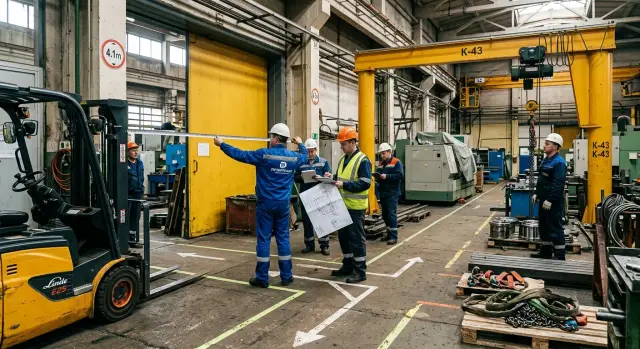
Why routes fail at the last minute
Problems almost never start at the gate. They start earlier, when the machine is judged by its data sheet and the path to the installation spot is eyeballed. On paper everything adds up: there is enough width, the weight is acceptable, the shop crane works. On delivery day it turns out that this is not enough.
The most common simple mistake is checking the machine's static dimensions but not the dimensions in motion. On a straight section there may be clearance, but on a turn the machine body, packaging, spreader beam or trolley can take a few extra centimeters. Formally the machine fits, but in reality it gets stuck where nobody expected.
The floor also spoils unloadings more often than people think. A small threshold at the gate can catch rollers or a trolley and the whole scheme stops working. If the load is heavy, even a couple of centimeters change the angle, the load and the travel. After that the crew starts looking for boards, metal sheets and temporary pads right on site. That adds unnecessary risk.
The crane story is similar. Capacity might be fine on paper, but the required outreach is missing. The crane can hold the weight but cannot bring the machine where it needs to go because of a column, wall or gate position. Then the load hangs in an awkward spot and people try to reach it with a forklift or rigging gear. That usually ends up expensive and nerve-racking.
Sometimes a route is changed by a small detail that wasn't noted in advance: a column at the corner, a cable tray above the passage, a pipe, a ventilation box, a repair joint in the floor or metal temporarily stored by the wall. Before the machine arrives these things seem insignificant. Later each of them eats time.
So proper preparation doesn't start with unloading but with checking the entire path. Suppliers are usually asked not only for opening sizes but also for photos of passages, turns, floors and the unloading zone. One good photo often shows more than a dry table of dimensions. If you walk the route beforehand, unloading in the shop goes smoothly. If not, the last day is spent not on installation but on urgently finding a workaround.
What to gather before measuring
Measurements are often taken too early, when you only have the model name and approximate weight. That’s not enough. For a correct route you need information not only about the machine itself but also about how it will arrive, how it will be lifted and what it will travel on inside the shop.
Start by getting from the supplier the packed and unpacked dimensions. These are two different tasks. Packed dimensions show whether the load will pass through gates and whether the crate can be removed immediately after unloading. Unpacked dimensions show how the machine will move inside the shop and whether there is enough room to turn.
A single gross weight is not enough either. You need weights by assemblies if the machine is shipped in parts, and the center of gravity position. Otherwise the rigging crew chooses equipment by eye. That usually ends with extra repositioning, load tilt or refusal to lift on the delivery day.
Also request the slinging diagram and lifting points. You cannot attach slings wherever convenient. If slings are placed incorrectly you can damage the cover, guides or electrical cabinet. For heavy models check in advance whether you need a spreader beam, what sling lengths are acceptable and what hook height the crane will require.
Without a shop plan measurements are of little use. You need not a pretty general drawing but a working sketch showing what actually obstructs movement: columns and protrusions, gates and doors with their clear opening, thresholds, trays, rails, pits, weak or uneven floor areas, the temporary unloading spot and the installation point.
Then check the lifting equipment. For the crane verify capacity at the required outreach and the hook height. For the forklift check capacity, fork length, turning radius and the actual width with the load. If you plan to use rollers, jacks or roller platforms, check their load capacity and height in advance. Sometimes an extra 40–60 mm of height is what breaks the whole route.
If EAST CNC supplies the machine, it’s best to request packing drawings, a slinging diagram and an installation plan right away. These documents help you measure the path on site instead of guessing from the shop manager’s memory.
How to walk the route step by step
Check the route not from drawings but along the actual path the machine will travel after unloading. Start at the unloading point and walk to the installation spot on foot with a tape measure, notebook and a phone for photos.
At each section look not only at the clear passage. Door handles, column edges, fire cabinets, cable ducts, low fixtures and even opening leaves can interfere. One such protrusion easily consumes 5–10 cm. That’s enough for the load to fail to pass.
It’s useful to break the route into short segments: from the gates to the first turn, from the turn to a door or column, from the narrow spot to the installation zone, and then the last meters to the foundation or setting point. When the route is laid out in pieces, you immediately see where there is margin and where there is none.
On the same plan mark where the load will be on a dolly, where the crane will take it and where a forklift is needed. If switching equipment happens mid-route, decide that in advance rather than on delivery day.
What to measure along the way
At each section record three dimensions: width, height and the length of the clear passage. Measure width at the narrowest point, height at the lowest point, and length where the load needs room to line up before a turn or stop.
Separately note everything that changes movement along the floor: thresholds, hatches, rails, grates, cracks, level differences and slopes. Even a small threshold can stop a trolley carrying a heavy assembly or divert the load if the wheels are small.
Don’t guess on turns. If you move a long assembly, check not only the corridor width but also the maneuvering radius. Often a load passes in a straight line but cannot turn because the tail hits a wall or column.
At the end, compare the route with the equipment and people. The forklift needs its own corridor and headroom for the mast. The crane needs an unobstructed working zone above. Riggers need space to stand safely and to give signals. One proper measurement sheet usually resolves half the questions before unloading.
A good route is not a general shop plan but a chain of points with dimensions and notes showing where the load is rolled, where it is lifted and where special attention is needed.
Doors, gates and narrow spots
Unloading often fails not at the machine or crane but at the first opening. On paper everything fits, but on site the load catches a handle, doesn’t fit by height or cannot turn without tilting. So openings must be measured in reality, not from memory or gate documentation.
Record the clear opening after the leaves are opened and secured. You need the clear width, the clear height and the effective width when fully opened. Gate specifications often look nicer than the real thing. Frames, bumpers, thresholds or stoppers are usually not counted in the documents.
Don’t forget small protrusions. Handles and locks on leaves, casings along the edge, ducts and pipes near the entrance, rubber bumpers, sensors and lights above gates often cause trouble. Sometimes 20–30 mm is the deciding factor.
If the machine is moved in packaging or on skids, the load’s dimensions must include more than the crate. Allowance is needed for slings, spreader beam, hook and slight sway during movement. The load does not behave like a perfect rectangle, especially on turns and during slow lowering.
Also check how the leaves open. If one leaf hits a column or a stack, you immediately lose part of the opening. If a door is kept by hand only, riggers will work under extra strain. Leaves must open to the required angle and remain fixed without swinging closed.
Sometimes a simple preparation fixes the problem: remove a stopper, clear the leaf swing area, temporarily remove a protruding handle. Even better is to simulate the passage. Take the machine footprint with allowances and mark it on site with poles, a box or tape on a trolley. You’ll see immediately where the machine passes and where you’ll have to remove a door, clear a protector or change the path.
When delivering a CNC lathe, a single mistaken measurement can throw the whole day off. It’s easier to spend an hour checking each narrow spot in advance than to keep the machine outside and urgently widen the passage.
Turns, slopes and floor markings
On a straight section a dolly usually moves without surprises. Problems start where the route turns, crosses a gate or runs over a change in floor level.
Measure turns not by the centerline but by two paths: the inner and the outer edge. On the inner side the dolly and load come closer to the wall than expected. On the outer side the load sweeps a wider radius and can catch a casing, pipe or gate frame.
The rule is simple: take the packed machine dimensions or its transport frame and add allowance for slings, rollers, dolly feet and people moving near it. If a 90° turn only just fits, look for another maneuver. Sometimes removing the packing earlier and moving the load further in a straight line, then turning it in two stages, helps.
For slopes the logic is the same. Know not only that there is a grade but its size. Even a small incline changes the effort on a dolly and the load’s behavior. On a downhill section the load pulls forward; uphill the effort on people and equipment rises sharply. If there is a threshold, repair joint or plate seam ahead, prepare sheets, a platform or some other flat underlay in advance.
Pay special attention to areas at the gates and near the foundation. There you often find drainage grates, filler plates, patches from local repairs and uneven concrete. On a plan it looks like a small detail, but in real unloading such points slow the whole process.
Mark places where the machine may stop to reposition equipment or change direction. Such a place needs not just a passage but a proper area with a flat floor and width reserve.
Crane, forklift and rigging
Even correct measurements of doors won’t help if lifting equipment is chosen by eye. Calculations must consider not only the machine weight on the data sheet but also packing, accessories and center-of-gravity shift. Check crane capacity at the outreach where it will work. A crane that lifts 10 tonnes close to the post may not lift the same load at the required distance.
Also check the hook lift height. The common mistake is that weight is fine but height is not. The hook must lift the machine with slings and spreader beam and leave clearance over the truck bed, gates or thresholds. For tall machines long slings quickly consume the headroom.
A crane rarely covers the whole route inside the shop. More often it only removes the machine from the truck, after which the load is moved by forklift or on rollers. A forklift is used where the floor is flat and there is room to maneuver. Rollers are handy on short straight sections when you need to move the machine calmly to the installation point. If there’s a slope, seam or tray ahead, prepare the section in advance and select equipment accordingly.
Before delivery prepare several items: a spreader beam if lifting points are wide or the body cannot be clamped; textile slings of the correct length and capacity; angle protectors and pads to avoid edge damage; and pads under the machine and under lifting gear supports.
One person should give commands along the entire route. They know the sequence, see the whole passage and give signals to the crane operator, forklift driver and riggers without arguments. When the machine is set at a far wall, this single control often resolves the day.
Workshop example: the machine is installed at the far wall
Such a case often looks deceptively simple. A CNC lathe must be placed at the far wall and the distance from the gate to the spot is only a few dozen meters. On paper everything fits: wide gates, free passage, a crane on site.
The problem appears not at the gate but at the entry. The machine fits by width, but the combination “machine + slings + spreader beam” no longer fits by height. If this isn’t checked in advance, unloading halts in the first minutes.
In a proper plan the crew doesn’t argue on site but changes the sequence. At the entrance they remove the external packing and anything that adds extra height. Then the machine is lowered onto rollers and moved further inside the shop without trying to carry it on the hook along the whole route.
Next the route goes through two turns. The first section is flat but has a threshold. They cover it with a steel plate so rollers don’t catch the edge and cause a tilt. This sounds trivial, but even a small bang on a threshold can break the pace and force another lift.
At the column there’s less space than a quick inspection suggested. So the crew avoids cutting the corner and takes a wider radius. Sometimes for this the machine is moved further forward in a straight line and then turned smoothly. The maneuver is longer but calmer and avoids hitting the column or wall covers.
If the shop is prepared in advance, the whole passage takes about an hour. A full shift is usually lost where they didn’t check entrance height, didn’t cover the threshold and tried to turn too sharply. In this example the crane is needed only to unload at the gate and for the final placement. The rest of the route the crew handles predictably and without rush.
Common mistakes that derail unloading
Unloading usually fails not because of one big problem but because of several small oversights that nobody checked together. On a plan the route may look fine, but in the real shop everything is decided by centimeters, the turning angle and the floor condition on delivery day.
A frequent mistake is measuring an empty opening instead of the working passage. On paper the door gives the required width, but when opened one leaf takes space, a handle sticks out and a cabinet or column stands nearby. As a result the machine fits by dimensions but not by trajectory. The same happens at gates where guides, thresholds or protective bumpers are not taken into account.
Another oversight is focusing only on weight. For rigging that’s not enough. If the crew doesn’t know the center of gravity, the machine may swing on forks or slings already in the first turn. It’s especially unpleasant when the body is heavier on one side and that becomes clear only after unloading from the truck.
A costly forklift mistake is choosing by tonnage but not checking mast height and working lift height. In the shop this quickly appears at the gates, under the crane beam or near a low truss. A forklift may lift the machine by weight but cannot move it where needed without risking strikes to overhead structures.
The floor is often underestimated. Yesterday the passage was dry and even, today it’s wet after cleaning or rain, or partially repaired. The trolley starts to slip, pads shift, wheels hit seams and the crew loses pace and accuracy. This is one of the most annoying small issues in shop unloading: it’s noticed too late.
And another typical reason for failure is the route being occupied. Pallets, crates, blanks, removed guards and even trash by the wall change the turning radius. People often think they can clear the passage half an hour before arrival, but on delivery day the shop runs on its own schedule.
A good rule is simple: the day before delivery walk the entire route with the same team that will receive the machine and look not only at sizes but at the actual situation. Such an inspection usually saves more time than any urgent reshuffling later.
Short checklist before delivery day
A day before the truck arrives it’s already late to remember gates, crane and weak floors. You need one working document that everyone sees: the shop foreman, riggers, the driver and the supplier. If sizes are scattered across messages and photos, someone will almost always make a mistake.
Before delivery check five things:
- Collect the whole route into one scheme or table: machine dimensions in transport form, door and gate sizes, passage widths, height to beams, columns and trays.
- Walk the route on site and leave clearance, not just a note “fits tightly”. A small reserve at narrow spots often solves everything.
- Inspect the floor along the entire line of movement. If the surface crumbles, has holes, seams, hatches or weak areas, prepare plates or other flooring in advance.
- Coordinate people and equipment for the same time. If the forklift arrives at 10:00 and slings are delivered at noon, the work will simply stop.
- Clear not only the passage but the installation point. The end of the route also needs clearance for turning and precise placement.
It’s useful to appoint one person to give final confirmation. They compare the scheme with the shop, sign off readiness and stay on call on delivery day. This reduces arguments and pauses on site.
What to do next
Gather everything into one clear plan. On a single sheet or file combine door and gate dimensions, passage widths, turns, floor level changes, the unloading spot and locations where the machine or packaging could catch. Add photos with notes directly on the images. Then people on site will see a real route, not an abstract drawing.
Include details that are often remembered too late: where the truck will stop for unloading, where it’s convenient to remove packing, where the machine can be parked temporarily if it cannot be brought straight to the final spot. These details strongly affect the whole process even if the path seems simple.
A day before delivery show the plan to the shop foreman and the rigging crew. It’s better not just to send a file but to walk through it together. Disputed points become obvious: is there enough headroom under the crane, will the trolley or forklift pass a narrow turn, will the floor hold a temporary installation spot, where is it best to remove packaging and who gives commands during the transfer.
If EAST CNC is handling the delivery, send this plan to their team in advance. The company does not only supply machines but also commissioning, so it’s important for them to see the route before the truck arrives.
A good plan does not need to look beautiful. It must remove questions before work begins. If after reviewing the scheme the crew has no doubts about doors, floor, equipment and the temporary installation zone, the preparation is done right.
FAQ
When is it best to start checking the route?
Start before the delivery date, as soon as you receive the packed dimensions, the slinging diagram and an idea of how the machine will be moved inside the shop. Waiting until the last day forces the crew to solve problems on site instead of installing the machine.
What information should I get from the supplier before measurements?
Request the machine dimensions both packed and unpacked, weight, center of gravity, lifting points and the slinging diagram. If the machine is shipped in parts, get the data for each assembly; otherwise lifting equipment will be chosen by guesswork.
Is it enough to measure only the gates?
No. Gates alone are not enough. Walk the entire path from the unloading point to the installation spot and measure openings, turns, low points, thresholds, slopes and any places where the machine will change handling equipment.
Do I need clearance if the passport dimensions say the machine fits?
Don’t move the load with zero clearance. Leave reserves not just for the machine body but also for packaging, slings, spreader beam, hook and small shifts during movement.
What typically causes the route to fail in the workshop?
Most often thresholds, door handles, columns at turns, cable trays, pipes, lights, repair joints and metal stored by the wall. These small items rarely show up on drawings, so mark them on site.
How do I know if a machine will make a turn?
Measure the turn against both the inner and outer edges, not only the centerline. If in doubt, make a simple mock-up of the machine’s footprint with poles, a box or markings on a trolley to see the actual sweep.
Can the packaging be removed right after unloading?
Yes—if the packaging or attached parts prevent passage by height and the supplier allows it, remove the packing at the gate where there is space and equipment, then move the machine inside the shop.
What should I check about the crane and forklift besides tonnage?
Check the crane’s capacity at the required outreach and the hook height (taking slings and spreader beam into account). For the forklift verify capacity, fork length, turning radius and the working height with the load.
Who should lead the unloading and moving?
Assign one person who knows the route and gives all commands: crane operator, forklift driver and riggers. When several people try to lead, the work stutters and the risk increases.
What should be done the day before delivery to avoid a failed unloading?
Walk the route with the same crew that will receive the machine and compare measurements with the actual situation. Clear the passage and installation spot, check the floor, prepare plates for problem areas and collect all dimensions into one clear plan.