
Machine Installation: Pallet, Anchors, or Vibration Mounts in the Workshop
Machine installation affects accuracy, service, and moving the equipment around the workshop. We break down when to choose a pallet, anchors, or vibration mounts without unnecessary theory.
Why the installation method changes how a machine works
The same machine can behave differently even in the same workshop. The reason is simple: the base carries the machine’s weight, absorbs or transmits vibration, and determines how level the body is from day one. That is why machine installation affects not only mounting, but also how the machine cuts metal, how much noise it makes, and how well it holds its setup.
If the base is uneven or the fastening method is chosen at random, misalignment appears right away. Sometimes it is tiny, just a few tenths of a millimeter, but that is already enough for the guides, spindle, and geometry. The operator notices extra noise, the machine takes longer to level, and the setup is checked again after the first shifts.
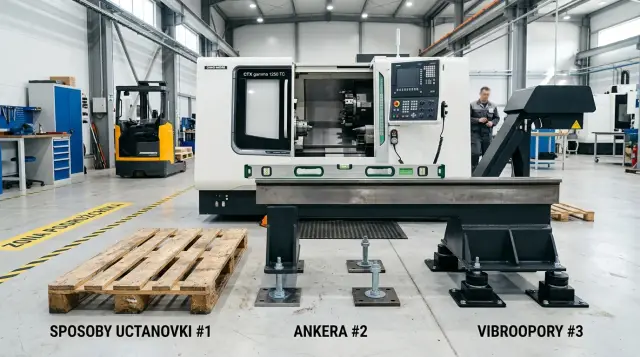
The difference is especially noticeable on CNC metalworking machines. On a pallet, the machine is easier to place and move, but not every such solution provides the required rigidity. Anchors tie the machine more firmly to the floor, but then moving it around the workshop becomes harder. Vibration mounts often reduce the transfer of vibrations to the floor and nearby equipment, but they also need to be selected correctly for the machine’s weight and operating mode.
The problem is that mistakes at the start rarely stay limited to the start. If the machine takes a long time to fine-tune after installation, maintenance becomes more complicated too: it is harder to monitor the level, fastening points wear faster, and sometimes the geometry has to be reset after repairs or even after an active week of work.
There is also a very practical side. Today the machine stands by the wall; in six months you may want to move it closer to the line. And then the installation method suddenly changes the cost and time of the work. What seemed minor during mounting later affects workshop downtime, the service team’s work, and the convenience of the whole area around the machine.
What changes in setup accuracy
Accuracy starts not with the machine’s datasheet, but with the floor under it. If the base is soft, uneven, or has a weak screed, the level shifts much faster. The machine may be set up correctly at first, but after a few days or weeks it can drift slightly. For a CNC lathe, that is enough to create small but annoying deviations in size and repeatability.
On a heavy machine, rigid fastening usually holds the geometry better. Anchors tie the bed more firmly to the base, so the body moves less under weight, cutting forces, and constant operation. This is especially noticeable when the machine is large and the load changes during the shift. If the floor itself is good, anchors provide a calmer and more predictable base.
Vibration mounts behave differently. They do not make a weak floor level, but they do make fine adjustment after startup much easier. That is useful when the machine has already been placed, warmed up, given its first load, and you see that the level needs a small correction. In practice, the technician spends less time on fine tuning than with a rigid setup without that kind of adjustment.
A pallet for a machine is often understood too optimistically. It helps with logistics, forklift handling, and sometimes with organizing the space, but on its own it does not solve the issue of precise alignment. If the floor under it is uneven or the pallet flexes slightly under load, accuracy will not improve. A pallet is a placement base, not a substitute for proper leveling.
To put it simply: on a poor base, any method will quickly reveal weak points; anchors hold a heavy machine better; vibration mounts are more convenient for fine adjustment; and a pallet does not replace proper level and geometry control.
What changes in maintenance
A machine is not serviced only from the front. The technician needs access from below, behind, and from the side, especially when checking coolant drainage, cable entries, the pump, chip removal, and the machine’s level after operation.
A pallet changes that more than it may seem. It raises the machine, and it is often easier to reach the lower assemblies with a tool or inspect a leak. But there is a downside: a cavity forms between the frame and the floor, where chips, dust, and coolant collect. If it is cleaned infrequently, dirt later interferes with inspection, and people start looking for the fault in the wrong place.
With anchors, maintenance is usually calm until the first floor repair or routing change for utilities. If you need to redo the coolant drain, add a cable tray, or shift the supply line, floor fastening immediately makes the work harder. You have to release the anchors, check the base, and then reset the machine. That takes longer and is almost always messier.
Vibration mounts are convenient when the machine sometimes needs a small level adjustment. The adjustment is faster, with no concrete work. But they cannot be forgotten: the rubber should be checked for cracks and settlement, and the threads for dirt and seizure. Otherwise a simple adjustment turns into hard work after a year.
No matter which installation method you choose, keep free access to four things:
- power cables
- coolant line
- drain
- fastening and level check points
If you cannot reach the machine with a tool without extra disassembly, maintenance will become more expensive in the first year.
What changes when moving the machine around the workshop
Moving a machine inside a workshop almost always takes more time than expected. It is not only about how to lift and transport it. The site preparation, downtime, and amount of work after relocation also change.
A pallet usually makes the job easier. It is simpler for forklift forks to get under it without long preparation, and the machine is easier to take out of the area and place in its new location. This option is convenient when equipment is occasionally moved because the parts flow changes, the floor is repaired, or the line is expanded.
With anchors, things are stricter. If the machine is fixed to the floor, a quick move almost always stops at the fastening. The anchors have to be removed, the spot checked, and at the new location the base often has to be prepared again. Even if the move is only a few meters, the work takes more time for the mechanic, the forklift operator, and the operator.
Vibration mounts give more freedom when the machine needs to be shifted slightly within the area. That is useful if you need to clear a passage, move a line, or adjust the layout near neighboring equipment. But this freedom should not be confused with full mobility: a heavy machine still requires careful movement and a check of the base.
After any move, the machine is leveled again. This rule must not be skipped, even if the equipment has moved only a short distance.
Usually, before relocating, people look at four things:
- how quickly the forklift can be brought in
- whether the floor fastening needs to be dismantled
- whether the new spot can support the machine’s weight
- how much time will be needed for the reset
In an ordinary workshop, the difference is obvious right away. A machine on a pallet can be moved within one shift. A machine on anchors often takes more time just to remove the fastening.
When a pallet makes sense
A pallet is chosen where the machine is not supposed to stay in one place for years. If the workshop layout changes for new orders, the area is expanded, or a passage needs to be cleared for another line, this option makes life much easier. The machine is easier to lift with equipment and move without long base preparation.
This is especially convenient for areas where equipment is moved more than once over its service life, or at least once every few months. For some CNC lathes, it is a practical compromise: machine installation is faster, and moving it inside the workshop does not turn into a separate project.
A pallet also helps when the machine needs to be raised above the floor. That makes it easier to use a forklift or pallet jack, if the design allows it. In older workshops, this sometimes solves a simple practical problem: the equipment does not sit too low over an uneven floor where dirt and chips collect.
But convenience has its price. A pallet adds height, and that should be checked in advance. Sometimes a few centimeters are enough to cause trouble with a gate, a beam, or safe positioning at the site. Before delivery, it is worth measuring:
- the machine height with the pallet
- the width of doors and gates
- clearance under a crane or beams
- the turning space for equipment
There is another point that is often underestimated. A pallet does not fix a bad floor. If the base under it is weak, uneven, or moving, accuracy will not improve. Proper operation requires a flat, rigid floor under the entire support area of the pallet. Otherwise the machine will stand conveniently, but not as stably as needed for precise machining.
A pallet suits those who value flexibility. If the machine will be installed for a long time and the site is already well prepared, it is not always the best choice.
When anchors are the right choice
Anchors are used where the machine already has a permanent place. This is usually heavy equipment that works under a large load and must not move even by fractions of a millimeter. If the machine sits in the same mode for months and performs the same group of operations, rigid fastening often gives the calmest result.
This installation method suits workshops that do not plan frequent relocation. Machine anchors hold the body firmly in place when there are sudden loads, repeated cycles, and long shifts. For a CNC lathe, this is especially noticeable when heavy workpieces are being machined or a stable production series is maintained.
But anchors require careful preparation. Mistakes are costly here because they are hard to hide by adjusting later. Before installation, people usually check:
- the flatness and condition of the concrete
- exact hole marking
- drilling depth and cleanliness of the anchor seats
- access to service points after fastening
Dirty concrete, a weak screed, or rushed marking quickly create problems. The machine can be leveled and tightened, and then you may see a misalignment, extra vibration, or a shift in level after the first week of operation. Then you have to loosen the fastening, realign the position, and sometimes drill new points.
Anchors are rarely chosen “just in case.” This is a solution for cases where the location is already defined, the floor is checked, and moving equipment around the workshop is not in the plans for the near future. If the workshop is building a stable area for series production, this option is often more sensible than a pallet and more reliable than ordinary supports.
Where vibration mounts help
Vibration mounts are needed where the floor transfers extra vibration to the machine or, conversely, where the machine interferes with nearby equipment. This is often noticeable in a shared workshop where a press, compressor, pumps, or a forklift are operating nearby.
For this type of machine installation, vibration mounts are also convenient because they speed up leveling. The mechanic places the machine on the mounts, tightens them at the points, and can then quickly correct the position if the floor is a little uneven or the machine settles after the first weeks of work.
A good result depends not on the name of the mount, but on matching it to the weight. You look at the total machine mass, the center of gravity, and how much load each support point carries. On a long bed, the load is rarely divided evenly, and this is often overlooked.
If you choose vibration mounts by eye, problems come quickly:
- the machine goes out of level after startup
- one point is overloaded and sinks
- vibration increases at speed
- the guides and assemblies are put under extra stress
This solution works well for machines that should not be rigidly fixed to the floor, but still need to stand straight and steady. In a metalworking workshop, that is useful when equipment is moved around the area from time to time and you do not want to make new anchors in the base every time.
There are limits, though. If the machine is heavy, has strong impact loads, or works in a mode where any base movement is a problem, vibration mounts alone may not be enough. In that case, the focus shifts from convenience of relocation to how the machine behaves under real load.
In practice, the mistake is almost always the same: weak or random mounts are installed because they “fit the size.” Size is secondary here. If a mount cannot carry the calculated load, misalignment will appear before it shows up in the part.
How to choose the right option step by step
It is better to start choosing support not from workshop habit, but from the actual conditions on site. The same machine installation can work well on a flat, solid floor and cause extra problems on a weak base with a slope and cracks.
It is easier to go in this order:
- First, check the machine’s weight and the support point layout. The load should be distributed as the manufacturer specifies. If the supports are not where they should be, the bed can twist even with careful leveling.
- Then assess the floor. Look not only at flatness, but also at slab thickness, old cracks, repaired areas, and the top layer. A nice surface does not mean it can carry the load.
- Next, decide whether you will move the machine in the coming year. If equipment moves around the workshop often, rigid anchoring is not always convenient. A pallet or vibration mounts may give more freedom.
- After that, compare the accuracy requirements with what you actually produce. Rough and medium machining have one set of tolerances; precision parts have another. You should not choose support based on price alone.
- Finally, check the space around the machine. You need access for service, cleaning, carts, pallet jacks, or a forklift. If space is tight, even simple maintenance will waste extra time.
If you are unsure, it helps to review the installation plan with the supplier before the machine is brought into the workshop. For heavy CNC lathes, this check often saves more than it costs, because mistakes at the installation stage are hard to fix without stopping production.
A real workshop example
A small turning area is installing a new CNC machine next to an existing line. The location is convenient: the workpiece supply is nearby, the passage is not blocked, and the floor is level. But there is one detail: in six months the workshop wants to move part of the equipment to free up space for another station.
In that situation, installing the machine on a pallet seems like the fastest solution. The machine can be installed now and then moved around the workshop later without extra work on the floor. That saves time. But the pallet requires careful leveling. If the installers rush and leave even a small misalignment, the operator later checks the level more often and takes longer to dial in the size during finishing operations.
Anchors are stricter and clearer. The machine sits firmly, which is convenient if the location has been chosen for the long term. There is less risk that the position will shift because of load, vibration, or an accidental hit from a cart. The problem appears later: when it is time to move the machine, the anchors start getting in the way. They have to be removed, the holes in the floor repaired, and the relocation takes more effort and money than expected at startup.
Vibration mounts for a machine often provide a calmer start. If the floor is in good condition, the machine can be leveled quickly without drilling or rebuilding the base. For an area next to an active line, that is convenient: less noise, less dust, fewer interruptions for neighboring equipment. And if the machine needs to be moved later, this option is easier too.
For a workshop where moving equipment around is already in the plan, vibration mounts or a pallet usually win. Anchors are better left for places that will not be touched for several years.
Mistakes that are expensive to fix later
Expensive mistakes start not with a breakdown, but with something small. The machine is placed on a floor with a slope, and people hope the supports will make up for it. Usually that does not work. Support travel is not endless, the bed becomes twisted, and the first test part shows that the size is drifting.
People also often save money on vibration mounts. They choose them by price instead of load, machine weight, and center of gravity. In operation, this shows up quickly: one mount settles more than the others, another holds harder, and the machine starts behaving unevenly. The operator changes the cutting mode, checks the tool, while the real problem remains in the base the whole time.
You should not rush with anchors either. If you drill the floor before you have fully marked the work zones, passages, the control cabinet location, and the workpiece supply route, almost any later change turns into floor repair. For a workshop, that means extra days and extra money.
Another common mistake seems minor only until the first service call. The machine is placed too close to a wall, a column, or a neighboring line. Then you cannot open the service cover, reach the cable, get to the hatch, or access the lubrication point. Each service visit takes longer than it should.
After moving equipment within the workshop, many people skip the checks entirely. That is risky, even if the machine was shifted only a few meters.
After relocation, you need to check again:
- level on all axes
- the condition of the supports or anchors
- access to cables and maintenance points
- a test part under real operating conditions
For machine installation, this is not a formality. One hour of rechecking is usually cheaper than a week of searching for the cause in the geometry, the tool, and the defective parts.
A short checklist before startup
Before the first startup, it is better to spend 15 minutes on checks than to later look for the cause of vibration, part misalignment, or extra noise. Machine installation often seems complete once it is connected, but small shortcomings usually show up in the first hours of work.
First, look at the base. The floor must carry the load without settling, and there should be no dirt, oil, or metal chips under the supports. Even a thin layer of dirt can sometimes cause a misalignment that people then try to “fix” with settings.
Before startup, check five things:
- The machine stands on a clean, dry surface, without rocking or shifting.
- The level is set as required by the manufacturer, not just “roughly level.”
- Anchors, bolts, or vibration mounts are installed without skew and tightened evenly.
- Cables, hoses, and coolant supply do not block access to service points.
- The area around the machine remains clear for the operator and the tool cart.
Also check access to the cabinet, pump, filters, and lubrication points. If changing a simple filter means walking around the machine sideways every time or dragging a hose through the aisle, that will quickly become a constant problem.
After the test start, do not rush to consider the job finished. Make the first few parts, then check the level and supports again. Under load, the machine can settle slightly, especially if the floor is new, the base was not fully leveled, or the fastening was tightened unevenly.
If everything stays calm at this stage, with no extra vibration, size drift, or movement of the supports, work will be much easier from then on.
What to do next
Do not choose the installation method at the last minute. First decide what matters most for the workshop every day: rigid machine fastening, quieter operation, or the ability to move the equipment quickly without a long production stop.
If there is one priority, the decision usually becomes simpler. For heavy, stable operation, anchors are often the best option. If the machine may later be moved within the workshop, it is better to assess a pallet or vibration mounts in advance. If there is sensitive equipment nearby or complaints about noise and vibration, do not wait until startup to deal with it.
It is better to agree on the installation method before ordering rigging, preparing the floor, and running electrical work. Otherwise it often happens like this: the machine has already arrived, the cable is in place, the spot is occupied, and the chosen fastening method needs a different supply layout, different clearance, or different base preparation.
For a new CNC lathe, this should be discussed already at the selection stage. Then it is easier to compare the machine weight, floor requirements, service access, and commissioning procedure right away. That saves time and avoids unnecessary rework.
A practical order is this:
- decide whether the machine will stay in one place for several years or may be moved
- check the floor condition and allowable load
- plan the rigging and power supply in advance
- clarify the manufacturer’s installation and startup requirements
- agree on who is responsible for setup, fastening, and the first startup
If you are choosing equipment through EAST CNC, these details can be discussed in advance for a specific model. The company supplies CNC lathes, provides commissioning and service, so it is easier to immediately clarify which installation method suits your workshop and which one will create extra work later. A good decision here gives not only a level machine installation, but also a calm startup without a rush on installation day.