
Machine geometry acceptance: what to measure and agree on
Machine geometry acceptance requires agreeing in advance on the list of measurements, test conditions, and tolerances to avoid disputes during commissioning.
Why fix acceptance conditions in advance
Disputes about accuracy usually start not because of the machine itself but because of different testing rules. The customer expects one set of numbers, the supplier shows another, and both can be sure they are right. This happens when parties haven't agreed in advance what exactly is measured, in which sequence and from which base.
Machine geometry acceptance almost always comes down to details. The same assembly can be checked in different ways and the results will differ. For example, if one error is measured relative to the guides and another relative to the spindle axis, those numbers cannot be compared directly.
Where discrepancies come from
On paper everything looks simple: check straightness, parallelism, runout and perpendicularity. In practice, without an exact list of measurements such wording is too vague. One specialist will include only basic items in the protocol; another will add measurements at several travel positions, in different orientations and with different fixturing.
Workshop temperature also changes the picture more than many expect. A cold machine and a machine after warm-up can show different values, especially on long moves. If you don't record the temperature in the measurement zone, warm-up time and machine condition before the test, a dispute is almost inevitable.
Before starting work it is better to agree five things: which axes and assemblies will be checked, which bases will be used for measurements, at what temperature and after what warm-up the checks start, which instruments will be used and which tolerances are considered acceptable.
Such a list doesn't complicate acceptance, it saves time. The engineer won't have to argue on the spot about what to include in the protocol. The manager won't have to find out why two reports for the same machine show different numbers.
Well-drafted acceptance conditions remove disputable points before delivery or commissioning. For CNC lathes and machining centers this is especially important: accuracy depends not on a single measurement but on a set of related checks.
If parties approve the list of measurements and acceptable deviations in advance, acceptance goes more smoothly. In the end you compare actual results with the agreed protocol instead of arguing about the method.
What to prepare before measurements
Start by checking the documents. For machine geometry acceptance you need at least three sources: the contract, the machine passport and the factory test procedure. If they state different conditions a dispute will start at the first measurement. The contract may specify one tolerance while the factory procedure specifies another.
Record the exact machine data immediately: model, configuration, serial number, axis composition and installed options. The same machine in basic and upgraded versions is not inspected the same way. If there is a counter-spindle, a different turret configuration or an additional axis, control points change. If EAST CNC supplies the equipment, it's better to request the procedure for your specific modification, not the series-wide checklist.
Workshop conditions should also be fixed in advance. Note the air temperature, floor condition, how the machine is installed and the warm-up time before testing. A cold machine after unloading often shows one picture, while the machine after 40–60 minutes of operation shows another. If the floor is uneven or the foundation still "settles", level and indicator readings will be disputable.
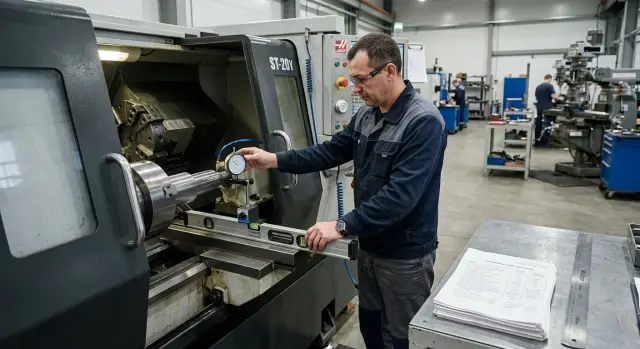
Gather instruments before starting work instead of looking for them mid-check. Usually a precise level, a dial indicator with a stand, a reference mandrel, a calibration rule per the procedure and a protocol form with fields for actual values and tolerances are sufficient.
Check the protocol form itself. It should have fields for date, model, serial number, test conditions, list of instruments and a result for each item. When data are first written on a temporary sheet, some values are later lost or recalled from memory.
Assign roles before the first reading. One person measures, another records, the supplier's representative witnesses the test, and the customer's representative decides on disputed points and signs the report. This reduces confusion. When the same person measures and fills the protocol, errors occur more often.
This preparation seems simple, but it removes most disputes even before measuring the machine geometry.
What measurements are usually included in acceptance
Acceptance rarely reduces to a single dial-indicator check. Typically people look at how axes move, how the spindle behaves and whether there is misalignment between assemblies that should work on the same line. Otherwise the machine may produce good results on a short part but deviate on a long one.
First check the guides on each axis. You need straightness of travel for X and Z, and for machining centers also Y. Even a small offset later becomes taper, a step at transitions or different material removal along the part length.
Usually the protocol includes straightness of guides and actual travel for each axis, parallelism of axis travel relative to the machine's reference surfaces, perpendicularity of axes where the design requires it, and radial and axial runout of the spindle and mating surfaces. Then add geometry of working assemblies specific to the machine type: the table, turret head, tailstock or rotary unit.
On a CNC lathe this is often not enough without a coaxiality check. Check whether the spindle axis coincides with the turret position and, if there is a tailstock, with it as well. If there is offset, the machine will turn a taper, tooling will be overloaded and surface finish will worsen.
On a machine with a table check the table flatness and its parallelism to axis travel. This is important when machining plates, housings and other parts with a large reference surface. If the table is tilted, a part can be clamped without obvious error, but after machining the surfaces won't match.
For more complex models, including 5-axis centers, the list of measurements is wider. Add checks for rotary units and their positions relative to the spindle and reference axes. On such machines even a small geometric error quickly accumulates and results in scrap parts.
A good protocol records not only final values but also the measurement method. It's useful to note travel length, the section measured, the instrument used and the machine condition. The same measurement over 100 mm and over full travel gives a different picture.
Step-by-step acceptance order
Acceptance goes better when nobody rushes and everyone follows the same method. If you start on a cold machine or change the order during the test, numbers quickly become a cause for dispute.
Clean the machine of preservation grease, chips and dirt. Then warm it up in normal operation so guides, spindle and axes reach working temperature. For a CNC lathe this is noticeable: the same reading on a cold machine may change after half an hour of operation.
Place assemblies in the positions specified by the procedure. If the document states checking at mid-travel of X and at two Z positions, do exactly that. Arbitrary changes almost always break comparison with the factory protocol or contract conditions.
A typical order is:
- First check basic parameters: installation level, guide condition, straightness and parallelism of main axes.
- Then move to more specific checks: spindle runout, coaxiality, perpendicularity, position of the turret or tailstock.
- Record each result immediately in the protocol with travel length, instrument, measurement point and axis positions.
- If a result is disputed, repeat the measurement immediately in the presence of both parties.
Such recording is often more important than the number itself. A difference of a few microns without indicating the base and axis positions says almost nothing. A full record shows at once whether results can be compared.
If a deviation exceeds the agreed tolerance, don't hide it in general remarks. Note what specifically requires adjustment: machine alignment, assembly tuning, a repeat measurement after warm-up or checking with another instrument. That way everyone ends the acceptance with a clear list of actions, not a set of disputed numbers.
Which tolerances to agree in advance
If tolerances are discussed during measurements a dispute is almost inevitable. Some look only at the number, others ask on what length it was obtained and in what position the assembly stood. Close this question in advance: fix the limit, conditions and method for each check separately.
Phrases like "accuracy complies" are not enough. The protocol should contain entries that cannot be interpreted in different ways. For each item specify what exactly is checked, which tolerance applies and in what units it is given, what base length is used, the positions of carriages, table, spindle and tailstock, which instrument performs the measurement and its own error.
Base length changes results more than it seems. If one side measures straightness on 300 mm and the other over full travel, you'll get two different numbers and an extra conflict. So write not only the tolerance value next to each limit but also the measurement base.
Don't leave assembly positions "by default." The carriage can be placed at mid-travel, near the edge or at the point where the machine works most often. For a lathe agree the spindle and tailstock positions separately. Otherwise the same machine will give different results even though nothing has changed on the machine.
Workshop conditions affect geometry as much as the instrument. Record room temperature, warm-up time, vibration level and foundation condition before acceptance. If the machine was just set in place and the base still "settles," precise measurements are pointless.
Also agree on a repeat check after adjustments: who performs it, with the same instruments and points, and which result is considered final. This clause often saves the acceptance report because parties have a clear procedure instead of an argument.
A simple example for a CNC lathe
The machine is delivered, leveled, connected and ready for the acceptance report. It often seems like only a few readings remain. In reality disputes start here if parties understand what and how to measure differently.
Suppose the customer requests two checks: spindle runout and spindle-to-tailstock coaxiality. These parameters directly affect shaft, bushing or long between-centers part quality on a CNC lathe.
The supplier usually adds two checks: Z-axis straightness and cross-slide parallelism to the spindle axis. Without these the picture is incomplete. The machine may show a good short test result but produce taper or dimensional drift on a long part.
To avoid later disagreement, parties should fix the measurement base and assembly positions in advance. The protocol should state the instrument, the exact measurement points, assembly positions, machine condition during the check and the tolerances accepted for each item.
For example, one side writes only "check spindle runout" while the other measures using their own scheme. Don't do that. It's much better to record exactly: "radial runout of the reference mandrel at 100 mm from the spindle nose" and put the agreed limit next to it. The same applies to tailstock coaxiality: indicate the length and quill extension used for the check.
After that both sides read the protocol the same way. One sheet answers simple questions: where was the measurement taken, in what position, with which instrument and what result was obtained. Acceptance goes faster and disputes don't drag on for weeks over one line in the report.
Where mistakes most often happen
Most disputes arise not from bad numbers but from weak recording of conditions. The report may state that a deviation is within tolerance but omit temperature, warm-up time, instrument and operator. A week later the same points are rechecked and yield different results. There's nothing to compare.
A common mistake is using different instruments and expecting identical numbers. One specialist uses a precise level, another a dial indicator on a different stand, a third changes the setup. Formally everyone checks the same geometry but the conditions differ. If the method isn't agreed beforehand, results become incomparable.
Another failure happens immediately after installation. The machine is set, connected and measurements start right away. This is a bad idea. After transport and initial power-up the machine hasn't reached working state. On a CNC lathe even simple checks can change with warm-up: guides, spindle assembly and base react to temperature and readings "drift."
Lack of reference to assembly positions also causes problems. If the protocol doesn't state where axes, carriage or cross-slide were during a check, you cannot repeat measurements identically. Without repeatability the test loses meaning. This is especially noticeable on a long bed where results at the start and near the end of travel may differ.
Separating machine geometry and test-part accuracy into one report is another mistake. They are related but not the same. Geometry shows the machine setup; a test part depends on clamping, tooling, cutting mode, material and program. If you put everything into one document it's hard to find the cause of deviation later.
What to record immediately
To prevent the machine accuracy check from becoming a dispute, record temperature in the measurement zone and warm-up time, the exact instrument and its class, the instrument setup scheme, axis and carriage positions, and separate results for geometry and for the test part. The clearer and more precise the record, the easier it is to accept the machine without disagreements.
What to check before signing the report
When acceptance nears the end people often hurry. It's worth pausing for 15 minutes and checking the paperwork as carefully as you checked the indicator on the guide. One missed item can later become a dispute: what was measured, under what conditions and who agreed to the result.
Before signing run through a short checklist:
- Collect all results in one protocol. Don't keep some readings in the technician's notebook, some in messages and some in a separate spreadsheet.
- Next to each measurement indicate the standard. The phrase "within tolerance" is not helpful. You need concrete numbers.
- Fix test conditions: temperature, installation level, foundation condition, measuring instrument, machine warm-up and presence or absence of a test part.
- Recheck disputed points immediately and record the final number on the spot.
- Put remarks in a separate list. If the machine requires adjustment, specify what to fix, who will do it and by when.
One more useful approach: don't mix geometry, commissioning and operator training in a single conclusion. A machine can pass geometric checks but still need fine tuning or a separate visit for automation. Then the geometry report and the list of improvements won't contradict each other.
If the supplier performs the full cycle from selection and delivery to commissioning and service, this order is especially convenient. All parties end up with one clear document and acceptance closes without extra calls a week later.
A good acceptance result only matters if it can be repeated and confirmed later.
What to do after acceptance
Work doesn't end after signing the report. If you don't save materials immediately, in a month it will be hard to prove how the machine performed on acceptance day.
Keep a folder for the machine in one place. It usually includes the measurement protocol, photos of each instrument setup, photos of readings, the machine serial number, check date, workshop temperature and participants' names. Such a folder helps with disputes and with service.
It's useful to keep not only final numbers but also the measurement scheme. If a deviation appears later you can repeat the check under the same conditions instead of comparing different methods.
The first weeks of operation often reveal more than the acceptance day. The machine settles in, foundations and supports may shift slightly and the operator starts working in the usual rhythm. So schedule a repeat check 2–6 weeks after start-up and the first loads.
Give the operator a simple memo. They don't need to perform a full geometric check but should spot early signs of geometry drift:
- dimensions "drift" without an obvious cause;
- taper or ovality increases;
- surface finish changes at the same cutting modes;
- new vibrations or noises appear;
- the part requires more and more corrections.
If such signs appear don't wait for planned maintenance. Quickly check basic parameters to determine whether the problem is geometry, tooling, fixture or settings.
One more practical step is to ask for the acceptance form before delivery. That gives you time to calmly review the measurement list, instruments, installation conditions and tolerances. It noticeably reduces the risk of disputes on acceptance day.
For companies planning a purchase it's useful to agree the whole procedure in advance: which measurements will be included, who participates in commissioning, who is responsible for the repeat check and how service will be organized. At EAST CNC such matters can be agreed before delivery so that acceptance follows a clear scenario without rush or guesswork.
A good acceptance result only makes sense if it can be repeated and confirmed later.
FAQ
Why agree acceptance conditions in advance?
Because disputes are usually about the test method, not the machine. If you record in advance what you measure, from which base, at what temperature, after what warm-up and with which instrument, you compare results against a clear protocol instead of arguing on the spot.
What documents are needed before measurements?
Compare the contract, the machine passport and the factory test procedure. Also record the model, serial number, axis composition, options, workshop temperature, warm-up time and how the machine is installed.
What is usually measured during machine geometry acceptance?
Typically straightness and parallelism of axes, perpendicularity where required by design, spindle runout and checks of coaxiality between working assemblies. For lathes, the spindle, turret (or tool head) and tailstock alignment are often checked separately.
Should temperature and machine warm-up be taken into account?
Yes — noticeably. A cold machine after unloading and the same machine after 40–60 minutes of operation often show different results, especially on long travels. Record temperature and warm-up time in the protocol.
What instruments are usually used for acceptance?
A precise level, a dial indicator with a stand, a reference mandrel, a calibration ruler per the procedure and a proper protocol form are usually sufficient. Use the instruments agreed in the scheme so results are comparable.
Can the machine be checked immediately after installation?
No. Right after installation is not the best time. Clean, set up, connect and warm the machine under normal operating conditions before measuring; otherwise guides, spindle and bases may not be in working state.
Why record more than just final numbers in the protocol?
Because a single number without conditions is almost useless. If you don't record the measurement base length, measurement point, axis positions, instrument and machine condition, you won't be able to repeat the check reliably later.
Should geometry and a test part be combined in one report?
Better not to mix them. Geometry shows the machine's condition; a test part result depends also on clamping, tooling, cutting mode, material and program. Keeping them separate makes it easier to find the root cause of deviations.
What to check before signing the acceptance report?
Collect all measurements in a single protocol, put a specific tolerance next to each item and record test conditions. Recheck any disputed points immediately and list required adjustments with responsible persons and deadlines.
What to do after machine acceptance?
Save the protocol, photos of instrument setups, photos of readings, the machine serial number, date, temperature and names of participants in one folder. Schedule a follow-up check 2–6 weeks after start-up when the machine has worked under load.
How to reduce the chance of disputes before buying?
Ask for the acceptance form before delivery. That way you have time to review measurements, instrument lists, installation conditions and tolerances, which greatly reduces the risk of disputes on the acceptance day.