
Machine for Heavy Steel Cutting: Selection Mistakes
Choose a machine for heavy steel cutting by mass, spindle torque, bed stiffness and chip evacuation. Avoid common mistakes before ordering.
Why selection often fails
A poor outcome usually starts not with a bad machine but with a bad selection method. Buyers look at part length and diameter, but don't calculate the load cutting steel will place on the insert and the machine itself. For heavy cutting this is the first mistake.
A large blank doesn't always mean a heavy regime, and the opposite is true as well. A small steel shaft can impose a very stiff load if you need a deep cut, low vibration and consistent dimensions across a shift. So you can't select a machine by part size alone.
Often comparisons are reduced to two lines in a catalogue: price and motor power. That's convenient, but almost always misleading. Two machines with similar power can behave completely differently under real load. One calmly handles a long steel pass, the other quickly goes into vibration.
Another common mistake is relying on a short demonstration. In the first minutes everything looks fine: the spindle turns, feed runs, dimensions hold. After a few hours the picture changes. Heat builds, surface finish degrades, chips interfere, and the operator reduces the regime just to get through the shift without stopping.
Before purchase people usually miss four things: the actual tool load at the required depth of cut, machine behavior after several hours of steel cutting, tendency to vibrate on roughing passes, and convenience of removing heavy chips from the work area.
Because of this, problems surface only after the machine is installed. At first it seems like setup or tooling. Later you find the machine itself doesn't like the regime: it cuts loudly, needs extra pauses, wears inserts faster and consumes time cleaning chips.
In metalworking this mistake costs more than any purchase discount. If the machine can't hold the necessary steel regime all day, the shop loses not only speed. It loses dimensional stability, predictability and shift hours that can't be recovered.
Machine mass: when it really helps
Many people treat machine mass as a simple guideline: heavier is better. For rough steel cutting this makes sense, but only partially. Large mass helps damp vibration when the tool takes deep cuts and the load increases each revolution.
A light machine in that work starts to shake sooner. First the cutting sound changes, then surface finish suffers, and insert life falls. If the shop removes a noticeable allowance from steel, the difference between a light and a heavy base becomes obvious quickly.
But you should look not only at the total weight on the spec sheet. It is far more useful to know where that weight is located. It's good when mass is concentrated in the bed, spindle assembly, carriage and turret, not in covers, cabinets and peripheral parts.
Two machines may weigh almost the same but behave differently. One has thicker bed sections and a stiffer carriage. The other lists a similar number in the spec but has thinner components and yields under load sooner.
When evaluating, compare machine mass with chuck size, check turret size and stiffness, confirm spindle diameter and front bearing size, and then relate all this to the claimed diameter and length of your machining. If you see a large chuck, a hefty turret and a substantial spindle on an unusually light base, be cautious. Such configurations often look convincing only in the catalogue.
In practice the difference is visible even on a simple part, like a steel shaft with a roughing pass. A heavier machine holds feed more steadily and reaches vibration later. A light one quickly forces reductions in depth of cut, which costs time.
Still, mass alone guarantees nothing. If you're choosing a machine for heavy steel cutting, evaluate weight together with component sizes and stiffness. Otherwise you might buy a heavy machine that doesn't actually handle heavy regimes well.
Torque matters more than peak power
Two machines can have identical motor power on paper but behave very differently in operation. For steel this is especially clear at low RPM, when the tool needs steady pulling force under load, not a pretty peak in the catalogue.
If the spindle torque is weak in the working range, the operator makes compromises almost immediately. They cut feed and depth of cut and perform more passes. The part is completed, but the cycle time increases and the tool often runs hotter than it should.
Here the typical trap appears. The buyer looks at motor power, sees an impressive number and assumes there is enough reserve. In reality it's not only power that matters but how much torque the spindle holds at the RPMs where you actually cut metal.
During a rough pass on a steel shaft the machine usually runs at lower speeds rather than high RPM. If torque falls off in that range, cutting becomes sluggish. The machine seems to ask for softer regimes, even though the spec sheet looks strong.
Ask the supplier not only for motor data but for figures on typical steel regimes. It's useful to know the torque available at 150, 300 and 500 RPM, how the machine holds feed during roughing, and an example of a real regime with depth of cut and cycle time.
Those numbers tell much more than a peak value at the top of a chart. If the supplier only shows the maximum and answers vaguely about the working range, that's a bad sign.
A simple check: request a regime specifically for your material and part. Don't accept "15 kW spindle power" alone; ask for a clear example — blank diameter, steel grade, RPM, feed, depth of cut and pass time. That makes it easier to judge whether the machine will handle the real job without compromises.
For shops that cut steel in series, this check saves not abstract percentages but actual shift hours. Sometimes a machine that looks modest in advertising works better simply because it confidently pulls where the main load is.
Bed shape and component stiffness
With heavy cutting steel quickly reveals how a machine holds load. If the base and components are weak, the problem shows not in the catalogue but on the part: taper appears, runout grows and inserts wear noticeably faster.
An inclined bed often helps with chip flow. Chips fall down more easily, accumulate less around the carriage and interfere with cutting less. But that layout alone guarantees nothing. If guides are narrow, supports placed close together and saddle travel small, a nice bed angle won't prevent vibration.
A horizontal layout is neither inherently bad nor good. For some tasks it fits well, especially when regimes are moderate and the part doesn't create a strong lever on components. But for heavy steel passes, especially on long parts, this option must be checked more carefully. If chips remain in the work area and components receive extra impacts, accuracy degrades faster.
Before buying, focus not on marketing text but on simple machine mechanics: distance between supports, overall bed length, saddle cross-section, contact surface areas, turret size and mounting, the width and type of guides, and how chips are evacuated from the cutting zone.
The turret is often underestimated. A small turret in heavy work can deflect even when the spindle looks powerful enough. The same goes for the saddle: if it's lightweight, the tool starts to "sing" on the first serious passes.
A normal check is simple. Take your part — for example a steel shaft with a long overhang — and ask to see how the chosen model handles that load. Look not only at power but at component geometry. For heavy cutting this matters more than pretty numbers in a spec sheet.
If the bed is weak, you pay twice: once for the machine and then for lost accuracy, extra passes and frequent tool changes.
How to evaluate chip evacuation before purchase
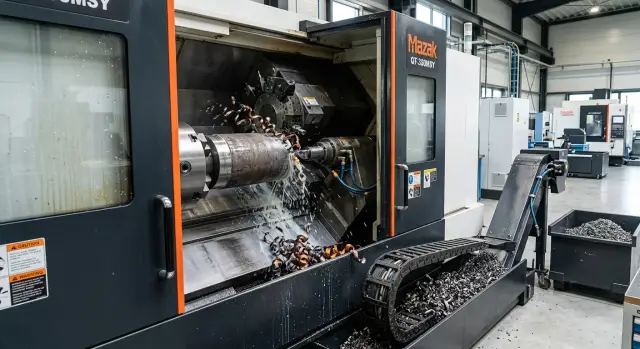
In heavy steel cutting chips are often long and stringy. They quickly collect under the chuck, around the tool and in the guide area, then interfere more than the catalogue suggests.
If chips don't clear by themselves, the operator starts stopping the machine to clean. Output falls, the risk of scratches and tool overheating grows. This is not a small issue but a daily operational problem.
First assess where chips fall after cutting. It's good when they go down a clear path, don't hang on covers and don't fly back into the cutting zone. If the bed, trays and inner panels form "pockets," dense clumps will form there soon.
Then look at the tray and conveyor. A narrow tray or a weak conveyor may look fine on a new machine but fail under real load. With steel this becomes noticeable quickly because chip volume grows in half an hour.
Ask to see the machine cutting, not only running idle. Best is on similar material and with feeds close to yours. During the demo check four things: how chips fall out of the work area, whether they accumulate near the chuck and turret, whether the conveyor handles wet chips in coolant, and whether short broken chips pass without jamming.
Wet chips are heavier and often stick together. Broken chips behave differently: they clog gaps, corners and scraper zones. If the supplier demonstrates only one regime, you see only half the picture.
A useful question is simple: how many minutes per shift does the operator spend cleaning? Not "does it need cleaning?" but how much time is actually spent manually. If the answer is vague, ask to show a typical cleanup after a working series.
A good sign is when, after several parts, the cutting zone remains clear and accessible and chips don't require constant intervention. If during the demo chips must be fished out with a hook, it won't get better in the shop.
Companies experienced in matching machines to metalworking tasks discuss these questions early. It's a normal part of selection, not nitpicking by the buyer.
Step-by-step machine selection
The usual mistake is the same: people first read the catalogue, then remember the part. That order doesn't work for heavy cutting. Start with the shop's real task, not the brand or price.
First describe the part on paper. Include steel grade, diameter, length, blank weight and stock allowance to remove. A 180 mm shaft and a 180 mm flange have different requirements even if the material is the same.
Then fix the machining regime. You need numbers, not generalities: depth of cut, feed, speed and surface finish after the pass. If you want to remove a lot of metal in one pass while keeping a clean surface, machine weaknesses show immediately.
Count separately how many heavy passes the machine will do per shift. One occasional roughing pass and constant heavy work are different conditions. This shows whether you need extra reserve in mass, spindle torque and chip evacuation, or you will overpay for unused capacity.
After that it's sensible to compare models. Look not at one parameter but at the combination: mass, torque, bed shape and chip behavior. A heavy machine alone doesn't help if the spindle falls off in torque and chips pile up at the part.
Usually comparing 2–3 models is enough. Put them in a simple table and note where each loses against your regimes. If you turn long steel shafts, immediately check how chips behave at the chuck and tailstock. That's where downtime often begins.
The last step many skip — don't. Ask for a real trial cut on a similar part. It must be not a pretty demo but a pass on your material, similar diameter and stock allowance. During the test watch three things: does the machine hold the load, does vibration increase, and do chips clear the cutting zone without stops.
If the test requires significantly reducing the regime, the choice is clear. That machine will slow the shop every day.
Where buyers most often go wrong
Heavy steel machines are often chosen by the most visible catalogue numbers. People look at swing, maximum diameter over the bed and total power. Problems start not on paper but on the first serious pass.
One common mistake is buying a machine with large travel but without stiffness reserve. The buyer assumes long travel and large working range will solve everything. In reality extra millimeters of travel don't help if the bed, carriage and other components lack stiffness.
There is also confusion around the drive. Spindle power and spindle torque are not the same. For heavy cutting the pulling force at low RPM is what matters, not a nice peak power figure in the spec.
Another oversight is layout. Easy access to the chuck and good visibility are attractive, but chip evacuation matters more than it seems. If long hot chips accumulate in the working area, the operator stops more often and the risk of scratches and repeatability problems rises.
Buyers also underestimate the actual weight of the setup. They count only the blank and later add chuck, fixtures, steady rest and tool block. The total load becomes quite different, and machine mass should be compared to the full working configuration, not the bare part.
There is a quieter error: buying a machine for a single part. Today the shop turns a steel shaft, but in six months similar but heavier orders arrive — different overhangs, different stock allowances and cutting regimes. If you don't consider adjacent part types in advance, the machine will quickly reach its limits.
Before choosing, ask yourself a few direct questions: how much metal must be removed at low RPM, what is the full blank weight with fixtures, which bed shape best holds your load, where will chips go during a long roughing pass, and what other parts will the shop run on this machine.
These mistakes are easier to avoid at the selection stage than to live with later: slow cycles, vibration and constant chip cleanup.
Example: a shop selects a machine for a steel shaft
A shop needs to turn a steel shaft 1800 mm long and 140 mm in diameter. On paper two models fit: both have enough swing, both are CNC, both handle the material. The mistake starts when selection is based only on part size and price, not on machine behavior during a roughing cut.
A long shaft itself causes issues. The part loads the spindle and components more, and a deep cut immediately reveals the stiffness of the bed, spindle assembly and tailstock. On a light machine the tool starts to vibrate during the roughing pass. First you hear it, then you see it on the surface.
The operator usually copes by doing the obvious: reducing depth of cut and feed. The part still gets made, but the cycle lengthens. Where a heavier machine removes the metal in one confident pass, a light one needs two or three. Over a batch this becomes lost hours, not a small detail.
The same applies to low-speed torque. For this job peak power in the catalogue is insufficient. If torque is weak, the machine won't pull the cut as needed for roughing steel. The operator again cuts shallower, takes fewer risks and waits longer for completion.
Bed shape quickly reveals itself too. A long shaft needs not just any heavy base but a structure that holds load without extra vibration. If the base and components are stiff, the shaft runs truer and dimensional variation between parts is smaller.
Many remember chip evacuation too late. Heavy steel cutting produces a lot of hot, long chips. If chips don't clear the cutting zone, they wrap up, interfere with the tool and force stops for manual cleaning. On a single shaft this is tolerable; on a series it becomes constant pauses.
In this example a heavier, stiffer model often wins despite higher cost. It delivers a steady cycle, less chatter, fewer cleaning stops and easier dimensional control on long parts. For the shop that usually pays off more than saving at purchase and then losing time on every shaft.
A quick check before ordering
Before payment it's useful to run a brief check and remove doubtful points immediately.
- Compare machine mass to your part and planned metal removal, not to the marketing text.
- Ask not only for spindle power but for the torque curve across the working RPM range.
- Inspect the bed, carriage and guides in photos, video and, if possible, in person.
- Clarify how long hot chips are evacuated during real cutting.
- Discuss your part, material, length, diameter, stock allowance and regime with the supplier, not only general model specs.
There is a quick test that exposes false impressions. Ask the supplier to name a regime for your part and explain why the machine holds it: thanks to mass, torque, bed shape and proper chip evacuation. A supplier who understands the task answers with numbers and component details. One who doesn't will speak vaguely.
If you choose a machine for heavy steel cutting, ask uncomfortable questions before signing. It's cheaper than later reducing feed, stopping the line and shoveling chips out of the work area by hand.
What to do next
Start not with the catalogue but with your parts. Selecting a machine for heavy work needs several real examples from the shop, not general wishes. If you collect them in advance, the conversation with the supplier becomes specific immediately.
Take 3–5 typical parts that make up the main load. It's better if among them are the heaviest and most demanding in terms of cutting regimes. From them you will see where the machine needs mass, where high spindle torque is required, and where everything depends on chip handling and access to the cutting zone.
Prepare minimum data: a drawing or at least part and blank dimensions, steel grade, blank weight and stock allowance, roughing regime numbers, plus requirements for commissioning, operator training and service. Also state planned machine loading: one shift, two shifts or near-continuous work.
These data quickly filter out weak options. A machine may look powerful on paper but lose stability on a long roughing pass of a heavy blank. Or vice versa: a model fits stiffness but poor chip evacuation slows the work in the first week.
If you have several similar parts, mark the one that creates the heaviest regime. That's usually the part to test stiffness, spindle reserve and total mass against. Other operations often fit within those boundaries without surprises.
Here it's useful to talk not only about the model but about the whole deployment cycle. For example, EAST CNC supplies CNC lathes for metalworking and helps with selection, commissioning and service. If you provide parts, regimes and shop requirements in advance, the discussion becomes much more concrete.
One hour of this preparation often saves months of disputes after purchase. The more accurate the input data, the smaller the chance of buying a machine that looks good on paper but fails in real work.
FAQ
Can a machine be chosen only by part length and diameter?
No. Part size is only a starting point. For heavy cutting you need to know the material, stock allowance, depth of cut, feed and how the machine holds that regime over a whole shift.
What matters more for heavy steel cutting: power or torque?
For steel, torque in the working RPM range is usually more important. If torque drops at low speeds, the operator reduces feed and depth of cut and the cycle time immediately increases.
Is a heavier machine always better for roughing?
Not always. Greater mass helps damp vibration, but look at where that mass is concentrated. If the bed, spindle assembly and carriage are weak, the weight on paper won't save you.
How can I tell in advance that a machine will go into vibration?
Ask for a real trial cut on a similar part and in a similar regime. If cutting sound changes, surface finish drops and you must reduce the regime, the machine is already at its limits.
Should I ask for a demonstration specifically on my part?
Yes — and don't settle for a short demo. A proper test uses your material, your stock allowance and runs long enough to show heating, chip behavior and dimensional stability.
Why does chip evacuation matter so much when choosing a machine?
Because during heavy cutting chips quickly stop production. If chips accumulate at the chuck, tool or guides, the operator stops more often, and parts and tools suffer.
Which components should I check first?
Look at straightforward mechanics: bed cross-section, saddle size, guide width, turret mounting, spindle diameter and front bearing size. These components directly affect stiffness under load.
What should I check if my shop turns long steel shafts?
For long shafts, check not only travel length but how the machine holds a roughing pass without chatter, how the tailstock performs and whether chips clear without manual cleaning after each part.
What data should I give the supplier before selecting a machine?
Prepare part and blank dimensions, steel grade, weight, stock allowance, depth of cut, feed, RPM and planned shift loading. With these numbers the supplier can say whether the machine will handle the real work.
When does it make sense to pay more for a stiffer machine?
When a stiffer machine holds the regime without extra passes, vibration and cleaning stops, paying more is justified. For shops doing series steel work, the extra cost usually returns in saved shift hours.