
Machine Floor Load: How to Account for Racks and Transport Path
Machine floor load is not just a number from the passport. We break down weight, support points, tooling racks, and the transport route without common mistakes.
Why the passport weight is not enough
The machine’s passport weight is only a starting point. You cannot tell how much load the floor will really see from that number alone. The floor does not take the weight "all at once"; it feels pressure at specific points.
The same machine behaves differently on different sites. If it stands on several supports, the weight is almost never distributed perfectly. Some of the load shifts more strongly to one or two points, especially when the floor is uneven and the machine is set on adjustable feet.
There is another common mistake: people count only the mass shown in the passport and forget everything added after delivery. The chuck, hydraulic station, chip conveyor, coolant tank, tooling, separate cabinets, spare units — all of that changes the calculation. For the floor, a few hundred kilograms make a real difference.
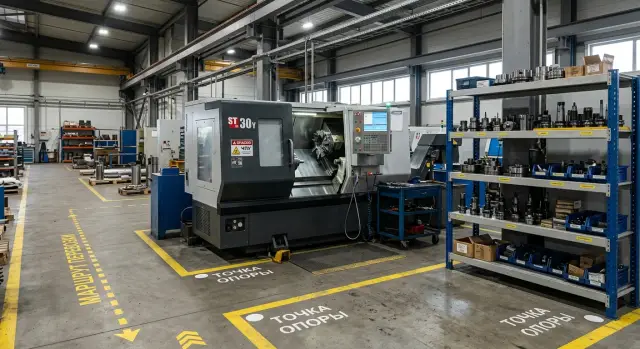
There is also rarely empty space around the machine. In the shop, tooling racks, tool cabinets, pallets with blanks, and boxes with parts appear very quickly. Each item on its own seems minor. Together, they create the load of not just one machine, but the entire workstation.
People often remember the delivery route too late as well. During movement, the machine, pallet jack, forklift, rigging rollers, and jacks can load the floor more heavily than after installation. This is especially noticeable on turns, at gates, on ramps, and in places where the weight stays on a small area for too long.
That is why you need to look at two zones at once: where the equipment will work every day and how it will even get there. Otherwise, the problem shows up at the gate or after the tooling has been placed, when changing the plan is expensive and inconvenient.
What creates floor load
The floor carries not only the machine itself, but also everything you place next to it, pour into it, and bring to the installation site.
First, calculate the weight of the CNC machine itself and all standard units. This may include the electrical cabinet, hydraulic station, lubrication tank, chip conveyor, loader, safety guards, and other equipment from the package. If these blocks are installed separately, the load is no longer concentrated in one area but spread across several.
Then add the working fluids. An empty tank and a filled tank are very different numbers. Coolant, hydraulic oil, lubricant, and reserve water for certain processes can add tens or hundreds of kilograms.
Next comes tooling. The chuck, jaw set, arbors, tool holders, collets, adapters, and spare fixtures quickly add up. One item may seem light, but a cabinet or rack next to the machine often turns into a separate heavy point.
The problem usually starts when the shop counts only the equipment and then places racks, tool cabinets, and pallet loads nearby. The floor does not care what is written in the machine passport. It responds to the total weight of the whole work area.
The easiest way to check the load is to include:
- the machine in working configuration;
- separate cabinets and auxiliary units;
- all fluids in filled condition;
- tooling and spare tools;
- racks, cabinets, pallets, and blanks nearby.
There is another unpleasant detail. Sometimes a heavy rack is more dangerous than the machine itself if it stands on small adjustable feet or narrow legs. Then the weight is concentrated into a few small spots. The same applies to a pallet of blanks: the total weight may be acceptable, but the local pressure can be too high.
In a small shop, this looks very ordinary. A lathe arrives, a control cabinet is placed nearby, two cabinets with arbors are set up, and a rack with jaws is installed, while a pallet of blanks is left in the aisle. Each item by itself seems fine. Together, it is several tons distributed unevenly.
Where the weight concentrates into one point
The floor almost never receives a machine’s weight evenly. It feels it where the supports stand. If a lathe weighs 8 tons and stands on four feet, the concrete does not carry 8 tons across the whole base area; it carries four pressure zones. Sometimes one of them takes more than the others if the floor is uneven or the machine is not leveled perfectly.
That is why you should look not only at the total mass, but also at the support points. The number of supports, the distance between them, and how the weight is distributed inside the machine all matter. On a machine with a heavy spindle unit, one side often presses harder. The closer the supports are to each other, the greater the risk that the load will concentrate on a small part of the slab.
Before delivery, it is useful to collect a few simple details: how many supports the machine has, where they are located, the size of each foot or pad, whether steel plates will be placed under them, and where floor joints, old repair patches, and pit edges run.
Foot size changes the picture a lot. A 80 x 80 mm support and a 150 x 150 mm support transfer the same mass very differently. If you place a leveling pad or a steel plate under the support, the contact area grows and local pressure drops. But that only works where there is solid concrete underneath, not a weak joint or an old repair patch.
On the transport route, the local load can be even harsher. Cart wheels and rigging rollers press on the floor through a very small contact patch. Because of that, a cart with narrow wheels can sometimes be more dangerous to a weak section than the machine after installation. On a turn, during braking, or when crossing a threshold, part of the weight briefly shifts to one wheel, and the floor sees a peak load.
Tooling racks are also often remembered too late. A rack with chucks, holders, and jaws can weigh unexpectedly much, especially if it is loaded gradually and no one recalculates the final weight. If such a rack stands near a floor joint, crack, or old repair area, the risk grows noticeably. Sometimes it is enough to move it aside and place properly sized leveling pads to avoid the worst-case scenario.
How to check the transport route
Floor problems often start not at the installation point, but on the way there. While the machine is being moved, the load changes: the weight passes through cart wheels, rollers, jacks, or temporary pads, and in some places the pressure is higher than after installation.
First, walk the whole route with a tape measure. You need not only the machine dimensions from the passport, but also the size with packaging, a spreader beam, slings, a platform, or a pallet jack. Measure the width of gates, doors, and corridors, and check turning radii and opening heights. On paper everything may fit, but in the real workshop a column, cabinet, cable tray, or low beam may get in the way.
Mark the places where the floor is weaker than usual. These include old repair sections, cracks, filled joints, cable channels, hatches, pits, and areas near the slab edge. If a cart or rollers pass over such a section, the risk is higher than on a flat, intact slab.
A simple route sheet works well. It is enough to note the width and height of openings, narrow spots and turns, thresholds, joints, hatches, old repair sections, and points where the load may stop temporarily.
Another mistake is to consider only the machine’s mass. On the route, rigging equipment is added: a cart, rollers, hydraulic jacks, a spreader beam, packaging, and temporary pads. If the load is placed for a moment on two boards or steel plates, the pressure on the floor can rise sharply. That is why it is important to look not only at the total weight, but also at how many points transfer it to the slab and what the contact area is at each point.
In a small shop, it may look like this: a lathe passes through the gate with almost no margin, then turns near a column and crosses an old cable channel. Formally, the route exists. In reality, the short section near the channel becomes the dangerous spot, where the load moves on rollers and concentrates into a few points.
In practice, the simplest approach helps: walk the route in advance and mark weak spots with chalk directly on the floor. It takes little time, but it reduces the risk of cracks, delays, and emergency repairs on delivery day.
How to calculate it step by step
The same total weight can press on the floor differently. For the floor, it is not only about how much the machine weighs, but also where that weight concentrates: on supports, under a forklift wheel, or under a roller during delivery.
If you use a simple method, there are fewer mistakes.
- Add up the weight of everything that will arrive and stay near the machine. Do not take only the passport number — include the chuck, chip conveyor, cabinet, hydraulic station, coolant tank, tools, first tooling set, and racks.
- Distribute the weight across the supports. Four supports do not mean that each carries exactly one quarter of the weight. On a lathe, the front side or spindle area is often loaded more heavily.
- For each support, calculate the pressure through the contact area. The formula is simple: load on the support / support foot area.
- Check the heaviest delivery stage separately. Often the peak happens not after installation, but when the machine is moving on a pallet jack, rollers, or a forklift.
- Record the margin for each scenario: the permanent load after installation and the short peak load during movement inside the shop.
A small example shows the difference clearly. A 5.8-ton machine on four supports seems like a moderate load. But if the two front supports carry most of the weight and each foot has a small area, the local pressure becomes much higher than the average. If you add a 900 kg tooling rack next to it, the calculation changes immediately.
For CNC machine installation, it is worth doing this calculation before ordering transport and rigging. It is best when the supplier provides the support layout, unit weights, and delivery sequence in advance. Then the problem is visible before delivery, not at the moment when the heavy machine is already standing at the gate.
Example for a small workshop
A small workshop planned to install a CNC lathe and two tooling racks next to it. On paper, everything looked calm: the machine weighed 4.8 tons, the floor slab had reserve capacity, so there should not have been a problem.
The issue appeared in the details. The machine did not rest on the entire base area, but on several points. The two racks were not empty either: one held chucks, holders, and jaws, and the other held tools, measuring equipment, and boxes with spare parts. In total, that added about 1.4 tons more, and the weight was concentrated on the small feet of the racks.
While they were calculating only the installation spot, nobody looked at the delivery route. An old joint in the floor was right at the gate. It had long stopped bothering people and light carts, but for a heavy load it was a weak point. The most difficult moment was not after installation, but during movement through the shop: the machine was moved on rollers, lifted with jacks in places, and the load concentrated on a very small area.
If you simplify the calculation, the picture looks like this: the machine at the working spot created a moderate average load, but a high load at the support points; each roller during delivery took on a noticeable share of the mass; the jack pressed on the floor harder at the moment of lifting than the machine did after installation; and the racks added weight exactly where the reserve was already small.
After the check, the route was changed. The machine was delivered not through the problematic joint, but along a longer yet intact strip of floor. Load-spreading sheets were placed under the rollers to increase the support area. The racks were moved as well: one was shifted to a wall-side area with a better slab condition, and the other was not loaded to the maximum; part of the heavy tooling was moved to a separate cabinet.
In the end, the floor was not reinforced, but the risk was significantly reduced through simple preparation. This happens often: the danger is not created by a single weight number, but by the combination of three things — the machine’s support points, the transport route, and the tooling weight nearby.
Where people make mistakes most often
Problems usually start not when choosing the machine, but on delivery day. Until then, many people look only at the passport weight and think that is enough.
The first mistake is simple: they count the machine’s "dry" weight and do not add everything that will appear nearby and inside it after startup. The calculation does not include coolant, hydraulics, chips in the tray, the chuck, tools, blanks, and tooling cabinets. On paper, the numbers look fine, but in the shop the load is higher.
The second mistake is to look only at the average load per square meter. That calculation is useful, but it does not show what happens at the points where the supports stand. That is where the weight concentrates over a small area. If a support lands on a weak section, an old screed, or the edge of a joint, the risk grows even if the average number looks fine.
The third mistake appears during unloading. People check the installation site, but they do not walk the whole route: gates, ramp, entrance slab, the turn in the aisle, the section near the columns. A forklift or pallet jack carrying a heavy machine can load the floor more heavily than the machine does after installation.
There is also a very ordinary but costly mistake: a heavy rack is placed where another machine is already operating. Each unit by itself passes the calculation. Together, they create an overloaded area, especially near a wall or an old floor repair.
Before delivery, it is useful to check four things: the machine’s full operating weight, the support layout and contact area with the floor, the entire route from the gate to the installation point, and the weight of racks, containers, and spare tooling nearby.
If the machine is being selected in advance, it is better to start this discussion before shipping. At EAST CNC, it usually makes sense to discuss the workshop plan, support layout, and movement route in advance, not after the equipment has already arrived on site.
A quick check before delivery
The day before unloading is too late to find out that the floor can carry the machine but not a cart on a turn, or a rack with heavy tooling by the wall. You need to check the whole setup and the whole route.
First, take the weight of the machine in working configuration. That often includes the chuck, hydraulic station, coolant tank, chip conveyor, control cabinet, and other attachments. Then check the support layout: how many supports there are, where they are located, and what the contact area with the floor is.
After that, walk the route on foot — from the unloading point to the installation point. Not from memory and not from a general plan, but along the real path, with a tape measure and marks on the floor. One narrow turn, an old joint, or a height difference can disrupt the whole delivery.
Before the truck arrives, it is enough to check five points:
- the actual weight of the machine and all units moving with it;
- the support layout and the places where the weight concentrates on a small area;
- the internal transport route in the shop, including gates, ramps, and turns;
- risk zones on the floor: joints, cracks, repair patches, channels, and slab edges;
- space for tooling racks near the machine, but not on a weak section.
Racks are a particularly common mistake. They are placed where there is room left, not where the floor can safely carry the load. If they hold heavy chucks, holders, jaws, and tools, the total load can sometimes be no less than part of the machine itself.
It is also worth agreeing on the rigging work separately. The riggers need clear stopping and turning points, the width of the passage, and the type of surface at each section. If there is a weak zone on the route, it is better to plan load-spreading plates or change the path right away.
What to do next
Do not postpone the floor check until delivery day. If you wait until the last minute, the real risks will already be on site: at the gate, on the turn, near the racks, and in the installation area.
Gather everything that affects the load into one folder: the machine passport with weight and dimensions, the support layout or base drawing, the workshop plan with passages and the installation point, and a list of racks, carts, pallets, cabinets, and spare blanks nearby. Then mark on the plan not only the machine itself, but also the storage zones. Very often, these are what ruin the entire calculation.
The transport route should be checked just as carefully as the installation spot. See where the wheels or rollers will create the highest local load, whether there is enough room to turn, and whether heavy equipment will pass over a weak floor section. Sometimes the short stretch near the gate is more dangerous than the entire working area around the machine.
This kind of calculation is best discussed before delivery. Then you have time to change the layout, reinforce a floor section, remove unnecessary storage from the passage, or choose a different route inside the workshop. That is cheaper than postponing installation and solving the problem urgently on site.
If you are preparing to install a CNC machine, it is useful to send the supplier the workshop plan and layout in advance. For EAST CNC projects, this discussion usually starts at the selection stage and is then confirmed before commissioning: the weight, support points, movement route, and placement of nearby racks. That helps remove disputed issues before the equipment arrives and saves time on installation day.
FAQ
Why isn’t it enough to look only at the machine’s passport weight?
The passport weight gives only one overall number. The floor does not carry the load across the whole machine area; it carries it at the support points, and the pressure there is often much higher than average. After delivery, you also add the chuck, fluids, cabinets, chip conveyor, and tooling, so the calculation changes right away.
What should be added to the machine’s weight in the calculation?
Take the full working setup: the machine itself, separate cabinets and units, coolant, oil, the hydraulic station, chuck, tools, spare tooling, racks, cabinets, and pallets with blanks nearby. The floor feels the total weight of the whole area, not just the machine body.
Why calculate the load by support points instead of by the base area?
Because the weight concentrates exactly where the machine touches the floor. If the supports are small or close together, the pressure on the slab increases. On an uneven floor, one support may carry more load than the others.
When is the floor under the highest load — during machine operation or during transport?
Often the transport phase is the most dangerous. Rollers, cart wheels, and jacks press on the floor through a very small contact area, so on a turn, at a threshold, or during a stop, the load can be higher than after installation.
How can you quickly check the delivery route to the machine?
First, walk the whole route with a tape measure. Check the gates, doorway heights, turns, ramps, columns, cable channels, joints, and old repairs. If you spot a weak point, change the route right away or prepare load-spreading plates.
Are joints, hatches, and old repair areas dangerous for the floor?
Yes, and they often create the problem. A cart or roller on such a section can create a sharp load spike, and a rack near the edge of a joint can increase the risk of cracks over time. It is better to move heavy equipment and storage away from those areas in advance.
How should racks with tooling be accounted for next to the machine?
Place them where the slab can safely carry the weight, not simply where there is free space. Count the weight of chucks, holders, jaws, and tools right away, because a loaded rack can easily become a separate heavy point next to the machine.
Do leveling feet and load-spreading plates help?
Yes, if there is solid concrete beneath them. Leveling feet and steel plates increase the contact area and reduce local pressure. But they will not help if you place them on a weak joint, the edge of a pit, or an old repair patch.
When is the best time to check the floor and route — before purchase or before installation?
Start before you order transport and rigging. That gives you time to change the route, move the racks, prepare plates for the rollers, or reinforce the floor section without rushing or extra cost.
What information should you send to the supplier and riggers in advance?
Prepare the machine’s operating weight, the support layout, the foot dimensions, the workshop plan, the route from the gate to the installation point, and a list of everything that will stand nearby. With those details, the supplier and riggers can spot the risk faster and suggest a proper delivery method.