
Machine Delivery Across the Border: Contract, Logistics, Commissioning
Delivering a machine across the border requires precise contract terms, clear logistics, insurance, packaging, and a complete document set for commissioning.
Where the process most often breaks down
A delivery rarely fails because of one big mistake. More often, time and money are lost at the handoff points between stages, when one party thinks its job is done and the next one has not yet stepped in. That is where downtime, damage disputes, and surprise extra charges come from.
The first weak point is the factory. The machine may be assembled on time but not prepared for shipment. Very often there is no exact packing list, the dimensions of the cargo units are not agreed, sensitive parts are not secured, and there is no clear lifting mark. If the contract describes this in general terms, it is almost impossible to check the cargo later without arguments.
The second risk point is transport and customs. The carrier usually spots the problem first: the actual weight does not match the declared one, different transport is needed, the route does not meet height or load limits, or a document is missing at the border. At that moment, costs rise very fast. Sometimes one day of delay at a terminal is cheaper than cargo damage, but someone still has to pay.
The third stage is the warehouse or transshipment point. The cargo is reloaded, stored temporarily, and sometimes left outdoors. If the parties did not agree in advance on who checks the packaging at each handover, it is hard to tell later where the dent, crack, or signs of moisture appeared.
The fourth risk point is the customer’s site. The machine arrives, but it cannot be accepted: there is no crane, no forklift with enough lifting capacity, the access road is not ready, there is not enough space for unloading, or there is no power for commissioning. Formally, delivery has happened; in practice, work has stopped.
At each stage, four things should be fixed in advance: who orders and pays for the work, who signs the handover, who inspects the packaging and records defects, and when the risk of damage passes. If this moment is not agreed separately, a dispute is almost inevitable. The supplier may believe the risk passed when the machine left the factory, the carrier may say it passed after acceptance without remarks, and the buyer may think it only passes after unloading at the site. For a machine, that is far too much uncertainty.
What to include in the contract
The more precise the contract, the fewer problems after shipment. In these deliveries, disputes usually start not with price, but with vague wording: incomplete configuration, an unclear cargo handover point, and different expectations about startup and documents.
The contract should specify not only the model, but the full specification. You need the series, version, CNC system, power, chuck, turret, chip conveyor, coolant system, tools, spare parts, and accessories. If the buyer expects a 12-position turret and the supplier treats an 8-position one as standard, a dispute is almost guaranteed. That is why the specification is better placed in an appendix and explicitly made part of the contract.
Delivery terms and acceptance
The delivery term should name the exact handover point. Phrases like “delivery to the buyer” explain nothing. It must be clear when the risk passes from the supplier to the buyer: at the shipper’s warehouse, at the terminal, at the border crossing, or at the buyer’s warehouse in Kazakhstan. This is also where you should state who pays for transport, export clearance, import charges, storage, transport downtime, and unloading.
Timelines are better broken into stages: machine ready, shipment, arrival, and commissioning period after delivery. If the schedule shifts, the contract should answer two questions: who bears the cost and how the parties formalize the delay. The acceptance procedure also needs to be explicit: who checks completeness, how many days are available for inspection, when the acceptance certificate is signed, and how remarks are recorded.
For CNC machines, work after delivery is often forgotten. If the supplier handles commissioning and service, it is better to describe that separately: what exactly is included in startup, how many days the specialist spends on site, who prepares the foundation, power supply, air supply, and lifting equipment, how many employees receive training, and how warranty service works.
A separate appendix should list the documents needed to put the machine into operation. This usually includes the invoice, packing list, specification, technical passport, operating manual, electrical and hydraulic diagrams, warranty documents, commissioning certificates, and papers for customs and internal accounting. State the transfer format right away — original, copy, or PDF — and the document language, for example Russian or Kazakh. One such clause often saves weeks after the equipment arrives.
How to describe packaging and marking
For a machine, it is not enough to write “seller’s packaging” or “standard export packaging” in the contract. If the crate gets wet and a part inside shifts or the control panel breaks, that wording will not help. Packaging should be described so that the warehouse, carrier, and insurer all understand it the same way.
First, specify the type of packaging for each item. This may be a rigid crate, a reinforced pallet, or a separate frame for a heavy base. It is also useful to state the packaging material, water and dust protection, and how long that protection is expected to last during transport and storage.
The contract usually includes moisture-barrier film, desiccant, anti-corrosion grease on exposed metal surfaces, and sealing of the electrical cabinet and connectors. If the cargo travels in winter or is transshipped outdoors, that should be stated clearly.
It is just as important to describe what happens inside the crate. The seller should secure moving parts with transport locks, remove fragile items and pack them separately, and fasten cables and hoses so they do not rub against metal. If the machine has a control panel, chuck, hydraulic unit, or tool magazine, the specification should note what is shipped assembled and what is shipped separately.
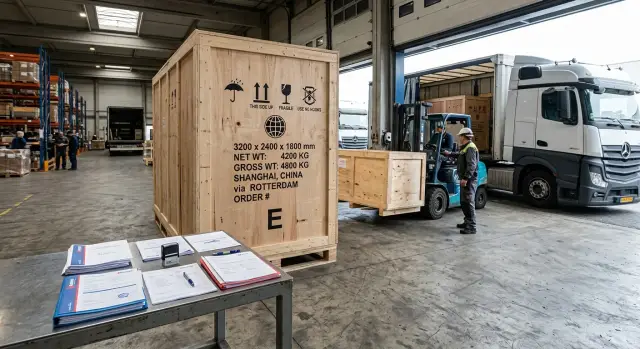
Each cargo unit usually shows the package number, total number of units in the lot, gross and net weight, dimensions, center of gravity, lifting points, an “up” mark, and warnings such as “do not tilt” and “keep dry.” Marking should appear not only in the documents, but also on the packaging itself, at least on two sides. For a heavy lathe, this reduces the risk of lifting errors and saves time in the warehouse.
Another common mistake is listing only the total shipment weight in the documents. The installation team and warehouse need the weight of each unit separately. Otherwise, during unloading, it may turn out that the forklift cannot lift the heaviest crate and the gate opening is narrower than the pallet.
A good practice is to ask for a packing list with dimensions and weight for each unit, plus a few photos before shipment. If the supplier provides this data in advance, it is much easier to plan unloading, choose a crane, and go through acceptance calmly. For companies like EAST CNC, which supply machines to Kazakhstan and other CIS countries, this is a normal and useful part of preparation, not a formality.
How to agree on insurance
An insurance dispute almost always comes up too late — after a dent, a broken screen, or impact marks on the spindle assembly have already been found.
First, state in the contract who buys the policy: the seller, the buyer, or the carrier on behalf of one of the parties. The phrase “the cargo is insured” is too vague. The contract should show who the policyholder is, who the beneficiary is, and what amount the coverage is written for.
Usually, the insured amount is set at no less than the invoice value of the machine. If full coverage is needed, transport, transshipment, and packaging costs are added. Otherwise, part of the loss remains outside the policy.
Also check which stages are covered. The most serious damage often happens not on the road, but during crane loading, warehouse reloading, or unloading at the buyer’s site. If these operations are not named explicitly, the insurer may refuse payment.
Before shipment, it makes sense to confirm at least four points: who arranges the policy and sends a copy to the other side, what insured amount is listed, whether loading, reloading, and unloading are included in coverage, and who files the insurance claim.
There is also a more delicate issue — partial damage. A machine may not arrive completely destroyed, but with a bent door, a cracked panel, or a shifted unit after impact. It is better to understand in advance how damage is calculated in such a case: by repair cost, by replacement of the unit, or by a reduction in the equipment’s value. If the policy has a deductible, minor damage will fall on you.
The claim deadline should also be stated clearly. One day and ten days after unloading are very different. Even if the supplier runs the whole project, it is better to request a copy of the policy before shipment and check the notification procedure yourself.
For a claim, agree on a set of photos in advance. In practice, you need pictures of the packaging before opening, the markings, all sides of the crate, the impact area, the serial plate, and the damage itself in close-up. Without photo evidence, it is very hard to prove when the damage happened.
Who is responsible for unloading and the site
Many delays happen not on the road, but at the workshop gate. The truck arrives on time, but no crane has been booked, the opening is too low, or the long-load vehicle cannot turn around. If this is not agreed in advance, transport downtime and a repeat trip of the equipment are usually paid by the buyer.
The contract should clearly name the party that organizes unloading. Separately state who orders the crane, forklift, slings, spreader beam, and rollers if they are needed. For a heavy machine, it is also better to fix the date when the site will be ready, the contact person on site, and the time when the truck can arrive without waiting.
Before shipment, the machine dimensions in packaging should be matched against the actual conditions on site. Look not only at the gate, but at the entire path from the entrance to the installation point: the width and height of openings, floor load capacity, level changes along the route, turning radius for the truck, parking space, a safe area for removing the packaging, and room for riggers to work.
If a regular forklift is not enough, rigging is needed. That is better written as a separate clause: who chooses the contractor, who pays for the work, and where the carrier’s responsibility ends. This is often where the dispute starts. The carrier believes it only had to bring the cargo to the machine by the shop, while the customer expects unloading and movement inside.
The unloading certificate should be signed by an appointed representative of the buyer, not just any warehouse employee. That person checks packaging integrity, impact marks, moisture, the number of packages, and the markings. If they see damage, they note it immediately in the certificate and take photos before the machine is moved.
Such detail only seems unnecessary until the first dispute. One missed item can quickly turn into a question of who pays for the crane, storage, or a repeat delivery.
What documents to collect for commissioning
If the machine arrives on time but the paperwork does not match, startup is delayed. Usually the problem is not one major mistake, but many small ones: the wrong serial number, no translation of the manual, one configuration in the packing list and a different one in the specification. That is why commissioning documents should be checked before shipment.
Usually, five document groups are collected: the contract, invoice, specification and packing list; transport documents from the carrier; the machine passport, operating manual, connection diagrams, and list of components; certificates and other confirmations if they are required by your accounting or commissioning rules; acceptance, installation, and commissioning certificates.
The set of documents often differs for customs and for accounting. The customs broker needs commercial and transport documents, product information, and data for import processing. Accounting needs papers that allow the machine to be booked as an asset and confirm its value together with delivery, installation, and commissioning if those costs are included in the total amount.
Check that the model, serial number, year of manufacture, and delivery scope match across all documents. It is also better to decide on the language in advance. If the engineers on site work in Russian, they need clear instructions and a passport, not only the original documents in the factory’s language.
Also check signatures, stamps, and the legibility of copies if your internal rules require that form. A blurred stamp rarely stops transport, but it can easily delay acceptance or payment. The same applies to serial markings: one extra digit in the certificate, and the passport no longer matches the actual machine.
It is useful to keep a simple document register in one table. Note who provides each document, in what form it is needed, and when it is received. That saves time when the machine is already on site and the service team is waiting for one missing drawing.
It is better to prepare acceptance and commissioning templates in advance. The acceptance certificate records completeness and condition after unloading. The commissioning certificate notes the start date, test results, remarks, and signatures of the responsible people.
Step-by-step procedure
A problem in this kind of delivery rarely starts in one place. Usually it follows a chain: one configuration in the contract, a different weight with the carrier, and no crane prepared at the site. That is why it is better to follow a simple sequence and record each step in writing.
- Compare the contract, specification, and actual delivery scope. The model, options, tooling, voltage, spare parts list, and startup work must match across all documents.
- Confirm that the machine is ready for shipment. Ask for photos of the equipment from all sides, photos of the nameplates, packaging, lifting points, and internal fastening in the crate. Agree on the ready date, the weight of each package, and the dimensions separately.
- Put together a document folder and a contact list. You should have the contract, specification, invoice, packing list, transport documents, and commissioning instructions at hand, plus the phone numbers of the supplier, carrier, broker, installation crew, and the person in charge at the site.
- On the day of arrival, inspect the packaging before unloading. Check the corners, crate, seals, impact marks, and signs of moisture. If you see damage, photograph it immediately, call the carrier, and note it in the certificate or waybill.
- After installation and inspection, sign the certificates only once everything is confirmed. Check completeness, startup, key components, and the condition of the machine. Keep a photo archive: overall view, serial number, packaging before opening, unloading, and the machine in place.
If the equipment passes through several carriers, this process can save not hours but weeks. When all participants work from the same set of data, there are far fewer disputes.
Common mistakes
The most expensive problems usually start not at customs, but earlier — in the contract and in the shipment correspondence. On paper, everything looks fine, but then it turns out that the packaging is described in one sentence, the insurance only covers the crate, and the crane at the site cannot bring the machine into the workshop.
The first typical mistake is too vague a packaging clause. If the contract only says “in standard export packaging,” it is hard to argue later about whether moisture protection, anti-corrosion preservation, rigid internal fastening, shock and tilt indicators, separate protection for the control cabinet, and component packaging are needed.
The second mistake is agreeing to insurance based on the value of the crate or on an understated cargo value. In that case, the payout may be only symbolic and not even cover diagnostics. For a machine, the full value is usually taken into account: the equipment itself, the tooling, and sometimes the cost of replacing units if the terms provide for that.
The third mistake is preparing unloading “by eye.” You need a site plan: where the trailer will stand, how the crane or forklift will enter, the gate height, whether there is enough width, whether the floor can support the load, who removes the packaging, and who is responsible for moving the machine after unloading. One missed measurement can push startup back by a week.
Do not rush to sign at acceptance. First photograph the crates from all sides before and after unloading, take close-ups of dents, impact marks, misalignment, torn film, and wet areas, check the markings and number of packages, and then compare the machine and component serial numbers with the documents. If you sign acceptance without remarks and notice damage later, it will be much harder to argue.
Another common mistake is delaying the serial number check until installation. It is easy to mix up the control cabinet, spindle unit, chuck, tool magazine, or the machine itself in the warehouse if another delivery is being handled nearby.
A simple rule works best here: everything that can go wrong on unloading day should be checked a few days before the truck arrives. That is cheaper than a crew standing idle, a second-day crane rental, and a dispute about where the defect appeared.
A short delivery example
A factory sends a lathe to Kazakhstan. The buyer checks the crate dimensions, the weight of each unit, and the unloading plan in advance. It is a simple step, but it often removes half the problems before the cargo even leaves.
At the buyer’s site, there is a 5-ton overhead crane. The packing list shows that the heaviest crate weighs 6.2 tons. If this is not checked ahead of time, the cargo would have to sit at the terminal, another crane would need to be found, and storage downtime would have to be paid. Instead, the buyer orders equipment with the right lifting capacity and agrees on unloading time for a specific day.
Shipment goes out under a contract with a clear packaging description: rigid crate, moisture protection, center-of-gravity marking, and a lifting plan on each unit. When cargo goes through several transshipments, these details are what later decide whether there will be a dispute or not.
At the temporary storage warehouse, the buyer’s staff accepts the cargo together with a representative of the carrier. On one crate, they notice a dent in the side panel. They immediately take photos from different angles, capture the marking and vehicle number, and prepare a report with the date and time. It takes about 20 minutes, but later it saves weeks of correspondence.
That same day, the insurer receives the document package: the contract, invoice, packing list, transport waybill, inspection report, and photos. The claim process starts right away, without extra requests. While the inspection is underway, the buyer already has the commissioning package ready: passport, manual, connection documents, and closing papers for the delivery. So after unloading and completeness checks, the team quickly moves on to startup.
What to check before the machine arrives
A couple of days before arrival, it is worth doing a quick check of the documents and the site. At this stage, it is usually not the big problems that show up, but small mismatches: the wrong model number on the invoice, a forgotten policy, an unprepared forklift, or no person available to accept the equipment right away.
Compare the contract, insurance policy, invoice, and packing list. The model name, delivery scope, price, delivery terms, and serial numbers must all match. Make sure you have direct contacts for the carrier, warehouse, and service team — not just the company’s general number, but specific people. Check the installation area again: is there enough room to bring the machine in, is power ready, is compressed air available, can the floor carry the machine’s weight, and has lifting equipment been ordered? And appoint one person in charge of acceptance and commissioning in advance. That person should collect the documents, accept the cargo, record damage, and coordinate everyone involved.
If you are buying a CNC lathe, service is better discussed even before shipment. You need to understand in advance who handles commissioning, what is included in that stage, and what requirements there will be for electricity, air, and the foundation. For suppliers who manage the project from selection to commissioning, such as EAST CNC, these issues are usually agreed in advance together with delivery and service.
And one last thing: do not sign acceptance out of habit. If a document is missing, the packaging is damaged, or the site is not ready, that must be recorded immediately. One extra day for checking almost always costs less than machine downtime after unloading.