
Machine Access for a Lathe: How to Guide a Trainee Step by Step
We break down how to grant machine access step by step: from a dry run and supervised work to the first independent setup.
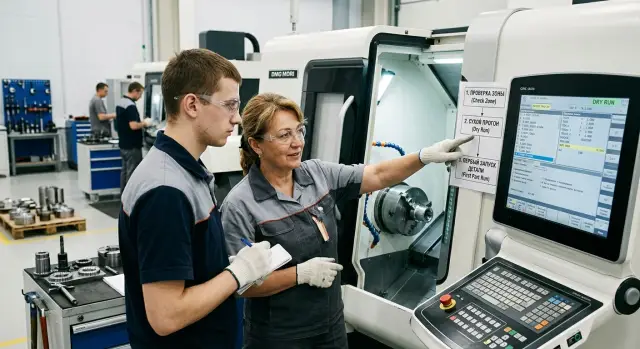
Why beginners make mistakes at the first machine
A trainee's first mistake is rarely just about the buttons. Usually, they still don't feel the machine's logic and don't understand what exactly needs to be monitored at each moment. Because of that, even a simple action, like choosing a mode or starting a cycle, becomes risky.
A beginner often mixes up modes because, for them, they are still just neighboring items on the panel, not different machine states. They see a familiar program, the blank is already in place, the mentor is nearby, and the hand reaches for start faster than the mind can check the small details. The mistake in such a moment is usually not serious, but annoying: the wrong mode, the wrong offset, the wrong return point.
There is another trap too. One successful cycle quickly creates too much confidence. The trainee thinks they already understand the process because one part came out fine. But with the first machine, the real danger is not total lack of knowledge, but early overconfidence.
What to check before the first access
The first machine access should not turn into a test of courage. A beginner needs a narrow and clear path: one machine, one training part, one type of fixture. If today they are learning a lathe and tomorrow they are trying to figure out a different panel and a different operation, mistakes are almost inevitable.
The training part should also be simple for a reason, not just for appearance. It is better to choose one with few transitions, clear datum setting and tooling, and dimensions that are easy to check. The trainee should see the connection between the operation sheet, the program, and what is happening in the work area. Then machine access becomes controlled, not random.
Before the first startup, the mentor should make sure of four things:
- the trainee can point out the emergency stop without help;
- they understand which doors, interlocks, and modes must not be bypassed;
- they can explain step by step how to stop the cycle normally;
- they know when they must call the mentor immediately.
The last point is often underestimated. If the rule is not discussed in advance, the trainee starts arguing with themselves: "Can I handle it, or should I call someone now?" That is exactly when extra button presses, a wrong offset, or a start in the wrong mode appear. It is better to agree clearly: if there is any doubt about the part zero, offsets, clamping, tool, or the first line of the program, they do not solve it alone.
Also check how the person reads the operation sheet. Not whether they "basically understood it," but whether they really follow it in order. Ask them to show the datum, size, tool, mode, inspection method, and final requirement for the part. If they jump around and only pick out familiar words, it is too early to bring them to the machine.
A good check takes five minutes. Give them the sheet for one simple part and ask where they will start, how they will verify the blank, where they might make a mistake before cutting, and when they will stop the machine on their own. If the answers are vague, do not speed up the stage. Trainees usually make mistakes not because they are lazy, but because too much freedom comes too early.
Stage 1: getting familiar without cutting
The first access is best started without chips and without rush. At this step, the trainee does not machine a part. They learn to see the machine as a whole: where the danger zone is, what moves, what can be touched, and what cannot.
First, let them approach the lathe and calmly inspect the work area. You need specific points of attention, not general words: the chuck, jaws, cutting tool, safety guards, and emergency stop button. If the jaws stick out too far or the tool is clamped in a questionable way, the trainee should notice it themselves, not only after a supervisor points it out.
Then practice the basic actions without cutting. The trainee turns the machine on, stops it, changes modes, opens the needed screen, and confirms commands. The important thing is that they do this in the same order every time, without fuss. A good sign is when the hands are not darting across the panel and every press can be explained.
Using a simple example, show the two basic reference points that beginners often confuse: part zero and tool zero. No complicated diagrams are needed. A training blank and one cutting tool are enough. Show where the machine "sees" the start of the part and where the tool tip is located. If the trainee mixes up those points, they will make a mistake on the very first move.
It is useful to give a short task: ask them to speak the full sequence aloud while standing at the machine. For example, what they check before power-up, how they make sure the area is closed, which mode they select, where they look for zeros and offsets, and when they press stop if they see strange movement.
This kind of explanation quickly reveals weak spots. One trainee confidently presses buttons but forgets about the guard. Another remembers the safety rules but mixes up part zero and tool zero. That is the whole point of the first stage: find the gaps before the machine starts cutting metal.
On typical lathes, including models used in production and training areas, this step often saves an entire shift. If a beginner learns a calm sequence without cutting even once, they work more composed later and make fewer sharp mistakes.
Stage 2: dry run of the program
A dry run is needed to catch an error before the first chip appears. At this step, the blank is usually not installed. The trainee watches where the tool actually goes, instead of just trusting the picture on the screen.
If a person cannot get through this stage confidently, it is too early to give machine access. One extra millimeter in the wrong direction can easily end in a hit on the chuck, the fixture, or the tool itself.
First, set a safe mode. Reduce feed to a minimum, keep rapid movements under control, and lower spindle speed to a safe level or disable it according to the shop rules. If the machine allows it, it is better to step through the program frame by frame instead of starting the full cycle at once.
On a CNC lathe, trainees most often get lost in three places: when first approaching part zero, when passing near the chuck jaws, and when changing tools. A machining center has a similar pattern: danger comes from the approach to the part, table rotation, tool changes, and the Z-axis move.
What to watch during the run
You do not need to try watching everything at once. It is enough to keep your attention on the points where mistakes are costly:
- the first approach to the datum point;
- rapid moves near the fixture;
- tool change and turret rotation;
- retract to a safe height after a pass;
- areas near the chuck, jaws, or vise.
If the trainee stops understanding what the machine is doing even for a second, stop the cycle immediately. Not after a hit and not after a strange sound, but at the moment of doubt. This is a useful habit: a good operator is not embarrassed to press stop.
A simple example: the program uses the correct tool, but the length offset was left over from the previous setup. On the screen, the path looks normal. During the dry run, it becomes clear that the tool is approaching too low and entering a risky zone. It is better to catch that mistake in 20 seconds of checking than later to replace the holder and figure out why the machine stopped.
After the run, the trainee should explain in their own words where the dangerous points were and why. If they only say, "Everything was fine," the step does not count. They need to understand the machine's movement, not guess it.
Stage 3: first part under supervision
At this stage, the trainee is no longer just looking at the screen and listening to the mentor. They make their first real part, but within narrow limits. It is better to choose a simple task: a standard blank, one operation, and a clear result after measurement.
For a first experience on a CNC lathe, facing or machining one outer diameter in 1-2 passes works well. Do not give a complex contour, a thread, or a part where several dimensions must be tracked at once. The simpler the task, the easier it is to see where the trainee loses the logic.
The mentor limits the actions in advance. The trainee only does what they have already practiced: loads the blank, checks the datum, calls the program, starts the cycle, stops the machine for inspection, and measures the part. If they have not yet learned how to change a tool or adjust cutting parameters, they are not allowed to do that yet.
How to guide the first part
While working, ask the trainee to say out loud what they will do next. Keep it short, one sentence: "Now I’ll check the overhang," "Now I’ll run one pass," "After the pass I’ll measure the diameter." This quickly shows whether they understand the process or are only repeating movements.
After each pass, the mentor and trainee check two things together: the actual size and the correction record. The size may be almost right, but the offset may have been entered in the wrong place. Beginners often celebrate the number on the caliper and miss the mistake in the logic itself.
If the trainee measured 20.12 mm instead of 20.00 mm, do not rush to adjust the correction yourself. Let them say how much to change the value, in which direction, and why. That extra two-minute discussion saves hours later in the shift.
Stop the work immediately if the trainee starts guessing. At this stage, it is better to make one simple part slowly than three parts with nerves and random adjustments. When a person confidently repeats the same sequence without help, you can move on.
Stage 4: first independent setup
At this stage, the trainee is no longer just starting a cycle. They prepare the machine themselves for one familiar part, but still work within narrow limits. That is enough for machine access, if you do not give them too much freedom too early.
The best option is one repeatable part that the shop runs for several shifts in a row. Then the trainee does not waste energy on a new shape and instead learns to keep the same process: load the blank, check the datum, call the needed tool, measure the part, enter a correction, and get the same result again. If the part is new every time, the beginner confuses setup with reading the drawing.
The most common mistake here is simple: the trainee starts "improving" the process from memory or by eye. It is better not to allow that. They should change tools only according to the operation sheet. If the sheet specifies a certain cutting tool, holder, and overhang, they use exactly those. A self-made replacement quickly breaks the whole setup logic: the size shifts, stiffness changes, and the risk of a hit grows.
The correction rule should also be strict. First measurement, then запись, then adjustment. Not the other way around. Beginners often hear a different cutting sound or see a mark on the part and immediately want to change wear or geometry. That quickly makes them lose control of the size. It is much safer to keep a simple order: make the part, measure the required dimensions, compare them with the tolerance, and only then enter a correction by the needed amount.
When access can be expanded
Full independence is better opened not after one successful part, but after a calm series. Usually, the mentor looks at four things:
- the trainee holds size for several shifts without help;
- does not confuse tools and does not deviate from the operation sheet;
- records measurements and the reasons for corrections;
- notices a deviation before scrap is made.
A good sign is when the person does not rush. They do not tweak everything at once, do not argue with the measurement, and do not try to "save" the size by guessing. If the diameter drifted by 0.03 mm, the trainee does not immediately touch three different offsets. They check the measurement, review the last pass, and make one clear adjustment.
If the size is still not stable, do not expand access. Let the trainee continue working on the same part. One more shift on a repeatable operation is almost always more useful than early independent setup on a new task.
Where trainees make the most mistakes
Beginners rarely ruin a part because of a complex toolpath. More often, they fail on small things that seem simple. These are the things that later lead to scrap, tool breakage, and dangerous situations.
The first common mistake is clamping the part on dirty jaws or on a poorly wiped datum surface. Chips, oil, and fine dust cause misalignment that first looks like a random size drift. The trainee starts looking for the reason in the program or the correction, although the problem was in the clamping from the start.
The second mistake is even simpler and more dangerous. After checking, the key, probe, hex wrench, or rag is still left near the machine. The beginner gets distracted, closes the door, and presses start. At the training stage, this needs to be stopped immediately, otherwise the habit will stick.
A lot of scrap appears when the trainee tries to fix the size quickly. They change two parameters at once: for example, the tool offset and the feed, and sometimes even the cutting mode. After that, it is no longer clear what caused the error. For CNC operator training, it is better to keep a simple rule: one adjustment per cycle, then check the result.
Another trap is measuring a hot part. After machining, the metal is warm, and the size can shift by several hundredths. The trainee sees a deviation that will no longer exist after cooling and enters an unnecessary correction. As a result, the next part comes out undersized. From the very beginning, it is important to teach the person to measure the part in the same state every time, not by mood.
Short pre-start checklist
Before the first startup, trainees usually make mistakes not in the program, but in the small details. The chuck was not tightened enough, the wrong offset was selected, a key or caliper was left on the machine bed. These mistakes seem minor until they break a tool or spoil the first part.
That is why machine access should only be given after a short, familiar check. It takes a couple of minutes, but it immediately shows whether the trainee is thinking about safety and order or acting on autopilot.
Before startup, the mentor usually asks them to check five things:
- the part is clamped firmly with no play;
- the tool is in the position specified in the sheet;
- the offsets have already been entered and are not just in someone's head;
- the door closes properly, coolant flow is on, and air is available;
- there are no unnecessary items near the work area.
This is especially visible on a training part. The trainee may do everything right on the screen, but forget a drill bit nearby or leave a rag near the chuck. At that moment, the mentor is looking not only at knowledge, but also at discipline.
If this check becomes a habit, the next stage goes more calmly. The trainee is less fidgety, notices strange sounds or incorrect movement faster, and the mentor spends time not on saving the situation, but on teaching.
Example route on one training part
For the first route, it is better to choose a simple part that can be checked easily with a caliper and micrometer. A training bushing or a short stepped shaft with facing, one outer diameter, and a chamfer will work well. The trainee has fewer chances to get confused, and the mentor can immediately see where the mistake is: clamping, zero, correction, or measurement.
On the first day, the trainee does not cut metal. They power up the machine, home the axes, open and close the chuck, load the blank, start the spindle, and stop the cycle. Then they run the same program in dry mode and learn to press Feed Hold in time if they see a risk.
On the second day, the dry run of the program begins. The part is already in the chuck, the tool is called, but the cutter travels above the blank at a safe height. The mentor asks the trainee to name the dangerous points out loud: approach to the jaws, tool change near the chuck, rapid retract, return to zero. If they cannot explain the path, it is too early to let them cut.
On the third day, they make the first part under supervision. After the cycle, the trainee measures the part themselves and records the values on a simple inspection sheet. For one training part, three measurements are usually enough:
- outer diameter;
- length of the shoulder or overall length;
- chamfer size or second diameter.
On the fourth and fifth day, the trainee repeats the same operation without help. The mentor no longer walks them through the buttons and only watches safety. The trainee checks the workpiece setup, tool number, zero point, program start, and final size on their own.
After a series of identical parts, machine access can be expanded. I would not rush: first give permission to adjust tool wear within a small range, then allow changing the blank and checking zero again on the same operation. It is worth moving to independent machine setup only when the trainee holds size on 5-10 parts in a row, keeps program logic intact, and does not miss dangerous points.
What to do after the first access
One successful startup does not mean the trainee is ready for all modes. After the first access, it is better to move narrowly: add only similar operations, on familiar tooling and with the same part type.
If the person confidently handled facing and simple turning on one blank, there is no need to immediately give them threading, deep drilling, or a new clamping system. Such a sharp jump is usually what creates CNC trainee mistakes: they do not confuse the program itself, but the changing conditions around it.
A good rule is simple: one new risk at a time. Either a new tool, or a new material, or a different setup method. Not all at once.
At the end of each shift, it is useful to review any failure based on facts, without vague phrases like "they were inattentive." It is much more useful to record exactly what happened: on which frame the deviation started, which offset was changed, where the operator failed to check tool overhang, and what alarm message appeared on the panel.
That kind of review takes 10-15 minutes, but it quickly shows repeated weak spots. One trainee is always in too much of a hurry to clamp the part, another forgets to verify zero, and a third handles the dry run of the program well but gets lost at the first size correction.
For each trainee, it is worth keeping a simple error log. Just record the date and shift, operation, the mistake itself, the cause, and what the person should check next time. This sheet is not for reporting, but for growth. In two weeks, it already shows who can be given the next operation and who is not ready yet.
If the shop needs a different machine, new tooling, or proper commissioning, it helps to involve the people who do it every day. EAST CNC supplies CNC lathes for metalworking and helps with selection, commissioning, and service in Kazakhstan and other CIS countries.
A normal pace after the first access looks like this: repeat the familiar operation several times without failures, then add one new action and reinforce the result on another series of parts. That is how the trainee builds not bravery, but a precise working habit.
FAQ
When can a trainee be given their first machine access?
Only bring the trainee to the first startup after a short check at the machine. They should be able to show the emergency stop without help, explain how to stop the cycle normally, name the hazardous zones, and say when to call the mentor immediately. If they confuse the workpiece zero, tool, or modes, it is better to postpone startup.
Why is the first stage better done without cutting?
This helps the trainee learn the machine calmly and without the risk of breaking a tool. At this stage, they look at the work area, get used to the panel, talk through the sequence of actions, and learn to spot danger before an actual run.
What is the best first part for training?
Give one simple part with a clear datum, one tool, and easy size control. For a lathe, facing or one outer diameter over a couple of passes works well. Leave complex contours, threads, and multiple dimensions for later.
What should you watch during a dry run of the program?
Focus not on the screen as a whole, but on the expensive mistakes. The most dangerous spots are the first approach to the workpiece zero, movement near the chuck jaws, tool changes, and the Z-axis retract. If the trainee loses track of the path even for a second, stop immediately.
Can a trainee be allowed to change offsets right away?
Let them adjust only after measuring, and only one thing per cycle. Beginners often start changing the offset, feed, and cutting mode at the same time, and then they can no longer tell where the size drift came from. One calm correction gives a clear result.
Where do trainees make mistakes most often?
Most often, beginners make mistakes on small things. They clamp the part on a dirty base, leave a key or rag near the work area, mix up modes, look only at the screen, and rush to correct the size. Another common problem is measuring a hot part and then adding an unnecessary correction.
When should you stop the cycle and call the mentor?
Stop immediately as soon as the trainee cannot explain the machine's next movement or notices an unusual sound, travel, or tool position. Don't wait for a hit and don't hope the cycle will return to a safe point on its own. At the first stage, a cautious stop is better than extra confidence.
When can you expand access to independent setup?
Usually not after one good part, but after a calm series. If the trainee holds size for several shifts, does not mix up tools, records measurements, and notices deviations before scrap appears, you can add the next level of responsibility. If there is no stability yet, keep them on the same operation.
What should you do after the first successful startup?
Don't rush into a new machine, new tooling, and new material on the same day. Give one new risk at a time: for example, a different tool on a familiar part first, then a new clamping setup. This pace helps закрепить the routine instead of guessing on the fly.
What is the minimum pre-start check that should become a habit?
Before startup, the trainee should check the part clamping, the tool number, the entered offsets, the door closing, and the cleanliness of the work area. This check takes a couple of minutes, but it often prevents the most avoidable mistakes. If they do it the same way every time, work becomes calmer.