
Spare parts with long lead times: what to keep in stock
How to assess long-lead spare parts, identify critical assemblies and set a minimum stock without unnecessary purchases.
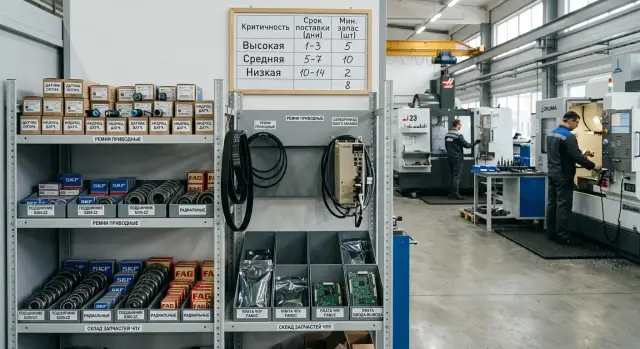
Why long lead times become a problem
Machine downtime won’t wait for the end of the month. If a CNC lathe stands idle even for one day, the shop loses output, delivery dates shift, and often time and money are spent urgently setting up other equipment. Sometimes production stops over a cheap part, while each day of downtime costs much more.
The issue is that the lead time on paper and the real lead time often differ. A supplier may say three weeks, but then queueing at the factory, transport, customs, approvals and reorders for wrong part numbers add time. For companies in Kazakhstan and other CIS countries this gap can stretch even more, especially for made-to-order components.
So evaluate long-lead parts by downtime cost, not by part price. If a machine produces daily, a month of waiting usually costs more than storing one spare assembly in the warehouse.
But keeping everything in stock makes no sense either. Some failures don’t stop production completely. Some parts can be replaced during scheduled maintenance, some are common across several machines, and some fail so rarely that stock ties up money unnecessarily.
Typically you create a short list of components without which a machine won’t start, can’t hold tolerances, can’t operate safely, or causes downtime longer than your schedule allows. That list should be short: a few items per model, not a catalog of dozens of pages.
EAST CNC uses this approach in practice when selecting and servicing machines: they look at stoppage risk first, not the full parts list from the manual. When the list is short and clear, it’s easier to assess criticality and set a sensible minimum stock without excessive warehouse costs.
Where to start your parts list
Start with facts, not the catalog. Pull failure history from the last 12–24 months and focus on incidents that actually stopped the machine. If record-keeping is weak, use repair logs, service requests, supplier correspondence and notes from shift mechanics.
The first draft of the list should answer one question: which part caused production loss. Don’t include everything. If a component failed but the machine kept running until a planned stop, that’s a different group.
For each item collect four things:
- which machine it’s on
- how many times it failed
- how many hours or shifts the downtime lasted
- how long the actual delivery took, not the promised lead time
Real lead time often changes the picture. On paper a sensor or drive may be fast to deliver, but in reality delivery delays happen due to logistics, customs or ordering mistakes. Record the actual wait time from the last incident rather than the supplier’s promise.
Which parts usually go into stock
In stock you usually put not the most expensive parts but those that stop the machine immediately. If a part takes 6–10 weeks to arrive, downtime quickly becomes more expensive than the replacement part.
First group — small but disruptive failures: sensors, limit switches and encoders. They aren’t costly, yet a faulty sensor can prevent an axis from homing and a failed encoder can make a drive run with errors. Keep at least one of these per machine type.
Second group — mechanical items that wear faster than expected: belts, couplings and coolant pumps. A belt can stretch or break during a normal shift, a coupling may develop play, and a failed coolant pump disrupts machining. For a busy CNC lathe area this is common.
Also consider parts that are hard to replace quickly in an emergency: spindle bearings and hydraulic seals are rarely purchased on impulse, but for heavily loaded equipment they often enter the minimum stock. If a bearing gets noisy or a seal loses pressure, the window before repair can be short.
The most sensitive category is electronics: control boards, power modules and servo drives are expensive, so they aren’t kept in large quantities. But one critical module for a group of identical machines often pays off after the first serious failure — a failed board usually stops the machine completely.
There are components that make startup impossible: chucks, certain hydraulic elements, clamping blocks, and sometimes assemblies for spindle or feed. They are stocked not because they fail often but because downtime cost is high. The logic is simple: if the part can’t be bought locally quickly and without it the machine can’t make a single part, consider it for stock.
A good rule: stock items that fail predictably, take a long time to arrive, or immediately stop the machine. If at least two of these apply, add the part to the working list.
How to classify parts by criticality
Sort parts not by price but by what happens after failure. If the machine stops immediately, the part is top-critical. If you can safely finish a shift or produce one batch without quality or safety risk, it’s another level.
Usually three groups are enough:
- high criticality — the machine stops immediately, work without the part is impossible, and risk of accident or scrap increases
- medium criticality — the unit works unreliably, but the shop can finish the shift or one batch under a supervisor’s control
- low criticality — there is a temporary substitute, a duplicate on a neighbor machine, or the failure doesn’t stop production right away
The top group is defined not only by downtime. If a failure risks the operator, the workpiece or expensive tooling, raise the part’s priority even if the machine continues running. Problems in lubrication units, position sensors or safety-stop modules are often more dangerous than they first appear.
Medium group parts give time to react. For example, a coolant pump may be noisy but still provide flow, or a fan in the electrical cabinet may run intermittently while temperature remains acceptable. These items shouldn’t be deferred forever, but you don’t need multiple spares on the shelf.
Low criticality doesn’t mean the part is unnecessary — just that its failure doesn’t break the plan today. This group often includes items that have replacements in general stock or components that can be moved from a spare machine without stopping the whole area.
Mark parts that fit multiple machines. The same sensor, belt or module on two or three machines becomes more important because it covers several risks at once.
If unsure between two groups, err on the higher side. An extra box on the shelf is usually cheaper than a week of downtime.
Steps to set minimum stock
You can’t estimate minimum stock by eye. For long-lead items a mistake quickly turns into downtime.
First, write lead time in days for each part. Use actual lead time: order, transport, customs, acceptance. If a part usually arrives in 40–45 days, use 45.
Then calculate annual consumption. If you have statistics, use warehouse write-offs and service requests. If data is limited, use the last 12 months per machine. Convert annual consumption to need for the lead time: divide annual consumption by 365 and multiply by the lead time in days.
If consumption was calculated per machine, account for the number of identical machines in the shop. The same sensor on four identical lathes runs out faster than you might think. The formula:
Minimum stock = ((annual consumption per 1 machine x number of identical machines) / 365) x lead time
Round the result up to the nearest whole unit. You can add one extra unit for unexpected failure, but only for items that stop the machine completely or cause long precision loss.
Small example. One machine needs 2 sensors per year. There are 3 such machines, lead time is 60 days. Calculation: 2 x 3 / 365 x 60 = 0.99. Round up to 1. If the sensor failure stops work, add one more. Minimum stock = 2.
Final step — check the budget. If the total doesn’t fit, don’t cut everything equally. First keep items that are slow to arrive and stop production. Then defer cheaper items that can be bought locally, rarely replaced parts and spares for lightly loaded machines.
This gives you a clear minimum that you can review quarterly as machine load, fleet composition or lead times change.
Example for a shop with two machines
Two identical CNC lathes make the same part. The shift plan holds only when both machines run. If one stops, the second can’t cover the volume.
Consider three parts. The encoder for this model takes 45 days and there’s no quick local replacement. If it fails, waiting is too long. Such a part almost always needs a minimum spare, even if it’s not cheap.
Belts are different: cheaper, easier to replace, and wear is often visible — noise, cracks, loose tension. For two identical machines one spare belt for the area usually suffices. Keeping a belt per machine is excessive.
Control boards are similar to encoders but with a caveat. If both machines use the same board, it’s sensible to keep one shared spare. That’s enough to return either machine to service quickly. Buying two boards for the pair is rarely necessary.
Minimum stock for this area might look like:
- encoder — 1 for the area
- belt — 1 for the area
- control board — 1 shared for both machines
- items with local replacement in 1–3 days — 0
That last line often saves budget. Buttons, standard relays, hoses, fasteners and other common small parts are easier to buy quickly than to store extra.
This example shows the principle: stock parts that cause weeks of lost production, not only the most expensive components.
Common mistakes
Most often parts are chosen by catalog, not by real failure history. On paper it seems logical: open the machine’s parts list and mark everything that can fail. In practice the warehouse fills with items that aren’t needed for years, while the needed part is missing at the moment of downtime.
Build the working list from facts: service reports, emergency stop logs, recurring errors and past delivery times. If a part already stopped a machine once and it was awaited for three weeks, that’s more important than a dozen rare catalog items.
Another frequent mistake is looking only at the part price. A cheap item can be very expensive if it stops production. A small sensor, board or power supply can cost less than one shift of downtime. Conversely, an expensive cover or a secondary assembly isn’t always worth stocking.
A useful rule: count the cost of downtime, not the purchase price. If two machines’ one-day downtime costs more than the spare for the problematic part, the decision is usually obvious.
Warehouses also get filled with cheap consumables because they’re easy to order. Filters, belts and small electrics accumulate, while a rare long-lead assembly is missing. Procurement follows habit, not risk.
Also check shared parts for multiple machines. If two lathes use the same sensor, pump or module, the risk is higher: one failure is bad, two identical failures leave the area without a reserve.
Don’t postpone stock review. After a change in machine model, supplier part numbers or shop layout the old list quickly becomes irrelevant. Recalculate stock when:
- a new machine model arrives
- the supplier changed assemblies or part numbers
- service begins replacing the same parts more often
- lead times for some items increased
A practical rule: after commissioning new equipment or a noticeable change in nomenclature, compare the list with real failures from recent months. Otherwise the warehouse and production live separate lives.
Quick check before ordering
A five-minute check before ordering often saves both money and mistakes. It prevents ordering an item that supposedly exists in stock but nobody knows where it’s stored.
Each item must have its own lead time — not a group average: 3 days, 2 weeks, 45 days. If lead time isn’t specified, the item is easily underestimated.
Before ordering check five things:
- how many machines will stop without this part
- its criticality level
- the exact lead time for this specific part, not for a similar one
- whether duplicates already exist in the warehouse "just in case"
- who is responsible for the item, its storage location and current balance
The same part can matter differently across areas. If a sensor is only on one standby machine, the risk is low. If it stops three machines, the decision is different. Note the dependency next to the part: 1 machine, 2 machines, whole line.
Criticality needs a simple definition. High criticality means the machine stops and work can’t be quickly avoided. Medium means you can stretch to replacement or reorganize the schedule. Low means the failure is annoying but doesn’t stop output immediately.
Money often goes on duplicates, not on missing items. Two similar couplings, three extra belts and a spare sensor accumulate because someone once reordered them. If the reason for stock isn’t recorded, review such items.
Even if the supplier helps with selection and service, internal records are still necessary. At EAST CNC, for example, you can discuss critical components during selection, delivery and maintenance of Taizhou Eastern CNC machines, but the exact balance and storage location inside the shop must be known by your team.
What to do next
Don’t postpone this work. One downtime over 24 hours quickly reveals which parts hit the shop hardest.
Start with a working table of 15–20 items. Don’t try to cover the whole machine at once. Enter only the riskiest components first: those without which the equipment stops and that take weeks to arrive.
A table usually needs columns like:
- part or assembly name
- which machine it’s on
- lead time
- what happens on failure
- whether a replacement or workaround exists
- minimum stock
Review the list with others. The shop foreman sees what really fails and how it affects output. The service engineer understands hidden risks: which parts fail rarely but stop the machine completely.
For new machines don’t wait for the first failure. Request a list of critical components during purchase and commissioning. This prevents bloating the warehouse while avoiding being without a necessary part at the worst moment.
If you have Taizhou Eastern CNC equipment, it’s convenient to discuss the list with EAST CNC in advance. The company works with this manufacturer in Kazakhstan and assists with selection, commissioning and service, so talk about spares before the first startup.
Introduce one rule: after every downtime longer than one day, review the stock. Which part failed? Could one spare have prevented it? Do you need a different minimum for that part?
A good spare plan rarely succeeds on the first try. But after two or three reviews the list becomes more accurate: fewer random items in the warehouse and a lower risk of long downtime.
FAQ
Which spare parts should be stocked first?
Start with items that make the machine stop immediately or lose accuracy and whose delivery takes weeks. The typical minimum includes sensors, encoders, control boards, servo modules, belts, couplings and coolant pumps. Don’t look only at the part price. If a part can cost the shop several days of production, keeping one unit in stock is usually cheaper than waiting for delivery.
Does it make sense to keep expensive control boards and servos in stock?
Yes, if the module stops the machine completely and has a long lead time. For a group of identical machines one spare board or one spare servo often suffices for the whole area. Don’t buy such expensive items without failure history and understanding of lead times. One shared spare usually solves the problem better than two expensive units sitting unused.
How to tell if a part is truly critical?
Look at the consequences of failure. If the machine won’t start, can’t hold dimensions, damages tools or creates a safety risk for the operator, classify the part as high criticality. If the area can safely finish a shift and replace the part later, it’s medium or low criticality. What matters is how much production you lose when the part fails.
How to calculate minimum stock without a complex system?
Use the real lead time in days, the annual consumption per machine and the number of identical machines. Calculate the need for the delivery period and round up. If the part stops the machine immediately, add one extra unit for an unplanned failure. This works better than estimating stock "by eye."
Which lead time should be used — promised or actual?
Base your calculation on past deliveries. Take the full time: ordering, shipping, customs and acceptance — all delays that have actually happened. Promises on paper often look better than reality. If last time a part took 45 days, use 45 in your planning.
Is a spare list needed for a new machine with no failures yet?
Even for a new machine it’s better to prepare a short list of the riskiest components in advance. Request this during purchase or commissioning before the first downtime. Usually a few items that stop the machine and are slow to deliver are enough. This prevents bloating the warehouse while avoiding being without a needed part at a bad moment.
What is usually not worth keeping in stock?
Don’t store items that can be bought locally in 1–3 days: standard relays, buttons, hoses, fasteners and other common small parts. Also avoid buying rare parts that hardly ever fail and don’t stop production immediately; they just tie up money and space.
How often should the spare parts list be reviewed?
Review the list at least quarterly and after any downtime longer than one day. That’s enough to remove unnecessary items and add parts that actually caused issues. Also recalculate stock after introducing a new machine model, changes in part numbers, increased lead times or repeated failures of the same part.
How to avoid tying up money in unnecessary spares?
Count the cost of downtime, not only the purchase price. A small sensor may be cheap but can stop the whole area for days. Keep a short list, remove duplicates and use shared spares for identical machines where it makes sense. This directs the budget to risky items, not to random purchases.
Who should be responsible for the spare parts list and inventory?
Assign one person responsible for the list, stock levels and storage location, and make decisions on criticality together with the shop foreman and the service engineer. That way someone keeps records instead of searching for parts at the last minute. The supplier can help select parts and point out weak spots, but your team must know the exact stock and where each item is stored. Otherwise the warehouse exists but provides little benefit.