
Lifting and Clamping Large Flanges Without Damaging the Base
Lifting and clamping large flanges: how to choose lifting points, arrange supports and avoid dents, skewing and marks on the base before the first setup.
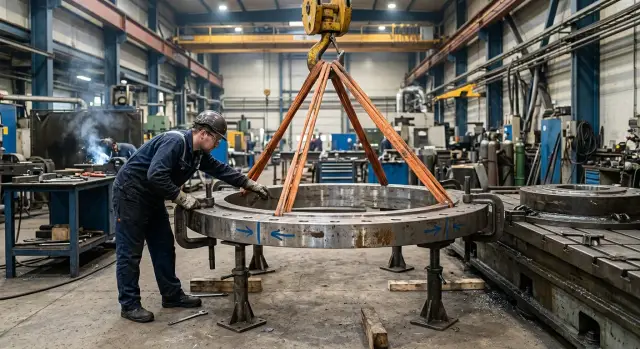
Why the base gets damaged
The base is often ruined even before machining begins. The problem starts when the flange is hanging on slings and someone tries to set it down on supports and clamp it. If the part touches the table or pads only by part of its surface, all the load concentrates in one area. That’s where dents, scratches and a local tilt appear.
A common reason is simple: the base takes the weight before the flange fully rests on the supports. Large parts have a lot of mass, so even a slight edge contact creates significant pressure. From the outside it looks harmless: the flange touched slightly, then was pulled in by clamps. But by that moment the plane may already be shifted by hundredths of a millimeter or more, and the mark on the base will remain for the first setup.
A skew during lifting also quickly damages the seating surface. If the sling points are chosen poorly, slings pull the part not straight up but with rotation. One edge drops, the opposite edge hangs higher, and when lowering the flange lands on a random spot instead of the supports. Sometimes that’s the outer diameter, sometimes a thin area near the base. For a heavy part that’s enough to leave a mark before clamping.
Clamping causes trouble when applied where it’s convenient rather than where the part is already supported. Then the force passes through a section that’s hanging or touching a pad only by a corner. The metal is pressed, the base gets a contact spot, and after removing the part you see a ring, streaks or individual marks. Such traces later interfere with re‑seating and flatness checks on the machine.
Even a single incorrect pad can spoil the start of work. If it’s higher than the others, too narrow or placed near the edge, the plane will shift immediately. An operator might not notice because visually the flange seems to lie flat. In reality the part rocks on three points, and the next clamp only locks in the mistake.
Small mistakes in the sequence of actions do more harm than blunt impacts. First, the flange must reliably sit on the supports. Only after that should the base be loaded with clamps.
What to check before the first lift
With a large flange mistakes begin before the crane is even involved. If the crew doesn’t know where the working base is, where a thin wall is, and how the weight is shifted, the first lift can easily end with a dent, a plane shift or hidden deformation.
Start by collecting simple data: the part’s weight, outer and inner diameters, wall thickness, shelf width, rib height if any. Don’t estimate these by eye. Even a 20 mm thickness difference in one area noticeably changes how the part behaves during lifting.
Next, identify areas that must not be loaded without a pad or must not be touched at all. Usually these are the finished base, fine reference planes, hole edges, thin sections near recesses and spots near ribs where a sling can slip. If you have drawings, mark these zones on a copy. If there are no drawings, mark them with chalk or tags on the part. That way the crane operator and the fitter look at the same plan instead of arguing under load.
Then check the center of gravity. For a ring part it doesn’t always match the geometric center. Bosses, ribs, asymmetric holes, local thickening and welded elements shift it. With a flange that has a heavy boss for fasteners, one side will drop earlier during lifting and the sling on the opposite side will immediately go off balance.
It helps to lay out the plan on the floor or next to the part. You’ll immediately see where sling legs, the spreader, pads and future supports will fall. If even one point falls on the base, a thin shelf or the edge of a hole, change the scheme before lifting.
Good preparation looks simple: weight known, forbidden zones marked, center of gravity identified and contact points chosen in advance. Then the first setup proceeds calmly, without improvisation while the part is hanging.
How to choose sling points
Pick sling points based on the part’s stiffness, not convenience. If you hook a thin shelf, the flange may bend slightly in the air. That is enough for the base to later sit unevenly and start the first setup with an error.
It’s usually safer to take the load near thick sections: the hub, a thickening, a rib or an area near a massive transition. For a large flange this is almost always better than hooking the outer rim. If the part has a machined base, the sling must not press directly on it.
Spread the slings so the part hangs steadily without rotating. When both legs are too close the flange starts to twist. Then someone tries to catch it by hand, and the edge often gets a dent at that moment.
If the shape is asymmetric, don’t rely only on the geometric center. Look at the real mass distribution. A large‑diameter flange with a heavy hub or a side boss may look symmetric but behave with a tilt under a symmetric lift scheme.
Place soft pads between the sling and the rim. They should protect the surface, not compress under load and not slip when tensioned. Too soft a pad does not help: it creases, moves aside and leaves the same mark, just later.
Always do a short trial lift of a few centimeters before moving. That’s enough to reveal tilt, skew or a tendency to rotate. If the flange pulls to one side, lower it and change the attachment points. Trying to pull out a skew while the part is suspended is a bad idea.
Quickly check four things:
- slings are placed nearer stiff zones, not the thin ring;
- the distance between points gives a stable hang without rotation;
- pads cover all contact areas;
- the trial lift shows no noticeable tilt.
On a heavy or expensive part these minutes almost always pay off. It’s much cheaper to correct the scheme immediately than to find the cause of runout and redo the first setup later.
How to lay out supports under the flange
Supports determine the part’s shape on the table. If they are placed under random spots, the flange will sit skewed before clamping, and the finished base will get a dent or excess strain.
Tie the support layout to the stiff areas. These are usually thicker sections, spots next to ribs and bosses, or areas that don’t require a finished seating surface. Avoid putting supports under an already machined base unless the process specifically calls for it and the surface is protected.
Three points are enough for stability. Three supports always define a plane so the part won’t rock. A fourth support is possible but only after height verification. Otherwise one pad will start to prop the flange, the part will bend, and clamping will only lock that shape.
For a large, thin flange don’t put supports too close to the outer edge. The rim often acts like a spring. Shift the points closer to a stiffer ring section where the metal carries load more calmly.
Commonly, supports are placed under thickened areas near the bolt circle holes (if there’s enough cross‑section), next to the inner boss or hub, on sections with rough machining allowance, and where a clamp later will not press the metal through. The logic is simple: a support must accept the weight without local deformation.
Level the pad heights in advance. Don’t hope the flange will settle under its own weight. It’s much safer to match supports by indicator, feeler gauge or calibrated shims, then lower the part gently.
Even a good scheme fails if chips, scale or a random metal piece remain under the supports. A single spiral chip easily produces a tilt of a few tenths, and that’s enough to spoil the first setup.
The work sequence is simple: clean the table, wipe the pads, lay out three primary supports, check their heights, lower the flange and ensure it sits without rocking. On CNC lathes and machining centers this routine noticeably reduces time spent on re‑aligning.
Sequence for the first setup
Dirt before the first seating is more dangerous than it seems. A single burr on the table, a drop of coolant on a support or a chip under the base causes tilt; then a clamp mark or an edge impact appears. So first clean all surfaces that will touch the part: table, supports, pads and the flange itself. Usually rags, degreasing and a quick hand and feeler check are enough.
Don’t start lifting directly to the working height. Lift the part a few centimeters first and perform a trial lift. At that moment you can see if the flange pulls to one side, if one sling is overloaded or if the center of gravity drags one sector down. If the suspension is uneven, don’t try to fix it over the table. Lower the part, reposition the slings and repeat the lift.
When the suspension is calm, lower the flange onto the supports slowly and without jerks. At the end of the travel the load must not catch up with the hook. As soon as the part rests, it’s too early to tighten clamps. First understand how it sits. Check for rocking, look at gaps between the base and supports, and if necessary slightly raise the flange and correct a pad. If the part rocks even by a fraction of a millimeter, clamps will only lock the error.
How to tighten clamps
Bring clamps to light contact only after all support points are truly working. First set them to a gentle touch so the flange won’t shift. Then tighten them in sequence over several passes. One bolt tightened fully at once often shifts the plane, especially on large diameters.
A good routine is: give all clamps the same initial contact, then tighten opposing sides alternately and check after each round that no rocking appears. Finish tightening without sharp force.
If after tightening the flange sits on an edge again, spend a few minutes and reposition a support. That’s still cheaper than removing the part later, chasing runout and finding why the base was spoiled.
Example for a large‑diameter flange
A flange around 1200 mm in diameter often arrives to the first setup already not perfectly geometric. After cutting and heat treatment the metal can warp slightly, and the base may not sit flat around the full circle. If you lift such a part as usual and clamp it immediately around the perimeter, the base quickly gets dents and the flange seats skewed.
The most common trap is that the center of gravity rarely stays in the middle. Bosses, ribs, hole groups and local thickening shift it. You can’t always see that by eye. So place slings according to the real mass distribution, not just the symmetry of the drawing. Sometimes a 30–50 mm difference in sling placement noticeably changes how the part behaves.
A simple scheme often works here. Two upper slings carry the main weight and define the flange’s position in the air. From below set pads that don’t take the full weight but catch the skew during seating. Important: these pads must not push the part upward. They only accept the side that drops earlier than the other.
Next, make a trial seating without clamping. The fitter slowly lowers the flange onto the supports, watches where the first contact appears and checks whether the opposite zone is hanging. If one side drops sooner, don’t tighten clamps harder. Instead change the height or position of one pad and repeat the seating.
Usually one correction is enough if the sling points were chosen correctly. A normal seating looks like this: the flange rests quietly on the supports, without rocking; slings after contact do not pull the part sideways; no obvious gap bridges exist between the base and supports; and a light clamping does not begin to twist the plane.
Only after such checks does it make sense to clamp the part for the first machining. On large flanges an extra 10 minutes for pads is almost always cheaper than chasing ovality, runout or base marks later.
Mistakes that damage the base
The base is damaged more often in the few minutes before cutting than during cutting. The part hasn’t settled correctly yet, and slings, supports, clamps and dirty pads are already acting on it. If even one of these elements is wrong, the base gets a dent, shift or tilt.
A common mistake seems logical but fails in practice: choosing sling points by geometric symmetry. On a large flange the center of mass is frequently shifted by the hub, a boss, machining allowance or an already finished area. As a result the part hangs with a tilt, one side seats earlier, and the edge collides with a support. After such an event the base may seem intact, but you won’t get an accurate seating.
Placing a support under a thin rim because it’s easier to level is also bad. Thin sections deform first. This often happens on large diameters where the flange seems stiff but the edge actually springs.
Another issue is clamping to full torque while the part is still supported by slings. In that moment the flange seeks a position between the suspension and the supports. The clamp doesn’t fix it gently but pulls it to the side. This causes scratches, burrs or rubbed spots on the base.
A dirty pad ruins the setup even when everything else is done carefully. One chip, scale flake or dried coolant drop is enough for the flange to sit on a false plane. The operator sees a support, but the part actually stands on debris. When the slings are released the load redistributes and the seating shifts.
One more clear mistake: slings are removed before checking the seating. While tension is still present the part may appear stable. Once the sling is fully released the flange swings, drops on one point and damages the base against a pad or clamp.
Spend a few minutes to check contact on all supports — it’s almost always the cheapest step for the first setup.
Checks before the final clamp
Before final clamping stop for a minute and inspect the part calmly. A flange sitting on the table does not automatically mean it’s placed correctly. A chip the size of a grain, an extra pad or a support under a weak spot cause tilt that only becomes visible after the first cut.
First, inspect the base plane and all contact areas. They must be free of chips, scale, dirty oil and burrs. Check that the base is not sitting on a sharp edge of a pad, prism or fixture.
Then confirm supports are under the part’s stiff zones: near the flange body, ribs or the massive hub, not under a thin outer rim. If a support is under a weak area the metal will bend already at the first clamp.
Next, press the part lightly by hand in two or three points. A properly seated flange does not rock or give a dull knock. If it does, one support isn’t working or pad heights don’t match.
Then check clamp direction: clamps should push downward, not pull the flange sideways along the table. Lateral shift often happens when a fixture is angled or the contact point is placed too high.
Only after these checks remove the slings completely and check the seating again. Sometimes the part stays level only because the crane still supports it. After the slings are off the plane must not move and the indicator should show no new tilt.
A practical routine is: give a light clamp, recheck contact on all supports, and only then tighten finally. Catch the mistake before the fixtures begin to bend the part.
What to do after a successful first setup
If the first setup went well with no base marks and no extra adjustments, don’t rely on memory alone. In a few days even an experienced fitter may move a support by a few millimeters or tighten clamps in a different order. For a large flange that’s enough to get base marks or extra runout again.
Right after removing the part, record the scheme that worked on the shop floor: where slings were placed, which zones were used for lifting, how many supports, each pad height, the order of clamps and where soft pads were used. Don’t write a long text; make a simple map of the first setup on one sheet. A top and side view with sling points, support locations, clamp numbers and tightening directions usually suffice. Note the measurements you checked after clamping: support seating, axial runout and gap under the base.
This map is especially helpful when the part returns or another fitter takes over. Instead of guessing, they’ll have a clear support scheme and the same sequence that already gave a clean result. For repeat parts this saves much more time than an oral handover.
If production grows, don’t keep a temporary scheme too long. Random spacers, universal clamps and makeshift pads are fine for the first check, but in a series they produce scatter. At that point it’s sensible to move to dedicated tooling for the specific flange: supports of the right height, stops, soft contact elements and defined clamp locations.
Repeatability is as important as the first successful seating. One clean clamp is not a system. A system starts when you can repeat the same setup on the next part without new trials.
If your shop regularly handles heavy flanges and you need not only proper setup procedures but also a machine suited for the job, discuss the task with EAST CNC engineers. The company supplies CNC lathes, machining centers and automated lines, and handles selection, commissioning and service. This conversation is useful when you need to align the setup scheme with a specific part and the actual conditions on the floor.
FAQ
How can I tell the flange has settled on the supports with a tilt?
Look for wobble, gaps and the first contact points. If the flange settles by one sector before the others, rocks when pressed by hand, or the base touches a support only by its edge, the seating is already wrong. Another sign is when a clamp pulls the part instead of simply holding it down. After such a seating you often see streaks, a ring or isolated contact marks on the base.
Why are three supports usually enough for a large flange?
Because three points define a plane immediately, the part won’t rock. For a first setup this is usually enough if the supports are placed under stiff zones. Add a fourth support only after you’ve leveled it by height; otherwise it will prop the flange and distort it before clamping.
Where is it best to attach slings on a large flange?
Take the load near stiff areas: close to the hub, a thickened section, a rib or a massive transition. Thin flanges and outer edges are less suitable because they dent and bend more easily. If the part has a finished base, don’t press the sling directly on it. Place a pad between the sling and the edge that keeps its shape and won’t slip under tension.
Should I do a trial lift before moving the flange?
Yes. Without it you can miss a tilt. Lift the part only a few centimeters and watch whether it pulls to one side or tries to rotate. If the flange hangs unevenly, lower it, change the attachment points and try again. Don’t try to correct a tilt while the part is suspended.
Can supports be placed directly under a finished base?
Usually not. Supports under a finished base are rare because that surface is most easily damaged by dents, scuffs or local distortion. If the process requires such supports, protect the surface and precisely level the pads. A random pad under a finished face quickly ruins the first setup.
When can I start tightening the clamps?
Only after the flange is clearly seated on all supports and no longer rocks. Before that, clamps will only lock in the error and press down an area that is hanging or touching by an edge. Bring clamps to light contact first, then tighten them in sequence over several passes. A single screw tightened hard at once often twists the plane.
What most often damages the base before cutting?
Most often the base is ruined not by impacts but by small misses: a dirty pad, a chip under a support, the wrong sling point or early overtightening of a clamp. Even a single spiral chip can cause a noticeable tilt. A shifted center of gravity worsens the issue: one side settles earlier than the other and the flange hits a random spot.
What should I do if the flange rocks after seating?
Don’t force it with a clamp. Slightly lift the part, correct the height or position of one support and repeat the seating. On large flanges this fix is faster than searching for the cause of runout after clamping. If the part rocks even slightly, you won’t get a true base.
When is it safe to remove the slings completely?
Only after you’ve checked the seating. While the crane still supports part of the weight, the flange may appear stable though it hasn’t actually settled correctly. Give a light clamp, confirm all supports are contacting, then fully release the slings. After that, check again that the plane hasn’t shifted.
What should be documented after a successful first setup?
Record a simple setup map: sling points, support locations and heights, clamp tightening order and where soft pads were placed. One sheet with a top and side view usually suffices. This record helps repeat the setup without guessing. If volume increases or the part is heavy, consider fixed tooling and discuss machine choice and fixtures with EAST CNC.