
Interrupted Turning on Cast Skin: What to Check Before Startup
Interrupted turning on cast skin needs preparation: insert choice, allowance reserve, first start-up, and checks that reduce the risk of chipping.
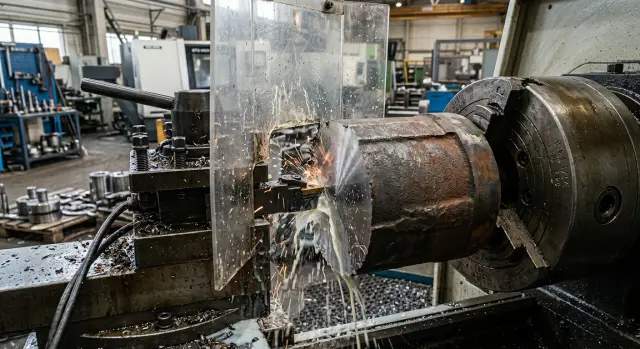
Why cast skin makes the first pass difficult
Interrupted turning on cast skin rarely starts calmly. On the first pass, the cutting tool does not meet a smooth layer of metal, but a surface with different hardness around the circumference. In one place the skin is denser, in another thinner, and somewhere there is already a step from casting. Because of this, the load on the cutting edge changes almost immediately.
In this situation, the insert does not cut evenly. It enters the metal, then gets hit again at the next contact. For the machine, this looks like a normal start, but for the cutting edge the difference is significant. Instead of smooth cutting, you get a series of short impacts, and even a new insert can chip on the very first contact.
The problem gets worse when the stock allowance on the cast skin varies. If the allowance is larger in one area, the tool takes a heavier and deeper cut. Half a turn later, it reaches a spot where there is almost nothing left to remove, and the cutting conditions change suddenly. This kind of shift quickly causes vibration, load spikes, and insert chipping during turning.
The first bad pass almost always leads to extra losses. The operator reduces feed, stops the cycle, checks the size, changes the insert, or adjusts the offset. Time is lost not only on the fault itself, but also on the restart. If the part has already moved out of size, you may need an extra pass or even scrap the blank.
What is worst of all is that the cause often seems random. In reality, it is usually simple: the skin is uneven, the tool entry is too abrupt, and the insert was chosen for ordinary turning, not impact work. That is why the first pass on a casting should be treated as the toughest moment of the entire operation. If you get through it without a chip and without a stop, the rest of the machining usually goes much more smoothly.
What to check on the blank before clamping
Problems on the first pass often do not start with the cutting conditions, but with the casting itself. During interrupted turning on cast skin, one uneven spot can cause an impact that chips the insert right away.
First, inspect the blank in good light. Look for excess metal, porosity, signs that the mold halves shifted, and rough ridges along the parting line. If the mold halves moved even a little, the tool will meet a thicker skin on one side and reach the metal sooner on the other. Such a transition rarely goes smoothly.
After the inspection, do not rely on the drawing size or the batch data. Measure the actual diameter in several places, not just one point. If the real size is larger than expected, the stock allowance on the cast skin may be very different, and the first pass will be heavier than planned.
It helps to mark with a marker the areas where the skin looks thicker. These are usually places with a darker, denser surface, excess metal, or a noticeable difference in color and texture. During a trial start, the operator already knows where the tool will meet the toughest entry and does not have to guess from the machine sound.
Also check how the blank will sit in the chuck. The jaws should rest on a stable surface, not on a random ridge or a bump in the skin. If the clamping happens on an uneven area, the part may tilt slightly, and then the impact at entry becomes stronger even with a normal feed.
The same applies to the base. The face or seating surface should not rest against cast skin that prevents a tight fit. Sometimes the blank seems clamped normally, but after the first contact it shifts slightly, and that is exactly when insert chipping during turning appears.
Before clamping, a few simple actions are enough:
- inspect the casting around the full circumference and along the parting line;
- measure the diameter in several sections;
- mark the areas with thick skin and visible defects;
- check that the chuck and base rest on even surfaces.
If you are working with a batch, do not assume every blank is identical. Even within one batch, one part may sit true while the next one shows runout and a different allowance. On machines used for this kind of work, including the turning models used by EAST CNC, this check takes only a few minutes, but it often saves an insert and the first hour of setup.
How to tell whether the stock allowance is enough
On a cast blank, one measurement almost always misleads you. The skin is rarely even across the whole diameter, so the operator should check several sections along the length of the part and at different angular positions. If you look at only one diameter, it is easy to think there is enough material, while on the first pass you cut into a clean spot on one side and keep hitting the hard skin on the other.
During interrupted turning on cast skin, an allowance error quickly leads to insert chipping. First, do not think in terms of a "total material reserve". Instead, separate two zones: how much needs to be removed from the skin itself, and how much must remain after that for normal machining. This is simple, but useful.
For example, if your measurements show 3 mm per side, that still does not mean you have a full 3 mm to work with. If the skin is 1.5-2 mm thick in places, and the part still has ovality and runout, the real reserve after the first roughing pass may be very small.
Check at least four things:
- several sections along the part length;
- ovality in each section;
- runout after clamping;
- the minimum remaining material after removing the skin.
It is better to consider ovality and runout together, not separately. If the blank is already egg-shaped and is also clamped slightly off-center, the tool will remove more in one place than expected and hit the skin again in another. That makes the cut uneven and causes the load on the insert to jump.
If the allowance is borderline, do not try to do everything at once. Two roughing passes are often safer than one deep pass. The first pass removes the hardest and most uneven part of the skin, and the second evens out the surface and leaves a clear allowance for the next stage.
On the first part, do not squeeze the allowance down to zero just to save material. It is better to leave a small reserve and see how the specific casting behaves in a real start. After a couple of stable parts, you can recalculate the conditions and remove the extra stock if the measurements confirm it.
In short, a good allowance is not a number from the drawing, but the minimum based on real measurements, taking the skin, ovality, and chuck clamping into account. When you calculate it this way, the start is calmer and there are fewer stops.
How to choose an insert for an impact entry
Interrupted turning on cast skin rarely forgives a cutting edge that is too sharp. On the first contact, the insert takes an impact, then moves along a hard and uneven surface, and weak geometry chips quickly. That is why, for the start, people usually choose not the sharpest insert, but a stronger one with an edge that can handle impact.
Set the finishing insert aside right away. It works well on a smooth surface and in calm cutting, but cast skin behaves differently. Here, what matters most is surviving the entry and getting through the first layer without an emergency stop. If the first pass goes smoothly, you can think about a cleaner cut later.
Look not only at the insert shape, but also at the grade. Cast skin often combines two problems at once: impact at entry and abrasive wear. A grade that is too hard but brittle may chip almost immediately. A very tough grade may survive impact longer, but wear down quickly. In practice, a compromise grade for heavy turning often works better than a finishing option.
The nose radius also should not be chosen at random. A large radius likes a rigid machine, a short overhang, and a firm part clamp. If rigidity is not enough, the insert will start pushing instead of cutting, and the edge will be damaged even faster. A small radius enters more smoothly, but with a large depth of cut and uneven skin, it can behave nervously. The simple rule is:
- if rigidity is questionable, start with a moderate radius;
- for a small first cut, you do not need a very large nose;
- for a heavy pass, the radius should match the depth of cut;
- if there is vibration, do not try to save the setup with feed alone.
It is useful to keep not one, but two inserts near the machine. One is the working insert, the other is a stronger one with more impact resistance. This saves time: the operator does not waste time on the first failed setup, but quickly changes to another option and continues the trial start.
If the casting looks uneven and there is a risk of hitting a thicker area in some spots, I would start with the stronger insert. Losing a little surface quality on the first pass is better than getting a chip in the first few minutes.
The holder and machine before the first start
On the first pass over cast skin, the tool does not get a steady load, but a series of short impacts. Any extra overhang, weak clamping, or play in the assembly will quickly chip the cutting edge. That is why it is better to spend 10 minutes on the mechanics before the start than to change the insert after two revolutions.
First, look at the tool overhang. The shorter it is, the more calmly the holder handles impact. If the tool sticks out farther than needed for the operation, rigidity drops very quickly. On interrupted cutting, you can feel it right away: a ringing sound appears, the edge starts to crumble, and the surface comes out in bands.
The center height is also worth checking carefully. If the tool sits above or below center, it enters the skin with extra force. For the first part, this is often more important than fine process tuning. At the same time, check how the insert sits: is there any chip under the seat, is the mounting surface clean, does the clamp pull down properly? Even a tiny chip under the insert changes the angle and speeds up chipping.
The chuck, jaws, tailstock, or steady rest must hold the blank without play. If there is looseness, interrupted turning on cast skin quickly turns it into runout under load. It is useful to rotate the blank by hand and check for a dangerous size change, contact with the guard, or a noticeable imbalance.
The coolant should be aimed exactly at the point where the cutting edge enters the metal. Not just at the part, but into the cutting zone. Then the insert heats less, and chips do not get under the clamp. If the stream misses the target, the operator may think cooling is present, but the edge is working almost dry.
Before the start, I would check five things:
- short tool overhang;
- accurate center height;
- clean seating and firm insert clamping;
- no play in the chuck and support;
- safe rotation of the blank with runout control.
A good sign that everything is ready is simple: the spindle accelerates the blank smoothly, the tool does not ring during idle approach, and the coolant reaches the point of first contact. After that, you can run a trial pass at a moderate feed and listen to the machine instead of guessing what will fail first.
How to start the first part without rushing
The first part should be started slowly. During interrupted turning on cast skin, rushing often chips the insert within the first seconds, even if the process settings look fine on paper.
First, rotate the blank without cutting at low speed. This lets you see the runout, understand whether the skin catches in any spots, and notice a dangerous point before the tool enters.
Then bring the tool not to the smoothest zone, but to the roughest one. Do this with a small safety gap so you do not catch a random impact during the approach. If the edge survives this area calmly, the rest of the job usually goes more smoothly.
A good start looks like this:
- the blank makes several slow revolutions without contact;
- then the tool approaches the problem area with a safe gap;
- the first pass is roughing, without excessive speed or aggressive feed;
- the operator watches the sound, chip form, and tool mark;
- after a few seconds, the machine is stopped and the insert edge is checked.
It is better to keep the feed moderate. Too little feed is also harmful: the insert starts rubbing against the cast skin instead of cutting it. That quickly dulls the edge, and then it breaks on the next impact.
Listen to the machine. A dull, even knocking sound during interrupted entry is acceptable, but ringing, sharp clicks, and a changing noise usually point to a rigidity problem, runout, or a process setting that is too aggressive. The chips also tell you a lot: if they come off as broken dust, and the surface is left with shiny islands and dark spots, the edge is cutting inconsistently.
After the first few seconds, stop the cut and inspect the insert with a magnifier or at least in good light. Even a tiny chip on the nose should not be ignored. If you continue, the edge will break down on the next pass, and you will lose not only the insert, but also the first part.
A careful start takes a few minutes. But it often saves an hour of tool changes, repeated setup, and figuring out why the first pass went wrong.
Example: a casting with uneven skin thickness
The same casting can behave unevenly right from the first revolution. Suppose you are turning a cast bushing: on one side the skin is thin and cuts almost calmly, while on the other there is a dense bump and a hard spot. The tool enters the metal unevenly, and the impact on the edge becomes noticeably stronger.
That is why interrupted turning on cast skin is rarely started with a full roughing pass. If you give it a normal depth right away, the insert may chip within seconds. It is much wiser to remove only the top irregularities first, so the worst spots are taken off.
In practice, the first pass is often shallow. It does not establish the final size and does not level the whole surface. Its job is simpler: knock down bumps, remove protrusions, and find out where the skin is tougher than expected. After such a pass, the surface may still look patchy, but the impacts are usually weaker.
The second pass then goes over a more even layer. Cutting becomes more stable, the sound more consistent, and the load on the edge more predictable. If the allowance allows it, this is the stage where you can create a proper rough geometry without extra risk.
After the first two passes, it is useful to stop for a minute and look at the insert. If there are small chips or a shiny band near the nose, it is better to adjust the setup right away. Usually, you first reduce feed or depth of cut a little, rather than trying to force the skin.
A good sequence looks like this:
- the first pass removes only the top of the skin and the bumps;
- the second pass runs over a calmer surface;
- after inspecting the edge, the process is adjusted;
- finishing is left for the end.
Finishing on such a casting is better left until the roughing pass has produced a smooth and clear surface. Otherwise, the finishing insert will meet leftover skin, take an impact, and spoil the size. A few extra minutes at the beginning usually save both the tool and the time for the entire batch start.
Mistakes that break the insert in the first minutes
Interrupted turning on cast skin does not break an insert because of one big reason, but because of several small mistakes at once. One of the most common is installing a sharp finishing insert for the first pass. It cuts smooth metal well, but it handles impact from hard skin and local bumps poorly. As a result, the cutting edge chips quickly, and the trace on the part becomes rough.
Another common mistake is too little stock allowance. On the outside it seems like there is enough material for the pass, but in fact the insert does not cut steadily and rubs against the skin. This is the worst mode: lots of heat, little chip removal, a sharp sound, and the edge dies almost immediately. If the skin thickness varies, that kind of mistake shows up on the very first part.
A long tool overhang is also often underestimated. Even if the machine is rigid, extra millimeters quickly create vibration during impact entry. First, a ringing sound appears, then small chips on the insert, and after that the operator tries to compensate with speed or feed. That usually only makes things worse.
What people often do too early
Many increase feed before they look at the first cutting mark. That is rushing. First, you need to make sure the insert enters the material evenly, does not break loose on the skin, and does not hit an impact on every revolution. If the mark is unstable, it is too early to increase the settings, even when the machine has enough power.
Another mistake is failing to check blank runout and local bumps. On a cast part, this is normal, not rare. If the blank runs out, the insert receives a different load on each revolution. If there is a bump on the surface, the first contact may be too harsh. Sometimes one such point is enough for a new insert to lose its edge in a few seconds.
In practice, it is useful to watch the first 10-15 seconds very carefully. If the sound changes suddenly, the chips come off in bursts, and you can already see shine or a microchip on the edge, it is better to stop immediately and correct the setup. That is cheaper than changing the insert, the holder, and then searching for the cause through the whole chain.
On CNC lathes, this check is often seen as unnecessary, but it is exactly what saves the first startup from pointless stops. Start with a stronger insert, enough allowance, and a short overhang. Then add feed only if the first pass went smoothly.
A quick checklist before production
Interrupted turning on cast skin rarely forgives haste. If you do not check a few simple things before production, the very first part can end with insert chipping, an extra stop, and repeated setup.
Before starting, it helps to run through a short checklist and not keep everything in your head. A paper card, a note in the control, or a route sheet is better than a verbal agreement.
- Measure the blank in several points and write the values down. One check is not enough: on a cast part, the skin and runout often vary around the circumference.
- Confirm that the allowance really covers the skin. If there is enough material in one zone but the tool is almost on the surface in another, the impact at entry will be stronger.
- Keep the main insert and an identical spare near the machine. When a chip happens at the start, time is lost not on the replacement itself, but on finding the right position and grade.
- Save the first working setup after a successful pass. Feed, speed, depth, and entry point should stay in the record so the next start does not begin from scratch.
- Agree on the sign that tells the operator to stop the cycle. Usually it is a sharp ring, a new streak on the machined surface, higher load, or a change in chip shape.
It is also worth checking small details that often seem unimportant. The insert should sit cleanly, with no chips under the seat. The holder should be tightened once more. The blank should be rotated by hand to make sure there is no unexpected protrusion that the tool will meet first.
A good sign that you are ready for production is simple: the first pass was calm, and its settings can be repeated without new trials. If the operator already knows when to stop the cut, and a spare insert is ready at the machine, the startup goes much more smoothly.
For shops that often work with different castings, this checklist quickly becomes standard practice. It saves not minutes on paper, but parts, inserts, and nerves at the machine.
What to do after a successful start
A first smooth pass does not give full confidence. During interrupted turning on cast skin, the insert often fails not on the first part, but on the second or third, when the operator decides to increase feed or speed right away. It is better to lock in the good result than to rush the process changes.
Right after the first pass, save a photo of the cutting edge. The image is not for a report, but for comparison. After a couple of parts, you will see how the chip changes, whether there is edge wear at the nose, and whether the wear is moving to one side. If there is no photo, the judgment is usually based on memory, and memory often fails.
Then write down the real data, not the calculated ones. On paper, the allowance may be one thing, but on the casting it may be another. It is useful to note:
- the actual allowance in several areas of the part
- the place where the skin hits hardest
- the condition of the insert after the first and second pass
- the settings at which cutting runs smoothly
Such a log pays off quickly. On the next batch, you already know where to expect the impact, how much material is really removed, and when it is better to change the insert in advance instead of after a chip.
Increase the settings only after two stable parts in a row. If the first part came out clean, but on the second the edge is already crumbling, the start still cannot be called normal. First, get the same cutting sound, predictable chips, and similar wear. Only then change speed or feed, and even then in small steps.
If this part comes into production regularly, there is no need to solve the same machine-side problems every time. In that case, it makes sense to discuss the machining setup itself: whether the current lathe is suitable, whether the rigidity is enough, whether impact entry is convenient, and whether it is worth reviewing the tooling and start-up settings. For such tasks, EAST CNC can help with machine selection, commissioning, and service for turning operations if you work with serial casting blanks.
A good start is only valuable when it can be repeated on the next part without extra stops.