
Interrupted Cast Iron Cutting: How to Choose Entry and Exit
We break down interrupted cast iron cutting: which entry and exit schemes chip the edge less, what to check before a production run, and how to reduce scrap.
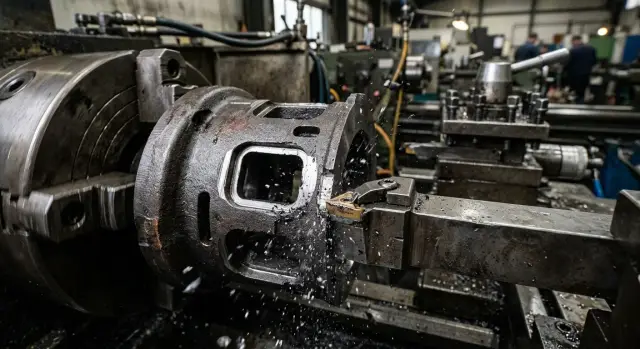
Why the edge crumbles in interrupted cutting
In interrupted cast iron cutting, the insert does not cut metal continuously. It enters the material, then meets air again, and then takes another hit. These short impacts usually damage the cutting edge faster than speed or feed rate themselves.
At entry, the tool does not start removing chips gently. The insert tip takes an instant load, and the most delicate part of the cutting edge absorbs it. If the entry is abrupt, especially at full depth of cut, chipping appears very quickly.
With cast iron, this is even more noticeable. The material is brittle, often with a hard skin, pores, and uneven zones. Because of that, the load does not come in evenly; it comes in jolts, and the insert tip works in the worst possible conditions.
The problem is not only at entry. The exit from the cut also hits the tool, especially when the tool leaves the metal at full depth and without a smooth unload. At that moment the chip changes shape suddenly, contact with the part breaks off, and the cutting edge gets another shock.
In series production, this effect builds up fast. First you see a small chip, then roughness increases, the size starts to drift, and after a few parts the insert no longer holds geometry. Average cutting conditions may look fine, but the edge is killed by a short peak at the moment of impact.
A good example is a part with a slot, hole, or casting window. In one pass, the tool enters and exits the metal several times. If the path sends the insert straight into the wall, tool life drops much faster, even when the cutting speed does not seem high.
Another common cause is too much faith in a "strong" insert. A tougher grade helps, but it does not cancel the physics of impact. If the entry and exit scheme is poor, chipping will still start at the tip or near the nose radius.
That is why, in interrupted cast iron cutting, the first thing to look at is not only the insert grade, but how the tool enters the metal and how it leaves it. Often those transitions decide whether the edge survives the whole batch or starts crumbling on the first few parts.
Where the part creates the strongest удар
On a cast iron part, the impact is rarely spread evenly along the whole path. Usually the edge takes it at a few short points, and that is where the insert starts crumbling within the first parts of the batch.
In interrupted cast iron cutting, the most dangerous thing is not the break in contact itself, but the sudden return into the material. If the tool re-enters the metal after a gap, the load jumps sharply. For cast iron, that is especially harsh: the material itself is abrasive, and the impact breaks the thin part of the cutting edge.
Problems most often begin in these places:
- after a window or slot, when the tool cuts back into solid metal
- on areas with casting skin, where the surface is harder and rougher than the normal layer
- near a thin wall, if it deflects and vibrates when the tool exits
- at a sharp corner, where the full load concentrates almost in one point
Windows and slots change the cutting conditions instantly. Before the break, the tool works smoothly; then it unloads for a fraction of a second, and after that it gets hit again on the next entry. If the feed is high, chipping may not appear along the whole edge right away, but on one small section. After that, the insert wears much faster.
Casting skin often ruins the picture even more than the interrupted section itself. On clean metal, the tool behaves predictably, but skin acts like rough sandpaper. In series production, this shows quickly: the first part still holds, and by the second or third part, small crumbling appears.
With a thin wall, the problem is different. Entry may seem fine, but on exit the wall starts to flex and the tool catches vibration. That impact is weaker than a re-entry after a slot, but it repeats on every part and quickly eats away at tool life.
Sharp corners should not be underestimated either. If the path brings the tool directly into the apex, contact starts too locally. It is better to treat that area as the hardest point in advance and choose the entry and exit scheme around it.
In practice, the operator should not look at the whole surface of the part, but at the points where contact changes. That is usually where the decision is made: whether the insert survives the shift or starts chipping after a few cycles.
Which entry and exit schemes are worth comparing
In production, there is usually no point in trying ten different toolpaths. Five schemes are enough to quickly show where the edge lasts longer and where the insert starts crumbling on the first parts.
In interrupted cast iron cutting, the impact at the moment of contact often damages the edge more than the cut itself. That is why you compare not only entry, but also exit: the last contact with the metal can easily cause chipping too.
- Straight entry into full stock. This is the simplest option and the harshest in terms of impact. It works if the allowance is small, the part is rigid, and the insert can handle the first contact.
- Tangential entry with a short lead-in. The tool enters more gently, and the load does not rise all at once. This is often better when the part has windows, casting cavities, or an uneven skin.
- Entry through a chamfer or relief groove. The edge first touches a small area rather than the full height of the stock. For cast iron, this is often calmer, especially if the first hit lands on a rough cast surface.
- Exit into a pre-removed allowance. If a small section is removed in advance, the tool does not get a sudden release at the end of the pass. It is a small thing, but in production it often adds dozens more parts per edge.
- Two light passes instead of one heavy pass. Cycle time increases a little, but the impact at entry and the release at exit become much weaker. For unstable castings, this option is often better than frequent insert changes.
Compare the schemes fairly. Keep the same insert, the same tool overhang, the same depth of cut, and the same feed. Change only the entry and exit path, otherwise the conclusion will be blurred.
If the part is produced in a large batch, do not judge by one nice blank. Check at least 20 to 30 parts in a row. Sometimes straight entry looks fine for the first three parts, but by the tenth, the edge is already crumbling, while tangential entry runs the whole series more steadily.
In practice, the selection often goes like this: straight entry is kept only for light stock, a chamfer or groove is chosen for rough cast surfaces, and two passes are used where insert scrap costs more than a few extra seconds of cycle time. It is a simple way to choose a scheme without guessing.
How to choose a scheme for a series
For a series, it is not enough for the tool to survive one part. You need a path that the machine can repeat hundreds of times without surprises. In interrupted cast iron cutting, I would first look not at the insert datasheet, but at the point where the edge takes its first hit.
Find the point where the tool first re-enters the metal after the material breaks. That is where the edge most often chips. If the break is wide, the impact is usually harsher. So it helps not to guess, but to measure the width of that break on the part or on the drawing and compare it for different toolpaths.
Next, choose the softest entry scheme that the part geometry allows. Usually this is the option where the tool does not slam into the material head-on, but enters smoothly with a short lead-in. A sudden entry may look faster, but in production that saving is often eaten up by insert changes and machine stops.
A good sequence is:
- find the first impact point on the path;
- measure the width of the material break;
- run a short trial batch, not just one part;
- after a few parts, inspect the edge with a magnifier;
- keep the scheme where wear stays even, without corner chipping.
The trial batch should be short, but honest. One part is not enough: the insert may survive the first impact and then crumble on the sixth or eighth part. In practice, 10 to 20 parts is enough if the batch is typical and the conditions are already close to working settings.
Do not look only at whether chipping happened. Look at the shape of it. If the insert corner crumbles on the same side every time, the entry is too harsh or the first contact hits a weak part of the edge. If wear is even across the working face, the scheme is usually suitable for production.
A small example. There are two toolpaths, and the cycle time difference is only 2 seconds. The first one gives small chips after just 7 parts. The second one lasts for 20 parts, and the edge wears down smoothly and evenly. For production, the second option wins. It is slower on paper, but cheaper and calmer on the shop floor.
What to adjust in the cutting conditions after choosing the scheme
Even a good entry and exit scheme will not save the edge if the cutting conditions are too aggressive. In interrupted cutting, the insert takes a hit in the first fractions of a second, and that is where chipping usually starts.
First, remove extra aggressiveness at the entry point. If you already chose the path, reduce feed during entry, even if only for a short section. Often a 10-20% reduction is enough for the insert to enter more calmly and avoid a sharp удар.
It is also better not to push speed to the limit right from the start. Cast iron cuts dry and likes stability, but on an interrupted contour, too high a speed at contact quickly chips the thin edge. It is wiser to give the machine a slightly softer start and then increase the setting if the edge is holding well.
You should also review the depth of cut on the first pass. When the part hits the edge because of a window, rib, or casting irregularity, a large removal on the first contact almost always works against you. It is better to remove less on the first pass and leave the main removal for the next one than to lose the insert on the second part.
Also check the tool itself. If the nose radius is too small, the edge chips more easily from impact. If the radius is too large, cutting force rises and the impact becomes heavier too. The insert grade should handle impact load, not only produce a nice finish on smooth continuous cuts.
Tool overhang often hurts the result more than it seems. A long overhang adds vibration, and every repeated entry into the material becomes harsher. If possible, shorten it even by a few millimeters. In production, that quickly shows up in insert life.
In practice, a simple sequence helps:
- slightly reduce feed at entry
- do not set maximum speed at the start
- reduce the first depth of cut
- verify nose radius and insert grade
- remove unnecessary holder overhang
Suppose you are turning a cast iron blank with a slot, and the tool re-enters the material on every revolution. If the edge still crumbles on the 6th or 8th part after you choose the entry scheme, first soften the entry, then reduce the first pass, and only after that change the insert. That order usually saves both time and tooling.
An example for a series part
A good example for the topic of "interrupted cast iron cutting" is a housing made of EN-GJL-250 with two windows on the outer diameter and a shoulder near the end face. On paper, the operation looks simple: ordinary external turning. On the machine, it is more complicated, because the tool passes through empty space twice and then takes another impact on the metal.
In the trial batch, the straight entry was chosen first. The tool almost immediately entered the zone where a window followed a solid section. Very early in the run, the edge started to crumble. The size was still holding, but small chips appeared on the insert, and the cutting sound became sharp and uneven. For production, that is a bad sign: if the edge crumbles on the first parts, size and roughness will start to vary.
The scheme was changed not by the cutting conditions, but by the path. The tool entry and exit were made softer: the entry was led tangentially so the tool would not hit cast iron head-on, and a small groove was added at the exit. It gives the tool a clear departure point. Instead of a sudden pull-away, the edge leaves the cut calmly, without an extra snap.
The difference is usually visible right away. The sound becomes smoother, there are fewer signs of impact load on the insert, and the edge of the shoulder does not drag chipping with it. In CNC turning of cast iron, this is often more important than simply reducing feed. If the entry remains poor, the machine may sound quieter only for a short time, but the edge will still crumble.
For series production, two passes worked better here. The first removes the main allowance and takes the roughest impacts at the windows. The second pass runs more calmly and holds the size on the outer shoulder. This takes a little more cycle time, but it removes unnecessary insert stops and gives predictable results across the whole batch.
If your part is similar, do not rush to adjust only spindle speed and feed. First look at where the tool meets the first impact and how it exits the metal. In many cases, that is what decides whether the insert edge chips right at the start or whether the insert lasts until the end of the shift.
Mistakes that make the insert crumble
In interrupted cutting, the insert often crumbles not because of the cast iron grade itself, but because of a couple of wrong decisions at the start of the pass and at the exit. The operator changes the insert, tweaks the feed a bit, but the cause stays in place.
The first common mistake is simple: the same settings are used on casting skin as on an already cleaned surface. Skin is harder and behaves more unevenly. If the tool cuts into it at normal speed, the impact on the edge is sharp. In production, this shows quickly: the first part passes acceptably, then chips begin to appear in the same spot.
A direct approach into a sharp corner is no better. When the tool enters without a smooth transition, the load arrives almost instantly. For cast iron, that is a bad scenario. A brittle edge does not like that kind of entry, especially if the part already creates impact because of slots, windows, or changes in section.
Another mistake is related to exit. If the full allowance is left all the way to the edge, the tool leaves the metal under full load. On sound, this is often heard as a dry click. After that, small edge chipping appears, and then size drifts and finish gets worse.
Many operators make it worse at the moment they hear the impact and increase speed. The logic is understandable: move faster and shorten contact time. In reality, the impact usually becomes harsher. If the problem is the entry scheme or rigidity, speed does not fix it; it only accelerates wear.
There is also a more boring reason that is often forgotten. The chuck runs out, the holder has a slight looseness, and the tool is not clamped as rigidly as it seems. Then even a normal entry and exit work poorly. On a turning operation, this is easy to miss because cast iron is noisy anyway.
Before starting a batch, check five things:
- is there casting skin at the entry point;
- is the tool entering directly into a sharp corner;
- is full stock left at the exit;
- did the speed increase after the first impacts;
- is there chuck runout or fixture looseness.
If CNC turning of cast iron starts chipping the edge, do not look first at the insert catalog, but at the process mechanics. An indicator on the chuck, a short test pass, and one calm recheck of the entry usually tell you more than another box of inserts.
A quick check before starting the batch
Before production, do not trust one successful trial part. In interrupted cast iron cutting, the edge often survives the first pass and then starts crumbling on the third or fifth blank.
The quick check is not for reporting; it is to avoid losing a shift to chipping and insert changes. This is especially important if you are doing CNC turning of cast iron with a hard impact in the entry or exit zone.
Before starting the batch, go through five simple points:
- First, look at the drawing and mark where the tool enters and exits the metal. If there is a slot, casting cavity, step, or window nearby, the impact at those points is almost always stronger than the path on the screen suggests.
- Then check clamping and part overhang. Even a good setup will not save you if the blank is seated unevenly or sticks out farther than needed. On cast iron, you can quickly hear that through a harsh sound and small chips on the cutting edge.
- On the first blank, measure the actual allowance, not just the calculated one. Castings often vary, and then the tool cuts deeper than planned. That changes both the load and the behavior at exit.
- After a few parts, remove the insert and inspect the edge. Do not wait for obvious failure. If you see dull edge breakdown, small chips, or impact marks on one area, the entry and exit scheme already needs adjustment.
- If everything runs smoothly, record the working setup immediately in the setup sheet: path, allowance, cutting conditions, insert radius, overhang, holder number, and after how many parts you checked the edge.
It also helps to do one more short test: machine not one part, but at least three in a row without stopping for extra corrections. That run shows faster whether the chosen scheme is fit for production, or whether it only holds up under the calm conditions of a trial start.
In production, it is often the small things that cause trouble. The drawing was only glanced at, the allowance was not rechecked, the first insert was not inspected in time. On interrupted cast iron cutting, that is already enough. It is better to spend 10 minutes before the batch than to change inserts every few parts.
What to do next
If the edge is still crumbling, start with the path, not a new insert. A different entry and exit scheme often removes the impact better than trying to "tough it out" with a harder grade or lower feed.
In interrupted cast iron cutting, small details matter a lot. The insert can work calmly at the same settings if the tool enters more softly and does not take a sharp hit at the exit zone. So it is better to change the tool path first, and only then look for a different geometry or coating.
For a new series, it is better to plan a chamfer or a small groove in advance where the tool exits the cut. Such a feature does not always change the part visibly, but it often removes the most annoying chip. That is cheaper than losing inserts and time on setting up the cut at the machine.
Do not rely on the operator’s impression after one part. Compare 2-3 schemes on a short run, for example on 10-20 blanks, and record the result. Look not only at tool life, but also at cutting sound, size, repeatability, and cycle time.
It is worth keeping a simple check sheet handy:
- how many parts the edge lasts before the first chips
- where the impact appears: at entry, at the bridge, or at exit
- whether the size changes by the end of the test
- whether noise or vibration grows as wear increases
- whether the same result can be repeated on the next batch
When the batch gets larger, it makes sense to look beyond one operation. If you regularly turn similar cast iron parts, discuss with EAST CNC engineers not only the toolpath, but also the machine itself, commissioning, and service for your needs. For production, that is a practical step: the right machine and a clear service plan create fewer surprises on identical parts.
If one scheme gives at least 15-20% more tool life without losing size, lock it into the setup sheet and do not go back to the old version "out of habit." In series cast iron machining, the winner is usually not the fastest path, but the one that cuts the same way every time.