
Inter-process Packaging for Precision Parts Without Losing Size
Inter-process packaging for precision parts reduces the risk of dents, shifts, and mix-ups along the route. We break down trays, inserts, and labeling.
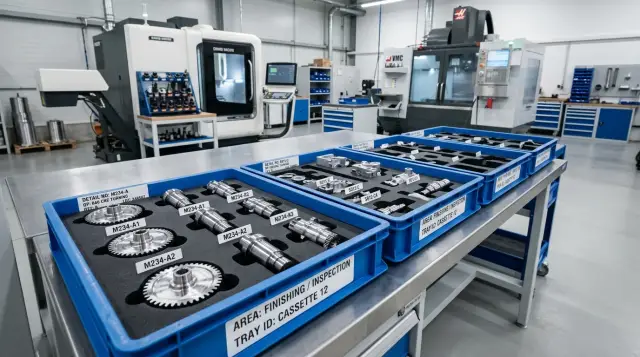
Where parts lose precision on the way
A part often loses accuracy not on the machine, but on the way from one station to another. After a finishing operation, the part already has datums, chamfers, and mating surfaces. If even a small impact hits them, the dimension on the drawing may stay the same, but the part will no longer fit as it should.
The first common issue is sudden cart movement. Packaging without fixation lets parts move around inside the box, and the blank hits the wall every time there is braking, a floor joint, or a turn. One impact is not always obvious right away. But a dent quickly appears on the finishing area, a burr grows on the edge, and the datum is no longer flat enough for the next setup.
The parts themselves also cause damage when they lie too close together. In a batch of shafts, housings, or bushings, neighboring parts rub against datums, chamfers, and ground areas. To the eye, it looks like fine dust or a light mark. In reality, the operator later has to deal with runout, a contact mark, or extra microns after reinstallation.
The problem gets worse when the batch changes packaging between stations. One operator puts the parts in a plastic bin, another transfers them to a metal tray, and a third wraps them in film. There is no common rule, and every move adds risk. The part gets handled one extra time, placed however it fits, or stacked on top of another. That is how inter-process packaging for precision parts turns into a random set of boxes instead of part of the process.
Film and shop rags also create a false sense of protection. They keep dust and chips off the surface, but they do not hold the part in place. When shaken, the film shifts, the rag bunches up, and metal still touches metal. For precision parts, the danger is not only dirty contact, but any free movement inside the packaging.
This shows up quickly on metalworking lines: the dimension goes off not because of the machine, but because of storage and transport between operations. If the packaging does not set the part’s position and does not isolate finishing areas, losses start before the next setup.
What the part needs protected
Usually it is not the whole body that gets damaged, but a few zones that affect the next measurement and assembly. If the packaging holds the part by “safe” areas, the size stays intact. If the support lands in the wrong place, the part reaches the next station already scratched, dented, or with a damaged edge.
First, look at the datums used for the next measurement. These may be the face, outer diameter, bore after boring, or a shaft journal. These are the areas that must not rub against the bottom of a box, be pressed by a strap, or be stacked under another part. Inter-process packaging for precision parts should unload the datums, not rest on them.
Thin edges, chamfers, and finished threads are often overlooked. On a drawing they look minor, but in the shop they are exactly what catches on another part, the edge of a tray, or chips left in the cell. After that, the chamfer gets crushed, the thread develops a burr, and assembly becomes tight.
Finishing surfaces need special attention. After grinding, honing, or boring, even light contact leaves a mark. Film and rags often only hide the problem here: the part seems to lie softly, but underneath there is a fold, abrasive dust, or a sharp edge. For these areas, trays with precise cell geometry and soft inserts that prevent movement work better.
Usually these zones need protection:
- datums for the next operation
- thin edges and chamfers
- finished threads
- finished mating and ground surfaces
- thin-wall areas that dent easily
There is a simple rule: do not load the part where the metal dents easily. For a thin-wall bushing, that is the edge and cylindrical wall. For a shaft, it is the finished journal if the whole weight of the part rests on it. For a housing, it is the bored hole if the part rocks in the packaging and hits a stop.
In short, good packaging does more than move the part between stations. It decides in advance which surfaces may touch and which may not. Then the next operator receives not a “nearly good” part, but a part with no extra questions about size and surface condition.
How to choose packaging step by step
Choosing packaging starts not with a catalog, but with the part itself. In the shop, a part is rarely damaged by one strong удар. More often, the size shifts because of small contacts when the blank or finished part is moved many times between the turning area, washing, and inspection.
For inter-process packaging for precision parts, first take the real dimensions, not just the drawing data. Measure the length, diameter, protrusions, chamfers, and the places that can catch during placement. Then set the allowed clearance in the cell: the part should not rattle, but it should not fit too tightly either.
Next, check where support is actually acceptable. For many parts, you cannot press on a ground journal, thread, thin collar, or reference plane. If the support lands there, the tray will look neat, but it will start damaging the surface on every transfer.
It helps to follow a short checklist:
- Mark the support points on the rigid and non-working areas of the part.
- Estimate the weight of one part and the total weight of a full tray.
- Consider the distance between stations, cart turns, and manual transfers.
- Check how the operator picks up the part with gloves and whether they can place it without twisting it in the air.
- Do a trial run and look immediately for marks: rubbing, point dents, shiny edges, and knocking in the cell.
The number of parts in a tray should be chosen not by the wish to fit more, but by what the bottom can handle and what a person can move safely. If the tray is heavy, the operator starts setting it down more abruptly. After that, a soft insert no longer helps.
A trial run often shows more than an hour of discussion. Move the tray along the usual route, lift it the way it is handled on shift, and unpack the parts one by one. If the same marks appear on the surfaces, the source is usually close: a cell that is too small, the wrong support, or an awkward hand grip.
Good packaging saves more than scrap. It removes extra motions, and the operator places the part the same way every time. That is what gives a stable result between stations.
Which trays and inserts work in the shop
In the shop, the best packaging is the kind that keeps its shape and does not change from shift to shift. If a tray bends or shifts on the cart, parts start moving, bumping into each other, and taking small impacts on datums, edges, and finishing surfaces.
A rigid tray solves this problem first. A metal or dense polymer body keeps its geometry even when the packaging is stacked, rolled over an uneven floor, or turned between stations. For precision parts, that is more useful than film, cardboard, or rags, because the shape of the compartment does not change every time.
A tray with a milled insert works even better. Each part has its own pocket, and it sits in the same position every time. That makes it easier to maintain clearance between neighboring parts and avoid accidental contact on a ground surface.
On turning and grinding stations, such an insert usually supports the part at areas where a small mark does not affect the size. This may be a rough band, a face that will be machined later, or an area that will be hidden in assembly. If the part is supported in the wrong place, precise packaging quickly loses its purpose.
A soft insert should be used only where metal-on-metal contact is not allowed. It is useful for polished journals, thin edges, coated surfaces, and parts after a finishing operation. If the whole insert is made soft, the part starts to “float,” and chips and oil get pressed into the material.
For long shafts, bushings, and thin rings, separators work best. They stop the part from rolling, keep the spacing, and remove load from the edge. For a long shaft, support at two or three points is usually better than a continuous soft pad.
If the packaging is often moved around the shop, a lid or a clamp is essential. A part may sit well on the table, but shift at the first threshold. The clamp should not press on a finishing surface. It should only keep the part in place.
A good simple example is a batch of shafts after finish turning. A rigid tray, separate pockets for each shaft, a soft insert only under the finished journal, and a light lid on top usually work better than wrapping in film. Film hides the part, but does not hold it.
If the station runs parts in batches, such packaging saves more than scrap. The operator spends less time transferring parts, notices empty spaces faster, and is less likely to mix up part orientation before the next operation.
How to label packaging without confusion
If the operator has to guess what is in the tray and where to put it, the labeling does not work. For inter-process packaging for precision parts, markings should be readable at a glance, from the aisle and at the workstation. That is why the part number and current operation are best shown in large type and repeated on at least two sides of the packaging.
One label on the end is not enough if the tray is turned the other way. In the shop, packaging is often stacked tightly, moved by crane, or turned on a cart. When the marking is on two sides, the person does not waste extra seconds and is less likely to take the wrong batch.
If the part orientation affects placement, that should also be written directly on the packaging. A simple “Up” with an arrow works better than a long instruction. For parts with a finished surface or thin collar, this is not a small detail: turn the tray once, and the surface is already touching the support on the wrong side.
The labeling should have four clear fields:
- part number
- current operation, for example “after turning” or “after washing”
- allowed quantity and total batch weight
- batch status: good, inspection, scrap
The quantity and weight limit is not for paperwork, but for real protection of the parts. If people put “just a few more” into the cells, the bottom row gets extra load. For thin shafts, rings, and parts with a precise fit, that is sometimes enough to cause scratches, dents, or size shift after remeasurement.
The batch status should be obvious at first glance. Color signs, plastic cards in a holder, or replaceable tags made of sturdy material work well. Paper sheets taped on quickly get oily, tear, and disappear. After a couple of shifts, no one is sure where washing is, where inspection is, or where scrap is.
A simple system works well: permanent data is put on the packaging itself, while variable information is changed on a separate tag. That way, part trays last longer, and inter-process packaging labeling stays readable. If a worker understands in two seconds what is inside, how to place the packaging, and whether the batch can move on, there is almost no confusion left.
A simple example for a shaft batch
After turning, a batch of 40 shafts often looks finished. The surface is shiny, the size is within tolerance, and the ends are clean. But this is exactly when the part is easy to damage: the journal is already almost at size, and one accidental scratch is enough to create extra problems at the next station.
If the worker puts the shafts into a regular box, metal touches metal. During transfer, the parts roll slightly, hit the ends, and rub against the side surface. Film and rags help only a little: they bunch up, catch fine chips, and do not hold the shaft in place.
In the shop, inter-process packaging for precision parts works better with a rigid tray. Inside, each shaft rests on two supports. The supports are placed so that the finished journal does not touch the bottom of the tray. Then the load goes to less sensitive areas, not to the surface that will later be ground or measured for size.
Separators are placed between neighboring shafts. They stop the parts from shifting and rubbing against each other when the tray is moved between stations or placed on a rack. It is a simple thing, but it often prevents small dents that are noticed too late.
Labeling also prevents many small mistakes. The tag includes only what the supervisor and operator need:
- the station where the batch was made
- the next operation
- the number of parts in the tray
- the part or batch designation
Such a label helps avoid mixing up sizes and guessing where to send the tray next. If a shift runs similar shafts with different allowances, confusion starts very quickly.
In the end, the batch arrives at grinding in the same condition in which it left turning. There are no dents on the journals, the surfaces are not worn, and the parts are not mixed up by size. And that is not a small detail: the grinder spends time machining, not sorting and looking for the cause of scrap.
Mistakes that make packaging fail
Even good inter-process packaging for precision parts will not help if the part is left to move freely inside it. The most common problem is simple: the cell is too large, and the blank or finished part hits the walls during transfer by cart or crane.
From the outside, everything looks fine, and then at inspection small nicks, scratches, or size drift appear. For a shaft, it can be one impact against a divider. For a housing, it can be contact on a face that is later used for fixturing.
Where packaging fails most often
Many inserts are made to match a convenient shape, not the logic of measurement. As a result, the support presses exactly on the datum used later for sizing. After that, the operator argues with inspection, but the cause is in the tray itself.
Another mistake is putting parts from different operations into the same packaging. A semi-finished part after turning and a finished part end up in one cell. They have different surface quality, different tolerances, and different damage risks. Confusion starts quickly: one part is sent forward too early, another is sent back, and a third gets scratched by its neighbor.
Dirty packaging damages parts quietly and steadily. Chips, abrasive dust, drops of old coolant, and small debris work like sandpaper. If the tray is cleaned only occasionally, the metalworking inserts themselves become a source of scratches.
There is also a purely practical issue: the packaging is inconvenient to use. If the operator has to twist their wrist, reach deep into the cell, or pick up the part in two awkward motions, they start placing it off target, on the edge of the tray, or directly on top of another part. After a couple of shifts, that setup falls apart.
A short five-point check is usually enough:
- the part does not rock in the cell and does not knock when the packaging is moved lightly
- the supports do not touch the datum or finishing surfaces
- the tray contains parts from only one operation
- the bottom and insert are clean at the start of every shift
- the part can be taken and placed with one hand and no extra movement
If even two points do not match, the problem is not the people. The inter-process packaging labeling, cell shape, and cleaning routine need to be revised before the next batch.
A quick check before launch
If inter-process packaging for precision parts is chosen correctly, the pre-launch check takes 10–15 minutes. Those minutes usually save a whole shift of arguments between stations when a new scratch, chip, or size drift suddenly appears on the part.
First, take 3–5 parts from the batch and place them into the cells the way they will actually be handled in the shop, not “carefully for the test.” Then gently rock the packaging, tilt it, and roll it on a cart for a few meters. If the part touches another one in even one position, the packaging does not pass the test.
Check five things.
- Parts do not rub against each other during transfer, tilting, or light vibration.
- Each cell holds the part evenly, without skew or rocking. If a shaft or housing can be pushed sideways with a finger, the support is too weak.
- The marking is visible from the aisle. The worker should be able to read the part number, route, and status immediately without turning the packaging.
- The packaging completes the whole route without extra transfers: cart, pallet, washing, machine table.
- After the trial shift, there are no new scratches, dents, or chips on the surfaces.
Usually the problems show up not at the inspection bench, but in motion. A cell may seem convenient while the packaging is standing still. But as soon as it is rolled to washing or to the next station, the part starts to rest on an edge, hit its end, or roll inside the pocket.
It helps to do a simple test. Send one filled tray along the usual route for a trial shift, then compare the parts with the ones left at the start. Look not only at the size, but also at new marks on ground areas, chamfers, threads, and datum surfaces. Even one fresh scratch already shows that the part trays or metalworking inserts need improvement.
If even one point fails, do not rely on staff being extra careful. It is better to change the cell, the support height, or the loading method right away. The packaging should hold the part correctly on its own, without extra reminders.
What to do next on your line
Do not try to redesign the whole flow at once. Take one part that most often shows scrap or marks, and follow its entire route between operations. Usually the problem is not on the machine, but at the moment the part is removed, placed down, transported, sent for inspection, and put back into packaging.
Inter-process packaging for precision parts usually gives results when it is tested on one clear route. That makes it easier to see where the part gets scratched, dented, or hit on a datum surface, and avoids arguing based on guesses.
For a start, a short check is enough:
- Choose one problematic part and follow its full path during the shift.
- Photograph all contact marks: rubbing, nicks, chip marks, thread or journal contact.
- Make a simple tray or insert sample and run it for one shift.
- If you are preparing a new machine or line, think about the packaging together with the movement of the part between stations.
It is better not to overcomplicate the first sample. Often a plywood or polymer tray with supports in safe zones is enough to show the difference right away. If fresh marks disappear after the shift and loading does not get slower, you have already found a workable direction.
Do not look only at appearance. Check the size after transport, see whether the part changes position in the cell, and ask the operator whether it is easy to pick up and return the part with one hand. If the tray slows the pace, people will stop using it quickly, even if the idea itself is right.
A good sign is when you can show before-and-after photos, name the contact point, and say how many parts passed the shift without new scrap. At that point it is no longer an opinion, but a fact for the supervisor, technologist, and quality control.
If you are launching a new CNC lathe or a line, discuss the packaging in advance, not after the first losses. In EAST CNC projects, this can be considered already at the equipment selection stage: where the part is removed, where it goes after the operation, and how it reaches the next station. That kind of discussion at the beginning often saves more than reworking the packaging after startup.