
Indexing Chuck on a Milling Center Instead of a 4th Axis
An indexing chuck on a milling center can help you get by without a 4th axis at the start. We break down the cost, accuracy, flexibility, and practical limits of the solution.
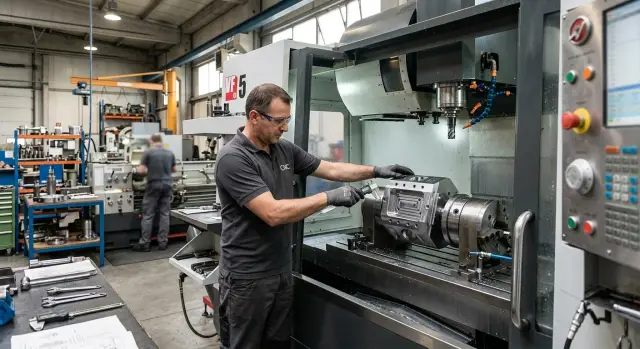
Why people look for a 4th-axis alternative
A full 4th axis changes more than the line on the invoice. Along with it come costs for the rotary unit, connection, setup, tooling, programming, and commissioning. For a small shop, this is no longer a simple add-on to the machine, but a separate project.
If the parts come in small batches, this kind of purchase pays back slowly. There are not many orders, the unit works only a few hours a week, and the money is already tied up in it. That is why many shops first look for a way to cover current operations without a big upfront spend.
Very often, the job is simpler than it seems. For many parts, there is no need to rotate the workpiece during cutting. It is enough to turn it to a fixed angle, clamp it firmly, and machine the next side. If the part has two, three, or four working faces, indexing is often enough.
That is why an indexing chuck attracts the attention of people who look at the budget without illusions. It makes it possible to start multi-face machining without a sharp increase in investment. The shop does not have to postpone the order for months just because there is no budget for a full axis right now.
There is also a purely production-based reason. The job has to start on time. If a milling center is already in the shop, it makes sense to use its full potential first with indexing tooling, and only then decide whether automatic kinematics are really needed.
A good example is a small series of housings or flanges. You need to machine the top face, a side face, and the end face. Between operations, a precise turn to a fixed angle is enough, and continuous rotation gives no real advantage. In that case, the shop spends less at the start and gets a working result faster.
Replacing a 4th axis is usually needed not because someone wants to save money at any cost. The reason is simpler: the order is already there, the machine is already there, but a full axis still does not fit the budget.
What an indexing chuck can do
An indexing chuck solves a simple task: it turns the workpiece to the required angle and holds it rigidly in that position. After the turn, the machine machines the next face as if the part had originally been set at that angle. For many parts, that is enough.
This option works when you need to machine several sides one after another, not cut while the part is rotating. For example, a housing may need holes on four faces, a slot on the side, and several threaded holes at 90 degrees to each other. The chuck turns the part, locks it, and the milling center keeps working.
It is usually used for multi-face machining in one setup, drilling and boring in different positions, slots, pockets, and flat surfaces at fixed angles. It is especially convenient where operations repeat in the same positions, for example at 2, 4, 6, or 8 positions.
Another advantage is a simpler launch. In this type of setup, there are usually fewer connection issues and fewer control requirements than with a full 4th axis. If the parts are standard and the angles repeat, the setter spends less time on preparation.
But indexing should not be confused with continuous rotation. An indexing chuck works in steps: rotate, clamp, machine. Then rotate again. It does not replace an axis that turns the part during cutting.
That is where the limit begins. If the part requires helical grooves, continuous machining around the circumference, a complex 3D contour, or precise synchronous interpolation, the chuck is no longer suitable. That is where a full 4th axis is needed.
Accuracy depends on the chuck design, the clamping method, and the part itself. For holes, slots, and multi-face machining at fixed angles, it is often enough. But if the part is sensitive even to a small angular error, the savings quickly lose their value.
In practice, this is a normal compromise for small and medium batches. It covers many common metalworking tasks where the need is not rotating machining, but a precise change in the part position.
Where it really replaces a 4th axis
An indexing chuck works well where the part does not need continuous rotation during cutting. If you only need to turn the workpiece to a fixed angle and machine the next face, a full 4th axis is often not necessary.
This is most obvious on housing-type parts. A housing has holes on two, three, or four sides, and each side only needs standard drilling, spot-facing, or light milling. The machine machines one plane, then the part is moved to the next angle, clamped again, and the next operation starts.
The same approach works for flanges and prismatic parts with repeating angles. If features are placed at 90, 60, or 45 degrees, indexing tooling solves the task without extra expense. For many small batches, that is enough, especially when the start-up budget has to stay under control.
This setup is usually justified in a few cases:
- the part has several working faces, but no machining during rotation;
- the angles repeat and are known in advance;
- machining one side takes several minutes, so manual rotation does not break the cycle;
- the batch is small or medium, and the investment needs to stay controlled.
There is a simple rule of thumb. If machining one side takes 3-10 minutes, manual rotation usually does not get in the way. There are time losses, but they are not too large compared with the whole operation. If the part has to be turned every 20-30 seconds, the savings from buying cheaper equipment disappear quickly.
An indexing chuck is especially appropriate where the part lives in a few clear positions, not in continuous rotation. It covers multi-face machining when the route is simple: machine a face, turn, clamp, continue. For a shop that is still building its machine park, this is often a sensible intermediate option.
Small manufacturers in Kazakhstan often make this choice as well: they first launch the series, check demand, and only then decide whether a more complex unit is needed. If the parts are standard and the angles repeat, an indexer gives a working result without unnecessary complexity.
Where the replacement no longer works
An indexing chuck does one job very well: it turns the part to a fixed angle. But it does not replace a 4th axis where the tool must move together with the rotating part. If the part has helical grooves, spirals, cam profiles, or a complex surface around the circumference, indexing alone is not enough.
The limits are also clear in jobs where the part has to be finished in one setup without rechecking the base. An indexing chuck moves the workpiece in steps, but it does not offer the same freedom of motion as a full axis. If the base has to be checked again or zero has to be corrected after every turn, you lose time and add the risk of error.
Problems become more visible with long parts. The farther the machining zone is from the clamping point, the stronger the effect of runout, misalignment, and even a small amount of play in the tooling. On a short housing, this may pass almost unnoticed. On a long shaft or tube, an angular error can already ruin the fit, hole alignment, or the geometry of the part.
Another weak case is frequent changeovers for non-standard angles. Today you need 0, 90, and 180 degrees, tomorrow 17, 43, and 127. Simple indexing tooling quickly starts getting in the way. The operator spends time on setup, checking, and test passes. In the end, the cheap solution on paper consumes hours on the machine.
This is especially noticeable in serial production, where every extra second affects unit cost. A full axis turns the part by program, without pauses for manual actions. An indexing chuck usually requires a stop, a turn, position confirmation, and a new start. That is fine for a one-off batch. It is not fine for an order of hundreds of parts.
The replacement usually does not work if at least two of these conditions are true: continuous machining during rotation is needed, one setup without rechecking the base matters, the part is long and sensitive to runout, angles change often, and the batch is large so downtime immediately affects the part price.
In such cases, the indexer is only a temporary measure. If a shop regularly takes on this kind of work, it is better to calculate not only the price of the tooling, but also the cost of each mistake, extra setup, and lost machine time.
How to calculate the cost of the solution
Do not look only at the tooling invoice. A cheap option at the start can easily produce an expensive part if the operator spends extra minutes on every turn and the first batches go into adjustment.
It is useful to separate costs into one-time and recurring ones. You pay the one-time costs when you launch. The recurring ones accumulate on every part.
What to include in the calculation
First, add up everything that has to be bought and installed on the machine. If you are considering an indexing chuck, the calculation usually includes the chuck itself, the locking mechanism, adapter plate, fastening hardware, air or hydraulic supply, as well as installation and setup. With a full 4th axis, the list is longer and the total is usually higher: the unit itself, CNC connection, kinematic setup, and positioning checks.
Then add the fixture for your part. This line is often underestimated, even though it decides whether the part will consistently sit in the same place. Soft jaws, support elements, stops, and base modification can easily change the calculation by hundreds of thousands of tenge.
Next, calculate cycle time. If the operator manually turns the fixture, clamps it, and checks the position each time, that is not free. Even an extra 2 minutes per part at a rate of 6,000 tenge per hour adds about 200 tenge per part. For a batch of 50 parts, that is acceptable. For 2,000 parts per year, it is not.
Do not forget startup losses. With a new solution, there are almost always test parts, program corrections, and scrap risk because of angle or setup errors. If a blank costs 15,000 tenge, and 8 test pieces were used at startup plus 2 parts had to be scrapped, that is another 150,000 tenge that does not appear in the chuck price.
For the calculation, five points are enough:
- purchase and commissioning of the tooling;
- fixture for the part;
- test parts and possible scrap;
- extra operator time per piece;
- final cost of one part at the required volume.
A simple example. A chuck with installation costs 1.2 million tenge, the fixture costs 300,000, and startup losses are 150,000. Before the first normal batch, the total is 1.65 million tenge. If the series is small, for example 100 parts per year, this solution may make sense. If the series grows to 3,000 parts, the extra minutes spent on indexing quickly erase the price difference, and a full 4th axis starts paying back.
Compare the cost of one finished part at your actual volume, not the price of the hardware. That is where you see whether the savings are real or only exist on the first invoice.
How to choose the right option
It is better to start a purchase not from the catalog, but from the list of parts. Take only the items where the workpiece has to be turned by faces: a housing with holes on two sides, a flange machined at 90 degrees, a small prismatic part. If there are only a few such parts and their geometry repeats, an indexing chuck often solves the task without unnecessary expense.
Then separate the operations into two groups. In the first group, the part is set into fixed positions, for example 0, 90, or 180 degrees, and then milled, drilled, or bored. In the second group, the part has to rotate during machining: a spiral, a continuous arc, or a complex path around the circumference. For the first group, indexing is usually enough. For the second, you need a full 4th axis.
Next, check not only the part dimensions, but also the tolerances. If the drawing cares about the angle between faces, hole alignment, and repeatability after each rotation, you need a stricter choice. It is worth asking the supplier in advance about the indexing step, positioning repeatability, and how the tooling holds the part after many re-clampings.
After that, calculate the batch size and cycle time. For 10-20 parts, manual rotation and clamping usually do not ruin the economics. For a batch of several hundred parts, every operator stop becomes a noticeable loss.
And there is one more question that often decides everything: what will you do in a year. If right now you only need multi-face machining on standard parts, an indexing chuck looks quite practical. If you expect parts with complex angles, frequent setups, and tighter accuracy, it is better to calculate the option with some reserve right away.
A quick test helps remove doubts. Take 3-5 real drawings and for each one note whether fixed angles are enough, how many times the part will need to be repositioned, and how critical even a small angular deviation is. After that check, the choice usually becomes much clearer.
A simple example for a small batch
A small shop makes an aluminum housing in batches of 80 pieces per month. The part needs machining on the top face, one side face, and the end face. Continuous rotation during cutting is not needed, so indexing covers the task without extra expense.
In this situation, an indexing chuck is often a sensible step. The operator sets the part, machines the top, then turns the workpiece to a fixed position and machines the side, then moves the chuck to another angle for the end face. The setup is simpler than with a full 4th axis, and for this batch size it usually works well.
The shop already has a vertical milling center and does not want to buy a 4th axis right now. So it uses indexing tooling, sets up three proven positions, and writes a program for each face. Preparation takes a little more time, but startup investment is lower.
The compromise is clear. The cycle is longer because the machine does not rotate the part continuously during cutting, but machines the sides one by one. The operator also spends time on turning and position checks. But if the batch is only 80 housings per month, the productivity difference does not always outweigh the cost of a full axis.
This approach has three clear advantages: you do not have to freeze a large budget right away, the series can start quickly, and the shop has time to check demand and order repeatability.
The limitation is just as clear. If volume later grows to several hundred parts per month, the slower cycle will start to get in the way. The same happens if the customer tightens tolerances on the relationship between faces or adds complex machining around the circumference. For a simple housing, indexing is enough. For a more complex part, not always.
Common mistakes when choosing
Most mistakes are not in the chuck itself, but in calculating the whole job. People see the price of the indexing chuck, compare it with the price of a 4th axis, and decide the savings are obvious. Then the plate, adapter, jaws, fixture, setup, and inspection are added, and the final sum looks very different.
If the part is non-standard, the tooling can cost much more than expected. For one simple bushing, that is not a big problem. For a series of parts with different geometry, the expenses grow quickly.
Another common mistake is related to the indexing step. On paper, everything looks convenient: 4 positions, 6 positions, 8 positions. In practice, the drawing may require angles that do not match the fixed positions of the chuck. If the part has holes at 45 and 135 degrees, and the chuck only works at 90-degree steps, the problem appears immediately.
Many people underestimate rigidity during side milling. An indexing chuck works well where secure holding in a fixed position is needed. But if machining comes with noticeable side load, a weak base, high part overhang, or a thin fixture quickly create vibration. After that, dimensions, surface finish, and tool life suffer.
There is also confusion about accuracy. Repeatable clamping and overall system accuracy are not the same thing. The chuck may sit almost the same way every time, but the final result is also affected by workpiece runout, base accuracy, plate quality, spindle condition, and the clamping method. If you only look at the number in the chuck datasheet, you can easily overestimate the result on the part.
And one more very practical mistake: the working envelope is not checked. After installing the chuck and tooling, there may not be enough room for the tool, spindle overhang, or the clamp itself. This often comes up when machining multiple faces, where the tool has to approach safely from the side.
Before buying, it is enough to answer four questions. Do the fixed positions of the chuck match the drawing angles. Is the rigidity enough for the real cutting mode. How much will the full tooling cost, not just the chuck. And will there still be room in the machine for the tool, the part, and the clamping device. If even one answer is unclear, the calculation should be checked again.
Quick check before buying
A purchase makes sense if the part repeats and the turns are made at fixed angles. If you machine 2, 3, or 4 faces on one part and use the same position each time, an indexing chuck often solves the task without extra expense. If there are more faces and the angles keep changing from order to order, the savings disappear quickly.
Separate indexing from a true 4th axis right away. If the rotation has to happen during cutting, the replacement will not work. Helical grooves, continuous passes around a cylinder, and complex profiles around the circumference require synchronized motion. Indexing tooling is suitable for the "stop - turn - clamp - machine" scheme.
Then open the drawing and look at the tolerances honestly. You are interested in two things: the allowed angle and the allowed runout. If the part tolerates a small deviation, the indexer will usually handle it. If holes must match exactly after rotation and the datum faces hold tight tolerances, the accuracy margin may run out sooner than expected.
A short checklist looks like this:
- how many faces you really machine on one part;
- whether rotation is needed during cutting;
- what angle and runout the drawing allows;
- how many minutes are spent on one turn and recheck;
- when trial batches will turn into serial production.
Setup time often matters more than the tooling price. For a batch of 10 parts, an extra 5 minutes per turn is not a big issue. For a batch of 300 parts, that already turns into dozens of machine-hours and operator hours. So do not only count the purchase, but also every position change, zero check, and reclamping.
A simple example: a shop makes housings with machining on three faces. Today that is 15 parts per month, and the indexer looks reasonable. Six months later, the order grows to 200 parts, and the operator spends 6 minutes on every cycle for turning, clamping, and checking. At that point, the cheaper scheme starts losing to a full 4th axis.
If you are unsure, ask the supplier to calculate both scenarios using your drawings: with indexing and with a 4th axis. Then you can see not only the purchase price, but also the point where the simpler solution stops being profitable.
What to do next
Do not choose tooling by catalog and total price. Take 2-3 standard parts that you make most often and put together a clear package for each one: drawings, material, tolerances, batch size, and cycle time in the current process. When these data are on the table, it becomes immediately clear where an indexing chuck will save money and where it will only add another setup.
Then calculate the two options separately. First, with an indexing chuck. Second, with a full 4th axis. Do not mix them into one calculation, or it is easy to lose the difference in the details. Look not only at the purchase price, but also at setup changes, number of setups, scrap risk, and operator utilization.
Before ordering, check the simple things: will the unit fit in the working area without losing the required X, Y, and Z travel, will the part or tool hit the spindle or enclosure, will the current tooling fit the new setup, and will the whole system deliver the required accuracy on the real part.
One step that many people postpone too long: discuss commissioning before buying. Who will handle startup and setup, who will set the base, who will write the first program, who will train the operators, and how service will be organized afterward. On paper, two options may cost almost the same, but at the start the difference often turns into weeks.
If you are choosing not only the tooling but also the machine itself, it makes sense to look right away at the working envelope, rigidity, and compatibility with rotary tooling. At EAST CNC, this conversation is usually easier when it is based on real drawings, tolerances, and planned volume. That makes it faster to see where indexing is truly enough and where it is better to prepare the equipment for the next step.
FAQ
When can an indexing chuck really replace a 4th axis?
Yes, if the part does not need to rotate during cutting and only needs to be set in several fixed positions. This is usually the case for parts with two, three, or four working faces, where normal operations follow each rotation: drilling, boring, face milling, or slot milling. If the angles are known in advance and repeat, this option often delivers solid results without a large upfront investment.
Which parts are best suited for an indexing chuck?
It works best for housings, flanges, and prismatic parts where features are placed at 90, 60, 45 degrees, or other repeating positions. The process is simple: machine one side, rotate the part, clamp it, and continue. For long shafts, tubes, and parts with strict concentricity requirements, this option needs very careful checking.
When will an indexer no longer replace a 4th axis?
If you need a helical groove, spiral, continuous machining around the circumference, or a complex 3D contour, you really need a full 4th axis. In that case, the tool and the rotating part must move together under program control. It is also needed when the series is large and every manual rotation starts to hurt the unit cost.
Is the accuracy of an indexing chuck enough for normal work?
For holes, slots, and multi-face machining at fixed angles, the accuracy is often enough. But you should judge the whole setup, not just the chuck itself: the plate, workholding, clamping, part overhang, and actual runout all matter. If the drawing calls for very tight face-to-face angles or high concentricity after each rotation, it is better to test it on a sample part first.
Does it make sense to buy an indexer for a small batch?
For small and medium batches, it is often a good choice. You spend less at the start and begin production faster, especially if the machine is already in the shop. But the benefit only holds as long as manual rotation does not consume too much time on each part. That is why you need to calculate the cycle, not just the purchase.
Should I compare the chuck price or the part price?
Look at the cost of the finished part, not just the chuck price. A cheap unit can easily produce an expensive result if the operator spends minutes each time on rotation, zero checking, and reclamping. Usually, the calculation includes the tooling itself, the fixture for the part, test pieces, possible scrap, and the extra time per part.
What are the most common mistakes before buying?
People often underestimate the total cost of the setup and only look at the chuck itself. Then the plate, mounting hardware, jaws, air or hydraulic supply, setup, and inspection appear, and the final number looks very different. Another common mistake is not matching the indexing step to the actual drawing angles. If the chuck gives fixed positions but the part needs non-standard angles, the job quickly becomes more complicated.
How do I know when manual rotation is already eating the savings?
Here is a simple guideline: if one side takes several minutes to machine, manual rotation is usually acceptable. If the part has to be turned very often and the operator spends several minutes on each cycle, the difference adds up quickly. When the batch grows to hundreds of parts, even small pauses turn into dozens of machine-hours. At that point, the indexer often stops being economical.
What should I check on the machine before ordering the tooling?
First, check whether the chuck, part, and tool fit in the working area without losing the required X, Y, and Z travel. Then make sure rigidity is enough under side load and that vibration will not appear because of excessive overhang. Do not skip workholding either. If the part sits slightly differently after each rotation, even a good chuck will not solve the problem by itself.
How do I make the decision based on my drawings, not a catalog?
Take several real drawings and answer three questions for each one: are fixed angles enough, how many times will the part need to be repositioned, and how critical is even a small angular shift. After that, calculate the cycle for the indexer and for the 4th axis separately. If the current volume is small and the geometry is simple, an indexer often does the job. If you already see growth, frequent setups, and tighter tolerances, it is better to calculate the more robust option right away.