
In-Process Form Control: How to Save a Batch in Time
In-process form control helps catch geometry drift before final inspection, so you do not have to re-sort the whole batch, lose a shift, or miss the deadline.
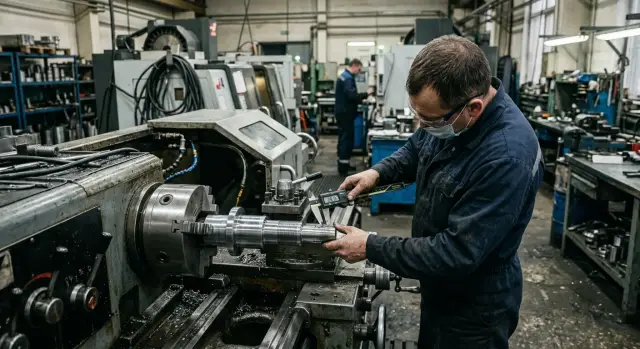
Where a batch starts to drift
A batch rarely goes bad with the first part. More often, it starts quietly: after the tenth or twentieth piece, the size still holds, but the shape slowly begins to drift. On a turning operation, you can see it in taper, ovality, runout after repositioning, or in how the geometry changes after the finishing pass.
The problem is that one failure in the middle of the route quickly multiplies. The operator keeps the cycle running, the machine keeps cutting, the parts keep piling up in the bin, and the deviation is already living inside the batch. If it is caught only at final inspection, it is not just one part at risk, but dozens at once.
Most often, a batch starts drifting for very down-to-earth reasons:
- the tool wears faster than expected;
- clamping changes after a setup change or jaw cleaning;
- the part heats up and takes a different shape after cooling;
- the datum on the next operation repeats the error instead of correcting it.
The worst case is when the size is still within tolerance, but the shape is already out. On paper, everything looks calm, but on the next operation the part starts behaving differently
What a quick measurement catches
The most expensive problems rarely appear at the very end. More often, the part starts to "drift" earlier, when the size can still be saved but the shape is already going off.
After rough machining, taper often shows up. The diameter at both ends may still look fine, but the difference between the start and end already hints that the finishing pass will not fix things without taking off extra material. One measurement at that point helps show where the cause is: feed, part rigidity, tool overhang, or cutting conditions.
Ovality is also best caught not at final inspection, but right after clamping and heating. This is a common story for thin-walled parts and bushings. The part came out of the chuck, cooled down, and the circle became slightly more like an "egg". If you catch it in the middle of the route, you can change the clamping force, the pass sequence, or let the part cool before the next step.
After repositioning, runout often appears. On the machine everything looked straight, but the new datum shifted it, and the axis is no longer where you expect it to be. A quick geometry check of the part after such an operation saves a lot of time, because from there the error only grows.
Another common case is face or seating surface drift. This is especially troublesome on parts that later go into assembly with a bearing, cover, or flange. The size may stay within tolerance, but the contact surface already performs poorly. Then the batch comes back from assembly, and finding the cause takes longer.
In-process form control also catches repeat drift caused by tool wear. Usually, you see it not on one part, but on several in a row. The first one still passes, the second is on the edge, the third is already out. If you measure the middle of the route at a clear interval, for example every fifth or tenth part, wear becomes visible before it ruins the whole batch.
In practice, a quick measurement is needed wherever the defect grows across the batch. If the same drift repeats in a similar step pattern, the problem is almost always already in the process, not in the final check.
When to place the control point
A control point is not placed where it is convenient, but where scrap starts to get expensive. If the part already received its shape in a tight tolerance after an operation, it is better to check it right away instead of waiting for final inspection. One quick measurement at that moment often saves the whole batch.
Most often, this kind of control is needed after an operation that sets the part geometry almost to final form. That can be finish turning, boring, grinding, or machining a seating surface. If cylindricity, coaxiality, or runout has drifted at this stage, the error will only be locked in from there.
A separate case is a change of datum or a re-clamping. While the part sits in one setup, form drift can still be kept under control. As soon as the operator repositions the part, changes the clamping scheme, or moves it to another operation, the risk rises noticeably. That is exactly when a measurement is needed.
On a long cycle, the control point needs to come earlier than it seems. If the blank takes a long time to process and material has already been removed, losing it hurts especially much. It is far cheaper to stop in the middle of the route, check the form, and see whether the process has drifted out of tolerance.
There are several moments when in-process form control almost always pays off:
- after an operation with a tight form tolerance
- right after changing the datum or reloading the part
- on a long cycle, where the blank is already expensive in time and material
- at the start of a new setup, while the process is still unstable
- after changing the tool, jaws, or clamping settings
At the start of a new setup, do not wait for the tenth or twentieth part. It is better to check the first one, then a couple more in a row. That makes it easier to catch an error while it is still small: incorrect tool overhang, excess clamping, size drift due to temperature.
After changing the tool or jaws, control is also needed right away. Even if the operator set everything according to the sheet, a new tool cuts differently, and the jaws can slightly change how the part sits. On CNC lathes, these small things quickly turn into a repeat defect across the whole batch.
A good control point is where you can still stop cheaply and correct the process. If after that you are only packing parts, the point was chosen too late.
How to introduce in-process control
It is better to introduce in-process form control narrowly, not broadly. If you try to measure everything at once, the shop floor quickly gets tired of extra steps and stops believing the check is useful. At the start, choose one form characteristic that tends to drift earlier than the others in your batches: ovality, taper, runout, or flatness.
That choice should be tied to the operation, not to the drawing as a whole. If ovality often drifts after turning, control that. Geometry inspection works better when it has one clear target.
The measuring point should be right by the machine. If the operator has to carry the part across the shop, look for a gauge, and wait for a free inspector, part measurement during production will start being skipped by the second shift. The measuring tool, reference, and recording sheet should be kept where the part comes off the operation.
The record does not need to be complicated either. A short template is enough: time, machine number, part number or sampling step, actual measurement for the form characteristic, and the action taken after the check. One line per check is enough. Long comments are almost never filled in honestly.
The check frequency should be set in advance, before the batch starts. It depends on how quickly the process drifts and how many parts can build up before obvious scrap appears. Usually, this rhythm is enough:
- the first part after setup
- the first part after a tool change
- every 10th, 20th, or 30th part in the batch
- an unscheduled check after a machine stop or suspicious cutting sound
The same interval does not fit everyone. On a stable operation, the frequency can be reduced. On new tooling or a complex shape, it is better to measure more often in the first few hours than to sort through the whole batch later.
Before starting, you also need to decide who stops production. This is not a formality. If the measurement goes out of tolerance and the operator has to find the supervisor first, the batch will keep growing along with the scrap.
It is better to agree on a simple rule in advance: whoever sees drift in the control characteristic immediately pauses production and calls the setter or supervisor. For shops with CNC lathes, this is especially important, because a few extra cycles can quickly turn a small drift into dozens of equally bad parts.
A bushings batch example
A typical story looks deceptively calm. A turning department is machining a batch of bushings, and by diameter everything looks fine: the size holds, the spread is small, and no scrap is visible. But the part is slowly losing coaxiality, and that is a different kind of risk. On paper, the size is there, but in assembly the bushing later performs poorly.
The problem is that the final operation here can hardly save anything. If the main datum shifted earlier, the finishing pass will not restore the correct geometry. It will only neatly repeat the mistake the part picked up on the previous step.
Imagine a normal start-up. After setup, the operator makes the first parts, checks the size, and sends the batch onward. On the 10th part, someone makes a quick measurement not only of the diameter, but also of the form. And then the drift becomes visible: the hole and outer surface no longer hold the required coaxiality, even though the micrometer by size is still not alarming.
Such a part measurement during production often takes a few minutes. Full batch sorting later takes hours, and sometimes the whole day. That is the point of in-process form control: catch the deviation before it spreads across dozens of identical parts.
In that situation, the setter does not have to guess. They immediately check the blank locating, the condition of the jaws or mandrel, whether the tool is pulling, whether there is play, and whether the correction shifted after the first parts. Sometimes the reason is very simple: the blank sat differently than on the trial part, or the tool started pressing harder after warming up.
After the check, the shop does not have to stop the whole order and inspect every bushing from the start of the shift. If the drift was found early, the team separates the last few parts for an extra check, adjusts the setup, and continues work. In the end, the batch moves on without full re-sorting, and geometry inspection stops being a formality and actually saves time.
This is exactly where you can see the difference between late detection and the good habit of checking form not at the end, but along the route.
What to do if the measurement shows drift
If the measurement shows form drift, do not wait until the end of the shift and do not hope the next part will "correct itself." Production needs to stop immediately, before the next part. A 10- to 15-minute pause is almost always cheaper than sorting dozens of blanks after final inspection.
First separate what is definitely good from what is already questionable. The reference point is the last part that passed inspection without remarks. Everything made after that and before the current measurement is better kept separate and marked, so you do not have to look for it later in the bins or argue about where the drift started.
Then look for the cause not in one number, but in the assembly that could have changed the result. On CNC lathes, the problem is most often in three places:
- the clamping loosened or the part seated differently than in previous cycles
- the datum is contaminated with chips, oil, or a small burr
- the tool wore, chipped, or changed overhang
- the program correction no longer holds the shape in the required range
Check these in order. First remove the part and inspect the clamping and datum surfaces. Then look at the tool under real light, not from a distance by eye. If you see a chip, built-up material, or obvious wear, do not argue with the tool - replace it or adjust the cutting conditions.
After the check, make a new part and measure it the same way as the last one. Do not compare different methods, or you will create extra confusion. If the first part was measured with an indicator on V-blocks, repeat the measurement the same way. If the form depends on temperature, let the part cool for the same amount of time you normally wait during acceptance.
The batch can return to production only after a stable result. One good part is not enough. It is much calmer when two parts in a row show normal geometry without tweaking every cycle. Then it is clear that you removed the cause, not just caught a lucky coincidence.
If the drift repeats, do not speed up production or widen the tolerance "for this batch." It is better to stop again and look deeper into the process. Otherwise, questionable parts will quickly become scrap that shows up too late.
Mistakes that make control useless
Even careful in-process form control will not save a batch if it is done just for show. The problem is usually not the measurement itself, but how and when it is done. A couple of wrong habits, and the shop keeps producing scrap until final inspection.
The first mistake is simple: they measure too late. If the operator checked the tenth, thirtieth, or fiftieth part after size or form drifted, the batch has already built up a problem. Then you have to sort the whole lot, find the cause, and argue about which operation introduced the defect. One measurement in the middle of the route is needed before a pile of questionable parts appears.
People often look only at size. A diameter within tolerance does not yet mean the part is fine. On a bushing or shaft, it is easy to miss ovality, taper, or coaxiality drift. In the end, the part passes an intermediate check, and then assembly or final inspection shows that the shape drifted even though the diameter number looked "good."
Where control breaks down
Another common miss is measuring a hot part. After machining, the metal is still moving, and the reading looks better or worse than it will a few minutes later. If the part needs to cool, it should be given that pause. Otherwise, the shop makes decisions based on a random number, not on the part's real condition.
Poor recordkeeping creates just as many problems. If the log has no operation number, machine, tool, or measurement time, the data is almost useless. The defect was found, but the source is hard to understand. Was the insert changed? Did the chuck settle? Did the tool shift after the setup change? Without tying it to the operation, these are just guesses.
Leaving the decision entirely to final inspection is an expensive habit. Final inspection records the fact, but it does not save the process. When inspection is the first to see form drift, production has already spent material, machine time, and operator hours.
In short, control stops working in five cases:
- the measurement is taken after the defect has already built up;
- they check only size, not form;
- the part is measured immediately after machining, without time to stabilize;
- they do not record which operation and which tool produced the result;
- they expect final inspection to solve the problem on its own.
A proper setup looks less exciting, but works better: check early, look at more than size, record the source of the measurement, and stop the drift right away. That is how geometry inspection starts saving money, not paper.
A short checklist before startup
Before starting a batch, a short one-page check is more useful than a long instruction. If in-process form control is set up in advance, it catches drift at the moment when you have lost 3 parts, not 300.
First, choose one characteristic that drifts before the others. For a bushing, this is often ovality or taper; for a housing, flatness of the seat; for a shaft, runout. Do not try to measure everything at once. The first control should catch the defect that most quickly drags the rest of the batch into scrap.
Before startup, it is worth checking five things:
- The measuring device should be next to the machine, not in the main quality room. If the operator has to go across the shop for an indicator or gauge, the check will start getting skipped.
- Set the control interval in advance. For example, the first part, then every 10th or every 20th. The interval is not chosen by guesswork, but by risk: the faster size or form drifts, the shorter the interval.
- Assign one person who can stop production without going through a chain of approvals. Usually, this is the shift supervisor or setter. If everyone waits for someone else’s decision, the machine keeps making questionable parts.
- Define what counts as a stop signal. Not a vague phrase like "if something is wrong," but a specific threshold: runout above tolerance, ovality at the upper limit, or the same deviation on two parts in a row.
- Decide the fate of the questionable batch in advance. It is not mixed with good product. It is set aside, labeled, and later checked by an agreed rule, not from memory.
A simple setup works well: the machine has a control sheet, the needed tool is nearby, the sheet shows the check interval, and there is a signature of the person who can stop the process. In practice, this saves a lot of nerves. In a shop making small batches on CNC lathes, that kind of discipline often saves a batch before final inspection.
If the checklist takes more than a minute, people almost always start bypassing it. That is why, before startup, you keep only what affects the decision immediately: what to measure, with what, when to measure, who stops production, and where the questionable batch goes.
What to do next week
Start not with new tables, but with the last three cases where the batch drifted in geometry. Take real records of scrap, rework, or questionable parts after final inspection. Look not only at the final defect, but also at the moment when it could have been caught earlier: ovality, taper, runout, or coaxiality drift.
After that, choose one operation, not the whole route at once. Usually, one early measurement is enough at the stage where the part already has its shape but has not yet reached expensive rework or the next loading. Such a part measurement during production often takes less than a minute and saves hours on batch sorting.
For one shift, this is enough:
- take one machine and one part type;
- set a simple control point: the first part, then every tenth, and again after a tool change;
- record only the time, part number, measurement result, and what you did afterward;
- if size or form moves toward the tolerance limit, do not let parts pile up — stop the batch immediately and find the cause.
Do not make the trial run complicated. In-process form control does not require a big system from day one. If the operator needs five forms and three signatures, the check will quickly become a formality.
At the end of the shift, compare losses before and after. Look at things that are easy to count: how many parts went to rework, how much time the measurements took, whether there was downtime for correction, and how many parts you managed not to spoil. Even a rough comparison gives you an answer. If before, out of a batch of 200 bushings, 15 went to extra checking, and after the early measurement only 4 did, the value of that control is obvious.
If the trial works, keep the rule on that operation for another week. If it does not work, change not the idea, but the control point or the measurement frequency.
Sometimes the issue is no longer measurement discipline, but the machine itself, its repeatability, or service. If you need help choosing equipment and support for stable batch production, you can discuss the task with EAST CNC. They offer CNC lathes, commissioning, and service, which is useful where batches regularly drift in form.