
Hydraulics or Pneumatics for First-Time Automation in the Shop Floor
Hydraulics or pneumatics for first-time automation: we compare cost, maintenance, and how each system works in dust, chips, oil, and other everyday shop conditions.
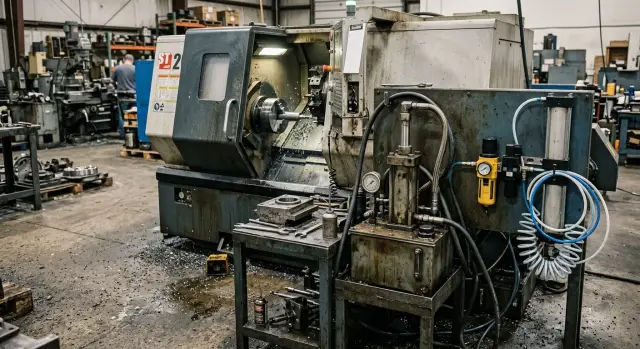
Where the choice begins
The decision usually does not come down to the price of the cylinder, but to the task itself. For the first automation project in metalworking, you first need to understand what the drive actually does: clamps the part, feeds it into the machining area, ejects the blank, or simply opens and closes a unit. Until that is clear, the argument "hydraulics or pneumatics" is almost pointless.
If the unit must hold a large force for a long time without dropping, hydraulics usually look calmer and more reliable. That is a typical case for rigid clamping on a CNC machine, where heavy cutting is involved and the blank must not shift. Pneumatics are simpler and usually work better where the stroke is short, the force is moderate, and the clamp does not need to hold peak load for hours.
The second question is how many cycles you have per shift. At 100-200 activations, the difference between systems may be small. At thousands of cycles, air consumption, heat, seal wear, and downtime from minor faults start to matter more.
Before deciding, it helps to answer four simple questions:
- What exactly should the drive do, and what accuracy is needed?
- Does the force need to be held for a long time, or is a short clamp enough?
- How many times will the unit operate per shift and during peak hours?
- What will stop production faster: pressure loss, oil leakage, compressor failure, or dirt in the line?
That last point often matters more than any table. In an ordinary shop, automation lives next to chips, oil mist, and dust, not in a clean room. If a CNC lathe clamps a steel part for a long cut, losing clamping force is more dangerous than spending a little more on hydraulics. If you just need to push a part to the next position or open a stop at the end of the cycle, pneumatics are usually simpler, cheaper, and faster to put into service.
A good first project should not look complicated. It should be easy for the operator and the setup technician to understand: why this scheme was chosen and what to do if the unit fails.
How the systems behave in a normal shop
In the shop, the choice quickly stops being theory. The system has to work next to chips, oil, vibration, and constant part changes.
Pneumatics usually win on speed of movement. The cylinder quickly pushes the stop forward, quickly pulls it back, and the operator does not lose an extra second on every cycle. For simple actions, that is convenient: clamp the part, move the stop, open or close a light clamp.
But air is compressible. Because of that, pneumatics are worse at holding force when the load changes during operation. If there is a leak in the line, pressure drops, and the clamp no longer holds as confidently as it did after morning setup.
Hydraulics are usually slower to respond, but they hold force better and drift less under load. If a CNC machine is cutting a part with noticeable force, that often matters more than a fast cylinder stroke.
In practice, the difference is simple. Pneumatics are better for short and frequent movements. Hydraulics handle firm and stable clamping better. Air loses force more quickly if there is a leak somewhere. A hydraulic system almost always comes with separate equipment: a power unit, tank, pump, hoses, fittings, and oil level monitoring.
That last point is often underestimated. Pneumatics use air from the shop’s common supply, so the fixture itself ends up more compact. In a tight area, that can matter more than the argument about maximum force.
Noise also affects the choice. Pneumatics are often louder because of air exhaust and sharp movements. When the cycle is short, that noise quickly becomes annoying. Hydraulics are usually quieter during clamping, but the pump and vibration from the power unit create a constant background hum.
On a production lathe, the difference is especially visible. If you need to move a stop quickly and retract it after clamping, pneumatics are often more convenient. If the part is heavy and even a fraction of a millimeter of movement ruins the result, a hydraulic fixture usually works more calmly.
Where the money goes
In first-time automation, many people look only at the price of the cylinder or clamp. But the budget grows elsewhere: air preparation, valves, hoses, sensors, installation, and downtime if the system behaves unpredictably.
If the shop already has stable compressed air, pneumatics usually cost less at the start. For a simple clamp on a CNC machine, you often need a basic set: a cylinder or rotary actuator, an air preparation unit, a solenoid valve, hoses, fittings, and position sensors. On paper, that looks inexpensive. In reality, the small items add up fast. One valve, a few proper fittings, hose, silencers, connectors, brackets — and the budget no longer looks like "cheap pneumatics."
If the shop does not have air of the required quality, you will need to add a compressor, drying equipment, and piping. Then the difference from hydraulics shrinks noticeably.
Hydraulics work the other way around. Here you pay not only for the cylinder, but also for the power unit, tank, pump, filtration, safety and control valves, high-pressure hoses, distributors, and oil. Installation is usually more expensive too: the connections are stricter, and startup errors take longer to fix.
At the same time, in both systems it is usually the small components that inflate the budget. The most common mistake is trying to save on connections. A cheap fitting in pneumatics starts leaking air. A bad hose in hydraulics quickly turns an ordinary shift into a shutdown and a cleanup.
In the first year, you usually buy more than just hardware. You need filter elements, seals, oil, spare hoses, fittings, valve coils, small sensors, and limit switches. On a turning line, downtime is almost always more expensive than questionable savings on the fixture. If the clamp did not engage, the machine stops, the operator waits, the batch slips, and sometimes the part becomes scrap. One such failure can easily eat up the difference between "cheaper now" and "properly built the first time."
What you will have to maintain
In the debate over "hydraulics or pneumatics for first automation," maintenance often matters more than the purchase price. In a real shop, a fault usually starts with something small: a clogged filter, water in the line, dirty oil, or an aging hose.
If the area is small, it is best to assign responsibility right away. The operator checks the system at the start of the shift: pressure, visible leaks, water in the air prep unit, or oil level. The mechanic or setup technician works on a schedule: changes filters, checks hoses, tightens connections, and records what has already been replaced.
Pneumatics usually involve more routine, but it is simpler. You need to regularly drain condensate from the moisture separator and make sure the filter does not clog with dirt. If the compressor supplies wet air and chips and coolant are flying around nearby, valves and cylinders quickly begin to work unevenly.
Hydraulics do not have a condensate problem, but they do not forgive dirty oil. Oil is checked by level, color, and smell, and the filter element is changed on schedule, without the habit of "it will last a bit longer." Topping up oil from an open can next to the machine is a bad idea: dust and fine abrasive particles can easily enter the system that way.
Seals and hoses are rarely changed just because of the calendar. They are usually replaced when the rod starts to sweat, pressure is held worse, movement becomes slower, or the hose shows scuffs, cracks, or swelling. On a CNC turning line, that shows up quickly: the clamp takes longer than usual, and the pneumatic cylinder hisses after the cycle.
Small leaks in pneumatics more often appear at quick couplers, fittings, tube cuts, and valves. They start with a quiet hiss, which makes the compressor come on more and more often. Hydraulics have different weak points: threaded connections, hose crimps, and shaft seals. A leak is less common there, but it costs more, because oil dirties the machine, the part, and the floor.
It is worth keeping a small stock of consumables on hand: filter elements, a couple of common fittings, sections of hose or tubing, a seal kit for the loaded cylinder, several O-rings in the needed sizes, the correct oil, and a clean container for topping up.
If you are automating a CNC machine that needs to run without unnecessary stops, ask the fixture supplier right away which parts wear out most often and what is actually in stock. For a shop, that is more useful than arguing about schemes on paper alone.
What happens in dust, chips, and oil
An ordinary shop quickly reveals the weak points of both systems. If the unit sits near the cutting zone, it is hit by fine chips, dust, coolant drops, and oil mist. In these conditions, problems often show up within the first few weeks.
Chips hit shafts and mounting points hardest. Even tiny sharp fragments scratch the surface, and then the seal no longer holds as well as before. At first it looks minor: the cylinder still works, but the stroke feels heavier. Then jerking, misalignment, and leaks appear.
Pneumatics have their own problem. Dust and fine abrasive particles clog filters, silencers, and valves, especially if the air was not prepared properly. The valve starts responding with a delay, the cylinder does not fully clamp the part, and the operator looks for the problem in the wrong place.
Hydraulics usually tolerate outside dirt more calmly if the unit is well protected. But dirty oil wears them out faster from the inside. Particles in the oil work like lapping paste: they wear down the distributor, pump, seals, and seating surfaces. After that, the system loses pressure, heats up, and starts leaking.
Coolant is not as harmless as it seems either. It lands on seals, fittings, and hoses, mixes with dust, and creates a sticky layer. That layer hides small leaks and speeds up rubber aging.
On a turning line, that is especially easy to see. If the fixture is open and takes the full chip stream, shafts and hoses do not last long. On CNC machines that run without pauses, a small problem quickly becomes half a shift of downtime.
Usually, the simplest measures help: a shield against the direct chip flow, a protective cover on the shaft and hoses, proper air cleaning, monitoring oil cleanliness, and timely replacement of filters and seals.
If you are choosing a system for a dirty area, do not look only at force and price. It is more important to understand where the unit will stand, what hits it every hour, and who will clean it. For first-time automation, the winner is often not the strongest system, but the one you can actually protect and service without constant battles with dirt.
How to choose the system step by step
The mistake at the beginning is almost always the same: people look at the price of the cylinder, not at how the unit will live in the shop every day. Because of that, the clamp either does not hold the part, works too roughly, or requires too much care.
It is better to start with clamping force. Not by guesswork, but based on the part, the tool, and the cutting mode. If the blank can move even by a fraction of a millimeter, a weak pneumatic cylinder will quickly reach its limit. For heavy cutting, hydraulics usually provide a larger safety margin.
Then check the air in the shop. If pressure fluctuates, there is water in the line, or the compressor is running at its limit, pneumatics will behave unevenly. On one cycle the clamp is fast, on the next it is slower. For first-time automation, that is a common cause of strange and unpredictable failures.
Next, assess the available space for the equipment. Hydraulics need a tank, pump, hoses, space for routing, and service access. If the machine stands right against the wall and the area is already tight, compact pneumatics sometimes win not on force, but on ease of installation.
After that, compare the cycle itself and the stroke length. If you need a quick approach, a short cycle, and simple movement between two points, pneumatics often solve the task. If you need smooth travel, repeatable force, and reliable clamping without surprises, hydraulics usually behave more consistently.
And one more simple question: who will maintain the unit? If there is a mechanic on the shift who knows how to work with a power unit, filters, and leaks, hydraulics are not complicated. If there is no such person and the machine setup technician is responsible for the unit, a simple pneumatic scheme may cause fewer problems.
On a small turning line, the choice often becomes very practical. For a light part and clean air, pneumatics may be cheaper and simpler. For a heavy blank, where the machine cuts aggressively and you cannot risk slippage, a hydraulic fixture usually pays for itself through calmer operation.
If you do not have exact answers to two or three of the questions, do not buy the system right away. First check the part, the machine, and the people who will live with this unit every day.
Mistakes in the first project
The first mistake looks harmless: people choose pneumatics only because they are cheaper at the start. On the invoice for cylinders and valves, that is true. But in the shop, the price changes quickly if air pressure swings, water builds up in the line, and the clamp holds one moment and not the next. In the end, the savings on purchase turn into downtime, adjustments, and scrap.
The opposite extreme is also common. People install hydraulics where air would be enough. For simple clamping on a straightforward operation, you may not need a power unit, tank, extra hoses, and constant leak monitoring. The system ends up heavier, more expensive, and more temperamental than the task itself.
A lot of problems are born not in the choice of cylinder, but around it. Pneumatics in the shop work poorly without proper air preparation. If you do not install a filter, regulator, and condensate drain, dirt and moisture enter the valves and cylinders. At first the mechanism just gets noisy and jerky. Then it starts sticking.
On a turning line, people often forget shaft protection too. Chips do not sit quietly next to the fixture. They fly around, stick to oil, get into seals, and scratch the shaft. After that, the cylinder loses stroke or starts leaking. Simple protection, a shield, or a good unit location usually costs far less than replacing the cylinder.
Another common mistake is drawing the unit neatly and compactly, but nobody thinks about how it will be serviced later. The filter is hidden behind a cover, the fitting cannot be reached with a wrench, and to tighten a connection you have to remove half the fixture. On paper, everything is compact. In a real shift, that means an extra 20-30 minutes for every small issue.
First projects usually fail for one of five reasons: the system was chosen by price, not by force and working conditions; air preparation or condensate drainage was not planned; the shafts were left open to chips and oily dirt; access to filters, fittings, and adjustment points was blocked; or the scheme was made too complicated for a simple operation.
If the part is simple, the cycle is clear, and the environment is dirty, it is better to start with a solution that is easy to clean, check, and repair yourself.
Example for a small area
In a small turning area, the picture is often simple: the lathe machines batch bushings, the operator changes blanks dozens of times per shift, and the clamp must work the same way every time. If the force varies, the dimension starts to drift, and scrap often appears not immediately, but at the end of the batch.
Air is already available on the site, and that pushes people toward pneumatics: lower entry cost, simpler scheme, faster startup. But line pressure fluctuates. It is one thing in the morning, another after lunch, and when another consumer starts up nearby, the pneumatic cylinder no longer clamps the same way it did during setup.
On bushings, that is noticed quickly. If the blank has thin walls or a strict runout tolerance, pneumatics can give different clamping from shift to shift. On a forgiving batch, that may go unnoticed. On a stable production run, you get extra checks, adjustments, and arguments between operators.
A hydraulic fixture in such an example usually behaves more evenly. Circuit pressure stays more stable, clamping force repeats better, and the part sits predictably. For production turning, that is often more important than a lower initial budget.
But hydraulics have their own price for that calmness. You need a power unit, hoses, leak control, and careful installation. If oil gets out, fine chips stick to the unit immediately. Cleaning that setup is less pleasant than cleaning an air line.
In a dirty area near the chuck, both schemes need protection. Fine chips and coolant spray are bad for shafts and seals alike. The difference in practice is this: pneumatics more often forgive a cheap start, but handle pressure swings and wet air worse; hydraulics hold the clamp more consistently, but require more careful maintenance.
For such an area, the conclusion is usually straightforward. If the bushings must be clamped the same way every shift and the size is sensitive to force, hydraulics usually win. If the part is simple, the force is moderate, and the first-project budget is tight, pneumatics remain a workable option — but only after checking the real pressure in the network across the full shift, not just by the compressor specifications.
Checks before buying
Before ordering, it is worth checking a few things on paper and directly at the machine. A mistake at this stage costs more than the fixture itself: weak clamping ruins the part, dirty air stops pneumatics, and poor access to the filter turns into half a day of downtime.
If you are choosing between a hydraulic fixture and pneumatics, do not look only at the price of the unit. Look at how the system will live next to chips, oil mist, and the usual pace of a shift.
- Calculate the clamping force and add a real safety margin. If the cutting conditions change or the part has a thin wall, the margin should be in numbers, not in feeling.
- Check what you actually have on the shop floor every day: clean compressed air or clean oil. Pneumatics quickly become finicky because of water and dirt in the line, while hydraulics dislike old oil and weak filtration.
- See whether the working elements are protected from chips. An exposed shaft, hose, or sensor near the cutting zone does not last long.
- Assess maintenance with your hands, not from the catalog. The mechanic should be able to change a filter, a seal, and small consumables quickly without taking half the unit apart.
- Calculate the cost of one hour of downtime for the area. After that, the cheap option sometimes stops looking cheap.
There is also a simple common-sense test. If one operator is running a CNC lathe and two other operations nearby, they need a system that does not require constant attention. If they have to remove guards every time, search for leaks, or blow out the line, the area will start losing time on small things.
It also makes sense to ask the supplier two separate questions: what fails most often, and how long a normal consumable replacement takes. For a first project, it is better to choose a scheme that a mechanic can understand without a long breakdown.
If doubts remain after all the checks, do not pick the more complicated system — pick the one that is clearer for your shop. First automation should hold the part steadily and not interfere with the shift.
What to do next
If you are comparing hydraulics and pneumatics for first automation, do not try to rebuild the whole shop at once. It is usually wiser to start with one clear operation: clamping the part, moving a stop, or a simple pusher. With one unit, mistakes cost less, and the conclusions are more honest.
First, collect the numbers for the operation itself. You need three things: cycle time, required force, and the condition of the area where the unit will work. If the part is wet with coolant, chips are flying around, and the operator keeps opening the guard, that affects the choice more than the catalog.
The check is best done during a normal shift, not on an empty startup after cleaning. Only then can you see whether the system holds force, whether elements stick, whether speed drops, and how much attention the unit asks from the operator.
Before buying, it helps to put the comparison into one simple table: fixture cost, installation and commissioning, consumables and ongoing maintenance, losses from downtime, and payback time for one operation. At that stage, many people are surprised. What is cheaper to buy is not always cheaper to run.
For a small area, a very simple scenario is often enough. If a CNC lathe needs to clamp the same part reliably for two shifts, and the area is relatively clean and the force is moderate, pneumatics may solve the task without unnecessary complexity. If the part is heavy, you need firm clamping, and there is a lot of oil and chips nearby, a hydraulic fixture usually behaves more calmly.
If the task is limited not only by the drive but also by the overall layout of the metalworking area, you can look at EAST CNC materials at east-cnc.kz. The company supplies CNC lathes and other metalworking equipment, and its blog publishes reviews and practical advice for real shop conditions.
The next good step is simple: choose one operation, collect shift data, and test the unit in real work. After that kind of test, the decision is usually made without unnecessary debate.
FAQ
Which is easier to install first — hydraulics or pneumatics?
Pneumatics are usually easier for a first setup if you need a short stroke, moderate force, and your shop already has good compressed air. If the clamp must hold a heavy part firmly and evenly during cutting for a long time, hydraulics usually bring fewer surprises.
When is pneumatics no longer enough?
Pneumatics quickly reach their limit when the part cannot move even by a fraction of a millimeter or the clamp must hold a high force for a long time. In that kind of work, air reacts more strongly to leaks and pressure swings, so hydraulics behave more consistently.
Why does pneumatics look cheap at the start, but end up costing more later?
Because the money goes beyond the cylinder itself. The budget quickly grows with the air prep unit, regulator, valves, hoses, fittings, sensors, installation, and spare consumables — and if the air quality is poor, you may also need a compressor and drying equipment.
What holds the clamping force more reliably on a CNC lathe?
For a tight and stable clamp on a CNC lathe, hydraulics are usually the better choice. They hold force more calmly under load, while pneumatics lose consistency more easily if line pressure fluctuates or there is a leak.
How do chips, dust, and coolant affect the choice of system?
In a dirty area, both systems suffer if shafts, hoses, and sensors are left exposed. Chips scratch surfaces, coolant ages rubber faster, and dust clogs filters and valves, so protecting the unit and keeping the environment clean often matter more than arguing about the drive type.
What usually fails or becomes troublesome in pneumatics?
The most common issues start with water in the line, a clogged filter, leaking fittings, and valves that respond with a delay. Outside, it looks simple: the cylinder moves in jerks, does not fully clamp the part, or the compressor starts too often.
What needs servicing most often in hydraulics?
Hydraulics usually need attention for the oil, filters, hoses, and shaft seals. If the oil is dirty or a connection starts leaking, the system loses pressure, makes a mess on the machine, and turns a small issue into a shutdown very quickly.
How can I tell that the shop air is not suitable for pneumatics?
Check pressure in a real shift, not just according to the compressor nameplate, while other consumers are running. If the pressure swings, water collects in the line, or the cylinder behaves differently in the morning and after lunch, pneumatics will give unstable results.
Does it make sense to choose hydraulics for a small shop?
Yes, if you have limited space, a heavy workpiece, and strict repeatability requirements for clamping. But a small shop does not like complex installation or dirty maintenance, so without someone who can monitor the power unit and leaks, such a setup becomes tiring quickly.
Where should I start with my first automation project?
Start with one simple operation, such as clamping the part or moving a stop. Record the shift data: force, cycle time, air or oil condition, number of activations, and how easy the system is to service, then choose based on real operation rather than the cylinder price.