
Hydraulic Chuck or Shrink-Fit Holder for Steel Machining: How to Choose
Hydraulic chuck or shrink-fit holder for steel machining: we compare runout, tool change time, shop requirements, and a simple way to choose.
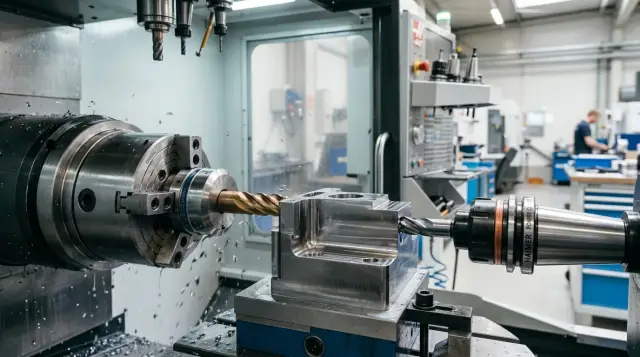
Why this choice often puts a shop in a dead end
The debate over “hydraulic chuck or shrink-fit holder” is rarely settled by a single number in a catalog. In one shop, the priority is changing tools quickly between small batches. In another, it is keeping tool runout stable over a long production run, where any size deviation immediately creates scrap.
That is why there is no universal answer. The same CNC tooling can deliver different results even on similar machines if the cutting conditions, tool overhang, operator preparation, and the shop’s workflow are different.
Mistakes are usually not made at the time of purchase, but later, in day-to-day work. If a holder takes longer to prepare, the machine spends more time idle. If the holder does not repeat accurately after a tool change, the operator spends time on adjustment and checking. If the system is awkward for the shop, people start bending the rules, and that is a direct path to scrap and tool breakage.
Most often, the question comes down to three things:
- how much runout the system really holds with your tool and at your required overhang;
- how much time is spent on tool changes and preparation in a normal shift;
- how convenient the tooling is to use every day, not just during a test.
This is where both money and parts are lost. Poor runout wears the cutter faster and can ruin the surface. Slow preparation eats up setup hours. An inconvenient system creates small delays that are almost invisible one by one, but over a month they turn into noticeable losses.
Another common mistake is looking only at the purchase price. The holder itself is bought once, but it is used every day. If a cheaper option adds even 10–15 minutes to a single changeover, the savings disappear quickly. The opposite also happens: an expensive system does not pay off if the shop runs simple operations and never uses its strengths.
Companies that select equipment and tooling for metalworking look at this more broadly: not just the price of the item, but how it performs in the real cycle. That approach is usually more honest. It quickly shows that holder selection is not a debate about “which is better,” but a question of “what causes fewer losses in your shop.”
How a hydraulic chuck performs in practice
A hydraulic chuck clamps the shank without heat. The operator inserts the tool into the bore and tightens the screw. Inside the chuck, pressure in the working fluid compresses the thin wall of the clamping zone around its full circumference, so the shank seats evenly and without noticeable tilt.
In practice, you feel that immediately. The chuck holds the tool gently and evenly, without a harsh point load. On steel, that often gives a calmer cutting sound and less fine vibration, especially on finishing passes and when using a long tool.
During a normal tool change, the operator follows a simple sequence:
- loosens the screw
- removes the end mill or drill
- wipes the shank and the bore clean
- sets the required overhang
- tightens the chuck to the correct torque
No heater is needed. There is no need to wait for a holder to cool down either. If there are many short changeovers in a shift, a hydraulic chuck makes life noticeably easier: fewer preparation steps, lower risk of burns, and easier tool changes right at the machine.
Another advantage for the shop is predictability. It is easier for the operator to repeat the same operation when the process comes down to a clean seat, one screw, and overhang control. That is convenient for series work: the supervisor trains a new employee faster, and the employee makes fewer mistakes on simple steps.
Accuracy after reinstallation depends on more than the chuck itself. It is affected by bore cleanliness, shank condition, exact tool diameter, consistent overhang, and proper tightening torque. If the shank is scratched, has oil and dirt on it, or the operator sets a different length every time, tool runout and repeatability suffer even with a good chuck.
For that reason, a hydraulic chuck likes order. A clean bore, an in-tolerance tool, and careful tightening deliver the result it is valued for in CNC tooling. But if a shop often changes tools in a hurry and does not pay attention to small details, the chuck will not hide those mistakes.
How a shrink-fit holder performs in practice
A shrink-fit holder grips the tool through heat. The metal in the body expands slightly, the end mill or drill is inserted, and then the holder cools down and tightly clamps the shank. The mechanism is simple, but in real use it is not a matter of just “pick it up and install it.”
The operator needs an extra step before starting. The holder goes into a heater, waits until the required temperature is reached, the tool is inserted quickly to the correct depth, and then the assembly is allowed to cool.
On paper, the difference seems small. In a real shop, heating is only one part of it. Preparation, checking the overhang, waiting for cooling, and handling hot tooling all add time. If there are many tools, the workstation can quickly become hectic without a clear routine.
Where a shrink-fit holder is convenient
The biggest strength of a shrink-fit holder is its thin body. It leaves more space around the tool, so it is easier to reach a deep cavity, pocket, or wall where a bulkier holder simply will not fit.
This is especially clear in steel machining in tight areas. For example, if you need to mill near a tall wall on a housing, the slim holder reduces the risk of hitting the part with the body and lets you keep the tool overhang shorter, which helps keep the cut calmer.
What the shop needs
A shrink-fit holder likes order and stable conditions. For proper use, you need:
- an induction heater or another suitable heater
- clean tool shanks without dirt or burrs
- a place where the holder can cool down without rushing
- clear rules for insertion depth and heating time
- careful storage so the bore is not damaged
If the shop has a well-organized flow, a shrink-fit holder performs predictably and works well for series operations. If tools are changed constantly and the machine is set up repeatedly, the extra steps start to get in the way. That is why, in the debate over hydraulic chuck or shrink-fit holder, shrink-fit often wins where compactness and a stable repeatable process matter more than the fastest possible tool change.
Where runout and repeatability are better
If the question is which is better, a hydraulic chuck or a shrink-fit holder, the answer is not always obvious from a single indicator reading. With a short overhang and a proper tool, both systems often show similar results. The difference shows up less in the catalog and more after the holder is mounted on the machine and then reinstalled a day or a week later.
After the first assembly, a shrink-fit holder often gives a very clean starting point for runout. Its construction is simple, with no extra clamping parts, so the geometry stays stable. But there is a condition: the operator must heat the holder correctly, insert the cutter on time, and not miss the insertion depth. A hydraulic chuck is a bit easier to handle. It is easier to assemble without fuss, and in a normal shop it often gives a steadier repeatable result from shift to shift, even when different people are working.
Tool overhang changes the picture more than many expect. With a short setup, you may not see any difference between the systems. When the tool is extended further, every micron at the spindle becomes a more visible deviation at the cutting edge. In that mode, a shrink-fit holder more often holds geometry tighter, especially in hard steel machining. A hydraulic chuck can behave more softly and calmly on finishing passes, but it does not forgive a long overhang.
This difference is not always visible on the surface. Roughing can easily hide small deviations. They show up faster on finishing passes:
- on the wall of a hole, where size variation grows
- on a flat surface after light side milling, where stripes appear
- on a shoulder, where the edge leaves a different mark each pass
- on a small cutter, which reacts immediately to minor runout
There is another thing that is often underestimated: the condition of the shank. If the shank is scratched, packed with fine chips, corroded, or simply out of diameter, both systems lose their advantage. A shrink-fit holder is especially sensitive to dirt and ovality. A hydraulic chuck will not save a poor tool either; it may only hide the problem a little longer. That is why a fair comparison starts not with the holder, but with a clean, straight shank and the same overhang.
Which one is faster in a normal shift
If you look at a live shift instead of a catalog, a hydraulic chuck usually wins on the speed of a single tool change. The operator removes the cutter, installs a new one, sets the overhang, and clamps it without heating. When work involves small batches and frequent changeovers, this is felt almost immediately.
With a shrink-fit holder, the change itself is simple, but heating is added on top. Then the tool and holder need time to cool down to a normal temperature. If one induction station is shared by several machines, people start waiting for one another. Those minutes are rarely noticed one by one, but over a shift they add up quickly.
The difference usually looks like this:
- hydraulic chuck: about 2–4 minutes for a change and check
- shrink-fit holder: about 4–8 minutes if the tool is assembled on the spot
- in urgent replacement work, a shrink-fit holder is almost always slower
- with preassembled tool setups, the gap becomes smaller
There is an important caveat. If the shop prepares tools off the machine, a shrink-fit holder no longer looks slow at the machine itself. The operator simply changes the whole assembled unit. But the time does not disappear; it just moves to the tool room. That is fine for series production. It is not always convenient for frequent changeovers and small orders.
Extra pauses appear in the same places: you need to walk to the heating station, wait for a free slot, heat the holder, insert the cutter carefully, and then wait for cooling. In theory that is quick. In a real shop, there is almost always a delay between these steps.
If there are 8 tool changes in a shift and each shrink-fit change takes at least 4 minutes longer, the shop loses 32 minutes of pure time. With 12 changes, that is almost an hour. In steel machining on an ordinary shift, that is enough to push part output toward the end of the day.
So the choice is simple. When tools are changed rarely and the batch is long, the time difference matters less. When the work is irregular and there are many changeovers in a day, a hydraulic chuck is usually more convenient for the shop and calmer for the operator.
When each system brings more value
If the shop often changes parts, diameters, and tool overhangs, a hydraulic chuck usually brings more value. It is simpler in daily work: insert the cutter, set the length, clamp it, and move on. For small batches and frequent changeovers, that is often more convenient than spending time on heating and waiting for cooling.
A shrink-fit holder performs best where the same operation repeats for a long time without changes. If the batch is large, the conditions are stable, and tools are assembled in advance, the preparation time is less noticeable. In that kind of work, its compact body and rigid fit often make up for the extra steps before the machine starts.
In the question of hydraulic chuck or shrink-fit holder, the shop rhythm matters more than the brochure. The same tooling unit can be convenient in serial production and a real slowdown in job-shop work.
In a tight area near the part
When you need to get close to a shoulder, pocket wall, or fixture, a shrink-fit holder usually wins. Its body is slimmer, so the tool can be kept shorter without unnecessary extension. In steel machining, that often reduces vibration better than trying to reach the area with a bulkier chuck.
A hydraulic chuck loses here on size, but that is not always a problem. If the operation is open, there is plenty of space around the part, and tool change speed matters more, its larger body is no longer such a drawback.
What matters in practice
The layout of the section also has a big impact:
- For 2–3 machines with frequent changeovers, a hydraulic chuck is usually easier to keep moving.
- For repeating batches on several identical machines, a shrink-fit holder often delivers better return.
- If the shop has one heating station for many workstations, shrink-fit holders can create a queue.
- If operators work with different habits, a hydraulic chuck is easier to standardize.
There is also the human factor. A shrink-fit holder needs careful discipline: correct heating, a clean seat, and calm advance preparation. A hydraulic chuck is more forgiving in routine work where tasks change quickly and the operator has no spare minutes.
Put simply, a hydraulic chuck is more often profitable in a shop with short batches and active changeovers. A shrink-fit holder more often gives the better result where there are many identical parts, high speeds, and a tight working zone around the part.
A real shop example
Take a typical batch of steel parts where the operator changes cutters several times during a shift. For example, 80 steel housings need to be machined: a pocket has to be milled, stock removed on the contour, and a finishing pass completed. The work uses 10 mm, 12 mm, and 16 mm cutters in sequence, and there are 8–10 tool changes per day.
To make the comparison fair, keep everything else the same: the same machine, the same cutters, the same cutting conditions. Only the holder changes. In the first scenario, we use a hydraulic chuck. In the second, a shrink-fit holder.
With a hydraulic chuck, the shop runs more easily when the work has frequent changeovers. The operator removes the cutter, installs another one, tightens it, checks the overhang, and continues. One change takes about 2–3 minutes if the area is clean and the tool is already nearby. Over a shift, that is about 20–25 minutes.
With a shrink-fit holder on the same job, the picture is different. Heating itself is fast, but insertion, cooling, and length control are added on top. If there are only a few holders and the tools are assembled on the fly, one change can easily take 5–7 minutes. Across those same 8–10 changes, the shop loses 40–60 minutes.
The scrap difference is also easy to understand without complicated calculations. A shrink-fit holder usually gives better tool runout and higher repeatability, especially on finishing work and small cutters. But if the operator is in a hurry, the cutter may be seated at the wrong depth or the job may be delayed if the holder is still hot. A hydraulic chuck also holds runout at a good level, and there are fewer mistakes during changeovers simply because the process is shorter and calmer.
On such a job, the question of hydraulic chuck or shrink-fit holder is decided not by the catalog, but by the changeover conditions:
- Frequent cutter changes and small batches — a hydraulic chuck is often more convenient.
- A long run of the same operation — a shrink-fit holder often brings more value.
- If the shop keeps spare preassembled holders, the shrink-fit holder loses its time disadvantage.
- If tools are changed right at the machine during the job, a hydraulic chuck usually saves the shift.
A supervisor does not need a long argument about CNC tooling. It is enough to look at two things: how many times the cutter is changed per day and how much one bad part costs. After that, the choice usually becomes obvious.
How to choose for your own tasks
If you are deciding between a hydraulic chuck or a shrink-fit holder, do not start with the catalog. First, describe your normal machine work: what steel you produce, what cutter or drill diameters you use, and what overhang is really needed on the part.
The same holder can work well with a short tool and struggle with a long overhang. That is why holder selection should not be made “in general,” but for a specific set of operations. In steel machining, this is especially noticeable: a mistake in CNC tooling quickly shows up as extra wear and wasted time.
A simple approach works well:
- Write down 3 things for each frequent operation: material, tool diameter, and overhang.
- Count how many tool changes happen in a shift, not just “a lot.”
- Check where the heater will stand if you are leaning toward a shrink-fit holder, and who will actually use it.
- Compare the price of the holder not only with the purchase cost, but also with downtime, changeover time, and scrap.
- Keep one option for a test part and look at the result under the same conditions.
On the second step, many people are surprised. If the shift involves frequent changeovers, preparation convenience can matter more than the numbers on paper. If tools are changed rarely and tool runout and repeatability are the top priorities, the picture may be different.
Shop discipline matters too. A shrink-fit holder needs space, discipline, and a clear routine: heat it, insert the tool, wait for the fit, and do not rush. If the machine area is cramped and work comes in bursts, people start cutting corners and then blame the system instead of the process.
When it comes to money, it is better to estimate roughly but honestly. For example, a holder may cost more than expected, but save 15–20 minutes on every changeover. With frequent tool changes, that difference can come back faster than it seems. And vice versa: if the batch is long and setup is rare, paying extra for convenience may not be necessary.
A test part removes the argument. Take one steel operation, one machine, one tool, and the same cutting conditions. Then compare runout, preparation time, operator comfort, and tool edge condition after the batch. After that test, the choice usually becomes much easier.
Mistakes that cost a lot
The question of hydraulic chuck or shrink-fit holder often goes off track. Many people look only at the holder price and then lose money on scrap, extra changeovers, and early tool replacement. Cheap CNC tooling can seem attractive until it starts hurting surface finish and size.
The second common mistake is ignoring tool overhang and cutting conditions. Even a very accurate holder will not save the job if the cutter is extended too far and the feed and depth of cut are left the same as for a short, rigid setup. In steel machining, that quickly creates vibration, size drift, and extra load on the spindle.
There is also a more practical problem: a worn shank. The operator puts a tool with scratches, corrosion marks, or obvious wear into an accurate hydraulic chuck or shrink-fit holder and expects a perfect result. That is not how it works. If the shank has already lost its shape, tool runout increases, and the holder gets blamed later.
Shrink-fit holders are often misused during heating. Heating longer than normal does not make the fit better. On the contrary, the holder loses accuracy faster, and the tool can be seated crooked if the operator rushes during cooling. In a shop, this usually starts with one small shortcut and ends with unstable production.
Another costly detail is when every shift follows a different assembly routine. One operator cleans the shank, checks the fit, and waits the proper time. Another does everything faster: no air blowout, inserts the tool right after heating, or does not check the overhang. On paper, it is the same tooling; in reality, the result is different every time.
A typical example is simple. On a finishing operation in steel, one shift holds size steadily, while the next gets surface waviness and a deviation of several hundredths. The cause is often not the machine and not the clamping system itself, but small things: a different overhang, a dirty shank, extra seconds of heating, assembly by memory.
To avoid paying for those mistakes, the shop needs one clear standard: what overhang is acceptable, what condition the shank must be in, how long to heat a shrink-fit holder, and in what order the tool is assembled. It is boring work, but it usually saves more than trying to buy a cheaper holder.
What to do next in your shop
If the debate about which is better, a hydraulic chuck or a shrink-fit holder, has been going on for weeks, do not decide it based on someone else’s experience. First look at your own parts, your own cutting conditions, and your own runout tolerance. For one operation, the difference is almost invisible; for another, it shows up immediately in size, surface finish, and tool life.
Start with simple measurements. Check which steel you machine most often, what feeds and speeds you use, and what tool runout is actually acceptable for your operation. If the part requires a tight tolerance, there is no point choosing CNC tooling based only on price or the setter’s habit.
Then count time, not impressions. In a normal shift, a tool change can happen many times, and even a few minutes of difference per changeover quickly adds up to hours over a month. If you have small batches and frequent tool changes, preparation speed sometimes affects the result more than the difference in specification data.
It is also useful to check the geometry of the operation itself. When a tool needs access to a narrow area near the part, the compactness of the holder often matters more than a theoretical debate. This is especially noticeable on deep pockets, shoulders, and long overhangs.
The best approach is a short shop-floor test:
- take one typical part that you make often
- add one difficult operation where runout and access matter
- run both options with the same tool and similar cutting conditions
- measure preparation time, runout, tool life, and operator convenience
After such a test, the choice usually becomes obvious. One option may give calmer performance on a precise operation, while the other saves time during tool changes and maintenance.
If your shop handles many different parts, do not try to choose one system for every case. In practice, a mixed approach often wins: one holder for precise and demanding operations, another for flow work and fast changeovers.
If you need a selection for specific parts and machines, it is better to start from the real task, not the catalog. EAST CNC works with CNC lathes and metalworking in Kazakhstan, and helps with selection, startup, and service. That is useful when you need to verify a solution not in theory, but on your part and in your own working conditions.