
How to Test a CNC Operator Candidate in One Day
How to test a CNC operator candidate in one day: structure the test around drawings, measurements, a safe start and response to an error code.
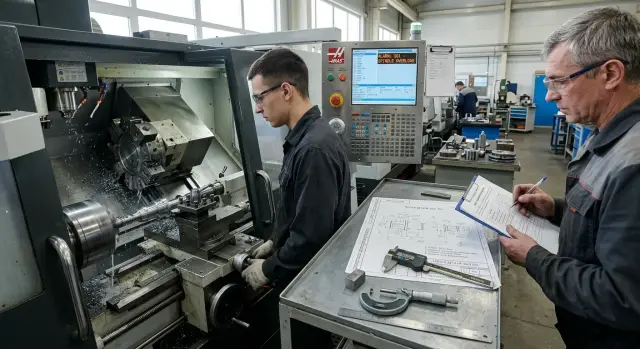
Why a resume doesn't show true skill
A resume helps to know where someone worked and what equipment they used. But it rarely shows how they behave at the machine. On paper a candidate can look confident, while on the shop floor they mix up datums, rush measurements or skip pre-start checks.
For a CNC operator the gap between talk and real work is especially noticeable. In interviews many say the same things: "I read drawings," "I set datums," "I worked with serial parts." Without practice these words prove little. Give a simple drawing and a caliper, and it becomes clear whether the person understands the dimension chain or only learned the right phrases.
A common hiring mistake is to look only at experience length. Five years on a work record doesn't mean the operator notices risks, controls dimensions, and stays calm during a fault. Sometimes a person has repeated the same operation for years. For steady production that's not enough.
The cost of a mistake appears quickly: the first part goes to scrap, a setup technician spends time fixing someone else's errors, the machine stands idle, and the risk of a dangerous start or damaged tooling rises.
So it's better to check a candidate with short practical tasks than with a long interview. One day of practical assessment shows more than an hour of talking. You see habits, not promises: how the person reads a drawing, what they measure with, what they do before start and whether they ask clarifying questions.
A good test should not be a trap. Its goal is simple: find the candidate's current level, separate a self-sufficient operator from a trainee, and immediately see where they will need help in the first days. That's fair for both sides. Production gets a real evaluation, and the candidate understands what will be expected at the machine, not just what is on the resume.
What to prepare before the candidate arrives
One simple part is enough. Prefer a part without extra geometry: a couple of diameters, one length, clear datums, no complex radii or ambiguous features. An overly tricky drawing tests more than basic skills — it tests coping under pressure.
Have everything ready before the candidate arrives. Don't spend the first 20 minutes searching for tools, printouts or blanks. That disrupts the pace and makes it hard to compare people fairly.
Prepare a drawing with readable dimensions and tolerances, a blank or a sample part, verified measuring tools, a clean workstation and a short evaluation sheet. Keep the sheet simple: drawing reading, datum selection, basic measurements, safe start, reaction to a typical error and general discipline. A scale from 0 to 2 or 0 to 3 is sufficient.
Check tools in advance. The caliper should move smoothly, the micrometer without play, measuring faces clean. A dirty workplace or inaccurate tools give a false result — then it is the test that fails, not the candidate.
Allocate time per stage in advance. For example: 10 minutes to read the drawing, 10 minutes for measurements, 15 minutes for safe start and 10 minutes to discuss a typical error. This keeps the test within 60–90 minutes and prevents one stage from consuming all the time.
Another important point is roles within the assessment team. It's better if one person guides the candidate through the stages and asks the same questions to everyone, while a second only observes and records scores. If both argue, give hints or interrupt, results cannot be compared.
How to run the one-day check
If you need to quickly gauge a candidate's level, don't stretch selection across shifts. A short, focused scenario of 60–90 minutes is enough. It shows not what a person remembers from a textbook, but how they act at the machine.
Start with a short 10-minute talk. Don't ask "tell me about yourself." Instead ask what machines they worked on, how they measured parts, how they checked the first part after start-up and what they did when a program stopped. These answers quickly reveal where there is real practice and where there are only general words.
Then follow the same order the operator would in the shop. Give the paper drawing first and 10–15 minutes to read. Ask them to name basic sizes, tolerances, fits, surface finish and control sequence. Then hand over the sample part and a simple set of measuring tools. Let the candidate choose how to measure the diameter, length and any internal size.
Next, bring the person to the machine and ask them to demonstrate a safe start. They should check the work area, chuck condition, blank, tooling, zeros and start mode. Then present one typical error code or describe a screen situation and ask what they would do first, what to check next and when they would call a setup technician.
Score each stage immediately after it is completed. If you postpone evaluation, details fade within half an hour.
Don't give hints too early. If the candidate is silent, give them a minute. Then ask one clarifying question and watch their reasoning. Some people are nervous at first but gather themselves quickly — that is also part of the working picture.
It's convenient to split the assessment into four blocks: drawing reading, measurements, safe start and reaction to an error. For example, 5 points for each. This makes the final picture obvious at a glance. One candidate speaks confidently but loses points on a simple measurement; another answers tersely but completes the practical part calmly and without mistakes. The second is usually more reliable.
How to assign the drawing-reading task
For this check you need a real, not "textbook-pretty" drawing. Best choices are a bushing, shaft or flange with clear geometry, 6–10 dimensions and a couple of places where mistakes are easy. If you need an operator for a CNC lathe, give a turned part, not a 5-axis housing.
First give 3–5 minutes for quiet reading without prompts. Then ask the candidate to explain aloud what they see: material, overall size, diameters, lengths, threads, chamfers, radii. At this step you can already tell whether they read the drawing as a working document or just list numbers in order.
Next ask a few questions about meaning. Ask them to point out where tolerances are indicated, where there is a fit and how it affects machining and control. They don't need in-depth tolerance calculations, but an operator should understand that 30 h6 and 30 without tolerance are different accuracy levels and different scrap risk.
A useful question is: "Which dimension is the most critical here and why?" One candidate may point to the largest diameter because it seems important. Another will notice the bearing fit or a shoulder length that determines assembly. The second answer is closer to shop reality.
Then ask about datums and control order. The person should explain which surface they will reference from, what they measure first and what they check last. If they jump around the drawing without logic, the same will likely happen at the machine.
Watch not only correctness but thought process. A strong candidate speaks plainly and to the point: quickly names the material, identifies dimensions that affect assembly, notices tolerances and explains which tools and sequence they'll use to measure. If the person hesitates, waits for leading questions, or confuses a datum with a regular dimension, that's informative too.
How to check basic measurements
Basic measurements quickly show whether the candidate works with their hands and tools, not just talks correctly. One simple part with 2–3 dimensions of different tolerances is enough.
A stepped turned part is suitable. Give the drawing and ask to measure the external diameter, the step length and, if relevant, the groove depth or hole diameter. That is enough to see whether the person understands what to measure and with what.
Look not only at the final number. Much more important is how the candidate chooses tools for the sizes. A coarse tolerance diameter is usually fine with a caliper. Tighter sizes require a micrometer. Depths need a depth gauge or another appropriate tool, not an improvised attempt with whatever is at hand.
During the check note four things: whether they clean the part and tool before measuring, whether they check the zero, whether they hold the tool level, and whether they repeat a measurement if a value looks questionable.
Also observe grip and handling. If someone squeezes a micrometer too hard, measures holding the part in the air, or positions a caliper at an angle, the result is unreliable. These things are often missed in conversation but obvious in practice.
After each measurement ask the candidate not only for the number but to compare it with the drawing tolerance. A good reply: "Size 24.98 with tolerance 25.00 ±0.02 — within tolerance." A weak candidate often gives just the number and doesn't relate it to the drawing.
Another useful question: what to do if a result is doubtful? The normal order is simple: stop, clean the surface, check zero, measure again, use a more precise tool and then conclude. If a candidate immediately says "part scrap" or "it will do," that's a bad sign.
How to check a safe start
A safe start is easier to assess with a short hands-on scenario at the machine. Give a routine task: prepare the machine for a ready program and explain each step aloud. This shows whether the person acts by habit or only knows the right phrases.
First ask them to name pre-start checks. A good candidate doesn't rush to the start button. They look at the chuck, the blank, tooling, clamping, closure of the safety area and the emergency stop. If someone goes straight to the control without inspecting the machine, it's a warning.
Allow 2–3 minutes for silent inspection of the work area. Don't interfere. You're evaluating the sequence of actions. If the candidate notices a tool too close to the part, protruding chuck jaws or an open door, they already demonstrate correct work logic.
Then assess the actual start procedure. The candidate should calmly explain the steps: power on the machine, check initial state, call the required program, verify the program number matches the operation, check offsets and tools. A bad sign is eagerness to press start without verifying the correct program and trajectory for the current setup.
Ask separately when a dry run is needed. The normal answer: during a new setup, after a tool change, after program edits, after a part change and in any situation of doubt. If someone considers a dry run a waste of time, that is risky.
Score this stage by five points: can they name pre-start checks unprompted, do they inspect the work area attentively, do they follow a clear start order, do they ask for a dry run or step-check, and do they notice collision risks before starting.
How to evaluate reaction to an error code
Use one common, easy-to-understand alarm that doesn't require deep diagnostics. Examples: "door not closed" or "no air pressure." The candidate should not repair the machine. They must show an orderly reaction under pressure.
Give the scenario verbally and, if possible, show the message on the control. Ask: the machine stopped during pre-start — what do you do first? A strong candidate first eliminates immediate risk. They don't immediately press Reset, retry the cycle or reach into the work area.
The safe first reaction is simple: stop, read the alarm text, check the machine state and only then look for the cause. If someone immediately says "I'd hit Reset and check," the answer is weak — that habit can be costly.
A good answer is calm and stepwise. The candidate puts the machine in a safe state, reads the code and message, checks obvious causes per instructions and on the spot, doesn't guess if the reason is unclear within a few minutes, and calls a setup technician or foreman if the error is beyond their scope.
The point of this test is not to know rare alarm numbers. It's to see whether the person seeks the cause or just presses buttons. Useful direct questions are: "What will you check before resetting?" and "When will you stop trying and call a senior?"
A strong candidate usually understands their responsibility limits well. They will check door position, air pressure, presence of the blank, mode and axis positions themselves. Drive, lubrication, servo faults or repeated failures after reset are reasons to call a technician.
What distorts the result
Even a good test is easy to spoil if you assess the wrong role or make it an endurance test. Then you judge stress, guessing and likability instead of operator skill.
The most frequent mistake is starting with too hard a part. If you give a drawing with many operations, tight tolerances and complex datum logic, you test everything at once and cannot tell where the candidate failed. For a first-day check pick a simple real part.
Don't mix operator duties with setup/technician duties. If the vacancy is about running pre-made programs, inspecting sizes and ensuring safety, don't require full setup, program edits or cutting parameter selection from scratch. These are different responsibility levels.
Another trap is arguing about wording instead of checking actions. One candidate may say "zero point," another "datum," a third uses their own words. If a person correctly shows where they take measurements, how they set the tool and what they check before start, quibbling over terms is pointless.
A very long test also fails. When the check drags on for half a day, candidates get tired, lose pace and start making mistakes they wouldn't make in a normal shift. In practice, short blocks of 15–30 minutes with clear tasks are enough.
And don't draw conclusions from a single standout episode. A confident answer about an error code doesn't prove they read drawings carefully. Conversely, stumbling on a term doesn't negate correct measurements and a safe start.
In short: too hard a first task, questions outside the role, arguing terms, prolonged format and judging by one strong or weak answer usually distort results. The simpler and more uniform the frame for everyone, the fairer the outcome.
Example test on one part
You don't need a complex test. Take a simple bushing: OD 40 mm, ID 20 mm, length 35 mm and a 1x45° chamfer. That's enough to see how the person reads the drawing, makes basic measurements and behaves at the machine.
Start by giving the drawing and 15 minutes without hints. Ask the candidate to explain which dimensions must be held tighter, which datum they'll use, why there's a chamfer and how they'll measure the internal diameter. A strong candidate reads markings in order and asks reasonable clarifying questions if something is missing.
Then give a sample bushing and measuring tools. Usually a caliper and a micrometer suffice. If a bore gauge is available, add an internal diameter check. Observe actions as well as numbers: do they check zero, position tools correctly, and understand why a chamfer can't be judged just by eye?
Next do a dry safe start at the machine. The candidate should inspect the work area, check the chuck and clamp, verify tool position and zeros and the start mode. An experienced operator does not rush to press Start; they first remove risks.
Finally, show a typical error code and ask what they'd do. Common situations include door open, program zero mismatch or an overload. The candidate should first stop, assess the cause, ensure safety and only then reset the alarm.
Record four things: did the candidate understand the drawing without help, measure the sample without gross errors, perform a calm safe start and keep order of actions when an error appeared. This check takes about an hour and is enough to separate someone with real experience from a candidate who is good only at conversational interviews.
Evaluation sheet and decision after the test
Don't rely on memory after the test. A short evaluation sheet quickly shows where the candidate is precise, where they take risks and where they guess.
Make a sheet of 10–12 points with a simple scale: 0 — didn't do, 1 — did with hint, 2 — did independently and correctly. This format is convenient when you test several people in a row and want fair comparisons.
Include items for understanding sizes and tolerances, datum choice, correct use of caliper or micrometer, spotting an obvious mismatch between part and drawing, and habit of double-checking doubtful results. Add a separate block for safety and logic: does the person check the machine area before start, follow the start sequence, stop if they don't understand an error, and calmly explain what they will check first.
Leave a few lines for brief observer notes. These are more useful than general phrases like "decent candidate." Write specifics: "named tolerance but didn't understand datums," "reached for start button immediately," "did not hide an error, asked to show procedure."
Decide immediately after the test: hire, train, or reject. Don't postpone for a week. If the candidate observes safety and logical order but is weak on measurements, training is often easier. If they take risks at the machine, better to refuse even if they are fast.
If you are staffing a new shop or updating assessment requirements, it helps to align the scenario with real shop tasks. EAST CNC and the site east-cnc.kz have materials on metalworking, equipment reviews and practical advice. Use them as a reference to make the test closer to what an operator will face on the first shift.
FAQ
Why do a practical test if there is a resume?
A resume lists experience in words. A short practical test immediately reveals habits at the machine: how the person reads the drawing, what tools they use for measurement, what checks they make before starting, and how they behave on fault.
How much time is needed for this test?
Usually 60–90 minutes. In that time you can check drawing reading, measurements, a safe start, and reaction to a simple error without tiring the candidate.
Which part is best for the test?
Use a simple real part without complex geometry. A bushing, shaft or flange with clear datums and a few dimensions will show basic competence better than a convoluted drawing.
What should be prepared before the candidate arrives?
Prepare the drawing, the sample or blank, calibrated measuring tools and a clean workstation. Also have a short evaluation sheet so you can compare candidates by the same criteria rather than by memory.
How to quickly tell if a candidate can read a drawing?
Give 10–15 minutes to read the drawing without hints, then ask for the datums, tolerances and which dimensions they will check first and why.
How to test basic measurement skills?
Give a simple part and ask for 2–3 measurements of varying required accuracy. Watch not only the number, but actions: do they clean the part, verify zero, choose an appropriate tool and compare the result to the tolerance on the drawing?
What to look for during a safe start?
Bring the candidate to the machine and ask them to talk through the steps before starting. A normal operator first inspects the work area, the chuck, the tool and the program, not just reach for the start button.
How to assess the candidate's reaction to an error code?
Give a common message such as "door open" or "no air pressure." A good candidate first removes risk, reads the message, checks the obvious cause and calls a senior if the problem is outside their scope.
What most often distorts the test result?
Most often the result is distorted by too difficult an initial task, arguing about terms, or asking for duties beyond the role. A long test also harms results — candidates get tired and make mistakes unrelated to normal shift work.
How to make a decision after the test?
Decide immediately after the test: hire, train, or reject. If safety and process logic are good but measurements are weak, training is usually possible. If the candidate takes risks at the machine, it's better to reject even if they work fast.