
How to Reduce Ovality in Long Thin-Walled Bushings
We’ll show how to reduce ovality in long thin-walled bushings by comparing roughing in the chuck and finishing on an expanding fixture.
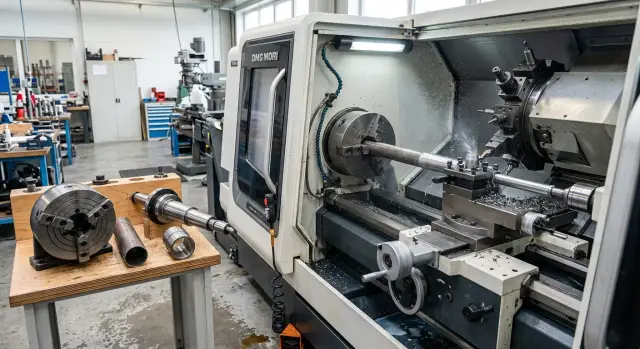
Why a bushing loses roundness after the mandrel
When machining thin-walled bushings, the metal does not hold its shape on its own; it holds it together with the clamping force. While the part sits on a mandrel or in the chuck, the wall springs a little and adapts to that force. When the clamping is released, the bushing does not return to a perfect circle, but to the shape created by residual stresses and uneven rigidity along its length.
This problem is more pronounced in a long bushing. A short part usually manages to "resist" along its entire length, while a long one behaves like a thin shell: one section has already relaxed, another is still held by the mandrel, and a third has heated up a little more during cutting. If the wall is thin, even a small difference in force causes a noticeable diameter deviation.
That is why the size while clamped almost never matches the free-state size. On the machine, the indicator and go/no-go check may show a good result because the mandrel temporarily straightens the shape. After removal, the part changes: one diameter "opens up," another slightly "shrinks," and instead of a circle you get an oval. The greater the length-to-wall-thickness ratio, the stronger this effect.
The worst part is that ovality is not always visible right away. Sometimes the bushing loses roundness immediately after removal, and this is only noticed on the inspection table. But it can also happen differently: the part sits for a while, cools down, stresses redistribute, and the deviation only shows up when measuring in several sections.
Usually this shows up in two cases:
- after roughing, the allowance was left uneven along the length
- the mandrel expanded the part more than necessary for the finishing pass
- the tool caused extra heat on the thin wall
- the check was done only in one section, where the shape still looked normal
A simple shop-floor example: a long bushing was brought to size on a mandrel, removed, and at the inlet and in the middle the readings differed in two mutually perpendicular directions. On the machine everything looked even because the fixture held the wall. In the free state, the part showed its real shape.
For this reason, a good result depends not only on a precise tool or a careful cutting regime. The machining route itself matters much more: where the part removes metal roughly, where the fixture supports it, and in what state it is checked.
Where ovality comes from in this route
To understand how to reduce ovality in long thin-walled bushings, you need to look not at one pass, but at the whole chain of loads on the part. A thin wall easily changes shape under clamping, under cutting, and even from its own heat. While the bushing sits on the fixture, this is not always visible. After removal, it releases the stress and moves out of round.
The first reason is simple: the jaws do not squeeze the part exactly equally. Even if the chuck is adjusted carefully, the thin bushing gets local pressure zones. In section, this often creates not a perfect circle, but a shape with two or three pronounced flattened areas. During roughing in the chuck, the tool removes metal from a part that is already slightly deformed. After unclamping, this shape changes again.
The situation gets worse with uneven allowance along the length. A long bushing rarely behaves like a single unit. If more metal remains on one end, that section is stiffer. If the allowance is smaller in the middle, it "breathes" more easily under the tool. As a result, the part springs differently along its length, and the ovality is not the same: one value at the end, another in the middle.
Heat is another problem. A long cut, a slightly dull insert, too much feed, or poor chip evacuation quickly raises the temperature of the thin wall. The metal expands a little right during machining. Then the part cools down and the size shifts. On a short and thick blank this is acceptable, but when machining thin-walled bushings the difference becomes obvious.
Where finishing mistakes happen
Finishing on an expanding mandrel usually helps because it removes part of the deformation caused by the jaws. But such a fixture does not solve everything. If the mandrel expands the bushing too much, if the contact is short, or if the fit is dirty, it introduces a new error. Then the lathe machining route for bushings changes the source of ovality instead of eliminating it.
In practice, the picture is often this: after roughing in the chuck, the bushing already holds internal stresses, and finishing on the expanding fixture only reveals them. That is why good results come not from the fixture change alone, but from a combination of moderate clamping, even allowance, and a calm finishing pass without extra heat.
When roughing is done in the chuck
Rough machining of a long thin-walled bushing is usually done in the chuck while the blank still holds its shape better than after boring and wall thinning. At this stage, it makes sense to remove almost all of the heavy allowance. This way the part moves less, and the mandrel later acts not as a force-heavy fixture, but as a base for a calm finishing pass.
The most common mistake is simple: the operator tries to get almost the finished size already in the chuck. For a thin bushing, that is a bad idea. The jaws squeeze the blank, the wall shifts slightly, the tool removes metal to the shape of the compressed part, and after unclamping the circle turns into an oval. That is why, during roughing, it is better to leave a clear and even allowance on both the outer and inner diameters. That allowance is then removed during finishing, when the part is held more gently and evenly.
If the goal is to understand how to reduce ovality in long thin-walled bushings, the route almost always starts here: most of the metal is removed before switching to the mandrel. Otherwise, the mandrel gets an extra load, the part heats up, and the shape drifts even more.
The clamping force should also not be set against the material. The maximum on a hydraulic chuck does not give a quality reserve. More often, it just squeezes the thin wall harder. It is better to choose moderate force: enough so the blank does not slip during cutting, but without noticeable deformation. Sometimes it helps to make a light trial pass and see how the size changes after unclamping.
Before the first pass, a short check is needed:
- make sure there is no seating misalignment
- check runout on the reference surface
- confirm the jaws are supporting the part steadily
- verify that there is enough allowance for finishing on both sides
In practice, this saves more time than it seems. If runout is already visible before cutting, afterward it usually only gets masked as "unstable material" or a "finicky regime." In reality, the cause is often the setup and an overly aggressive roughing pass in the chuck.
What finishing on an expanding fixture does
If the goal is to understand how to reduce ovality in long thin-walled bushings, finishing is often moved from the jaws to an expanding fixture. The reason is simple: at the end, the part is better supported by the inner diameter, rather than being squeezed from the outside at three clamping points.
When the jaws hold a thin bushing, the wall gives a little even with careful force. During the pass, the part may look round, but after it is removed from the chuck, the metal springs back, and the outer diameter turns oval or polygonal.
An expanding fixture works more gently. It supports the bushing from the inside, so the final pass removes metal with less local wall crushing. This is especially noticeable on a long part: the shape stays more even across the entire base, not just near the clamping point.
On long bushings, this gives another advantage. When support comes from the inner surface, the part behaves more calmly along its length, and the outer size is more even from start to finish. Usually, this makes it easier to hold not only the diameter, but also the geometry itself after removal from the mandrel.
There is one nuance, and it decides a lot: the expanding setup needs a straight, repeatable inner diameter. If the hole after previous operations has taper, barrel shape, or local waves, the fixture will expand the bushing unevenly. Then the error simply moves to the finishing surface, and the benefit will be smaller.
That is why a good route looks like this: first, obtain a stable inner diameter with a clear allowance, then place the part on the expanding setup and make a light finishing pass. At the end, it is better to remove as little as possible. Thin walls like a calm regime and predictable support.
You can see this quickly on the shop floor. Suppose a bushing 220 mm long with a thin wall comes out fine by the indicator after finishing in the jaws, until it is removed. After removal, a noticeable oval appears. The same blank on an expanding fixture often gives a flatter result already on the first repeat part, if the hole was prepared without scatter.
On CNC machines, this route is easier to repeat from batch to batch, because the support scheme does not change with jaw force. For production where not only size but also series stability matters, this is usually the calmer option.
Step-by-step route
When people ask how to reduce ovality in long thin-walled bushings, they most often change not the tool, but the order of operations. For such parts, the lathe machining route for bushings usually works better than trying to "pull" the size into place in one setup.
First, straighten the blank and check whether the allowance is sufficient. If the tube or forging already arrived with a noticeable bend, the machine will not fix that. You need to check straightness, wall thickness variation, and the stock for machining. If the allowance varies, finishing will only reveal that difference.
Next, prepare the datum and the seating for the mandrel. In the first setup, machine the support surfaces so the part will later sit predictably and without misalignment. It sounds simple, but this is exactly where the first mistake often happens: the datum is made roughly, and then precise geometry is expected at finishing.
After that comes roughing in the chuck. At this stage, the main allowance is removed from the outer diameter and, if needed, the inner surface is corrected, but the part is not taken to the finished size. The idea is simple: the chuck holds the part more rigidly, so it is convenient to remove most of the metal there. It is better to leave a calm finishing allowance, for example 0.2-0.4 mm on diameter, than to try to hit size under jaw load.
Then the part is transferred, and that is where finishing on the expanding fixture starts to work. The bushing is supported closer to its real state after removal, so the shape is more truthful. Expand only enough so the part does not slip. If you expand too much, ovality will return, only at a different stage.
Before measurement, let the part cool. It seems minor, but it is often overlooked. A thin wall heats up quickly from cutting, and immediately after the pass the size looks better than it does 10-15 minutes outside the fixture.
For the first parts in a series, only a few checks are usually needed:
- ovality after removal from the mandrel, not on the machine
- remaining allowance before finishing along the entire length
- signs of local overclamping on the seating
- repeatability of the result on 2-3 parts in a row
This order is what most often gives a clean result in thin-walled bushing machining. First a rigid setup to remove the bulk, then a gentle setup for shape and size. In the shop, this is usually more reliable than trying to do the finishing pass under heavy clamping and then hunting for the cause of the ovality.
A simple shop example
At one station, a bushing 240 mm long with a wall thickness of 2.8 mm was turned. The batch was medium-sized, 180 pieces, so manual adjustments on every part immediately hit both time and scrap.
At first, the route was the usual one: roughing in the jaws, then finishing the outer diameter in the same setup. While the part was clamped, everything looked normal. The indicator showed ovality within tolerance, and the size passed without questions.
The problem appeared after removal. The bushing released its stress, the shape opened up slightly, and on the QC table the numbers were already different. On the machine, they got about 0.01-0.015 mm of ovality, but after removal it rose to 0.04-0.06 mm. For this part, that was already scrap.
After that, the route was changed not completely, but in one place only. Roughing remained in the chuck, because that is faster for removing the main allowance and correcting the datum. Finishing was moved to an expanding mandrel so the thin wall would not be crushed by the jaws at the most sensitive moment.
The result became visible already on the first ten parts. After finishing on the expanding setup, the bushing came off with almost no shape jump, and ovality stayed around 0.015-0.02 mm. Inspection stopped "wandering": if the first part passed, the next one usually behaved the same way.
That is how you can see in practice how to reduce ovality in long thin-walled bushings. Not through complex tuning, but by putting the finishing pass in the right place.
But there was a second lesson. Once, the operator left an inaccurate seating for the mandrel after a previous operation: the hole came out with a slight taper and a contact patch only in one zone. The mandrel expanded the bushing unevenly, and most of the gain almost disappeared. Ovality started creeping up again, even though the cutting regime itself was not changed.
For such parts, small things matter a lot. If the seating for the expanding setup is clean, coaxial, and free of taper, the route works steadily. If the datum is inaccurate, even a good mandrel will not save you.
Mistakes that ruin the result
Ovality often grows not because of the machine, but because of several small decisions in the route. On a long thin-walled bushing, they add up quickly: the wall springs back, the part releases stress after the mandrel, and a good size on the operation does not always mean a good size after removal.
The first mistake is leaving too little allowance for finishing. After roughing, the part has already been deformed by clamping and cutting. If almost nothing is left to remove during finishing, the tool does not correct the shape; it only repeats it. In the end, the bushing looks round on the mandrel, but after removal it shows ovality above tolerance.
In practice, this is visible quickly. If only a symbolic allowance remains after roughing, finishing on the expanding fixture works almost like a sizing pass, not a shaping pass. For a long thin-walled bushing, that approach usually gives weak results.
The second mistake is expanding the mandrel more than necessary. Many people do this
Quick checks before a production run
If you are looking for how to reduce ovality in long thin-walled bushings, start not with the cutting regime, but with a short check before launching the batch. On a thin wall, small things quickly turn into scrap: too much jaw force, a fit that is too tight for expansion, or simply a warm part after the pass.
First, compare ovality in the fixture and after removal. If the part is almost round in the chuck or on the mandrel, but turns oval after removal, the problem is usually not the tool path, but the setup and clamping force. If the oval is already visible in the fixture, then look at the allowance, overhang, regime, and the rigidity of the lathe machining route for bushings.
On the first two parts, check the fit for expansion separately. Not according to the drawing in general, but by the actual result after roughing. Expanding fixtures work properly only when the fit is repeatable and stable. If one bushing seats tightly and the next one already with noticeable interference, finishing on the expanding fixture will give a different result even with the same program.
Then inspect the pressure marks. Jaws often leave bands or local marks, and a mandrel can leave an imprint along the contact length. Such marks are more useful than any general
What to do next
First, check the route not on the whole batch, but on the same blank or on two blanks from the same melt. That way you can quickly see where the bushing loses shape: after roughing, after finishing, or already after removal from the mandrel. For such a part, guessing usually does more harm than good. You need measurements and one clear test.
If the goal is to understand how to reduce ovality in long thin-walled bushings, compare only one factor at a time. Do not change the regime, material, fixture, and machine all at once. Otherwise the result will be noisy, and the conclusions weak.
A simpler approach is this:
- Run two routes side by side. First: roughing in a rigid chuck and finishing there as well. Second: roughing in the chuck, then finishing on an expanding fixture.
- Record the inspection map. Measure diameter and ovality in the same sections: near one edge, in the middle, and closer to the other edge. Take measurements before removal from the mandrel and after removal.
- Look not only at the average value, but also at the spread. If two parts out of five already