
How to Hold a Round Workpiece During Milling: Soft Jaws or a V-Block
We’ll show how to hold a round workpiece during milling: when soft jaws give better access, and when a V-block holds the part better for roughing.
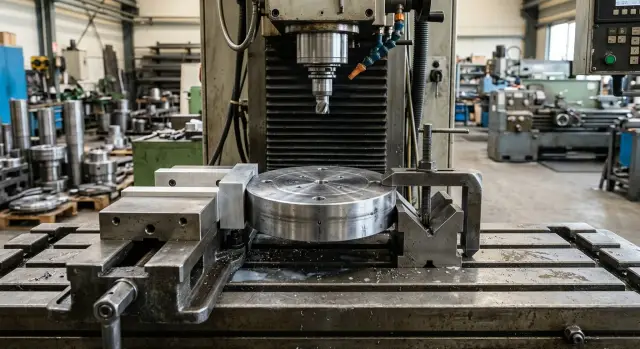
What makes a round workpiece difficult
A round workpiece is hard to hold with a standard clamp. Flat jaws touch the cylinder along a narrow line, so under side load the part can slip or rotate slightly. On a light pass, that is not always obvious. On roughing, the problem shows up right away.
Because of this, the question of "how to hold a round workpiece during milling" should not be answered by habit. The same clamping method may work fine for finishing and fail on a deep cut. The more material you remove per pass and the more the cutter pulls the part sideways, the faster a weak support starts to show its limits.
The consequences are familiar in any shop: vibration, surface marks, size drift, and extra load on the tool. People often blame the cutter or the cutting parameters, although the reason is simpler - the workpiece is supported in the wrong place and the wrong way.
There is also a second question: what matters more, open tool access or rigidity. Soft vise jaws usually give you more open surface. A V-block holds the part more securely, but access to the lower areas is worse. That is why the choice is made not by convenience, but by the operation itself: how much metal is being removed, where the cutting force goes, where the cutter needs access, and whether clamp marks are acceptable.
If you choose at random, you can lose not just a few minutes, but the whole blank.
When soft jaws help
Soft jaws are a good choice when precise seating and machining access matter. They are bored to the part diameter, and the round blank immediately sits in a clear, predictable position. That reduces misalignment during setup, especially if the part is short and the outside surface is already fairly clean.
The main advantage of this solution is open access. The vise does not block the top of the part, and the side areas remain more open than they would in a V-block. That is why soft jaws are convenient when you need to mill a face, drill from the top, or make light side passes without extra repositioning.
For production runs, this option becomes even more useful. Bore the jaws once for the required size, set the stop, and after that identical parts go in quickly and without lengthy alignment. The operator makes fewer unnecessary movements, and repeatability is usually better.
Soft jaws work best under these conditions:
- the stock removal is small;
- the part is short or medium in length;
- you need good access to the top and part of the side surface;
- you are doing finishing, drilling, or reaming;
- the job is a batch of identical parts.
But soft jaws have limits. If the cutter pushes hard sideways, a smooth cylindrical blank can start to creep or rotate slightly. This often happens when rough machining a cylinder, when a lot of material is removed per pass, when the feed is noticeable, or when a long part is clamped with a small contact area.
In those cases, more wraparound support by diameter, a longer seating area, and a calmer cutting mode help. If the operation starts with heavy roughing, soft jaws are chosen more for access and fast changeover than for holding strength.
When a V-block holds better
A V-block is the right choice when a round blank wants to rotate under load. The V-shaped support carries the cylinder from two sides, so the part sits more securely than on a flat contact. When the cutter pulls the material sideways, this setup usually behaves more steadily.
That becomes especially clear during heavy stock removal. If the allowance is large, the cutter is big, and the cutting conditions are aggressive, the cutting force rises quickly. At that point, a V-block often beats soft jaws in holding power.
It is usually chosen when:
- you need to remove a large allowance;
- the blank is long and tends to roll in the vise;
- the material cuts with noticeable force;
- holding strength matters more than access around the full circumference.
The rule of thumb is simple: the heavier the roughing cut and the stronger the sideways cutting force, the more reason there is to look at a V-block first.
The downside is just as clear. You pay for security with access. A V-block covers part of the lower area, and it becomes harder for the tool to reach where an open path is needed. If you need to machine a sector close to the bottom or quickly move to the opposite side, this setup starts to get in the way.
Usually one V-block is not enough. To keep the cylinder from moving along the axis, a top clamp and a lengthwise stop are added. Otherwise the part may not rotate, but it can still slowly creep lengthwise. On long blanks, that happens often.
How to choose the clamping method
If you are deciding how to hold a round workpiece during milling, start with three things: diameter, length, and weight. A short bushing and a long heavy shaft behave very differently. The longer the part is relative to its diameter, the higher the risk of vibration and movement.
Then look at the operation itself. Which surfaces need to stay open? Where will the cutter pass? Do you need access to a large arc, the end face, or a side wall? If access matters more, soft vise jaws are often more convenient. If stability during roughing is the priority, a V-block for a round part is usually more reliable.
Next, estimate the cutting force. Not in theory, but in simple terms: how much material comes off per pass, how far the tool sticks out, and which way the cutter will pull the blank. If the cut is heavy and the part is smooth and massive, it is safer to start with a V-block.
A practical sequence looks like this:
- Measure the diameter, length, and weight of the blank.
- Check which surfaces the clamp must leave open.
- Compare the planned stock removal with how securely the fixture holds the part.
- For heavy roughing, try a V-block first.
- If surface access matters more, switch to soft jaws.
After you choose, do not start the full program right away. Make a short test pass at a shallow depth and check whether the part has moved off the mark or shifted from its base. Even a small shift is already a reason to redo the clamping setup.
What to check before starting
Before you start the spindle, a minute of attention is enough. A round workpiece often looks clamped properly, but under load it immediately reveals every small mistake.
First, clear chips from the jaws, V-block, parallels, and table. Even a thin chip under one side creates a tilt. Then seat the part on the support and try to rock it gently by hand. There should be no play.
Tighten the clamp gradually. Watch that the part does not lift or move sideways. In a vise with soft jaws, it helps to lightly clamp the blank first, tap it into place by hand or with a soft spacer, and only then fully tighten.
Also check the tool path separately. The cutter must not hit the vise, V-block, bolts, or clamps, especially at entry and exit. It is best to set the work zero after final tightening. A round blank can shift by a few hundredths just from the final tightening, and that is enough to end up out of tolerance.
If the part is long, check both ends. One end may sit firmly while the other hangs or rests on chips. On roughing, that quickly turns into vibration and surface marks.
There is also a simple shop-floor trick: after tightening, try rocking the part by hand again and lightly tap it through a copper or plastic spacer. A dull, even sound usually means good contact. If one point sounds sharp, the seating is incomplete.
A two-setup example
In practice, it is often better not to look for one universal clamping method, but to split the job into two setups. Suppose you have a 60 mm round blank. First you need to remove material from one side, then machine a slot.
If you try to do everything in one go, the risk rises. On the roughing pass, the part gets a sideways push and may shift slightly. The problem shows up later, closer to finishing.
A simple sequence usually works better. In the first setup, the part is placed in a V-block and the main allowance is removed from the first side. After that, a base surface exists. In the second setup, the blank is moved into soft vise jaws and the slot or side wall is machined with better access.
The point is that the first setup solves the holding problem, and the second solves the access problem. On paper, that may look a little slower, but in real work it often saves time. You do not have to fight with a doubtful clamp, check for movement after every pass, or rework the part at the end.
If during machining it becomes clear that the cutter lacks access, the clamping force is too high, or the part leaves marks and wants to rotate, it is better to change the fixture right away. One extra setup is almost always cheaper than scrap.
Common mistakes
The most common mistake is clamping a smooth round blank in ordinary flat jaws without boring them. In that case, there is no true contact area, and under side load the part can rotate even by a small amount. That is already enough to throw the size off.
The second mistake is starting heavy roughing in soft jaws just because it is easier to reach the part with the cutter. Easy access is not a substitute for rigid clamping. If the cut is heavy, a V-block is usually calmer.
With long parts, people often forget about the axial stop. They clamp the bar or shaft, start machining, and then wonder why the length dimension drifts. The reason is simple: the part slowly creeps along the axis.
Another problem is a top clamp positioned too far from the center. Then it does not just press downward, but also tries to tilt the part or roll it out of the support. For a round blank on a V-block, that is especially unpleasant.
And finally, many people check tool clearance too late. Both soft jaws and a V-block can block the path if you need to machine below centerline or reach an end face near the clamp. In the end, the operator changes the strategy on the fly, and that is almost always a bad sign.
If, before starting, you do not have a clear answer to three questions - where the part is really sitting, where the cutting force will go, and whether the tool will hit the fixture - it is better to rebuild the clamping setup right away.
What to do next
After comparing jaws and a V-block, do not start the whole batch without checking. Make one test part and see how the blank behaves in each setup. Usually that is enough to understand where it sits calmly and where it starts to shift on the very first pass.
It helps to keep short notes right at the machine: which clamping method worked better, on which operation movement appeared, what tool overhang was safe, and how the part behaved after roughing. If you use soft jaws, record the bored diameter, seating depth, and stop position. If you work with a V-block, note the shim height, stop position, and part orientation.
After a month, those notes save more time than memory and guesswork. You end up with a ready-made setup instead of a new experiment.
If the question is no longer about the clamping method, but about choosing the machine, tooling, and the whole machining setup, you can rely on practical materials from EAST CNC. The company supplies metalworking equipment, including machining centers, and helps with selection, commissioning, and service. For shops where cylindrical parts are a regular job, that approach is usually more useful than solving the same task from scratch every time.
FAQ
When is it better to choose soft jaws?
Use soft jaws when you need open access from the top and sides and the stock removal is small. They work well for finishing, drilling, reaming, and batches of identical short parts, especially if you bore the jaws to the part diameter.
When is a V-block more reliable than soft jaws?
Choose a V-block for roughing when the cutter pulls the part sideways. It holds a long or heavy round blank more securely and reduces the risk of rotation, but it does cover part of the lower area.
Why do regular flat jaws hold a round blank poorly?
Flat jaws contact a cylinder along a narrow line instead of over a proper area. Because of that, the round blank is easier to shift or rotate slightly, especially when you remove a large allowance and apply side load.
What matters more when choosing clamping: tool access or rigidity?
First look at the operation. If you need access to the surface, soft jaws usually win. If holding power on a roughing cut matters more, it makes sense to start with a V-block and then move the part for easier machining.
Do you need an axial stop for a long round workpiece?
Yes, a lengthwise stop is needed almost all the time for a long part. Without it, the bar or shaft slowly creeps along the axis, and the length dimension drifts even if the part itself does not rotate.
Can you rough machine in soft jaws?
You can, but only if the cutting conditions are calm, the contact area is good, and the part is short. If the cut is heavy, a smooth blank in soft jaws often starts to creep or rotate, so a V-block is safer for the first step.
What should you check before starting the spindle?
Before starting, clear chips from the jaws, V-block, and table, then seat the part on the support and try to rock it gently by hand. After tightening, check that the part did not lift, the base did not move, and the tool will not hit the vise, bolts, or clamps.
Why split the work into two setups?
Two setups often give you a calmer process. First, remove the main allowance in the V-block and create a base, then move the part into soft jaws and machine the areas where better tool access is needed.
How can you tell that a workpiece is shifting during milling?
The part usually gives warning right away: vibration appears, marks show up on the surface, the size starts drifting, and after the pass the reference mark no longer matches. If you see even a small shift, stop the program and redo the clamping.
How can you safely check the clamping before a production run?
Do not start the whole batch right away. Make a short test cut at a shallow depth, check the datum, size, and clamp marks, then write down the setup, seating depth, stop position, and cutting conditions. Those notes will save time on the next batch.