
How to choose a chip removal system for your station without mistakes
How to choose a chip removal system for your station: by material, chip shape, flow volume, coolant and conveyor type—practical tips without extra theory.
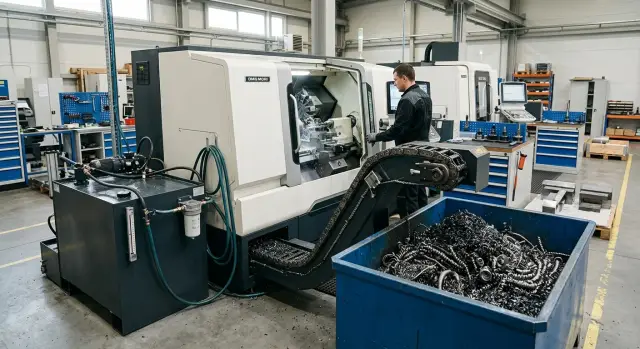
Why chip removal quickly becomes an issue
The problem starts long before the drawer is full. Chips accumulate in the work area, interfere with coolant flow, block sightlines and end up where they don't belong. The operator spends time not on the part, but on constant cleaning around the machine.
If chips don't leave immediately, they begin to affect the machining itself. Short pieces clog corners and troughs, while long ribbons catch on the tool, chuck and the workpiece. That leads to scratches on parts, extra stops and manual cleaning in the middle of a shift.
This shows up especially fast on materials that produce long continuous or coiled chips. They wind into balls, drag along fines and can stop production even where the machine itself is well selected. On paper it looks simple: install a chip conveyor and the problem is solved. In practice, an unsuitable removal type often creates more downtime than it prevents.
There is also a less visible part of the problem. Coolant carries fine chips and abrasive dust into the tank, and then this mixture passes through pumps and filters. If the removal scheme handles fines poorly, filters clog faster, the tank needs cleaning more often, and the fluid loses its working properties sooner.
In the shop this is very practical: machines are stopped more often for cleaning, the area around equipment becomes dirtier, filters and the tank demand extra attention, and the operator finds it harder to keep a steady production rhythm.
Another common mistake is expecting the same scheme to suit all materials. Cast iron, stainless, aluminum and structural steels behave differently. In some places chips are brittle and one approach works, while in others a long ribbon forms and the requirements are entirely different.
So choosing a chip removal system usually comes down not to the price of the conveyor, but to the real situation at the station. You need to look at what chips come out, how they mix with coolant and how much manual cleaning remains after a typical shift. This is where mistakes most often begin.
What chips come from different operations
Even on a single station chips behave differently. Turning often produces long continuous ribbons, drilling can throw out tight spirals, and with a well-chosen cutting mode chips break into short pieces and are much easier to remove.
Continuous ribbons stretch out in long bands. They cling to the part, wind on the chuck, catch on trough edges and quickly block narrow spots. This is common on steel and ductile alloys, especially with low feed and a tool that cuts smoothly without a positive chip breaker.
Coiled chips look calmer but still cause trouble. They come out as rings, springs or dense balls. This variant often appears during turning and drilling when the chip is no longer a continuous ribbon but hasn't broken into short pieces yet. If the rings are large, they jam in the removal opening and hinder the conveyor.
Brittle chips are usually easier to handle. They fall as short segments, sometimes almost like granules. But there's a nuance: with cast iron, bronze and some dry operations, fine dust appears alongside short chips. It settles in the sump, mixes with coolant and forms a sticky abrasive sludge.
Chip shape depends not only on the operation. It is influenced immediately by the workpiece material, feed, cutting speed and tool geometry. The same machine on steel can produce long ribbons, while on cast iron it yields short brittle chips. Changing the insert or raising the feed also alters the picture.
In practice it's useful to look at what actually ends up in the sump after an hour of work rather than at material names. On CNC lathes this is visible quickly: if there are balls at the bottom you need one removal approach; if fine crumbs and sludge accumulate you need another. The error usually starts when systems are chosen by the machine catalog, not by the real chip form in operation.
How the workpiece material affects the choice
Material almost always decides more than it seems. The same machine can run fine on cast iron and constantly clog on stainless. The reason is simple: chips behave differently, and the conveyor must handle them differently.
Steel often produces long coiled chips. They catch on edges, wind up and form dense balls. For that work you usually choose a conveyor that reliably pulls long elements and isn't afraid of overload. If coils are especially long, without chip breaking or extra traction the system quickly becomes unreliable.
Stainless usually causes even more problems. Its chips tangle more and carry a lot of coolant. Narrow channels, small pockets and poor coolant return quickly create mess under the machine. If a station often machines stainless, look for a removal scheme with good coolant drainage and no places where chips can hang in clumps.
Cast iron behaves differently. It gives fine brittle chips and dust. Long coils don't bother here, but another issue arises: fines pass through gaps, settle in the tank and clog filtration. For cast iron, solutions that reliably collect small fractions and don't scatter them across the sump work better. If the shop does a lot of dry machining, consider dust in advance.
Aluminum often seems easy, but it quickly exposes weak points. Its chips cling, hold coolant and rapidly fill the container. Even with small mass, volume increases quickly. Because of this the container needs changing more often, and deposits appear in troughs and bends.
In short: for steel you need resistance to long coiled chips, for stainless a good coolant discharge and places where chips can't hang up, for cast iron reliable handling of fine brittle chips and dust, and for aluminum capacity and anti-adhesion protection.
In shops where steel is processed one day and aluminum or cast iron the next, one solution for all usually performs only mediocre. It's better to understand which material creates the main load. If most of the shift is stainless, size the system for it rather than for occasional steel parts.
What removal schemes are installed on a shop
A removal scheme is chosen not from a catalog but from how machines are arranged, where chips fall and at what height it's convenient to pick them up. Even a good conveyor performs poorly if there's not enough room under it for a sump, cart or tank.
In practice most setups install a separate removal for each machine. This layout takes more space but is easier to clean and allows stopping a single machine if the channel clogs. For a small shop this is often the calmest option: the operator immediately sees where chips collect and doesn't have to look for the problem along the whole line.
A common channel under several machines saves walkways and gathers chips in one place. But it has a weak point: the flow becomes unpredictable. If one machine produces a long ribbon or coil, it can catch in a bend and hold up everything following. One local jam quickly turns into a general stop.
Dumping chips straight into the coolant tank is suitable only where volumes are small, for example on one or two machines with short cycles and without heavy continuous chips. If chips are abundant, the tank quickly loses useful volume, pumps pull a dirty mix, and the system needs cleaning more often than planned.
Shop layout is most often broken by sump depth under the machine, trough shape, number of bends, discharge height, space for maintenance and the coolant return path. These small details matter more than they seem. A low discharge is convenient for manual collection but requires frequent emptying. A high discharge allows a large container but needs extra height and can change machine location.
If the shop consists of several CNC lathes, first look at daily cleaning rather than price. Separate lines are almost always easier to live with. A common channel makes sense where machines are tightly grouped, materials and modes are similar, and staff have time to monitor the flow.
How chip conveyors differ
On one shop different conveyors behave very differently. One reliably removes long chips after turning, while another clogs quickly and pulls excess coolant along. So you should look not at the name but at what chips the machine produces every day.
By chip type
Articulated-belt conveyors are usually chosen where there are long or mixed chips. They suit CNC lathes well when the flow contains both coiled and short chips. This option is often selected for shops that work steel today and stainless tomorrow or where cutting modes change between batches.
Scraper conveyors work better with fine brittle chips. They reliably move fines together with coolant and depend less on the shape of individual pieces. If a shop produces a lot of short chips from cast iron or aggressive cutting modes, this type is usually more practical.
Screw conveyors are placed where there is little space under the machine or directly below the cutting area. They are compact and simple. But long coiled chips easily wind on the screw, so they are less suitable for those tasks.
Magnetic conveyors are used for fine ferromagnetic chips. They are good for steel and cast iron when the chips are short and small. They do not solve the problem for aluminum, non-ferrous metals or some stainless steels.
What to check before ordering
Before ordering it's useful to ask not only "will it move chips?" but also how it handles coolant. A proper conveyor shouldn't constantly throw fluid out with chips into the container. Otherwise the shop loses coolant and the area becomes dirty quickly.
Check a few simple things: what chips the conveyor moves without winding and jamming, how it separates coolant and returns it to the system, what volume it can handle per shift without overflow, how much space is needed for maintenance and how often the operator must intervene.
Put simply: for long and mixed chips an articulated-belt type usually fits best, for fine brittle chips a scraper, for tight layouts a screw, and for small steel chips a magnetic conveyor. The common everyday error is choosing the compact scheme and then finding it can't handle real chips.
How to choose a system step by step
Start not with a catalog but with the actual chips on the shop floor. To understand which system will fit, collect samples after each operation for at least one shift. Chips from turning steel, aluminum and cast iron behave differently, and one conveyor won't always manage everything equally well.
First, sort samples by operation: turning, drilling, boring, rough and finish passes. Continuous ribbons wind and block narrow spots. Coiled chips often catch on scrapers and partitions. Brittle chips flow easier, but if there's a lot of them they form a dense mass.
Next, calculate not the average volume "by eye" but the actual output per shift and during peak hours. This is a common mistake: during the day the system copes, but after a series of heavy passes the sump fills in 20–30 minutes. For selection you need the worst-case working scenario, not a pleasant average.
Then look at the path from the machine to the container. Everything matters: where the container stands, what discharge height is needed, whether there's a turn, room for pulling out the tank and whether the lift angle will work. On paper these look like small things, but in the shop such details hinder daily operation.
Separately, check the system against coolant. If a shop uses a lot of emulsion, you can't choose chip removal independently from the tank and filtration. Fine chips go into the tank, clog pumps, settle in the settling area and later return to the cycle. So always view the scheme as a whole: how chips leave the work area, how much coolant goes with them, where fines are separated and how the tank and filters are cleaned.
Finally, honestly answer who will clean the system, how often and how long it takes. If usual cleaning requires removing the cover, accessing the underside and long machine stops, people will avoid it and do manual cleaning instead.
A good choice usually looks boring. Chips leave without winding, the container fills without spillage, the tank doesn't clog and the operator can service the unit without long stops. For the shop that is more valuable than any attractive scheme on paper.
Example for a small shop
A small shop is often built gradually: two lathes cut steel and stainless, and nearby a machining center works on aluminum. At the start you want one removal type for all. That's usually where the first problems arise.
The lathe pair produces stubborn chips. On steel and stainless they often come out as long coils. If the removal is weak or the drop opening is narrow, chips catch, form clumps and wind on conveyor parts. Stops then happen not because of machining but because of cleaning.
For that group you usually choose a separate conveyor that handles long ribbons and doesn't jam on bends. An articulated-plated (hinged) scheme with a clear discharge to a container often works better. Take extra discharge height and container volume from the start, otherwise you'll be changing containers too often.
With aluminum the picture is different. Chips are lighter, but coolant carries them away. If they stay long in the tank the pump pulls fine particles back into the system and filters, nozzles and cutting zone cleanliness suffer. Here you need removal that quickly extracts chips from the coolant flow instead of just piling them at the bottom.
So in this example you shouldn't look for one answer for all machines. It's logical to choose two different schemes for the lathe group and the aluminum center, even if their containers stand side by side.
Before ordering, walk the shop with a tape measure and check the real layout, not the catalog: where the container will sit, whether there is room to roll it out, whether the conveyor will hit a column or cabinet, and if the operator can service the unit without disassembling half the area. That test sobers you quickly. On the drawing everything looks compact, but in the shop one extra container turn already slows the shift.
Where mistakes are most common
The most common slip starts with trying to save on the most visible part. They buy a cheaper conveyor and then get stops, manual cleaning and extra machine hours. Purchase price rarely shows the real cost of ownership. If the conveyor can't handle your chip type, the price difference quickly vanishes in downtime.
The second mistake is looking at the average chip volume per shift. That's a trap. The system must survive peaks, not just calm modes. One run of ductile stainless parts is enough to increase the flow, cause chips to clump and block discharge.
Another problem occurs when the same scheme is expected to work for cast iron and stainless. Cast iron chips are dry, fine and dusty. Stainless often gives long clingy chips that wind and snag on protrusions. If you don't account for this, the shop will live from one cleaning to the next.
Layout errors are common too. On paper everything fits, but in the shop the container turns out too tall or too close to the machine. The conveyor either doesn't deliver chips into the container or pours them beside it. Temporary boxes and shims appear. That is no longer a solution but an attempt to fix an awkward scheme.
A separate mistake is leaving too little space for cleaning and repairs. While equipment is new this is barely noticeable. Later you need to remove a cover, clear wound coils or replace a worn part, and there's simply no space.
Before ordering, check five things: what chip type each material gives on your shop, what the peak volume is, what discharge height and container will be used, how much space remains for cleaning and access, and whether one scheme is really needed for the whole area.
Quick check before ordering
Walk the shop with a notebook and observe machines working. On paper almost every removal scheme looks acceptable, but mistakes usually surface because of details: a different chip type, too much coolant in the container or inconvenient container removal.
A short five-question check will do. What chip type dominates most of the shift? Look at the main mode, not rare operations. How much coolant goes with the chips? Sometimes a container quickly fills not with metal but with a wet mass that then runs on the floor. Where will the container stand and how will it be moved? Check aisles, turning room for a cart or forklift and where it's convenient for the operator to empty chips without extra steps. Who will clean the system and how often? If routine cleaning requires disassembling half the unit, cleaning will be postponed. One last question: what if the load doubles? Add a second shift, shorter cycle or another machine and see if the same scheme will handle the flow.
A simple test helps. Take a typical batch, collect the chips for a shift and evaluate not only the volume but how the mass behaves in the container. Continuous chips can form a dense heavy layer, while coils quickly occupy volume even if the weight is still small.
In a small shop the everyday mistake looks mundane: they chose the right conveyor but placed the container too far, and the operator spends 15–20 minutes a shift on extra movement. After a month this becomes a noticeable loss of time.
What to do after choosing
A conveyor that fits on paper often doesn't fit the real shop without small but costly adjustments. Before ordering check not only length and width but how the system will join to the machine, the coolant tank and the collection container.
Most problems appear at interface points. The conveyor hits the machine support, the coolant return pipe faces the wrong way, the chip container is too high or too low for normal discharge. If you check this beforehand, you won't have to redo the shop after start-up.
Ask the supplier for a maintenance scheme before launch. Not a general phrase but a clear map: where to clean, how often to remove accumulated chips, how to access chain or screw tension, and where coolant goes during a line stop.
Leave a little free space around the system. That space is usually spared until the first cleaning. Then you find you can't reach the hatch, the container can't be rolled out, or long coiled chips must be removed manually.
Before final confirmation check discharge direction and drop height again, space for cleaning and rolling the container, coolant return to the tank without overflow or splashing, and access to units the operator will service regularly.
If you acquire a new machine or change the shop layout, bring up chip removal right away. For example, when discussing a package with EAST CNC it makes sense to agree on conveyor type, discharge height and tank scheme in advance. The company supplies CNC lathes and machining centers and handles selection, commissioning and service, so these details are easier to sort out before installation than afterward.
When the choice is made, don't postpone a trial chip route. Walk it on the floor — from the cutting area to the container. At this stage you usually see what the catalog doesn't show.
FAQ
How do I know the chip removal system is failing?
If the operator frequently stops the machine to clean, chips sit in the working area, or coolant ends up in the container with metal, the system is already underperforming. Another clear sign is chips winding onto the tool, chuck or tight spots of the conveyor.
Which conveyor is usually chosen for long coiled chips?
For long continuous and coiled chips, a hinged-belt (articulated) conveyor is most commonly used. It pulls long elements more reliably and handles mixed flows better than compact systems without traction reserve.
When is a scraper conveyor better than an articulated-belt one?
A scraper conveyor is suitable where fine brittle chips and sludge are common, especially with cast iron. It reliably moves small particles together with coolant and usually causes fewer problems than systems designed for long ribbons.
Can one removal system be used for all materials?
Rarely. In practice one scheme seldom fits all. Steel and stainless often give long clingy chips, while cast iron produces fine dry granules and dust, so a single system usually only works with little margin.
Why do chips clog the coolant tank and filters so quickly?
Fine chips and abrasive dust go into the tank with the coolant if the removal system doesn't separate them early. Pumps then circulate dirty mixture, filters clog faster, and the tank needs cleaning more often.
What should be checked on-site before ordering a conveyor?
First inspect the actual chips after a shift, not the catalog. Then check the route to the container: discharge height, container location, turns, coolant return and access for cleaning without long downtime.
What is better for a shop: individual removal for each machine or a common channel?
For a small shop, a separate removal at each machine is usually easier to operate. A common channel saves space but one jam in a bend can stop several machines at once.
Why isn't a screw conveyor always a good choice?
A screw conveyor is installed where space is limited, but its weak point is that long coiled chips can wind onto the screw. If the machine often cuts steel or stainless with long ribbons, a screw will quickly require manual cleaning.
How to accurately estimate chip volume before purchase?
You should account for the worst-case scenario, not the average output per shift. If a series of tough parts fills the sump in 20–30 minutes, the system is undersized even if it seems fine in calm hours.
What should be discussed with the supplier before installation?
Agree on conveyor type, discharge height and direction, coolant return and access points for cleaning. If the supplier configures the machine and shop layout, resolve these details before installation rather than after.