
How to Choose a Tool Supplier for Urgent Orders
How to choose a supplier for urgent orders: look at real lead time, a local warehouse, and technical support, not the price per insert.
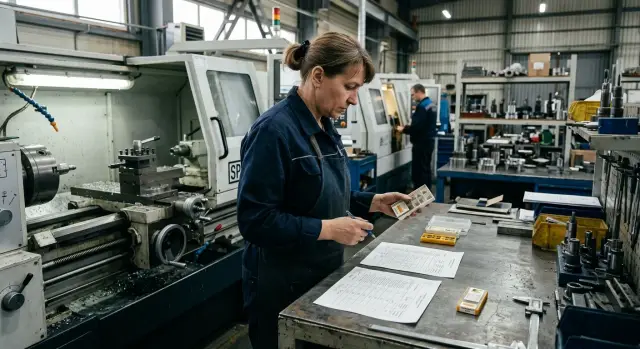
Why the cheapest insert ends up costing more
The lowest price for an insert almost never gives you the lowest cost per part. In an urgent order, the money is not spent on the tool box, but on the hours when the machine is not cutting metal. One simple machine stop can easily wipe out all the savings from a 5–10% discount.
The problem does not show up on the invoice, but on the shop floor. The operator is ready to start the batch, but the needed item is missing. The manager calls the supplier, the warehouse says there is no stock, and the substitute will arrive in a few days. The shift waits, the machine stands still, and the deadline gets tighter. At that point, the cheap insert is no longer cheap.
Often the buyer agrees to a replacement just to avoid losing time. On paper everything looks fine: same size, similar geometry, similar alloy. On the actual part, things can go differently. The cutting edge wears faster, dimensions drift, and surface finish gets worse. Then the shop spends time on re-adjustment, inspection, and rework. Sometimes a whole shift is lost just to get stable results back.
Money is usually lost in four places: machine and labor downtime, urgent shipping instead of normal delivery, scrap or extra passes because of a poor substitute, and missing the deadline for your own customer.
The last point is often the most expensive. If the customer expects the batch by Friday, they do not care that you saved 20,000 tenge on an insert. They see only one thing: the shipment was missed. After that come penalties, the loss of the next order, or an urgent weekend run. Against that backdrop, the price difference between two suppliers looks small.
For a shop with CNC lathes, this is simple arithmetic. One supplier has a slightly lower insert price, but delivery takes five days. Another has a higher price, but the item is sitting in a local warehouse, and the engineer can immediately suggest a working cutting condition. In the second case, you pay more for the box, but less for the whole order.
If the order is urgent, looking only at the unit price is risky. Much more important are three things: whether the product is nearby, how quickly it will be shipped, and whether the supplier will help if the tool does not behave the way it was promised.
What to check in the delivery time
Price can easily be misleading. But for an urgent order, it is more important to understand how many hours or days it will take for the tool to reach your shop. If the machine is idle, the difference in the price of one insert quickly loses its meaning.
It is better to count delivery time not from the first call and not from the date in the quote. Count it from order confirmation to actual shipment. Clarify whether this time includes payment verification, order picking, labeling, and handoff to delivery. A manager may say “we’ll ship tomorrow,” while the warehouse only assembles the order a day later.
It helps to separate two things right away: what is in stock now and what is being brought in to order. Do not mix them up. An item may show as “available” in the system, but already be reserved for another customer.
It is usually worth clarifying a few details: how long it takes from confirmation to shipment, which items are actually sitting in stock today, the lead time for rare inserts, tool holders, and non-standard sizes, and how quickly the supplier replaces defects and covers shortages.
Delays usually happen not with fast-moving items, but with the small ones. The main inserts may arrive on time, while one rare tool holder holds up the entire start. So check not only popular item codes, but also the positions you need rarely, yet cannot work without.
It is also worth asking separately about defect replacement. If the box arrives with the wrong geometry or part of the order is missing, you need a clear solution time, not a vague “we’ll sort it out.” One day, three days, or a week are very different risks for production.
Promises are best checked in practice. Place two small test orders: one for fast-moving items and one for something less popular. That way you see the real lead time, not a nice number in a message thread.
For shops in Kazakhstan, this is especially noticeable. Logistics between cities and cross-border delivery can easily add extra days. That is why a good supplier states a specific time right away, honestly separates stock from waiting, and does not dodge the question if something goes wrong with the order.
Why a local warehouse matters
When an order is urgent, the shop does not need the cheapest price list — it needs the tool nearby. If stock is stored in the country, delivery to production often drops from weeks to a few days, and sometimes to same-day shipment.
For a company in Kazakhstan, this is especially important. One missing box of inserts, a drill, or a tool holder can stop a section more than the price difference at purchase. A lost shift almost always costs more than a discount.
A local warehouse is useful not only for large batches. Often you need to top up just a little: one box of inserts for an unplanned order, a couple of drills after a material defect, or a spare item for the night shift. If the supplier brings everything only to order, even a small shortage turns into downtime.
The advantage of local stock is simple: delivery is faster, small quantities are easier to buy, and customs or border delays are less likely to ruin an urgent order. If the supplier knows your consumption, they can keep fast-moving items in reserve in advance.
Customs is straightforward too. It does not always break deadlines, but when it does, the shop usually cannot fix the situation anymore. Paperwork, holidays, inspections, border queues — any small delay can add days. If the tool is already in a warehouse inside the country, that risk is much lower.
Another plus is that a good supplier holds fast-moving items not “in general,” but according to real customer demand. If your shop steadily uses certain inserts and drills, a supplier with a local warehouse can reserve them for you and replenish stock faster. For urgent metalworking, that is often more useful than a low invoice price.
So when choosing a supplier, you should ask not only about the catalog and the discount. It is much more important to understand what they have right now, how many units are sitting in the warehouse in Kazakhstan, and whether they can quickly ship even one small item. From the answer, you can usually tell right away who helps production and who only forwards the order.
How technical support affects the result
The catalog and the price matter, but for an urgent order that is not enough. If no one can quickly suggest a replacement and cutting conditions when something goes wrong, the machine sits idle and the deadline slips away.
Good technical support saves money not on paper, but on the shop floor. One precise answer on the day you ask is often more useful than a long price list you have to figure out yourself.
A familiar situation for many: the needed insert runs out during a turning operation, and the part has a tight tolerance. If the supplier’s engineer immediately suggests a substitute by geometry and alloy grade, you do not lose a shift trying options blindly. If that help is not there, the machinist tries things on their own, and that is already a scrap risk.
Support is needed not only to find an equivalent. After changing an insert, cutting conditions almost always need to be checked. Even an insert meant for a similar job can behave differently: one tool holds size more steadily, another wears out faster, and a third starts vibrating with the same overhang.
Usually a good specialist asks about the material, type of operation, required tolerance, surface finish, overhang length, vibration, spindle speed, and feed. After that, they can suggest a workable substitute and adjust the cutting conditions right away. This helps keep the size, avoid losing tool life on the first parts, and keep the operator from endless trial and error.
This is especially clear on urgent orders, when every hour counts. For a batch of shafts, bushings, or parts for construction equipment, even half a day of downtime is often more expensive than the price difference between inserts for a month.
A sign of good support is simple: they answer quickly and directly. They do not send you to browse a general catalog; they ask about the material, the machine, and the task. That kind of supplier helps you ship parts on time.
How to choose a supplier step by step
If the tool is needed for urgent orders, choosing a supplier only by price is risky. It is much more useful to run a short practical check. It quickly shows who helps the shop stay on schedule and who only makes promises.
Start by making your working list. It usually includes the fast-moving inserts, tool holders, and consumption for a week or a month. Without this, the conversation with the supplier will be too general. When the list is exact, you can immediately see whether they understand your volume and can keep the needed items on hand.
Then send the same request to two or three companies. Do not change the wording, quantities, or desired delivery date. That makes the comparison fair. If one supplier writes “available,” and another only says “we’ll check,” the difference is already clear.
In the request, it is better to specify the exact items and quantities, ask for the lead time for each item separately, request an alternative in case the main item is out of stock, clarify whether the product is in a local warehouse or coming in to order, and get the contact of the person who will handle the issue further.
Look not only at the reply itself, but also at the path the reply takes. Who answers the phone? Who knows the stock? Who helps choose a substitute if the needed insert is unavailable? In an urgent situation, every extra transfer costs hours. For shops in Kazakhstan and across the CIS, this is especially sensitive: one day of shipment delay can easily turn into a missed shift plan.
After the exchange, place a small test order. The amount can be modest, but the order should be real and urgent. Check how quickly they issue the invoice, confirm availability, prepare shipment, and warn you about replacements. If the manager disappears after payment or support cannot answer questions about cutting conditions, you will see it right away.
It is better to compare more than the price list. It is useful to put actual lead time, substitute availability, response speed, and support quality into one table. Sometimes the insert is 5% more expensive, but the supplier saves an entire shift thanks to a local warehouse and solid technical support. For urgent orders, that is almost always better.
If doubts remain after the test, keep two suppliers in your workflow: one primary and one backup. That is calmer than looking for a replacement on the day the tool runs out.
A simple shop-floor example
On Friday afternoon, the turning section is machining a batch of shafts. Less than a day remains before shipment, the program is already tuned, and the size is holding steady. Then the operator breaks the last insert with the needed geometry.
There is no replacement in the shop warehouse. One supplier replies quickly, but gives a five-day delivery time. Their price is a few percent lower, and in a normal situation that might make sense. Right now, that answer solves nothing. The machine will stop, people will wait, and the customer will not move their assembly schedule because of someone else’s savings on consumables.
Another supplier keeps this item in a local warehouse and can ship it immediately. That changes everything. The machine does not sit idle over the weekend, the supervisor does not reshuffle the schedule, and sales does not have to send the client an unpleasant message with a new deadline.
But it is not only about availability. The shop does not have time for a long search for a substitute, because the shaft has a tight tolerance. The supplier’s engineer quickly checks the cutting conditions, material, and current holder, then suggests a replacement that fits without extra setup. The size stays stable, the surface finish remains fine, the first part is inspected, and the series continues right away.
At that point, the price difference between the two inserts almost disappears. Even a few hours of downtime on one machine often costs more than the entire savings on the tool batch. If you add the delayed shipment, the risk of a penalty, and the end-of-shift rush, the cheap option stops being cheap.
That is exactly how you see supplier selection in practice. Do not look only at the unit price. Look at the real delivery time, the local warehouse, and the technical support that can quickly give you a workable replacement.
Where people make the most mistakes
The most common mistake is simple: the buyer looks only at the price of one insert and stops there. On paper, the savings look good. On the shop floor, the picture is different. If the cheap insert lasts less, gives worse dimensions, or arrives late, the price difference disappears in one shift.
Many people do not calculate the cost of one hour of machine downtime at all. That is a mistake. If a CNC lathe sits idle for 4–6 hours because the needed insert is out of stock, the loss is usually higher than the savings on the entire tool batch. For urgent orders, you do not calculate the price per piece — you calculate the cost of stopping.
Another mistake is buying a rare item without a backup and without an equivalent. Today the supplier has it, tomorrow the wait is two weeks. If you do not have a substitute by geometry, alloy, or holder, the shop becomes dependent on one item.
Problems also start when nobody has clarified in advance who handles defects. An insert may chip too early. A tool holder may arrive out of tolerance. If the supplier answers only in general terms, the dispute drags on. You need a clear process: who accepts the claim, who checks the cutting conditions, who replaces the product, and within what time.
People also often accept vague promises. Phrases like “we’ll deliver quickly” or “the item is almost on the way” do not help you plan work. You need exact data: where the product is, how many pieces are available now, when it will be shipped, and who confirms the deadline.
Before paying, it is worth asking a few direct questions: what batch is available in the local warehouse today, what is the confirmed lead time for the next delivery, is there a workable substitute if the item runs out, and who handles claims and technical support for cutting conditions. A good supplier answers calmly and directly. A weak seller quickly brings the conversation back to the discount.
Quick check before buying
Before ordering, do not look only at the line price on the invoice. In urgent work, one machine stop eats up the price difference faster than it seems. If the supplier answers quickly, keeps fast-moving items in stock, and replaces unsuitable tools without argument, you lose less money and less nerve.
For urgent orders, it is useful to check real working conditions, not the catalog. This is especially noticeable in shops in Kazakhstan and neighboring countries, where one extra day in logistics often breaks the whole schedule.
It is enough to check five things. Find out whether your fast-moving items are in stock right now, not just “usually available.” Clarify who selects the tool and when that person is reachable. Ask about the replacement and return time if the wrong geometry arrives or the insert does not fit. Check whether a workable substitute exists in case of shortage. And compare the lead time for the first and repeat delivery, because a fast first order does not guarantee stable work later.
A small test also shows a lot. Give the supplier one real part, the material, and the operating conditions. Then ask them to suggest an in-stock item and a backup option. From the answer, you can usually tell almost everything: whether the person knows the topic, keeps stock, and can solve the problem today rather than after a long approval process.
If you are choosing a supplier for urgent orders, it is better to look at predictability. The price of one insert may be 3–5% lower, but that saving means nothing if the repeat delivery fails and the replacement has to be waited on for a week. Before buying, it is better to ask uncomfortable questions. After payment, they usually become even more uncomfortable.
What to do next
Start with numbers, not with the price list. Take your tool consumption for the last month and look at what you use every day, what you buy once a quarter, and what you need only when something fails or an urgent order comes in. Even at this stage, you can see where the shop is losing time and where it is arguing about the price of an insert instead of solving the real problem.
It is useful to divide items into three groups: fast-moving items that must never drop to zero stock, rare items that can be brought in to order without extra inventory, and emergency items that must be available as fast as possible if the process stops or an urgent part arrives.
That list immediately changes the conversation with the supplier. For fast-moving items, you check the local warehouse and the real stock level. For emergency items, you do not ask for promises — you ask for hours to actual shipment and a workable substitute. For rare items, you ask for a normal lead time and a clear replacement plan if the needed item is unavailable.
After that, there is one simple step left: give the supplier a small but real test. If they can handle an urgent order without confusion about stock, quickly offer a substitute, and not disappear after payment, you can keep working with them. If not, it is better to find out on a small order, not on the day the machine is standing still.
If you want an extra reference point on equipment and metalworking practice, you can review EAST CNC materials on east-cnc.kz. The company works with CNC lathes and publishes equipment overviews and practical advice for shops in its blog, which help you assess risks around deadlines, selection, and service more realistically.
For urgent work, the rule is simple: cheaper is not where the box price is lower, but where you do not lose a shift, a deadline, or a customer.
FAQ
Why shouldn’t you choose a supplier only by insert price?
Because the price of a box does not show the real cost of the part. If the tool is delayed, the machine stops, and the shop loses more money from downtime, urgent delivery, and rework than it saves on the discount.
What matters more than price for an urgent order?
Look at three things: whether the needed item is nearby, how quickly it can really be shipped, and whether the supplier can help with a replacement and cutting conditions. For urgent orders, that is almost always more important than the price difference per piece.
How do you check the real delivery time?
Count the time from order confirmation to actual shipment, not from the first call. Ask right away what is already in stock today and what is being brought in on demand, and request the lead time for each item separately.
Why is a local warehouse important in Kazakhstan?
If the warehouse is in the country, the tool arrives faster and the shop can close an urgent shortage more easily. You are less exposed to borders, paperwork, and extra days on the road.
What should you clarify about product availability?
Ask right away how many pieces are available now, whether the item is reserved, and who confirms the stock. The phrase “in stock” means nothing until you are given the exact quantity and shipping time.
How can you tell that technical support will really help?
Good technical support does not send you to read a catalog. The specialist asks about the material, operation, tolerance, overhang, and current cutting conditions, then suggests a clear replacement and adjusts feed and speed.
Do you need a trial order before working long term?
Yes, it is better to make a small but real order. That way you can see how quickly the manager issues the invoice, confirms availability, prepares shipment, and responds after payment.
What should you do if the needed insert is out of stock?
Do not pick the first substitute blindly. Ask for a replacement based on geometry and grade, check the cutting conditions on the first parts, and make sure the size and surface finish stay within normal limits.
What are the most common mistakes when buying tools?
People often do not count the cost of one hour of machine downtime, do not keep enough stock of fast-moving items, and trust vague delivery promises. Another common mistake is not finding out in advance who handles defects and replacements.
Should you work with two suppliers at once?
Yes, that is a smart approach for urgent orders. One supplier covers the main volume, and the second protects you when the needed item is unavailable, the deadline shifts, or you need a fast replacement.