
How to Choose a CNC Lathe for Your Parts
How to choose a CNC lathe: match diameter, length, material and batch size to machine type, spindle and tooling.
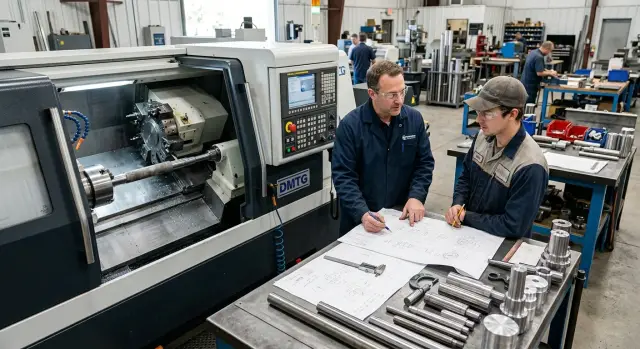
Why you should start from the part, not the catalog
When deciding how to choose a CNC lathe, don’t begin with price or a list of options. Start with the part. The part immediately sets limits for diameter, length, accuracy, material and cycle time.
Two models in a catalog can cost almost the same but perform differently on your parts. One machine may hold a long blank rigidly; another may be suitable only for short parts. That isn’t always obvious from photos or general specs.
Price alone explains little. It doesn’t show whether a machine can handle a 600 mm shaft, a large-diameter blank, or a series where quick changeovers matter. What’s cheaper initially often costs more in operation.
A simple example makes this clear. A short aluminum bushing and a long steel shaft might fall into the same price range for machines, but their needs differ. One needs fast part changeover, the other needs stiffness over length and vibration-free operation.
A mistake at the start almost always leads to extra expense. You may need to buy chucks, jaws, stops, steady rests, toolholders or even change how the part is set up. Changeover time grows and so does the cost per part.
Too much machine overcapacity rarely pays off. If you turn small and medium parts, a large machine won’t automatically make them better. It takes more space, needs more expensive tooling and often takes longer to set up.
So talk about the actual parts you run. When you have sizes and a clear parts list, selection becomes calmer and more precise.
What part data to collect in advance
Comparing models in a catalog is premature if you only have a general part description. For a proper choice you need a short part card: dimensions, material, operations and production volume.
First write two diameters: the maximum finished diameter and the blank diameter. These are not the same. The difference affects chuck selection, spindle bore and stiffness margin.
Then note the overall part length and separately the protrusion from the chuck during machining. For long parts this is often omitted in inquiries and later it turns out that without a tailstock or steady rest accuracy is hard to keep. If the part is thin and long, mention it right away.
Material strongly changes the choice. Don’t write just “steel” or “aluminum” if you can help it — include the grade, hardness and material condition if known. Also note the blank form: bar, forging, tube, casting. For the same sizes, a machine for aluminum and a machine for stainless are selected differently.
Next list the operations. External and internal threading, grooves, drilling, boring, operations on both sides — all affect machine configuration and tooling. If you want several operations in one setup, say so.
Express batch size as numbers. “Once a quarter 20 pcs” and “500 pcs monthly” are two different scenarios. Indicate whether orders repeat and how stable the assortment is.
For a supplier request, one table per part or family is usually enough. Example: blank 70 mm, finished diameter 62 mm, length 180 mm, steel 40X, threads and grooves both sides, batch 300 pcs/month. Then you can discuss machine selection concretely.
How diameter and length affect the choice
Diameter and length quickly eliminate unsuitable machines. If a part is short and rigid, clamping in a chuck is often enough. If it’s a long shaft, a single clamp may be insufficient: the part can run out of true and surface quality suffer.
For short parts you usually check machining diameter and chuck size. For long parts two extra questions appear: is support from a tailstock needed, and does the machine have enough stiffness along the working length? Shafts, axles and thin long parts often need both a chuck and a tailstock or steady rest.
Large diameter is limited not only by part size. It’s important what chuck can be fitted, what diameter the machine can actually machine and what the spindle bore is. If the bar must pass through the spindle, that becomes a hard limit. On paper a machine may look suitable, but in reality the blank simply won’t pass.
Typically check four sizes: maximum machining diameter, chuck capacity, spindle bore and distance between centers.
Part length almost always raises stiffness questions. The longer the blank, the higher the risk of vibration and deflection, especially in finishing. For heavy parts also check the permitted blank mass. A weak bed and low load margin cause problems on the first serious cut.
A simple example: a bushing 80 mm diameter and 60 mm long and a shaft 80 mm diameter and 1,200 mm long require different machines even though diameters match. The bushing is fine on a compact model. The shaft needs a machine with a larger base, support for the part and a stiffness margin.
When choosing a machine for your parts, start with these sizes rather than motor power. They quickly show the class of machine needed and the tooling you can’t do without.
How to determine the machine type
Choose machine type not by catalog name but by part shape and how you will run production daily. The same diameter can be machined on different equipment, but convenience, tool life and cycle time will differ greatly.
A horizontal lathe is often used for ordinary shafts, bushings, flanges and other standard parts. It’s a familiar, versatile choice if you don’t have very heavy blanks or complex multi-sided machining.
A slant-bed is usually better for series work. Chips fall away more easily, the work area stays cleaner, and the operator can monitor the process more comfortably. If batches repeat monthly, this layout often runs more smoothly.
A vertical lathe is chosen in different situations. It’s selected for large, heavy-diameter parts where it’s inconvenient or risky to hold the blank horizontally. A heavy disk or housing is easier to place vertically: the part rests on its weight rather than hanging in the chuck.
For complex parts, sizes alone are not enough. Verify whether the tool can reach all required areas without extra setups. The more operations you do in one setup, the lower the risk of runout and the less time you lose on re-clamping.
A short rule: ordinary shafts and bushings are usually horizontal. Repeating series with heavy chip loads benefit from a slant-bed. Large-diameter heavy blanks often point to a vertical lathe. For parts with many transitions, check tool access and the number of positions.
EAST CNC offers CNC lathes of different types, so compare how a specific model covers your parts and process rather than judging by general equipment class.
How material changes machine requirements
People focus on diameter and length and underestimate material. That’s a common mistake. Aluminum, mild steel and stainless cut very differently even when blank sizes are the same.
Aluminum usually needs high speeds, a sharp tool geometry and careful chip control to get a good surface. Steel requires a calmer regime. Stainless is more demanding: it heats the tool more, produces long chips and quickly reveals machine stiffness limits.
If the material is hard, don’t look only at spindle top speed. In roughing, torque in the working range is more important. When torque is insufficient, the tool vibrates, feeds must be reduced and surface quality suffers. For dense steel, forgings and heavy cuts, choose a machine with margin in torque and overall stiffness.
Material also changes tooling needs. Understand which inserts suit the alloy, whether the holder will handle the required depth of cut, how coolant reaches the cutting zone and where chips go during a long cycle.
For aluminum, sharp polished inserts are common. For steel, more versatile grades are used. For stainless, choose inserts that manage heat and resist build-up. If coolant flow is weak, tool wear increases noticeably.
Chip evacuation depends on the material. Sticky or long chips quickly clog the work area, especially on long cuts. Then the operator must stop the machine more often, losing time and risking the part surface.
A separate case is a blank with casting skin or forging scale. The first pass has an impact load. The machine must handle this calmly, not operate at its limit from the start.
How batch size affects the layout
Consider not only the part but also the batch size. The same blank for one-off versus repeat series requires different machine configurations.
For single and one-off jobs a simpler layout is usually better. Fast changeover, straightforward tooling and easy access to the work area are valued. A complex configuration only slows work: the setup person spends more time than the machine spends cutting.
For small series the picture changes. For batches of 20, 50 or 100, look at tool-change speed, the convenience of a turret head and repeatability. Saving 30–40 seconds per cycle adds up by the end of a shift.
On repeating batches automation pays off sooner than expected. A bar feeder removes repetitive work for the operator if parts are made from bar stock. Automatic part ejection or a catcher reduces idle time between cycles.
A common mistake is buying a machine for one successful series and forgetting other orders. If today you have bushings, tomorrow flanges and next month short shafts, an overly specific configuration will hinder you. Keep some margin in tooling and loading methods.
In practice, look at actual shop loading: how many changeovers per week, how often batches repeat and where the operator loses time. This calculation usually gives a more accurate choice than the catalog alone.
How to choose spindle, chuck and tooling
First check whether the blank passes through the spindle, not just motor power. If a 52 mm bar doesn’t fit the spindle bore, that workflow isn’t possible. You’ll have to clamp externally, which changes material feed, stiffness and cycle time.
Choose a chuck based on blank mass, shape and protrusion. A short round part is often fine in a standard three-jaw chuck. Thin rings, long shafts or irregular blanks may need soft jaws, a four-jaw chuck or a mandrel. Poor clamping quickly shows: parts wander, surfaces degrade and dimensions vary.
Long parts often require additional support. If length greatly exceeds diameter, vibration grows without a tailstock or steady rest. Then the tool chatters, the shaft may turn conical, and finishing cuts won’t fix it.
If a part needs holes, slots or threads in one setup, check not only the machine but the turret. It must support the required number of positions and driven tooling if you want to drill or mill on the lathe. Otherwise part of the work goes to another machine and cycle time increases.
Plan tooling from the start, not after purchase. Typical starter kits include jaw sets for common diameters, mandrels for fits, toolholders for main operations, drills, taps and driven tooling if needed, plus supports for long parts.
Discuss this starter kit with the supplier. If overlooked, the machine might arrive on time but production start will still be delayed.
Step-by-step machine selection
Begin with a set of real parts rather than a single position. One part usually gives a distorted picture. If you have a short bushing today and a long shaft tomorrow, a machine chosen for one part will quickly hit limits.
A good approach is to collect 5–10 typical parts, including what you make now and what you plan to run soon. This basis ties the choice to shop loading, not the most convenient example.
Then the logic is simple. List the extreme sizes: the longest part and the largest diameter. These two numbers immediately eliminate some models. Next check material. If stainless, tough steels or heat-resistant alloys appear, requirements for stiffness and spindle power rise above those for carbon steel or aluminum.
Then divide parts by production type: one-offs, small series, recurring batches. For single jobs quick changeover matters. For steady flow consider more productive layouts and automation.
Compare 2–3 suitable models, not a long list of options. Focus on maximum diameter, machining length, spindle bore, chuck type and available tooling. Long option lists distract; constraints decide more.
Also check startup time: how many minutes to change jaws, install tools, set up the program and get the first good part? Sometimes a less feature-rich machine wins because the operator starts it faster.
If one of ten parts requires long machining and two are stainless, choosing by the average part is risky. It’s safer to select for the most demanding items without excessive "just in case" margin.
Common mistakes
Errors often start with one catalog number. The buyer sees maximum diameter and assumes the machine fits. Later they discover length, protrusion or axis travel is insufficient.
This happens with shafts and long bushings. Diameter fits, but in practice the part needs a tailstock or steady rest. If not checked, you end up adding margin in the wrong place.
A second frequent mistake concerns the spindle. Many look only at top speed, while torque at low speeds matters for steel, stainless and large blanks. High RPMs look good on paper but don’t help if the machine struggles to pull a cut at low speed.
Tooling is often left for later. The machine is chosen first and only after purchase do jaws, holders, driven tools, tailstock or steady rests get budgeted. Costs rise, launch dates slip and some tasks still require compromises.
Picking a machine for one lucky part is another error. If your product mix changes, a too-narrow choice quickly becomes a problem. Aim for 70–80% of your typical orders, not one showcase part.
Chip flow and workspace clearance are often underestimated. If the material produces long chips and the layout doesn’t clear them, the operator stops the machine for cleaning. The same goes for tailstock and steady rest: they may be listed in specs but in real setups there may be no room.
A healthy sign of a good choice: the machine covers a group of parts, and you know what tooling is needed for the first batch.
A short example
Imagine a small shop making steel shafts 45 mm diameter and 420 mm long monthly. Batches repeat, usually 80–120 pcs. This example clarifies selection logic without overpaying for extra capacity.
First look at length. A 420 mm shaft needs a comfortable working zone so the machine doesn’t run at its limit. A compact model may fit the diameter but leave too little length, especially if a tailstock is required.
The material is steel, so the machine needs solid clamping and vibration-free operation. Check spindle bore too: if the blank can be fed through the spindle setup time is shorter and operator effort is less.
A tailstock here is often not optional but a regular requirement. The part is long relative to diameter, so without support runs and size instability appear. With a monthly repeating batch, any small problem will reappear.
An oversized machine isn’t ideal either. It takes more space, uses more energy and costs more in tooling. For a 45 x 420 mm shaft the extra size may bring no real benefit.
In this case look for a machine with a length margin, suitable spindle bore, a tailstock for stable support and tooling that maintains repeatability across batches. The choice is based on length, clamping method and monthly load, not on maximum power.
What to check before deciding
Make the purchase about numbers, not impressions. Without a short table of parts you’ll likely miss something and later overpay for tooling, rework or unnecessary features.
Collect diameter, length, blank weight, material and batch size in one place. Even a simple table of 10–15 positions quickly shows where spindle bore margin is needed, where stiffness matters and where you shouldn’t overspend on power.
List all operations: rough and finish turning, parting, drilling, threading, bar feeding, second-side work. Each operation needs specific tooling, and sometimes a different machine layout.
Before deciding, verify five things: does the machine cover diameter and length with margin for the largest parts; does the spindle suit your material and cutting modes; do the chuck and jaws fit the blank shape; is there space for required tools, driven tooling or a tailstock; can the machine handle your batch size without excess downtime. Also ask whether the supplier provides a clear startup plan, not just a general product presentation.
Ask for calculations tailored to your parts. A good supplier won’t say “this model will do.” They’ll show cutting regimes, required tooling, changeover time and where load margin remains.
Compare more than price. A model that looks cheaper may cost more once you add chuck, holders, tools, delivery, commissioning and service. If a machine takes longer to start or needs rare tooling, initial savings disappear.
For companies in Kazakhstan this is especially true: downtime from wrong selection costs more than careful calculation before purchase. EAST CNC is the exclusive official representative of Taizhou Eastern CNC Technology Co., Ltd. in Kazakhstan. The company supplies CNC lathes, helps with selection, commissioning and service, so discuss the whole path to the first production batch, not only the model.
If a supplier can’t link the machine to your parts, operations and batch in numbers, don’t rush the decision.
FAQ
Where should I start when choosing a CNC lathe?
Start with 5–10 typical parts, not the catalog. For each part, collect blank diameter, finished diameter, length, material, operations and production volume — this quickly narrows the range of suitable machines.
How much size margin should I allow?
Provide enough margin for the most demanding parts, but avoid excessive overcapacity. Check that the machine comfortably covers the maximum diameter, length, protrusion and blank weight rather than operating right at its limits.
When is a tailstock or steady rest needed?
When a part is long relative to its diameter, lack of support often leads to vibration and runout. For shafts, axles and thin long parts, check the availability of a tailstock or steady rest instead of relying solely on the chuck.
What matters more: spindle speed or torque?
For aluminum, high spindle speeds and a sharp tool geometry are often important. For steel, stainless and heavy roughing, spindle torque in the working range matters more — low torque causes vibration and slow cycles.
How do I choose between horizontal, slant-bed and vertical machines?
A horizontal lathe is common for shafts, bushings and standard parts. A slant-bed layout suits repetitive series better because chips clear easier. A vertical lathe is chosen for large, heavy-diameter parts where the workpiece rests on its weight.
Can I choose a machine based on one part?
No — selecting by a single part almost always skews the choice. Look at the group of parts that actually load your shop; otherwise the machine may only fit one order well.
When should I opt for driven (powered) tooling?
Driven tooling is needed if you want to drill, mill slots, perform milling operations or handle some threading in a single setup. If you don’t need these tasks, a simpler configuration is usually cheaper and easier to commission.
How does batch size affect machine choice?
For one-off jobs you value fast changeover and easy access to the work area. For repeat batches, prioritize quick tool change, bar feeders and other features that reduce idle time between cycles.
Why shouldn’t I rely only on the catalog price?
Because the base price rarely includes the full working kit. Chuck, jaws, toolholders, fixtures, tailstock, commissioning and service quickly change the final cost and lead time.
What data should I send to the supplier for an accurate selection?
Send drawings or at least a table with sizes, material, blank shape, list of operations and batch size. If you also specify protrusion, required tolerances and desired tooling, the selection will be much more accurate.