
How many SKUs does a tool shop need without excess stock?
How many SKUs does a tool shop need if you sell drills, end mills, inserts and tooling? A simple calculation to avoid empty bins and dead stock.
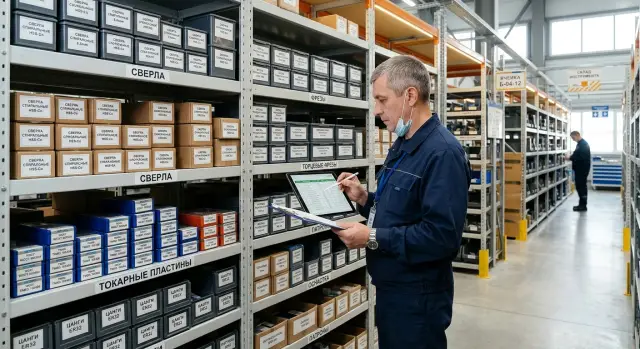
Why excessive SKUs get in the way
The question "how many SKUs does a tool shop need" is often answered by habit: people buy with a margin "to have everything". On paper it looks safe. In the workshop and at the machine that habit quickly becomes a problem.
Every extra SKU ties up cash. You buy a tool holder, insert, or drill for a rare size, put it in a bin and wait for demand. If that size is needed once every two or three months, the item barely moves. Money is spent, but the benefit is small.
The problem grows quietly. First a few items are added "just in case", then another ten for special orders, then duplicates by brand. In the end many bins are occupied but sales don’t grow at the same pace. The warehouse looks full, but only a few common sizes make the turnover.
That creates imbalance. Rare items sit for months while the popular ones run out at the worst moment. A manager looks at a long SKU list and thinks there’s ample stock. The operator or buyer opens a cabinet and can’t find the insert needed for the current batch.
This is especially visible in CNC turning shops. Work can stop not because of a major breakdown, but for a small reason: the needed radius, diameter or insert type ran out. Meanwhile five rare SKUs may sit nearby untouched since last quarter.
Excess SKUs hit several areas at once:
- they freeze working capital;
- they occupy bins and shelves;
- they complicate inventory accounting;
- they hide shortages of fast-moving items.
One more annoyance: the longer the list, the more likely people confuse similar sizes and equivalents. The purchaser picks almost the right article, the storekeeper spends more time finding the box, the operator checks usage. Each is a small delay, but over a month they consume many hours.
A wide assortment of cutting tools alone does not help. You don’t need the longest list — you need the set that covers repetitive tasks without empty bins and dead stock.
Which groups to count separately
Mixing all tooling into one general assortment is inconvenient. A drill, a micrometer and a collet have different prices, replacement rates and risks of becoming obsolete on a shelf. If you treat them the same, the warehouse quickly balloons while delivering little value.
Start by dividing the assortment by purpose. For metalworking this usually suffices to reveal the real picture.
Main groups
Cutting tools are almost always counted separately. This includes drills, end mills, taps and other items that directly cut metal. They have wide size ranges, wear out more often, and their SKUs grow fastest.
The turning group should also be in a separate block. Tool holders, indexable inserts and boring arbors behave differently: the tool body lasts long while the insert is consumed. If you keep them with end mills and drills, it’s easy to miscalculate stock.
Tooling and fixtures are counted apart from cutting tools. Chucks, collets and arbors are not changed as often, but a machine won’t run without them. In shops with CNC lathes and machining centers tooling often takes lots of space with low turnover.
Measuring tools are better not mixed with general stock. Calipers, micrometers and gauges are bought less often but require stricter control. Here inventory is about condition, calibration and storage, not just quantity.
Consumables and small items are easier to manage as a separate line: wrenches, screws for inserts, brushes and cutting fluids differ in cost but share one trait — they disappear fast if not controlled. On paper they seem minor, but in practice these items often create a false sense of full stock.
What to record for each group
For each group note a few things:
- how many size variants are actually used each week;
- which items are consumed constantly and which are kept as reserve;
- whether one item can be substituted by a close equivalent without stopping work;
- how many bins are needed for working stock and how many for rare demand.
This analysis removes extra noise. If a shop mainly works with steel and aluminum, the list of end mills and drills will be broad while the set of gauges stays small. When groups are separated it’s easier to see how many items actually need to be on hand.
What affects the number of SKUs
SKU count is driven not by a desire to "have more", but by how your customers work. The same warehouse can be normal for one shop and bloated for another.
The customer profile has the biggest impact. If you sell tools to workshops with simple, repeat orders, the SKU set is usually small. If buyers require tools for different batches, machines and operations, the list grows quickly. This is clear for suppliers to metalworking shops: a CNC lathe shop making two typical parts needs one set, while a facility with frequent changeovers needs another.
Workpiece material changes the picture too. Aluminum, stainless, structural steel and cast iron often require different tool series, coatings and geometries. On paper it may look like "the same drills and inserts", but in inventory they are separate SKUs. If your customers work with only two materials, you can keep a compact stock. With five or six materials the SKU count increases even without expanding the customer base.
Diameter and size range is another factor. When customers consistently work in a narrow range, stock is easy to limit. But if one day they need 6 mm, the next day 6.8 mm, and the day after 7.2 mm, SKU count rises quickly because of rare sizes.
Before revising the assortment check five things:
- who are your main customers and how similar are their orders;
- which materials they work with month to month;
- which sizes are taken regularly and which appear once;
- how often the same SKU is repurchased;
- how many days delivery takes from your supplier.
Purchase frequency helps separate working stock from dead stock. If an item is bought weekly or monthly, it belongs on the shelf. If a sale occurred once in six months, a permanent bin is rarely justified.
Lead time matters more than it seems. With short delivery you can keep fewer SKUs and reorder often. With long lead times you must insure demand, especially for fast-moving sizes. So two stores with similar customers can have different assortments: one replenishes in 5 days, the other waits 30.
Rule of thumb: the narrower the customer profile, materials and sizes, the fewer SKUs you need to hold permanently. The longer the lead time and the more repeat sales, the more SKUs you should keep active.
How to calculate the working minimum
Calculate the working minimum based on sales and lead time, not on gut feeling. Otherwise the warehouse quickly accumulates unnecessary SKUs and bins end up empty or filled with slow-moving items.
It’s easier to calculate group by group: drills, end mills, taps, inserts, tool holders. For a store serving metalworking and CNC this order is convenient because demand differs greatly by group.
- Gather sales data for 6–12 months per group. Look not only at quantity but at frequency. An item may have had a big order once and then sit for months.
- Split SKUs into fast-moving and rare. Fast-moving items sell regularly, even in small quantities. Rare items are bought for specific orders and usually don’t need a permanent bin.
- Set a minimum on the shelf for each fast-moving SKU. It should cover usual demand between replenishments. If a drill sells 8 pieces a month and delivery is every two weeks, a minimum of 2–4 pieces often suffices.
- Add reserve only for lead time. If a supplier delivers in 20 days, calculate stock for those 20 days, not for half a year.
- Finally remove duplicates. If two SKUs solve the same task and differ only by brand, keep the more frequently sold one. Keep the other as order-on-demand if there’s separate demand.
Small example: a store sells carbide inserts for turning. Over 9 months there are 24 SKUs in the report, but only 9 move steadily. Set a minimum of 2 packs on the shelf for them. Three more SKUs need a reserve because delivery takes nearly a month. The remaining 12 are not held permanently and are ordered for specific customer requests.
After calculation look not only at SKU count but at bin usage. One fast-moving SKU may need two bins if it’s taken daily. Three rare SKUs may not occupy space at all if you don’t store them permanently. That’s how you keep stock without extra purchases and without paying for unused space.
Example for a small shop
When sizing stock for small workshops, rely on weekly repeat demand. These customers usually don’t need the whole product line. They need sizes used daily: drills, end mills and turning inserts for typical operations.
Imagine a store serving 15–20 small metalworking shops. Monthly demand most often covers drills 4–12 mm, end mills 6–16 mm and several standard turning inserts for roughing and finishing. Keeping the full catalog on the shelf makes little sense — for a small store it’s usually frozen money and empty bins.
A sample calculation might look like this:
- 18 drill SKUs. Keep 3 pieces for the most common diameters, 2 for others.
- 12 end mill SKUs. Fast diameters kept in 2 pieces; rare ones not stocked.
- 9 insert SKUs. For common grades and geometries keep 2–3 packs.
- 8 bins reserved for replacements and one-off requests.
Total: 39 working SKUs and 8 spare bins — 47 bins for this block of assortment. This is not stock "just in case", but a clear minimum that cycles weekly. If a SKU hasn’t sold in 30–45 days, move it out of permanent stock and put it on order-on-demand.
Don’t store rare sizes just to keep the line complete. A 13.7 mm drill or an unusual-length end mill might be requested once every two months. It’s easier to bring such items for the customer than keep them on a shelf for six months. Shelf space is more expensive than it seems, especially if fast-movers then run out.
Consider not only SKU count but stock depth. One fast diameter in three pieces often works better than three rare diameters in single units. The logic is simple: bins should hold what leaves the warehouse each week. Everything else should be ordered quickly when needed, not left idle.
How to reduce empty bins
Empty bins appear not because the warehouse is small, but because the store assigns a separate spot to every rare SKU. Fast tooling gets crowded while a shelf for an item sold once a quarter stands empty.
First consolidate similar SKUs into demand groups. If several drills, inserts or tool holders are close in purpose, look at purchase patterns rather than article numbers. When demand targets one type with small differences, there’s no point in dedicating a permanent bin to each minor variant.
This is especially visible in CNC shops. Some SKUs leave weekly, others are needed only for special orders. Keep common turning inserts and small-range drills on the shelf; keep special tools in the catalogue and order them as needed.
It helps to divide the assortment into four storage regimes:
- permanent stock for daily demand;
- limited stock for irregular but repeating sales;
- catalogue without shelf space for rare orders;
- temporary placement for seasonal or project items.
This approach reduces empty bins without risking shipments. In essence, store space by sales frequency, not by article number.
Another common mistake is allocating shelf space to one-off sales that occur only every few months. If customers can wait 3–7 days for delivery, a permanent bin is usually unnecessary. It’s cheaper to keep a clear product card, lead time and reliable supplier than to freeze money and space.
Check turnover per bin monthly. If a bin is occupied but movement is minimal, ask: does this SKU really need to be on the shelf or is order-on-demand sufficient? This review quickly reveals excess.
Frequent mistakes
The mistake usually starts at purchasing. A manager or buyer looks at a catalog and takes the full size range even though the workshop uses only a few sizes. Bins get filled, money becomes tied up in metal and turnover drops.
That happens with drills, taps, inserts and end mills. If a shop mostly works with the same diameters and materials, there’s no need to keep the whole range "just in case". A rare size is easier to buy on demand than to store for months.
Another frequent error is mixing household and industrial tooling in one system. For ad-hoc repairs you need one type of tooling; for serial metalworking on CNC machines you need a different stock. When these groups are combined the demand picture is distorted. It looks like many SKUs are needed, while some actually belong to different tasks and operating modes.
Duplicate stock by brand worsens the problem. The warehouse holds nearly identical SKUs from two or three suppliers, although operators use one preferred series. Such stock rarely helps — it creates leftovers and confusion at issuance.
Where stock is calculated incorrectly
A one-size-fits-all approach gives extra SKUs. You can’t keep the same stock for carbide inserts, general-purpose drills and rare speciality tooling. They differ in consumption rate, price and downtime risk.
Seasonality is also often ignored. A small workshop may see more orders for construction parts in spring and summer, and more repairs in autumn. If you look only at annual averages, in a peak month the warehouse suddenly runs out of fast-moving items.
A quick check:
- which sizes were really taken in the last 3–6 months;
- what was bought only once for a single order;
- where identical SKUs from different brands exist;
- which groups are consumed weekly and which sit idle.
On the floor you’ll see the error fast. A shop may list 200 articles, but steady work is done with 40–60 SKUs. The rest is often stock kept for peace of mind rather than for making parts.
A quick filter before purchasing
Before ordering run each disputed SKU through a short filter. It quickly shows what should be on the shelf and what just occupies a bin and freezes cash.
If an SKU hasn’t sold at least once a month, don’t rush to restock it out of habit. Sometimes a size entered the assortment for a one-off order and then sits for years without real demand.
A useful five-question check:
- did it have a normal sale in the last 30–60 days?
- does the current balance cover the lead time with a small buffer?
- can a nearby size substitute the rare size without stopping work?
- how much shelf space does it occupy and has it been idle too long?
- is it clear who is responsible for ordering this group and what rule they follow?
This filter removes much excess. For example, a 10.2 mm drill sold once in four months while 10.0 and 10.5 mm move every week. If drawings usually allow substitution, there’s no need to keep the rare size in broad stock. One piece for emergencies or order-on-demand is enough.
Lead time often breaks purchasing logic. An SKU may sell steadily, but if there’s already two months’ stock and the next delivery arrives in three weeks, early purchasing only inflates inventory. For cutting tools boxes accumulate fast but turnover doesn’t always follow.
If you can’t answer at least two of the filter questions clearly, it’s better not to include the SKU in general stock. Here clarity wins over breadth: decide what you keep permanently, what you replenish minimally and what you buy only for specific demand.
What to do after the calculation
A number alone doesn’t solve anything. Turn it into a working rule for purchasing, the warehouse and the operators who take tools every day.
First compile a short list of fast-moving SKUs per group. Not the full long catalog, but a compressed set of what actually moves: main drill diameters, the most common inserts, typical tool holders, a few end mill and tap sizes. Such a list is easier to keep in stock and to replenish without disputes.
Move rare sizes to a separate order-on-demand category. If an SKU sells every few months it doesn’t need a permanent bin. That way the warehouse isn’t clogged with non-moving items and cash isn’t stuck in dead stock.
A simple rule helps:
- keep only what is regularly used in production;
- store rare sizes minimally or not at all;
- set a bin limit per group in advance;
- review stocking by actual issue, not by habit.
Fix bin limits in writing. For example, allocate 20 bins for drills, 15 for inserts, 10 for end mills. If a group exceeds its limit someone must remove duplicates, consolidate similar SKUs or move a portion to order-on-demand. Otherwise the assortment will expand again.
A monthly review of issues is useful. Open the issue report, mark what sold frequently, what sits idle and what is substituted by nearby sizes without hurting work. After 2–3 months the picture usually becomes more honest than any initial plan.
Example: a store held 12 end mill sizes but only 5 sold regularly. After the review they kept the fast sizes and moved rare ones to order-on-demand. The warehouse became clearer and replenishment faster.
If a shop is selecting a new machine, decide tooling stock early, not after the cell launch. Compare the SKU list to real operations and equipment type. This approach aligns with EAST CNC: when selecting machines for production it’s easier to decide in advance which SKUs are needed permanently and which shouldn’t be stocked.
FAQ
How many SKUs should I keep in stock?
There’s no single number that fits everyone. Keep in regular stock only the items customers buy repeatedly and that cover demand until the next delivery. Move rare sizes to order-on-demand — otherwise they tie up money and space.
Should I split the assortment into groups?
Yes. Otherwise different demand patterns get mixed and the picture is distorted. Count cutting tools, turning group, tooling, measuring tools and consumables separately. That makes it easier to see what’s actually used and what sits idle.
How do I know an item is a fast-moving SKU?
Look at repeatability, not just total turnover. If customers buy the item every week or every month, it deserves shelf space. If it sold only once in several months, it usually doesn’t need to be kept as a permanent item.
When should a rare size be switched to order-on-demand?
Remove it from permanent stock if it rarely moves and customers can wait a few days for delivery. Another sign is when a nearby size or an equivalent covers the same task without stopping production. In that case keep the product card, not a dedicated bin.
How do I account for lead time when calculating stock?
Lead time directly affects the minimum on the shelf. If a supplier delivers quickly, keep less and reorder more often. If lead times are long, keep a reserve for that delivery period — but only for the required window, not for months ahead.
Should I keep the same tool from different brands?
Usually it’s pointless to store nearly identical items from two or three brands. If operators consistently use one series, keep that in stock and bring the rest on request. This reduces confusion and cuts dead stock.
What’s more important: more SKUs or more stock of fast-movers?
Prioritize depth of stock for fast-moving sizes first. One popular diameter in three pieces often works better than three rare diameters in single units. SKU count matters, but production stops usually happen because of insufficient depth in the items that are used constantly.
How to reduce empty bins without risking production?
Don’t assign a shelf for every rare item. Reserve space for what moves weekly; leave special tooling and one-off sizes in the catalogue for order-on-demand. Check monthly for items with no movement and free up those bins.
How often should I review the assortment?
Start with a monthly review: open the issue/sales report, mark fast-moving SKUs, spot duplicates and remove anything not moved in 30–45 days. If demand changes seasonally or by project, review more often.
What to do after calculating the working minimum?
Turn the number into a working rule for purchasing, warehousing and operators. Define what you keep permanently, what you top up minimally, and what you buy on demand. Fix limits by group of bins and monitor so the assortment doesn’t expand again.