
Horizontal or Vertical Machining Center
We explain when a horizontal machining center is more advantageous than a vertical one: by part types, number of setups, loading and production rhythm.
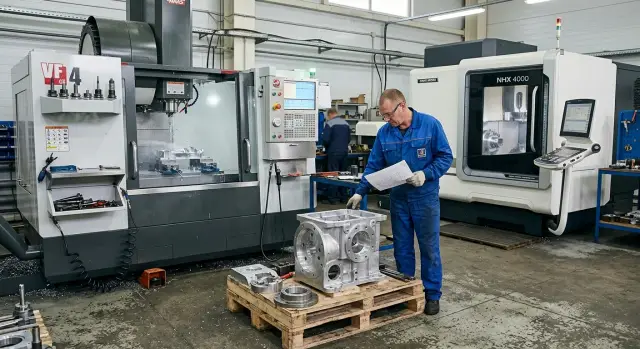
What's the real difference for the workshop
For the workshop the difference between these layouts shows up not in the machine specs but in the time per part. Two centers can have similar axis travels and comparable power, yet their shift output will differ. The reason is simple: the machine cuts metal only for part of the cycle. The rest of the time goes to removing and re‑fixturing the part, re‑datuming, loading and unloading.
If a part needs machining on several sides, a vertical machining center often requires more setups. Every additional setup adds minutes and increases the risk of a fixturing error. A horizontal machining center is usually more convenient where a part has many side faces, holes and pockets. Several sides can be reached in a single cycle or with fewer re‑setups. Also, chips tend to fall away downward, so the operator less often needs to stop the process to clear chips from the cutting area.
Having the same travel along the axes does not guarantee the same output. If on a vertical center a part must be taken off twice, rotated and re‑set, while on a horizontal it can be machined in one setup on a pallet, the difference becomes obvious quickly. You can save 6–10 minutes per part. For a batch of 40 pieces that turns into several hours.
So don’t focus on abstract “versatility,” but on your parts flow. For small, varied runs—where today you do a plate, tomorrow a bracket, and the day after a simple fixture—the vertical layout is often more convenient and straightforward. For housing parts and medium batches, where eliminating extra setups and keeping a steady cycle matters, the horizontal layout frequently pays back sooner.
A good calculation always starts with simple questions: how many times does the operator touch the part, how many minutes does each rotation take, can more sides be machined without re‑fixturing, and does the machine sit idle waiting for loading? That’s where the shop loses—or gains—output.
Which parts benefit most from a horizontal center
The horizontal layout performs best when a part must be machined not only from the top but from several sides in one cycle. If a part has windows, seats, threads and bores on three to four sides, extra rotations quickly eat time and increase error. In such tasks a horizontal machining center usually provides a smoother and more predictable route.
This is most noticeable on housing parts. Gearbox housings, hydraulic blocks, supports, crankcases, prismatic blanks with multiple faces—these are good candidates. When the operator fixturers the part once and then machines several sides without re‑setting, it’s easier to maintain concentricity of holes and the relative positions of surfaces.
Chip evacuation is another advantage. On a vertical machine chips often collect on the top face, in pockets and around deep zones, then interfere with finishing or require pauses for blow‑off and cleaning. On a horizontal center chips usually fall away on their own. That’s especially helpful for aluminum, cast iron and parts with enclosed pockets.
There are situations where the benefit becomes particularly clear: heavy blanks that are hard to flip with a crane, parts with multiple related bores, series with repeated routes, and blanks where the reference faces suffer from chip buildup. Removing each rotation not only saves minutes but also reduces the risk of damaging an already machined surface.
In serial production a horizontal center is especially strong if the machine works with pallets. While one pallet is being machined, the operator can remove the finished part and load the next on a second pallet. The spindle waits less and shift output increases without pushing cutting speed to the limit.
That is why these machines are often chosen for housing parts in automotive, construction equipment and other industries with many repeat operations where every extra setup is costly. If a part is simple and most work is on the top face, the advantages are smaller.
Where a vertical center is simpler
A vertical center is convenient when a part is open from the top and the operator doesn’t need complicated fixturing. If most work is on the top face, that machine usually gives the most straightforward route.
Plates, flanges, covers and simple housing elements machined mainly from above rarely require complex schemes. Load the blank, clamp it, check the datum and start the cycle. For such parts a vertical machining center is often simpler both to set up and to run daily.
Small and medium batches also often favor the vertical option. When fixtures change multiple times per week, the operator finds an open loading area and easy access to the table more comfortable. Changeover requires fewer moves, especially if parts are light and loaded manually.
Usually the vertical center wins when a part is machined mostly from one side, a second setup adds only a little time, batches change frequently, and tooling remains simple. It’s also preferable when the blank can be loaded without a crane and throughput is not large enough to justify a more complex layout.
A clear example is a flange with holes, a bore and milling on the top surface. On a vertical machine the operator quickly loads the part, starts the program and gets the finished face without extra preparation. A second setup may be needed later, but if it takes 3–5 minutes and such parts are few, it barely affects the order lead time.
A practical point: with a limited budget a vertical layout often seems more reasonable. If the shop doesn’t count every minute between setups and is not chasing high throughput, the lower price and easier commissioning can outweigh the horizontal center’s advantages.
How many setups will you save in practice
Count not only the setups themselves but the whole cycle around the part. You take it off, rotate it, re‑find the datum, check size, correct offset and only then continue machining. On paper that looks like “another setup,” but in time and risk it becomes a noticeable part of the shift.
For a simple plate the difference may be small. For a housing part machined on several sides the picture changes fast. If on a vertical center a part must be placed 3–4 times, each new setup consumes not only minutes but repeatability.
It helps to count per part: how many times does the operator remove and remount it, how many rotations are needed to access all sides, how long does it take to find the datum after each rotation, how many inspection measurements are performed after each new setup and how much scrap or rework appears because of accumulated error. Such a tally usually wakes people up. Cutting may take 18 minutes while all actions between cycles add 10–12 minutes.
A horizontal machining center more often gives a clear advantage when side faces, bores and seats must be machined from multiple sides in one clamp. Fix the housing once, index the pallet or rotary table to the required side, and the operator doesn’t lose time constantly removing the part. In that mode one setup can replace two, three or even four.
There’s a second effect often underestimated. After every new setup the chance of losing accuracy between sides increases. The error may be small but it accumulates: a datum shift, a changed part position, a loss of concentricity. For parts where mutual accuracy of holes and faces matters, that’s not minor.
So look at the part route, not the machine plate. If a part lives in multiple setups only because its sides are hard to reach from above, the horizontal layout usually pays off faster. If almost all work is on a single top face, the gain may be modest.
How loading affects shift output
Shift output often bottlenecks not on cutting speed but on how quickly you remove the finished part and load the next. If a machine waits for the operator at the open door for 3–5 minutes after each cycle, losses add up by the end of the shift.
For simple, light parts manual loading often works fine. The operator changes the blank quickly, checks the datum, closes the door and the machine cuts again. For small series this is the most sensible and cheap option.
Problems begin when part changeover takes longer than expected. You need to open the door, clear chips, bring the blank in, position it, set the clamp, get hands out of the danger zone, close the door and start the cycle. On paper the cycle may be 12 minutes, but in reality the machine sits idle another 3 minutes.
A pallet system changes the picture. While one pallet is being machined the operator readies the next blank outside the work area. Then the machine simply swaps pallets and the idle time between cycles drops sharply. That’s why a horizontal machining center often wins not just on access but on net cutting time per shift.
Simple example: if the cutting cycle is 18 minutes and manual reload takes 4 minutes, then out of every 22 minutes only 18 are cutting. If pallet changeover takes about 1 minute, you gain several full cycles per shift without changing feeds or spindle speeds.
With heavy blanks the difference is even larger. When a part is loaded by crane or manipulator, a manual scheme quickly loses sense. The operator waits for the crane, the crane waits for space, the machine is idle. For housing parts that’s typical.
You can spot the bottleneck easily: the operator comes to the machine ahead of time and waits for the cycle to finish, a crane is needed for nearly every change, blanks and fixtures pile up by the door, and actual output is much lower than the cutting time suggests. If this repeats daily, count not only spindle minutes but mainly minutes spent on loading.
How to choose for your flow in 5 steps
If you look only at machine specs, the choice often goes wrong. For the shop what matters is not nameplate speed but how many parts you actually produce per shift and how much time is spent outside cutting.
- Take 10–20 typical parts from the last quarter. Prefer recurring parts, not rare one‑offs.
- Group them by two criteria: how many sides must be machined and how many setups are currently needed.
- For each part record cutting time and non‑cutting time separately. Include re‑fixturing, datum finding, part rotation, inspection, crane waiting and changeover.
- Calculate shift output for two schemes: vertical machining center and horizontal machining center. It’s better to calculate for the whole mix of orders, not just a single part.
- Check the actual loading pattern. Who will feed blanks every hour, how often does the operator get distracted, and can the next part be prepared in parallel?
At this stage clarity usually appears. If you have many parts needing three or four side machining and the operator spends a lot of time rotating and re‑fixturing, the horizontal scheme often wins. If parts are simpler, mostly flat, and most work is from the top in a single setup, the vertical scheme often looks cheaper and clearer.
If after this calculation numbers are close, don’t pick a machine “for the future” at random. Choose based on the flow you have now and that repeats regularly.
Common mistakes when comparing
The most common mistake is simple: people look at machine price instead of shift output. A horizontal machining center is almost always more expensive up front, so comparisons often stop too early. But if it removes one or two setups, reduces rotation time and evens out loading, the price difference looks different.
The second common error: buying a horizontal center for a rare part that appears a few times a month. For such a mix the machine may sit idle or run under capacity. If the shop mainly processes simple plates, flanges and parts convenient to machine from above, a vertical machining center usually gives clearer economics.
The third mistake is counting only cutting time. In practice shift output is lost in other places: repeated setups, flipping heavy blanks, waiting for a crane, inconvenient loading area, lack of space for pallets and fixtures, and chip removal problems. For housing parts that error is expensive. On paper everything looks fine—one machine, big travels, future headroom—but if the blank is heavy and sides are hard to reach, each flip costs time, operator effort and positional accuracy.
Example: a housing part and two ways to run it
Take a typical housing part: machine the top face, two side ends, several holes and a seat on the fourth side. Geometry is typical for housings used in automotive, construction equipment and other serial metalworking.
On a vertical center this work is often split into stages. First the operator machines the top and some holes. Then the part is rotated, the datum re‑set and the opposite side is done. After that another rotation is needed to reach side faces or end bores. Even with decent fixturing two rotations and re‑fixturing consume time and increase the risk of size error between sides.
On a horizontal center the scheme is usually simpler. The operator loads the part once on a pallet or fixture, and the machine approaches required sides by indexing. In one setup you can sequentially machine several faces, holes and seating areas. That’s why a horizontal machining center often wins when a part has many working sides.
The difference is seen not only in the process but in rhythm. A vertical center often waits for the operator during rotations, datum checks and re‑starts. A horizontal center cuts longer without pauses while the operator prepares the next blank.
If one part needs 18 minutes of cutting and another 6–8 minutes for rotation, fixturing and inspection, spindle idle time accumulates. On a horizontal layout those 6–8 minutes often shrink to 2–3 minutes for loading and pallet change. For a single part the difference seems small; for a batch of 40–60 pieces it becomes hours.
For a small batch of 5–10 parts a vertical machining center is often simpler and cheaper. Fixturing is easier, start‑up faster, and the time benefit is not large yet. But if a housing part is produced in series and you repeat the same operations regularly, the horizontal layout pays off more noticeably.
A quick check before choosing
If you still hesitate, don’t start with a catalogue and don’t argue about which machine is “better.” Break down one typical part and one normal workday in your shop. That’s usually enough to clarify the picture.
Look at how many sides you actually machine in one route, how long each rotation and re‑datum takes, whether the operator waits at the machine door, whether the next blank can be prepared in parallel and what monthly volume of similar parts you have—not a single rare item.
If a part has 4–5 working sides and rotations follow one after another, losses rise quickly. You lose not only minutes but accuracy between setups. For housing parts this is especially noticeable: the more side faces and holes from different sides, the more often a horizontal machining center provides a smoother route.
Now look at the operator. If they often stand at the machine waiting for a short cycle to end, you have idle labor. If you want to load the next part while the current one is machined, the horizontal layout usually looks stronger, especially for repeat batches.
But this format isn’t for everyone. If a part is simple, mostly machined on the top face and one or two side operations, and batches are small and irregular, a vertical machining center is often more convenient. It’s easier for one‑off tasks and doesn’t force you to pay for capabilities you won’t use daily.
A quick test: take one part, count all rotations and add operator waiting minutes per shift. If many similar parts pass through the machine each month, those minutes become hours. After that the argument usually ends by itself.
What to do next
Before talking to a supplier gather your numbers in one table. Without that the comparison quickly becomes generalities; decisions are better based on your part, your shift and your route.
The table should include a few items: the parts you make most often, typical batch size, current number of setups, minutes for cutting, re‑fixturing and loading, and where time is lost—access to faces, chip issues, fixtures or operator waiting. That base is enough to make the conversation concrete.
Then ask for a calculation based on your parts, not the catalogue. A catalogue shows machine capabilities but doesn’t answer how your shift will run. Compare two schemes right away: how the task flows through a vertical machining center and how it flows through a horizontal one. Look not only at cycle time but at number of setups, loading time, chip evacuation convenience and the risk of errors when flipping the part.
Before purchase discuss items that often surface too late: required fixturing, who will be responsible for commissioning, how long start‑up will take and how service will be arranged. If the machine fits technically but needs complex loading or expensive fixtures, the economics change quickly.
If you choose equipment in Kazakhstan or other CIS countries, EAST CNC usually helps to break down the task by part and route instead of applying general rules. The company provides consultation, selection, supply, commissioning and service, so the discussion can be built around your setups, loading and shift output.
The conclusion is simple: one machine type is not inherently better than the other. Your parts, number of setups and loading method decide. When those numbers are honestly counted, the choice between vertical and horizontal becomes much calmer and more accurate.