
Holes for Hydraulic Lines Without a Step at the Channel Intersection
We’ll break down how to drill holes for hydraulic lines without a step at channel intersections: operation order, part rotation, and a simple check.
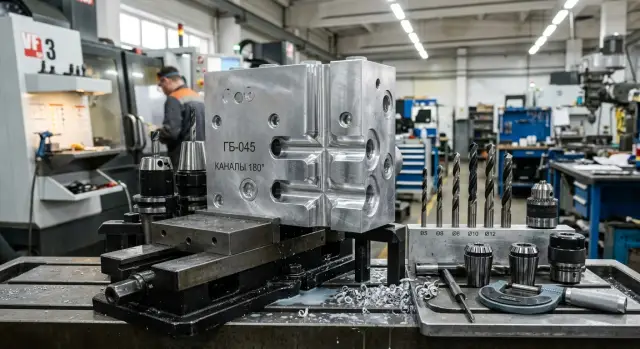
Where the step appears
At the intersection of two channels, the defect usually does not look like a major chip, but like a small internal ledge. If you look into the hole with a camera or cut a test sample, you can see that one channel entered the other off center. Instead of a smooth opening, you get a shift of a fraction of a millimeter.
From the outside, the part often looks fine. The diameters are within spec, the threads are in place, and the ends are clean. But inside, a shelf remains that is hard to spot without inspection.
That shelf does more than obstruct oil flow. It creates extra local resistance, catches fine chips after flushing, and holds dirt in the corner of the passage. In hydraulic lines, that is especially unpleasant: the fluid needs to pass without extra turbulence or pockets, otherwise it is harder to flush the part completely.
Sometimes the ledge is very small, but it still has an effect. On a test stand, it may show up as unstable fluid flow or a difference in resistance between identical parts. In service, the defect can sometimes cause slower response of the assembly, noise during mode changes, or extra heating in a loaded area.
A step at a channel intersection is not the same as a normal burr. A burr is a thin torn edge of metal that sticks out at the drill exit. It is often removed with a countersink, a brush, or light finishing. A step remains even after the burr is removed, because the problem is not the edge itself, but the mismatch of axes and machining depth.
In practice, the defect often shows up only during assembly. For example, the hydraulic block is assembled, plugs are installed, it is flushed, pressure is applied, and one circuit behaves worse than the others. People start looking for the cause in the valve or seal, while the source is actually inside the passage. It also happens that the fitting sits correctly and the thread is fine, but during blow-through you can see that the passage is "heavy" exactly in the intersection area.
For a hole for hydraulic lines, this is also an unpleasant defect because it stays hidden for a long time. While the part is on the table, everything looks acceptable. As soon as the part goes into the assembly, the small ledge starts to interfere as if the passage were made smaller than the drawing.
What determines a clean intersection
A clean channel intersection does not depend on a single trick, but on a sum of small details. If even one of them drifts by a couple of tenths, a step, a burr, or a thin ridge appears at the joint, which later interferes with flow and makes the part harder to flush.
Start with the diameters. When the main channel is noticeably larger than the cross channel, the small drill is easier to pull off center when entering an already weakened area. If the diameters are close, the problem is different: even a small offset becomes obvious along the entire intersection line. For holes for hydraulic lines, this is common, because the channels are often similar in size and work under pressure.
Drilling depth also changes the result. The deeper the channel and the greater the tool overhang, the more the drill drifts from the axis. On paper everything looks straight, but in the metal a long tool starts to "seek" its own path. This is especially noticeable on the second setup, when the cross channel must be brought accurately into an already finished main channel.
The base used for dimensions causes many problems. If the main channel is measured from one face and the cross channel is referenced to another base on a different setup, the error builds up very quickly. Both dimensions may be correct, but the axes no longer meet where they should. That is why it is better to keep one functional base through the entire operation.
On the second setup, everything depends on two things:
- how firmly the part is clamped;
- whether the clamp pulls the body sideways;
- whether the part is seated fully against the stop;
- whether the position repeats after each re-clamping.
If the clamping is too weak, the part shifts during feed. If the clamping is too strong and the shape is thin, the body bends slightly. In both cases, the intersection shifts even though the machine is working accurately.
Part rotation is a separate topic. Even a small angular error creates a noticeable offset at depth. For example, with an 80 mm channel, an angle error of only a fraction of a degree already shifts the axis enough for a step to appear at the joint. That is why the operator usually checks not only the angle, but also the repeatability of the rotation after unclamping and reclamping.
A good intersection is achieved when dimensions are taken from one base, the tool is not hanging out too far, and the second setup repeats the first without stress or skew. If one of these points slips, a clean joint starts to depend on luck rather than the process.
How to choose the operation order
A step most often appears not because of the tool, but because the channels are made in the wrong order. For holes for hydraulic lines, it is better to choose one base channel right away and build the rest of the operations around it.
The main channel defines the axis, depth, and the real geometry of the intersection. If you make the cross hole first and then try to hit it with the main channel, the drill often removes the edge unevenly. That is how a noticeable step appears at the channel intersection.
A typical drilling order works like this:
- First machine the main channel and bring it to a stable size after roughing.
- Then drill the cross channel into the already finished axis, not the other way around.
- Before starting the drill, check where it will break through into the intersection area. Even a shift of a fraction of a millimeter can ruin the edge.
- Leave the finishing pass for the end, when all rough holes are already complete and the part will no longer change shape as metal is removed.
- Lock this sequence into the operation sheet so it is not changed from shift to shift.
If the part has to be rotated, do not mix roughing and finishing without a reason. First remove the bulk of the material, then rotate the part, recheck the base, and only after that finish the joint to the required cleanliness. This approach often gives a smoother wall in the intersection area than trying to do everything in one setup.
A simple example: a housing has a 12 mm longitudinal channel and a 6 mm cross channel. First the longitudinal channel is brought almost to size, then its straightness is checked, and only then the cross channel is brought precisely into its axis. After that, a small allowance is left for the finishing pass and removed at the very end. If you reverse the steps, the cross channel begins to dictate the reference, and the quality of the mating surfaces drops noticeably.
On a vertical machining center, a 5-axis machine, or a simpler setup, the logic is the same: first the base, then the intersection, then the finish. When this order is written into the operation sheet, the result depends less on the operator’s memory and holds up better in production.
Step-by-step machining scheme
A clean channel intersection starts with the base. If the part sat unevenly from the beginning or the zero shifted, no sharp drill or careful feed will save it later. For holes for hydraulic lines, it is better to set one support scheme right away and not change it until the operation is finished.
- First, clamp the part on stable reference faces and check the zero on two axes and in height. If there is any doubt, even by a few hundredths, stop and recheck the setup.
- Then drill the first channel not to final size, but with a small allowance. This lets the tool remove the bulk of the material without leaving extra tearing on the wall before finishing.
- After that, bring the main passage to size with a reamer or boring. Reaming is suitable when the diameter is already close and you need a smooth surface. Boring is more convenient if you need to correct alignment or geometry.
- Then rotate the part, but do not change the clamping logic. Use the same faces and the same control points, otherwise the axes of the two channels will meet with an offset.
- At the end, make the second channel and immediately remove the internal burr at the intersection. If you leave it for later, it may break off, enter the hydraulic system, or distort the flow check.
On the last millimeters of the second drilling pass, it is better to reduce the feed slightly. At that moment the drill breaks into the already finished channel, and that is exactly where a step, a torn edge, or a noticeable metal ridge most often appears.
In practice, a simple check works well: after rotating the part, the operator checks the base again with a dial indicator or gauge rather than assuming the part will "sit right anyway." This short check often saves an entire batch.
If the part is machined on a vertical or 5-axis center, it is easier to keep this order: fewer unnecessary re-clampings, lower risk of offset. But even on a basic setup, the result depends less on the machine type than on discipline in the operation order. First the base, then the rough pass, then the finish size, and only after that the opposite channel.
How to rotate the part without offset
If the part is even slightly skewed after rotation, the channel intersection will no longer match. For holes for hydraulic lines, this shows up immediately: a step appears inside, and simple cutting will not remove it later.
A common mistake is very simple. The operator flips the housing and uses new edges as the base because they seem convenient. Do not do that. If the first side was machined from one base, the second side must rely on the same reference surfaces or on tooling precisely linked to them.
What to rely on after rotation
It is better to spend a couple of minutes on preparation than to ruin the part at the second hole. After rotation, look not only at the setup size, but also at how the part actually sits in the fixture.
Before clamping, it is useful to check a few things:
- whether there are chips, burrs, or a drop of coolant under the reference face
- whether the housing sits evenly on the support surface without rocking
- whether the clamp pulls the part sideways during tightening
- whether the position against the stops matches the first setup
Even a tiny chip under the body creates tilt, and tilt shifts the axis of the second channel. On a simple part, that may be only a few hundredths. In the intersection area, that is already enough to create a rough transition.
It is also easy to overdo the clamping. After rotation, the housing is often tightened harder "just in case." As a result, a thin wall or a long blank deforms slightly, and the axis shifts. It is better to clamp just enough so the part does not move under load, but not enough to change its shape.
Before the second pass, check runout. Usually an indicator on the base or on a control surface is enough, if the part has one. If runout is visible right away, do not hope that the drill will "go the right way on its own." It will repeat the setup error.
A good habit is to make a test entry at a shallow depth. For example, go in 1-2 mm, stop, and check the position. This short pass quickly shows where the tool actually landed. If there is drift, you lose minutes, not the entire part.
On a hydraulic block housing, this is especially useful. The first channel is already set, and the second must meet it cleanly, without axial offset. When the part is rotated on the same bases, the seating is checked, and the clamp is not over-tightened, a clean joint is noticeably more common even in regular series production.
Example on a simple part
Imagine an ordinary steel valve body. The main channel runs along the entire part, and a short cross channel brings oil to a fitting on the side wall. On such a simple geometry, it is immediately clear why holes for hydraulic lines cannot be made in a random order.
If the machinist first drills the cross hole and then runs the main channel, a rough edge often appears at the intersection. The main pass drill reaches the already open cavity, briefly loses support, and tears the metal. Inside, a small step or a torn transition remains. From the outside, the part may look normal, but flow then catches on that area, and chips do not flush out immediately.
On the same part, another order gives a cleaner result. First, the machinist makes the main passage along the housing, checks the size, and removes the burr from the end. Then the part is rotated on the same bases, and the cross channel is drilled toward the already finished axis. At that moment the drill enters the metal evenly and breaks into the finished channel without a sharp tear. The machinist still checks the edge, but the quality of the mating surfaces is usually better.
In practice, the sequence is simple:
- first, make the main channel;
- then remove the burr and check the size;
- after that, flip the housing and drill the cross channel;
- at the end, flush the part and inspect the intersection.
After flushing, the operator quickly notices any remaining step. If clean fluid is passed through the channel and the hole is lit from behind, the irregularity casts a shadow. Sometimes the machinist also checks the intersection with a thin gauge or soft wire. If the transition is smooth, the gauge does not catch.
This simple example clearly shows the effect of drilling order and part rotation. The mistake may be very small, but for a hydraulic line that is already enough. A step traps dirt, disrupts flow, and later takes time to finish or remake the part.
Mistakes that ruin the joint
Even if the machine holds size, it is easy to ruin the channel joint with one small mistake. For a hole for hydraulic lines, not only wrong cutting parameters are dangerous, but also the sequence of actions: from re-clamping the part to ordinary chips that nobody blew out before inspection.
A common mistake appears after rotating the part. The operator takes a new base from the nearest convenient edge instead of the same surfaces used in the first setup. On paper, the offset may look tiny, only 0.05-0.10 mm, but in the intersection area that is already enough to create a noticeable step at the channel intersection.
It is no better to drill to final size right away. A rough drill rarely leaves ideal geometry, especially at depth. If you do not allow a finishing operation after it, the channel may drift, and the edge where the two holes meet will come out torn. On the part, this looks like a small shelf, and in service it later interferes with flow and assembly.
The most common causes are:
- changing the base after rotation and not checking setup repeatability;
- using one long drill for the entire pass without accounting for deflection;
- not checking where exactly the drill will break into the intersection area;
- assuming that if the diameter is within tolerance, the joint is already clean;
- inspecting the part without removing chips and oil from the internal channels.
Long drills are especially tricky. They can shift the axis by tens of microns right at the start of the cut, and even more error accumulates by the exit. If the intersection is near the edge of the channel, even a small drift gives an offset exit. Then the part is measured by diameter, found to be within spec, and the defect is passed.
There is also a very ordinary mistake: checking a dirty part. Chips in the channel often catch exactly in the intersection area and create either a false impression of a step or, on the contrary, hide it. First blow through, flush, then inspect with a gauge, a borescope, or a simple visual check under light.
A good habit is simple: after every rotation, confirm the base; after roughing, leave allowance for finishing; and check the drill exit path before the defect appears, not after the part is rejected.
Quick check before production
Before starting a batch, do not look only at the numbers in the program. A step at the channel intersection often appears because of an offset between setups, not because of the drill itself. If you catch it on the first part, you lose a few minutes. If you miss it, you may ruin the entire batch.
The easiest way is to keep a short control routine and run through it every time on the first finished part.
- Check dimensions from the same base. If one dimension is taken from the end face and another from the opposite side, a small error can easily stay hidden until the channels intersect.
- Inspect the first part only after both setups. After the first setup, everything may look accurate, but the step often appears only after the part is rotated and machined the second time.
- Examine the intersection itself under a bright lamp. If access allows, run a gauge through it or look with a borescope. Even a tiny edge is usually easy to feel.
- Blow out the channel and watch how the chips come out. If they catch, collect in one place, or flow unevenly, there is often already a burr or axis offset inside.
- Record after which operation the edge appeared. Then you will not have to search for the cause from scratch on the next part.
Many people skip the last point, and that is a mistake. A simple note like "after cross drilling," "after rotation," or "after finishing pass" quickly narrows the search. If the problem starts after rotation, check the locating and clamping. If the edge appears right after drilling, check tool deflection and feed.
On a simple part with longitudinal and cross channels, this check takes about 10 minutes. But it immediately shows whether the process is ready for production. If the first part passes light, gauge, and blow-through without catching, you can work more calmly after that. If there is any doubt in even one area, it is better to stop and correct the setup than to spend time removing burrs from dozens of parts.
What to do next
If there is already a defect at the channel intersection, first name it correctly. Axis offset, drill exit burr, and a step at the channel intersection may look similar at first glance, but the causes are different. As long as the shop just says "it didn’t meet properly," no one understands what exactly needs to be fixed.
It is better to take one sample and go through it calmly. Write down which side the tool entered from, what order the operations followed, and how the operator rotated the part between setups. In practice, that is often enough to find the source of the defect.
For this kind of check, it is useful to record four things:
- where exactly the defect is visible
- after which operation it appeared
- which bases were used for each setup
- what changed after the repeated sample
Then do not change everything at once. First, correct the drilling order and repeat the sample on the same part or on an identical blank. Often that is already enough: one hole defines the geometry, the second channel intersects it, and a light pass at the end removes the extra edge. If the step remains, then look at the part rotation and how the base is held.
When the scheme works, lock it into the process plan. Not by word of mouth, but in written instructions for the operator: which base to use, in what sequence to drill, when to rotate the part, and what to check after the intersection. Otherwise, in a couple of weeks, someone will return to the old order and the defect will happen again.
If you make holes for hydraulic lines regularly, this kind of standardization pays off quickly. It reduces the number of trial parts, simplifies inspection, and removes arguments between shifts.
Sometimes the problem repeats even with good operation discipline. In that case, it makes sense to discuss not only the machining method itself, but also the machine, tooling, startup, and maintenance. For such tasks, EAST CNC can help with equipment selection, commissioning, and metalworking service. That is useful when the defect is tied not to one operation, but to the overall process stability.
The best place to start is small: describe the defect precisely, correct the operation order, and check one new sample. If it comes out clean, the scheme should be immediately locked in as the working one.