
Full Part Traceability in the CNC Process
Full part traceability changes shop-floor recordkeeping: link the melt, program version, tool, and measurement report to the part number.
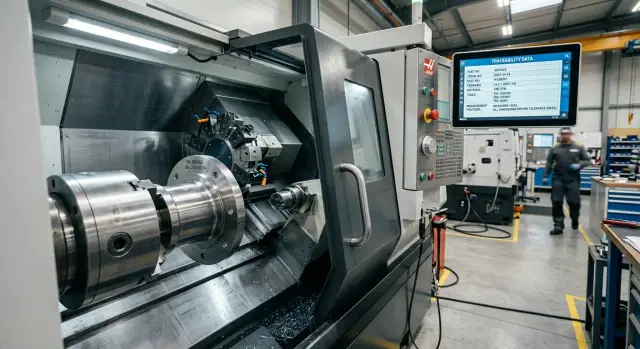
What changes when a full part history is required
When a customer asks you to prove the origin of every part, the entire process becomes stricter. In the past, a delivery note, a tag on the crate, and the shift supervisor’s memory were often enough. For a simple shipment, that sometimes still works. For full part traceability, it does not.
From that point on, a part can no longer be viewed separately from its history. It needs its own part number or batch number, so you can quickly pull up the whole path: which material melt it came from, which CNC program was used, which tool did the work, and what the measurement report showed.
This changes not only the paperwork, but also the daily routine on the shop floor. Any action that used to stay “in someone’s head” now has to be recorded. If a setup technician adjusted the feed, an operator changed an insert, and an inspector took a repeat measurement, all of it needs to leave a clear trace.
Usually, four things change:
- data is recorded as the work happens, not at the end of the shift from memory;
- every part or batch gets one common identifier;
- program edits and tool changes stop being “minor details”;
- disputed cases are checked against logs and reports, not against what someone says.
This becomes especially obvious when a complaint comes in. Say the customer finds a dimensional deviation in a batch of bushings. If there are no records, the shop starts guessing: was it the material, tool wear, or a program adjustment? If the chain exists, the answer comes faster. You can see right away which material melt was used, which version of the program was on the machine, and what the latest measurement report showed.
There is also a practical benefit for production itself. Traceability is not only “for the customer.” It helps avoid mixing batches, prevents the cause of scrap from being lost, and stops the same mistake from being repeated a week later on a new order.
In machining shops, this often becomes the line between “we roughly remember how we made it” and “we can prove how we made it.” In the second case, the discussion is shorter and the solution comes faster.
What records are linked to the part number
A part number should lead not to a single folder with a drawing, but to the full manufacturing history. If the history is built properly, you can see in a minute what material the part was made from, which machine turned it, which program processed it, and how the size was confirmed after release.
Usually, four groups of records are tied to the part number.
- Design data: the drawing itself and its revision. This protects against the common mistake of the shop working from an old version while QC is already checking against the new one.
- Material: melt number, grade, certificate, and, if needed, the blank number or bar batch number. This makes it possible to quickly see which parts came from the same melt.
- Machining history: machine, date, shift, operator, CNC program version, as well as the tool, offsets, and any changes made along the way.
- Inspection: the measurement report for the finished part, linked to a specific part number or serial number.
These records are useful only when they are connected by a single identifier. In practice, that can be a part number plus a batch number or a serial number. If the part number appears in the routing card but not in the program file, the tool log, and the measurement report, the chain is already broken.
A good minimum looks like this: part 201-045, drawing revision C, melt 87421, machine CNC-2, night shift, operator Nurlan, program O145 rev.3, tool T0202 with offset D12, insert changed after 80 pieces, measurement report 201-045-18. With a record like that, the supervisor can immediately see what happened to the part, without calling the shop or searching through messengers.
This is especially useful for repeat orders and scrap analysis. If the size drifted, you check not only the measurements, but also the drawing revision, material melt, program version, and the moment the tool was changed. EAST CNC often covers practical shop-floor work and process flow in its blog, and the rule here is simple: the earlier you connect every record to the part number, the less manual chaos you will face later.
How to build the chain step by step
If records live in different files, chats, and notebooks, the chain breaks in the very first shift. For full part traceability, you need one control center: the part number or batch number. Every other piece of data should be linked only to that.
It helps if the number is easy to understand at a glance. For example, you can build in the order number, item, and batch number. Don’t make it a 20-character code that people will keep copying with mistakes.
- First, create the part card before production starts. Usually, the part name, internal number, order number, quantity, and start date are enough.
- When material arrives, add the material melt, grade, certificate, and the blank or blank-batch number to the same card. If the material is cut for several production runs, it is best to note that right away too.
- Before machining starts, record which CNC program was loaded onto the machine. You need not only the file name, but also the version, save date, and the person who approved it.
- Then enter the tool setup and the first setup data. Usually, the machine number, tool position list, critical offsets, and the note on who set the first good size are enough.
- After inspection, save the measurement report to the same card. If there was incoming inspection, in-process inspection, and final inspection, it is better to keep them together rather than in three different places.
In practice, it looks simple. Say the part got the number D-24115-03. With that number, the supervisor immediately sees that it was made from material with a specific melt, machined using program version 1.7, run with a certain tool set, and checked against the right report.
Check the chain both ways. By the part number, you should find the material, the program, and the measurements in a minute. And the other way around: by the melt number, program name, or report number, you should quickly see which parts are connected to them.
If reverse lookup does not work, the system is still rough. Usually the problem is not the machine, but the fact that someone enters data manually in different places and under different names.
How to link the melt and the material
Full part history begins not at the machine, but the moment the material reaches the shop floor. If the melt number is lost before cutting, full part traceability stops working from that point on. You can keep every program and measurement after that, but you will no longer be able to restore the link to the original metal.
First, the employee checks the melt number on the tag or packaging against the material certificate. This must be done before cutting and before issuing blanks for production. If the data does not match even in one digit, it is better to set the material aside and check it immediately, not “clarify it later.”
After the check, the melt number must be linked to the part number in the production record. A short batch card or an entry in the tracking system is usually enough. It is convenient to keep the following there:
- part number and order number
- material grade
- melt number from the certificate
- date the material was issued to the shop floor
- who received and who issued the material
Then discipline on the shop floor becomes important. A blank without marking quickly turns into “just a piece of metal,” especially if similar leftovers are lying nearby. That is why not only the material package in storage is marked, but also the bin, cart, or crate that carries the blanks to the machine. If the part is small and it is hard to mark the blank itself, the mark is moved to the bin tag and kept with the batch.
A common mistake happens with leftovers. After cutting, shops almost always have pieces left over, and it is tempting to use them in the next order. That is fine, but only if you add a new note: what material it is, which melt the leftover came from, where it is stored, and which sizes it is still suitable for. If you mix several leftovers into one container without records, the chain breaks immediately.
Material substitutions during an order should also be recorded separately. For example, the paperwork called for one bar, but another one from the same grade was used in production. For the technologist, that may seem like a small thing, but for the customer the difference is big: the part history must show the real melt number, not the one planned for issue that morning.
In practice, a simple rule helps: one batch of blanks, one clear note on the melt and storage location. This approach is especially useful where long runs are made on CNC lathes and many similar parts pass through the shop in a day. The sooner you link the material to the part number, the fewer disputes there will be during inspection and shipment.
How to record the program and the tool
If a part is supposed to have a full history, one folder of files is not enough. You need to be able to see at once, by part number, which version of the program was used and which tool the machine was running with at that moment.
It is better to number program files by version. Even a simple scheme like V01, V02, V03 already prevents confusion. When a supervisor or technologist changes the feed, stock allowance, or cycle, they do not silently replace the old file; they save a new version and leave a short note explaining why the change was made.
Edits made directly on the control without recording them almost always break the chain. A week later, no one will remember why the tool started using a different offset or where the extra pass came from. If the code was changed on the machine, the log must keep the reason, date, time, and employee name. Otherwise, the part number stops being a reliable reference point.
The same principle applies to tooling. It is not enough to write “outer turning tool.” You need to tie a specific tool to a turret position or magazine slot. Then the record shows that part N-1542 was machined, for example, with the tool in position T03, with a certain offset and a certain holder.
Usually, a short operation card is enough, with the following details:
- part number and operation number
- CNC program version
- tool position in the turret or magazine
- insert, holder, and offset data
- date, time, and the name of the person who made the change or edit
It is important to record not only full tool changes, but also smaller things. Insert replacement after wear, a new holder after a crash, an offset adjustment of 0.08 mm — all of these affect size and surface finish. If these actions are not recorded, it becomes difficult to link the measurement report to the real cause of the deviation.
In practice, it is simple. For a batch of bushings, the operator runs program version V05, installs the tool in T02, and changes the insert after 120 parts. They enter the change in the record. If the next part drifts out of size, the technologist quickly checks not the whole shift, but the specific moment. That is how full part traceability works on the shop floor, not just on paper.
How to store measurements without manual chaos
When measurements are stored in the shift folder, in the inspector’s notebook, and on the setup technician’s flash drive, the part history quickly falls apart. For full part traceability, you need one main log. It can be a spreadsheet, a tracking module, or any shared system, but the source must be one.
The measurement report should be linked not to the shift and not to the date, but to the part number. If tracking is done piece by piece, the record is tied to the serial number. If it is a batch, the range of numbers is specified. Then one card can pull up the whole chain: material melt, CNC program, tool, and inspection results.
One log instead of three
Mixed recordkeeping almost always creates confusion. A paper sheet by the machine, the technologist’s personal Excel file, and a separate QC folder rarely match each other. In the end, people argue not about the size, but about which version of the record is correct.
The minimum set of fields is usually like this:
- part number or number range
- operation and inspection date
- first sample result
- batch result and report file number
That is already enough to quickly find the right measurement and understand where the deviation appeared.
The first sample should be stored separately within the same record, not lost among the regular measurements. It is the reference point. It shows what the part looked like at the start of the run. The batch result also needs to be separate, because it answers a different question: what actually went to storage or to the customer.
If the inspector finds a size out of tolerance, the part number should be written next to the measurement right away. Not “bushings after correction,” but, for example, “part 24-017.” Then you can quickly separate a one-off issue from a problem in the whole batch. This is especially helpful after a tool change or a CNC program adjustment.
Paper should not be the permanent storage location. If it is unavoidable at the machine, the operator or inspector enters the data into the shared system the same day. Personal files should also be banned. When a record lives only on someone else’s laptop, it is already almost lost.
Well-set-up tracking saves time on a simple question: “Show me the measurements for this part.” The answer should be found in a minute, not after calls around the shop.
Example for a batch of bushings
A shop received an order for a batch of bushings for construction equipment. For every part, one batch number was assigned from the start, and the rule was simple: all records go only through that number. That is how full part traceability stops being a separate folder and becomes part of the normal workflow.
The blanks were accepted from one material melt. The warehouse clerk checked the documents, marked the melt number on the container, and added an internal batch tag. After that, the operator no longer takes “just metal from storage.” They take a container with a clear label, and the link between the part number and the material melt is not lost at the start.
At launch, the supervisor approved CNC program version 1.7 and a specific tool set for this batch. The routing record included not only the file name, but also the version, start date, and machine. That seems like a small thing at first. But if versions 1.6, 1.7, and 1.8 are sitting in the folder later, there is no debate: the shop can immediately see which CNC program was used for these bushings.
The first parts passed inspection, and production moved ahead. After 20 parts, the operator changed the cutting insert. They did not limit the note to “tool replaced,” but recorded the time, part counter, and tool position. That note is not for bureaucracy. If the size starts drifting later, the technologist can quickly see from which point the batch needs closer attention.
The inspector entered the results in the measurement report using the same numbers. Diameter, length, and fit stayed within tolerance, and the final report confirmed it. There was no need to manually reconcile papers from different logs, because the part number and batch number already linked the material, machining, and inspection.
When the customer asked about one box before shipment, the shop pulled up the history in a few minutes. They found the melt, the container, program 1.7, the insert change note, and the measurement report. That is working traceability: not a long report for its own sake, but a fast answer to a specific question about a specific part.
Where the chain usually breaks
The break almost always happens when people do the work faster than they make the record. In CNC work, that is a common story: the part moves on to the next step, while the trace of the material, program, or inspection stays somewhere else. After that, full part traceability exists only on paper.
Problems usually start in five places.
- The warehouse issues blanks without a melt number. The material is physically there, but a day later it is impossible to prove exactly which batch this part came from.
- The setup technician changes the program on the machine and does not save a new version. The log shows one CNC program, but in reality the part was machined under another one.
- The operator changes the tool and does not make a note. Later it is hard to tell which cutter or drill was used on the dimension that went out of tolerance.
- QC saves the measurement report in a shared folder without the part number or batch number. The document exists, but it can no longer be tied to a specific bushing or series.
- Shipping puts parts from different batches into one box. After that, the link between part number, material melt, and measurement results is lost.
These failures seem minor until a complaint arrives. Then the shop starts looking for which blank was used, who edited the program, when the tool was changed, and which report belongs to the batch. If even one step was not recorded, the chain breaks completely.
What is worse is that errors often build up unnoticed. For example, the warehouse issued a bar without a melt mark, the setup technician tweaked the feed directly at the machine, and QC named the file simply “report 12.” The parts were shipped, and everything looked fine. But if the customer asks for the history by part number, the shop will not be able to rebuild it without guesses.
Usually, what helps is not a complicated system, but strict discipline in three places: when material is issued, when machining changes, and when measurements are recorded. If a record cannot be quickly tied to the part number, it is almost useless.
Quick check before shipment
Before shipment, you do not need a long audit. You need 5–10 minutes and one simple goal: by the part number, pull up the whole batch history immediately, without calling the shop or searching through chats. If that works, full part traceability is already working in practice, not just on paper.
First, check the part number on the container. It must match exactly the number in the batch log, the routing sheet, and the measurement file. If the box has one marking and the record has another, it is better to stop the shipment right away. Small errors like that later turn into arguments about what actually went to the customer.
Then quickly verify the chain itself:
- the material certificate and melt number are linked to this part number;
- the log shows the CNC program used for the final machining step;
- the latest program edit has a date and author name;
- all tool changes are recorded through the end of the order, with no empty gaps;
- the measurement report is easy to read: size, tolerance, date, instrument, and result.
It also helps to open the material certificate and make sure it belongs to this batch, not just that it happens to be sitting nearby in a shared folder. That mistake is common: the material is right, but the document is from a neighboring order.
The rule for the program is just as simple. You should be able to see which version was on the machine for the final pass. If the technologist changed an offset or the operator loaded a new revision, that record needs a date and a name. Otherwise, if a complaint comes in, no one will know which program the parts were made under.
With tools, there is no need to overcomplicate things. It is enough that the record shows the changes, especially if the batch ran across several shifts. Then you can see at which stage the new cutter or drill was installed and link that to the measurements.
A good report does not require guesswork. Any employee should be able to open it and immediately understand what was checked, what was used to measure it, and what result was obtained for that batch. If you need the supervisor to explain it, the pre-shipment check is still not in order.
Where to start on your own shop floor
Do not try to cover the entire shop at once. Take one item you produce regularly and test the scheme on that. It is better to choose a part without rare operations or frequent changes, so the team can quickly see where the chain holds and where it breaks.
For the first rollout, you do not need a long list of fields. You only need the records without which you cannot prove the part’s history by its number. Usually, this minimum is enough:
- part or batch number
- material melt and certificate
- CNC program version
- tool or offset used in the operation
- measurement report with date and result
If one of these items is missing, full part traceability turns into guesswork. People start looking for data in chats, notebooks, and the setup technician’s memory. That kind of process breaks at the first quality dispute.
Next, run a simple test. Take a finished part and try to trace it backward: who started the job, which blank it was made from, which program it was machined under, and what was used to measure the result. Then go forward: which batch the part went into, when it was accepted, and where it was shipped. If you hit verbal answers at even one step, the system is not ready yet.
A good check does not take long. One supervisor or technologist can do a trial search in 15–20 minutes. If it takes an hour or more, that means you are storing too much in different places or naming the same data in different ways.
When the pilot works, do not rush to expand it to every part. First, lock in the common rules: how you assign a part number, who enters the material melt, where the CNC program is recorded, and who closes the measurement report. After that, rolling the scheme out to neighboring parts becomes much easier.
If you are launching a new turning shop or a new line, it is better to discuss these requirements before the start. EAST CNC handles machine selection, commissioning, and service, so the record chain can be planned in advance rather than assembled after the first shipments.