
Foundation for a Heavy Machine: When You Need One and When You Don't
A separate foundation for a heavy machine is not always necessary. We explain when a slab and anchors are enough and when the floor needs reinforcement, leveling and control.
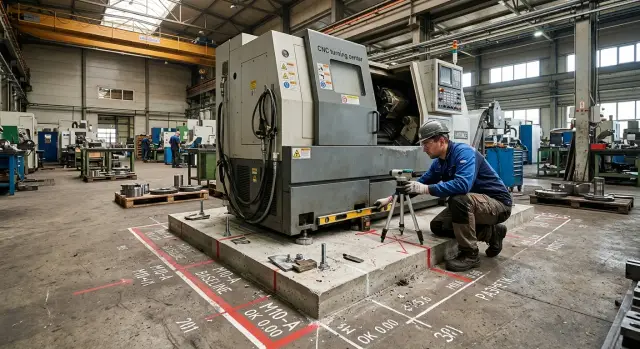
Why everything starts with the floor
When installing a heavy machine, many people immediately look at the mass on paper and overall dimensions. But the floor doesn’t feel the whole machine at once — it feels the support points. Load is transferred through pedestals, feet, supports or the area under the bed. These places experience the highest pressure on the concrete.
So even a floor that looks flat and solid may be unsuitable for installation. On paper the slab can seem reliable, but a weak spot is often local: a joint, a crack, a void under the top layer, an old patch or a settlement near the edge. For the machine this matters more than the total area of the workshop.
If the floor “gives,” the machine loses its level. At first it looks like a minor issue: it took longer to set up, a few tenths were adjusted, a shim was added. Then the problem accumulates. Geometry drifts, guides wear faster, part sizes start to vary, and the operator spends more time correcting settings.
This is especially noticeable on heavy CNC lathes and machining centers. These machines are sensitive not only to their own weight but to daily operation: acceleration, braking, tool changes and cutting vibration. The floor must support both the mass and this continuous dynamic loading without slow settling.
Therefore the question “does a heavy machine need a foundation” shouldn’t start with anchors or the cost of pouring concrete. First you look at the real floor: where the supports will stand, whether there are nearby joints, what the concrete is like under the top layer, whether the platform is flat or crumbling. Sometimes the existing slab is more than sufficient. Sometimes one unfortunate joint ruins the whole installation plan.
A mistake at this stage is expensive. Moving the machine, re-leveling, re-grouting after mounting, workshop downtime and scrap parts usually cost more than a proper inspection before purchase.
What to gather before calculations
Before any foundation calculation you need two groups of data: the machine documentation and factual information about the floor. Without them the engineer only sees approximate weight, and that’s not enough. Two machines with the same mass can load the slab very differently if they have different bases, center-of-gravity heights and support schemes.
Machine data
Start with basics: machine weight, dimensions and the exact footprint. Check what it rests on — adjustable feet, anchors, cast bed with multiple contact points or a ready frame. For calculations this is an initial condition, not a detail.
Then collect the manufacturer's requirements. Documentation usually contains tolerances for flatness, requirements for slab thickness, anchor types and grouting conditions. The most useful things to get upfront are the installation drawing, the support layout and anchor points, and the base and mounting tolerance requirements.
Floor and installation area data
For the floor you need facts, not general statements. What is the slab thickness, what concrete grade was used, is there reinforcement and where is it located. If exact data is missing, try to find old as-built drawings or do an inspection. Otherwise the calculation will be overly optimistic, which is a bad scenario.
Then inspect the immediate area. There may be contraction joints, cable channels, pits, trays, old pours or repair zones. Even good concrete helps little if a support falls on the edge of a joint or over a void.
Another important point is what happens around the area during a normal shift. If a forklift drives nearby, an overhead crane runs, a press operates or other equipment imposes impact loads, the slab receives not only static weight but vibrations and short peak forces. These are often neglected and later become the reason for geometry drift.
A good preparation looks simple: a shop plan with dimensions, photos of the area and the set of manufacturer requirements. Then it is clear right away whether the machine can be placed on the existing slab, whether the industrial floor needs reinforcement and where to include geometric control points in advance.
When a prepared slab is enough
A separate foundation is not always required. In many shops a heavy machine works fine on an existing reinforced concrete slab if the floor was designed for such loads and does not change shape under the supports.
You need to look less at total machine weight and more at how that weight is transferred to the floor. Number of supports, spacing and contact points matter. If the slab carries the design load with margin, does not crumble and shows no noticeable settlement, a separate base is often unnecessary.
A good sign is when supports sit within the “solid” body of the slab, not on an edge, not over a joint and not on a repair patch. Local weak zones usually spoil the installation. Because of them the machine is hard to level and setup takes extra hours at the start.
Floor height differences also matter. If the variation falls within installation tolerances, geometry is usually achieved with standard supports or adjustment elements without complex grouting or base rework. If one side noticeably settles, simply placing the machine on the slab looks questionable.
A suitable slab typically shows several signs: dry concrete, a top layer that is not flaky or peeling, no fresh patches near the support points, cracks that do not open under load, and the manufacturer does not require a separate foundation. That last point is often overlooked even though the maker usually states whether the machine may be installed on a prepared slab or requires a separate structure with specified thickness, reinforcement and anchor pattern.
In practice it’s straightforward. If you place a CNC lathe on an area where the concrete has long since gained strength, the slab is flat, supports do not fall on joints and level measurements are within tolerance, the prepared slab is usually sufficient. In that case a separate foundation only delays start-up and raises budget.
When a foundation or reinforcement is needed
A prepared slab is not always enough. If a machine is heavy and loads are transferred through several support points, the floor may fail even with a normal overall thickness. Mass alone does not determine it. What matters is how the load is applied to the slab.
A foundation is needed when the slab is too thin for such point loads. This is common on old floors that were originally poured for storage or light equipment, and later repurposed for a CNC lathe or machining center. On paper the slab may still look acceptable, but in reality it lacks the required stiffness margin.
The second common case is weak spots in the installation area. If at least one support falls on a joint, crack, repair patch, void or slab edge, the risk rises sharply. Sometimes a full foundation is unnecessary but a local reinforcement of the industrial floor under the problem point is required. That is cheaper and more sensible than rebuilding the whole area needlessly.
A separate base is often chosen when there are continuous vibrations or impact loads nearby. If a press operates close to the machine, heavy traffic passes, or other equipment produces sharp cycles, the general slab can transmit extra vibration into the bed. In such cases a foundation addresses not only strength but also stability during operation.
There is a simpler criterion: if measurements show the area is outside the level or flatness tolerances, the concrete is weak, and shimming and standard feet will not fix it, strengthen the floor immediately. Don’t rely on the machine “settling” and aligning itself later — usually the opposite happens.
How to check the floor step by step
Inspect the floor before the machine arrives at the shop. Then the problem is visible in numbers and on the concrete, not on installation day when the machine is already at the gate and any delay hits schedules.
First take the machine documentation and compare it with the actual support scheme. You need exact load points: where the supports stand, their spacing, whether anchor points exist and how much load falls on each point. If the model is produced in several configurations, check your specific version.
Transfer these points to the floor. Marking is best done before bringing the equipment. This makes it easier to see whether supports fall on joints, old repair maps or weak areas. Often at this stage it becomes clear a foundation is unnecessary but the mounting zone should be moved half a meter.
Next take measurements. Looking only at overall shop level is pointless. A machine rests on a small area and that area is what matters. Usually the zone is divided into a grid, level and flatness are measured at each point, diagonals in the support area are checked, and all deviations are recorded, not just the maximum. Photos of the layout and measurements will save many disputes during installation.
After that carefully inspect the concrete. Note cracks, contraction and working joints, old repairs, voids at edges and traces of previous anchors. An old repair by itself is not a disaster, but under a machine support it often behaves worse than monolithic slab. If anchors are planned near a joint, check that in advance rather than deciding on the spot.
The last step is to compare all numbers with the manufacturer's installation tolerances before drilling anchors. If the floor exceeds tolerance, don’t start “somehow.” Decide first: level the area, change the support scheme, reinforce the section or relocate the machine.
What anchors, supports and grout actually do
Anchors, supports and grout perform different jobs. When they are lumped together, people start expecting from fasteners things they cannot deliver.
Anchors secure the machine in place but do not cure a weak slab. If the slab crumbles, springs or settles under load, anchoring the machine only fixes that same problem. It won’t improve machining accuracy. Sometimes noise increases and geometry must be restored afterward.
Adjustable supports are useful on older floors with level differences. They help achieve level without crude shims and endless washer stacking. But supports do not replace proper floor preparation when concrete is weak or the tilt is too large.
Grouting solves another task: it fills gaps between the machine base and the floor, eliminates voids and spreads the load over a larger area. This works only when the base surface was prepared, weak layers removed, the surface cleaned, and the support scheme follows the machine documentation.
Too rigid a fixation is not always beneficial. Some machines require it, especially with high lateral loads or risk of displacement. But in some installations excessive stiffness transfers vibration into the slab and back into the bed. The machine may be tightly fixed yet machining quality remains poor.
In practice they consider five things: machine weight and load distribution across supports, slab condition and thickness, level and geometry tolerances, the nature of operational loads, and manufacturer fastening requirements. For a heavy CNC lathe on an old floor the usual logic is: first inspect the slab and level, then place the machine on supports, set geometry and only after that decide on anchors and grouting. If you start with anchors "because that’s the habit," misalignment may appear already during installation.
Common mistakes
The most frequent cause of problems is rushing the installation. People look at the total mass and draw a simple conclusion: if the slab holds 8 or 10 tons, everything is fine. But the floor works with how the load is distributed across each support, not with a single total number.
On a heavy machine one pedestal or support can press the floor noticeably harder than the others. If the load is higher under one point, that is where the slab begins to settle. Therefore you cannot choose a foundation based only on catalog weight. You need the support scheme, spacing and the actual contact area.
The second common mistake concerns anchors. The floor is drilled where the tool is easiest to access, without marking joints, hidden reinforcement or repair zones. As a result an anchor ends up too close to a joint, the concrete edge crumbles and the fixation is weak. Such anchoring looks neat on the first day only.
Problems also arise during leveling. Sometimes a machine is set on a stack of shims and that is considered solved. But if the slab under the shims is uneven, loose or contains voids, supports have different stiffness. The machine might appear level but a week later geometry drifts.
Rushing after floor repairs is costly too. A new patch may not have gained required strength yet, but equipment is already installed and anchors are tightened. On the surface everything seems fine, but the concrete below is still weak. Later micro-cracks, settlement and re-adjustment follow.
Another mistake is noticed too late. A forklift drove through the shop, a press was moved, or another heavy unit was relocated and the slab next to the machine is no longer the same as at the first check. If no one repeats the geometric control, a small misalignment accumulates unnoticed.
In practice it pays to stop one day earlier than a week later. Before start-up check three things again: load on each support, anchor locations and slab condition after all movements in the shop. These details are where accuracy is most often lost.
A simple example for a shop
Imagine a common situation. A shop in Kazakhstan buys a CNC lathe for serial parts where dimensions must be stable from batch to batch. There is an old reinforced concrete slab in the area. It looks normal: no obvious cracks, no heavy edge crumbling, the area is dry.
The problem appears after measurements. The slab deviates by a few millimeters in level — for ordinary equipment that might not be a disaster. But for a heavy machine the supports act at specific points, and one support falls almost directly on a joint of an old pour.
The shop then does the thing many postpone: checks the floor with numbers, not arguments. Slab thickness turns out to be acceptable for this zone. The load-bearing part is generally sound. The weak spot is not the whole area but a local point under one support.
In that situation a full foundation for the machine is not always required. That would be expensive and unnecessary because most of the base is suitable. It’s far better to keep the working part of the slab and locally reinforce the area under the problematic support, level the seat and re-check geometry afterward.
Usually the solution reduces to four actions: confirm slab thickness and condition on site, mark all joints, voids and level changes, move the support off the joint or locally strengthen the area under it, and after installation verify the machine seating on all supports.
This approach saves time and money. If you put the machine directly on the joint without improvement, at first everything may seem tolerable. Later small tilts appear, repeatability drops, level adjustments are needed more often and people look for causes in tooling or settings while the real issue was the floor all along.
What to check before installation
Decide about the floor before buying the machine. Then you have time to compare the documentation requirements, check the slab and understand whether a separate foundation or normal site preparation is needed.
Start with a simple data set: total machine weight, base dimensions, support scheme, anchoring requirements, permissible variation on the mounting area and commissioning conditions. If the manual specifies base stiffness or grouting, don’t postpone those notes. These details often determine whether the machine can stand on the existing floor.
Then inspect the slab itself. It’s important not only to know thickness and age but the actual condition: are there joints and cracks in the support zone, how flat is the platform, what happened in the area after previous repairs and whether the load will end up on a weak spot.
If the floor is flat, the slab thick enough and no weak joints lie under the machine while the load is within design, proper site preparation, leveling and correct support installation are often sufficient. If there are large level differences, voids, cracks, doubts about reinforcement or very high local loads, plan reinforcement or a separate base from the start.
Don’t wait for delivery. When the machine is already in the shop any surprise with the floor costs more: schedules slip, extra equipment is required, the area must be redone and people stand idle.
If you are selecting a CNC lathe or machining center, it helps to compare the model’s requirements with your floor in advance. At EAST CNC this is done during selection and supply: they compare the support layout, base requirements and the real condition of the site. It’s better to have this conversation before installation, while the problem can still be solved calmly and without extra expense.
FAQ
Does a heavy machine always need a separate foundation?
No. A separate foundation is not always required. If a reinforced concrete slab supports the loads at the machine support points, does not settle or crumble, and the supports do not fall on joints or weak spots, the machine is often installed directly on a prepared floor.
When can a machine be placed on an existing slab?
A slab is usually sufficient when the concrete is dry and dense, the area is flat within the allowed tolerance, and the support layout suits that section. Also check that there are no cracks, old repairs, voids or slab edges near the supports.
What should be checked before foundation calculations?
Collect two groups of data: machine data and floor data. For the machine: weight, support layout, base dimensions, anchor points and manufacturer's installation requirements. For the floor: slab thickness, concrete condition, joints, cracks, previous repairs and actual level measurements at the installation area.
Why can't you choose a foundation only by machine weight?
Because the floor reacts not to the total weight but to pressure at specific points. Two machines with the same total mass can load the slab very differently if they have different bases, support spacing or center-of-gravity height.
What to do if a support falls on a joint or old repair?
You should not leave such a support as-is. Usually the support is moved if possible, or the area is locally reinforced. Placing a machine on a joint or weak repair is a bad idea: the level will shift and the machine geometry will drift.
Will anchors save the situation if the floor is weak?
No. Anchors hold the machine in place but they do not fix weak concrete. If the slab is springy, crumbling or settling, anchors will only secure the same problem. First the foundation is checked and fixed, then the anchoring is addressed.
Why is grout used under a machine?
Grouting is used to fill gaps between the machine base and the floor and to distribute the load more evenly. But it works only when the surface was properly prepared first. If there is a weak layer of concrete underneath or a large tilt, grouting alone will not solve the problem.
When should the floor be checked for a machine?
Better to do it before purchase or at least before delivery. Then you can calmly compare the manufacturer's requirements with the actual floor and decide whether a foundation, reinforcement or relocation is needed. A surprise on installation day is much more costly.
Do neighboring machines and traffic affect the foundation?
If a heavy forklift drives by, a press operates, an overhead crane is used or other equipment with sharp cycles runs nearby, the slab experiences additional vibrations. Because of this, a machine can lose stability even on a strong slab. In such cases a separate calculation or a separate foundation is often required.
What risks does the shop face if a machine is placed on an unprepared floor?
At first everything may seem fine: the machine is leveled and parts start to run. Later misalignments appear, dimensions drift, slides wear faster, operators make more adjustments and the shop spends time on re-leveling. Usually it's cheaper to check the floor in advance than to move the machine and redo the area later.