
Floating Tap Holder: Where It Saves the Thread
A floating tap holder helps when there is misalignment, long overhang, and difficult materials. Let’s look at when it is useful and when it only slows the cycle down.
What is the problem when cutting threads
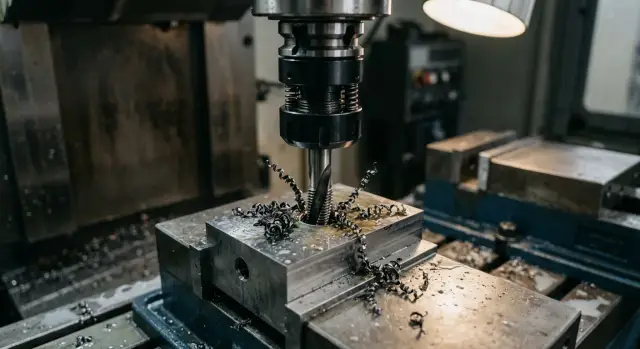
When tapping a thread, the tap rarely breaks on its own. The problem usually starts earlier: the spindle guides the tool on one axis, while the hole has already shifted by a fraction of a millimeter. That difference is enough for the tap to start not only cutting, but also pushing sideways.
When the tap axis and the hole axis do not match, the teeth work unevenly. One side removes extra metal, the other rubs and heats up. The thread comes out torn, the pitch can drift, and the operator sees a strange picture at the end: the tool seems fine, the settings do not look dangerous, but scrap still keeps coming.
This is especially frustrating because the cause is often mistaken for a bad tap or a poor batch of blanks. In reality, the problem may be spindle runout, inaccurate part setup, a shifted hole after drilling, or the fact that the machine is rigidly pulling the tap where the spindle wants it to go, not where the finished hole actually is.
Hole depth makes every weak point worse. In a short hole, the tap can still pass with a small misalignment. In a deep hole, friction grows, chips have a harder time escaping, and coolant reaches the cutting zone less effectively. The load builds with every turn, and the tool quickly reaches its limit. Often it does not break right away; first it damages the thread profile, then it jams on reverse.
The losses here are not limited to one bad part. In production, the expensive part is often not the damaged thread itself, but the pause around it:
- the machine stands still while the operator figures out the cause
- the part goes to inspection or rework
- the broken tap takes longer to remove than the hole took to make
- the batch loses rhythm and the next operation waits
If the part is simple and cheap, this is unpleasant but manageable. If it is a housing, a deep blind hole, or a small batch of expensive blanks, the cost of a mistake rises quickly. In such cases, interest in a floating tap holder appears not because it is trendy, but for a very simple reason: a small axis shift can easily turn into machine downtime and extra hours of work.
How a floating holder works
A floating tap holder gives the tap a little freedom where a rigid holder does not forgive even a small offset. If the tool axis and the hole axis are slightly off, the holder absorbs that difference. The tap enters more smoothly and rubs less against the hole wall.
Usually this freedom exists in two directions: along the axis and slightly sideways. Axial travel helps when feed and the tap’s actual movement do not quite match. Side travel helps when there is a small concentricity error between the tap and the hole. For fine threads, this often saves the tool from extra load on the first few turns.
A rigid holder works differently. It keeps the tap strictly following the machine’s command: the spindle turns, the Z axis moves at the calculated feed, and the tool has to follow exactly. This mode is good when the machine is accurate, the hole was prepared correctly, and the setup was made without misalignment. Then rigid tapping gives a better pace and a more predictable pitch.
A floating holder does not fix major mistakes. If the hole wandered, if runout is large, if the tap is dull, or if the program was set with the wrong depth and speed, the holder will not correct that. It compensates for a small error; it does not rescue a poor setup.
In practice, it helps in cases like these:
- there is a slight axial shift after drilling or boring
- the tap is long and sensitive to misalignment
- the material is difficult to cut and does not like extra load at entry
- threading is done on a machine that is not the stiffest
There is also a nuance with feed and reverse. During entry, the holder may compress or extend slightly if the machine and the tap are not moving quite in sync. On reverse, it first takes up that travel and then pulls the tap back. This lowers shock load, but the system response becomes less sharp.
That is why a floating tap holder often wins in tool life, but not always in cycle time. For short, simple threads on an accurate machine, a rigid setup is usually faster. But where there is a risk of misalignment, stripped first turns, or a difficult material, a little play in the holder works for quality rather than against it.
How the part material changes the result
The same tap behaves differently even with the same program. The material changes cutting force, heat, and how chips exit the hole. That is why a floating tap holder sometimes saves the job, and sometimes brings almost no benefit.
In mild steel and aluminum, the margin for error is usually larger. The material cuts more easily, chips come out more smoothly, and a small concentricity error between the tap and the hole does not immediately ruin the profile. If the machine keeps the pitch and the hole was prepared without surprises, rigid tapping often works quickly and cleanly. A floating holder is useful where the tooling is not ideal: for example, the part was clamped with a slight shift, or there is variation in hole position across a batch.
Stainless steel is tougher. It heats the tap more strongly, stretches, and likes to gall the cutting edge. A small misalignment, a hole that is too tight, or poor chip evacuation quickly raises the load. That is why threading in stainless steel more often benefits from a holder that provides axial and radial compensation. But do not expect miracles: if the tap is dull, the speed is too high, or cooling is weak, the holder will not fix the process.
The picture is similar with ductile alloys. The tap does not cut freely; it almost pulls the material along. As a result, torque rises, and the bottom of the hole becomes even riskier. Here it is better to look at the whole setup at once: the thread-drill diameter, lead-in geometry, tap type, and hole depth.
With cast iron, a floating holder is needed less often. Cast iron makes short chips, which interfere less with cutting, and the process itself is often calmer. If the machine is rigid and the tool was set accurately, rigid tapping usually gives a better pace and more consistent repeatability. Exceptions exist, but the benefit of floating compensation here is often smaller than in stainless steel or soft ductile steel.
Coating does not fix process errors
Tap coating reduces friction and helps extend tool life. That is useful, but it does not replace proper tooling. If the tap enters the hole at an angle, the coating will not restore concentricity. If there is too little clearance for the thread, it will not remove the extra load. If chips get stuck in a deep hole, it will not pull them out.
A good result comes not from one “magic” element, but from a calm process setup. First, the hole and tap are chosen for the material. Then the machine, chuck, and holder are checked. Only after that do you decide where a floating tap holder really helps and where it only adds extra travel and slows the batch down.
What changes in deep holes
In a short blind hole, the process is usually calmer. The tap quickly engages, cuts the required number of turns, and then comes back out almost immediately. Chips do not have time to build up in large amounts, and friction along the walls has not yet grown much.
A deep hole is different. The farther the tap goes, the longer its cutting section rubs against the already formed thread and the hole walls. Torque rises as it goes deeper, the tool heats up more, and any concentricity error between the tap and the hole becomes more noticeable.
People often look for the problem in the tooling, but at depth, chip evacuation is often the first thing to fail. If chips do not move upward or forward, they collect at the bottom, scratch the profile, and jam the tap on the last turns. In a blind hole, this happens especially often: there is simply no room for error.
If you compare two identical holes, the difference becomes obvious quickly:
- in a shallow hole, the tap cuts and exits with almost no increase in load
- in a deep hole, the load rises with every turn
- fine chips at the bottom start damaging the thread profile
- coolant reaches the cutting zone less effectively
- the tap comes back out harder than it goes in
That is why a floating tap holder should not be seen as a universal rescue. It may forgive a slight entry offset and soften the misalignment a bit, but it will not remove chips from the bottom or reduce friction by itself. If the hole is deep, first look at the tap geometry, bottom clearance, coolant delivery, and the actual thread length you really need.
Sometimes it is better to shorten the thread depth than to try to “stretch” it with the holder. For fasteners, 1 to 1.5 thread diameters is often enough, and everything deeper only adds risk. If the drawing says 20 mm of thread, but the part already holds the load at 12–14 mm, reducing the depth often gives a cleaner and more stable result.
A good example is stainless steel with a blind hole. At 8 mm depth, the tap runs smoothly, but at 18 mm it starts tearing the last turns and taking extra torque. In that situation, it is more useful to rethink the thread length or chip-flute design than to hope the holder will fix the whole process.
How to choose the solution step by step
The error often starts not with the tap, but with the spindle, chuck, and hole already being out of axis. So it is better to choose the solution after a short check of the setup and the operating mode. It takes a few minutes and often saves an entire batch of parts.
- First, check the chuck runout and the tool seating. If the shank is seated with dirt, a burr, or a tilt, no holder will remove the problem completely. If the runout is noticeable, it is better to fix the source of the error first.
- Then verify the hole diameter for threading. A hole that is too small sharply increases the load, the tap heats up, and starts pulling the thread off center. A hole that is too large gives a weak profile, and that is often noticed only during assembly.
- After that, evaluate the tool overhang. The farther the tool is extended from its support, the easier it is for it to drift off axis. If a long overhang cannot be avoided, a floating tap holder often gives the needed tolerance margin.
- Next, compare thread pitch, material, and speed. A fine pitch in a ductile material, especially when threading stainless steel, prefers a calm mode and a clean cut. On softer metals, you can work faster, but you should not raise the speed blindly.
- Finally, decide whether axial travel is needed. If the machine holds feed accurately, the tool is short, and the tap-to-hole alignment is within tolerance, rigid tapping usually gives a faster cycle. If there is clamping variation, long overhang, or a deep hole, compensation often reduces scrap risk.
It helps to keep one simple rule in mind. First remove mechanical causes, then check the hole and the process, and only after that choose the holder. Otherwise, it is easy to confuse the cause with the effect.
In practice, it looks simple. For a short thread in stable steel on a machine in good condition, a rigid setup is usually the better choice. For a part with long overhang, imperfect alignment, or a difficult material, it makes more sense to give the tool a little freedom than to later fish broken tap pieces out of the hole.
Where people most often make mistakes
The most common mistake is simple: a floating tap holder is installed as a cure for machine problems. If the spindle drifts, the chuck runs out, or the hole axis is already shifted, the holder will not correct the geometry. It may soften entry a little, but the thread will still go in with a risk of misalignment, scoring, and rapid tap wear.
The second mistake happens where a precise, clean thread is needed. People choose a holder with too much compliance and expect a perfect result. In reality, the tap gets too much freedom, and the pitch and thread profile can move away from the required size. For precision fits, that extra travel often gets in the way more than it helps.
Many people also confuse the cause of scrap. The tap is dull, the edge chipped, the flutes packed with chips, and the holder gets blamed. You can tell by a simple sign: the first parts were fine, then torque increased, the sound changed, and the thread surface became rough. A holder does not change like that after just a few parts. A worn tool does.
Another issue appears after switching from a rigid holder to a floating tap holder. People keep the old settings as if nothing changed. But feed, speed, reverse, and exit from the hole must be checked again. If that is not done, the tap may drag chips back, scratch the profile, and lose life earlier than expected.
In serial machining, mistakes often show up after the first two or three parts. But people miss them because they look only at the gauge. That is not enough. You need to open the hole after the trial batch and see what is happening inside.
Usually, four things are checked:
- the shape and color of the chips
- signs of rubbing at the entry
- the cleanliness of the bottom, if the hole is blind
- the same effort on several parts in a row
For example, when threading deep holes or working with stainless steel, the chips quickly reveal the problem. If they are long, torn, or start packing into the flutes, it is better to slow down right away. Otherwise, the batch will go slowly and the scrap will start appearing by the tenth part.
A good habit is simple: do not blame one holder until you have checked the machine, the tap, the settings, and the chips. Then the solution is found quickly, and the thread turns out predictable.
A real production example
A batch of stainless steel housings is being processed. Each part needs an M8 thread, the hole is deep, and the thread tolerance is ordinary, with no room for stripped first turns. At first, the job was run with rigid tapping because it is faster and more familiar.
On the first dozens of parts, everything looked acceptable. Then it became clear that the tap entered smoothly, but at the bottom of the hole and on the way back out it was noticeably harder. The spindle picked up extra load, chips came out reluctantly, and threading in stainless steel began to behave capriciously: here a burr appeared, there the profile was damaged, and sometimes the tap simply sounded wrong from the first few revolutions.
Several causes were at work at once. Stainless steel stretches more than ordinary steel. Threading in deep holes forgives feed errors less and evacuates chips worse. If the tap and hole alignment had shifted even slightly, the rigid setup passed that misalignment directly into the cut.
After that, a floating tap holder was installed on the machine. It did not remove the material issue, but it took some of the strain off during entry and during reverse. On the same batch, scrap dropped noticeably: where before several parts per hundred could be lost to torn threads or a risk of tap breakage, after the holder change such cases became rare.
But there was a cost in time. The cycle got longer, even if not dramatically. If even 2–3 seconds are added to one hole, that becomes visible in the shift plan across a batch. So this change worked well precisely for a difficult operation where stability mattered more than saving a minute over ten parts.
Short holes are different. There the tap travels a shorter distance, chips escape more easily, and the gain from floating compensation is much less noticeable. In that kind of job, a floating tap holder may reduce risk, but often it simply slows the pace down without bringing clear benefits.
The practical takeaway is simple: if the part is stainless steel, the hole is deep, and the tap is working hard on exit, a floating setup often saves the thread. If the hole is short and the machine holds good alignment, it is faster and calmer to keep the rigid setup.
Quick check before starting a batch
Before a batch, do not look only at the first successful part. Run 3–5 test passes in a row with the same settings. That makes it faster to see whether the process holds size, whether the tap drifts, and whether the load grows after a couple of holes.
If you are using a floating tap holder, do not look only at the thread itself. It may forgive a small concentricity error between the tap and the hole, but it will not save you from poor chip evacuation, wrong depth, or weak reverse. With rigid tapping, the check is even stricter: the slightest misalignment or extra chip immediately causes scoring, noise, and a torque spike.
Before starting a batch, it helps to quickly check five signs:
- the thread runs evenly along the full length, without stripping at the bottom or a crushed entry
- the tap enters smoothly and exits just as smoothly on reverse, without jerking or squealing
- the size does not drift across several parts in a row
- chips are not collecting in a tight clump at the bottom of the hole or in the tap flutes
- cycle time on the fourth or fifth part is not longer than on the first
This check takes only a few minutes, but it catches problems before scrap appears. If the top of the thread is clean but the bottom is rough, the usual causes are hole depth, chips, or too little allowance for exit. If the tap jams specifically on reverse, check the spindle reverse, coolant supply, and how the tap leaves the last turns.
Also compare the first and last test part. If the first one went easily and later the size drifted, look for heat, material buildup, or wear. This often happens where threading in stainless steel or ductile steel is involved. In such cases, even a good holder will not hide a process error.
A normal result before a batch looks boring. The same sound, the same force, the same thread on every test part. If even one sign stands out, it is better to stop right away and correct the process than to later sort through a pile of scrap.
What to do next
Do not change the holder, the tap, and the settings all at once. Then you will not know what caused the scrap or slowed the cycle. Take one test part and run a short comparison under the same conditions.
First, check two options: a floating tap holder and rigid tapping. Use the same material, the same tap, the same hole depth, and the same speed. Watch not only the thread itself, but also the cutting sound, heating, exit force, and cycle time.
If the thread became cleaner with a floating tap holder, that does not yet mean the problem was solved correctly. Often it only masks misalignment. So the next step is simple: check the concentricity of the tap and the hole. If the drift comes from the chuck, turret, spindle, or inaccurate setup, it is better to remove the cause in the machine than to keep correcting it through tooling.
It helps to record the result in one table:
- how many parts produced a good thread
- where squealing, binding, or tap breakage appeared
- how many seconds the cycle took
- what the entry and bottom of the hole look like
- after how many parts wear began
That is already enough to see the real picture without guessing.
Do not start with a complicated setup. A normal working path is: one material, one tap, one setting, one trial batch. Then change only one parameter at a time. For example, first the holder, then the feed, then the tap type. This approach often saves more time than quick trial-and-error adjustments.
If the issue is not only the tooling but also the machine itself, it is better to involve people who commission equipment in real production. EAST CNC works with metalworking machines and helps with selection, commissioning, and service. That is useful when you need to understand where the line is between a process error, an alignment problem, and the machine’s own capabilities.
The best result from a test is simple: less scrap, a clear cycle, and a thread that passes inspection consistently.