
Small-batch machines: which options actually add flexibility
Choose a small-batch machine by changeover speed, tooling and practical functions. We explain what truly helps and which options you often overpay for.
Why small-batch shops struggle to pick a machine
In a small-batch shop a machine is idle not only because of breakdowns. Much more often it’s waiting during a part change. When batches are small and the part mix changes weekly, money is spent not only on cutting metal but on every changeover.
Typical payback calculations like simple numbers: cycle time, power, price. For small batches that’s not enough. When a batch is 20–50 pieces, a 10-second difference per part hardly matters. But an extra 35 minutes to change jaws, set up tooling and check the program can eat all the benefit. That’s why a machine for small batches is chosen not by rated speed but by how fast it gets the shop to the first good part.
In a shop that today turns bushings for construction equipment and two days later runs small medical parts, time is usually lost in the same places: setup, clamp change, tool swaps and checking the first part. That’s where most of the hours disappear.
A powerful spindle alone doesn’t fix this. It’s useful for heavy roughing but it doesn’t shorten setup, improve access to the work zone or eliminate the risk of scrap at the start of a batch. If the main issue is frequent clamp and tooling changes, extra kilowatts don’t help much.
Before choosing a model it helps to answer a few direct questions:
- How many changeovers happen per shift or per week?
- How long does it currently take to reach the first good part?
- Which parts repeat and which are one-offs?
- What slows the work most: clamping, tooling, axis travel or accuracy of the first setup?
- Do you need to handle both very small parts and heavier blanks reliably?
If these questions aren’t clear, it’s easy to buy a machine “with headroom” and later pay for features that are rarely used. That’s a common mistake in small-batch production. Here it’s more important to have a fast, predictable changeover than maximum power.
Where to start: match the machine to your parts
Start not with the catalogue or features list but with the parts that pass through your shop each month. If you size the machine only for the most convenient part, it will soon slow everything else down.
Make a simple list of your part mix. No need for a complex report: record what actually affects the machine choice every day—diameter, length and mass of parts, materials, batch size, recurring operations and the amount of tooling change between jobs.
Then look not at average utilization but at the frequency of setup changes. For small-batch work that’s often more important than the rated speed. If you changeover 12–20 times a month, every extra 30 minutes quickly becomes lost production hours.
Write down recurring operations separately. If most jobs include facing, drilling, boring and threading, a machine with easy tool change and straightforward setup will be more useful than an expensive option used only a couple of times a quarter. For the shop that translates directly into money.
There’s another sobering calculation: what costs more—downtime during changeover or manual rework after machining? Sometimes the shop over-specs accuracy and automation while the real problem is a long chuck or tooling change. Other times manual finishing consumes so much time that a more convenient configuration pays back faster than expected.
Don’t only consider current orders. If today the shop runs small bushings and next month will take a different customer with other parts, some margin on diameter, length and tooling is useful—but without extremes. The logic is simple: the machine should cover your normal flow and have about a 20–30% buffer for new tasks, not margin for a rare hypothetical job.
Options that actually add flexibility
Flexibility in small-batch work isn’t a long feature list but the things that save time between jobs every day. If a machine is changed often, every minute lost at the door, chuck or control quickly turns into downtime.
First, check access to the work area. A wide door opening, convenient loading height and good reach to the chuck speed up workpiece change more than specs suggest. When an operator doesn’t have to stretch, walk around guards or work in a cramped space, they swap jobs faster and make fewer mistakes.
Memory for programs and quick recall of saved setups is also often more valuable than extra power. If the machine stores programs, tool offsets and clear data for past parts, returning to a repeat order takes minutes instead of half a shift.
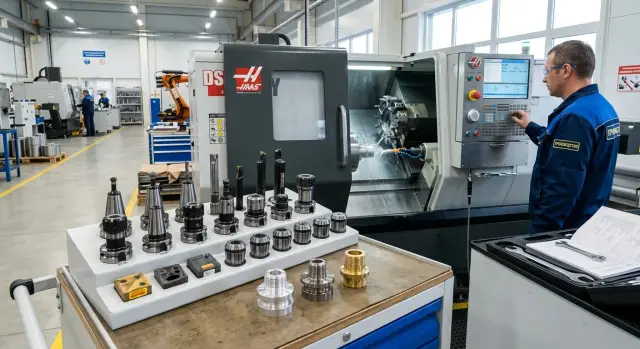
Driven tooling pays off too, though not for everyone. It’s most valuable when parts have transverse holes, slots, flats or simple drilling off-axis. Then the part is completed in one setup without moving between two machines. For small batches this matters: the smaller the batch, the more painful each extra reposition.
An automatic measuring probe noticeably shortens the path to the first good part. The operator checks the datum, tool length and size after a trial pass faster. This is especially helpful when blanks vary slightly or the batch is too small to spend long dialing in the process. A probe doesn’t replace inspection but helps get into tolerance faster.
Another underrated item is a standard chuck and common tooling. Exotic solutions look good on a brochure but in practice a common chuck size, standard jaws and available holders are more convenient. It’s easier to buy extra tooling, replace worn parts and avoid stopping production because of a rare item. This is particularly practical for shops in Kazakhstan and the wider CIS.
In short, the features that most often add real flexibility are:
- easy access to the work area;
- program and setup memory;
- driven tooling for single-setup operations;
- automatic probe to speed start-up;
- standard chuck and common tooling.
These options make the machine convenient for everyday shifts, not just for the spec sheet.
Options that rarely pay back
In small-batch work an expensive option often seems reasonable at purchase but later complicates setup, raises tooling costs and creates service questions. For a CNC machine for small batches look less at maximum capabilities and more at how quickly it switches from one part to another.
People often overpay for unused capacity. An extra axis is a typical example: if you don’t have parts that need it regularly, you end up with more complex kinematics, longer setup and more components to maintain. For short runs that’s a weak deal.
The same goes for an oversized machine. A large swing, long bed and big chuck look like future proofing. But if the shop mainly makes small bushings, flanges and housings, that reserve only drags out changeovers. Parts take longer to set up, jaws take longer to change and tool access becomes less convenient.
Poor payback also comes from rare automated modules that sit idle between short jobs, complex bar feeders or quick-change systems designed for runs of hundreds, closed tooling tied to a single supplier, and oversized tool magazines when the program uses only a fraction of the slots.
Automation isn’t always the savior. If the production is unstable, a loader or feed module can stand idle for weeks and still need reconfiguration when a new order arrives. In such cases a manual scheme with good shop organization can be faster and cheaper.
Check tooling carefully. Closed systems lock the shop into expensive consumables and long delivery times. For shops in Kazakhstan and CIS countries this is especially sensitive: downtime waiting for a small item often costs more than saving on a shiny catalogue option.
A useful test is simple: ask for not only the machine price but also the real changeover time, the annual cost of tooling and consumables. After that exercise the unnecessary options usually become obvious.
How to check changeover before buying
A good small-batch machine is judged by how you change from one part to another. If part mix changes often, extra 10–15 minutes several times a day eats shifts faster than a small difference in rated cycle time.
Measure not just cutting time but the whole interval between the last good part of the old job and the first good part of the new job.
-
Ask the supplier for a changeover time estimate using two of your real parts. Not a “typical blank” but parts that require different jaws, tooling and programs. Make sure they separate operator actions from machine downtime.
-
Compare the number of steps for each model. Where does the operator change fixtures in three steps and where in eight? Where do you manually enter offsets, hunt for zero, confirm extra screens and clean hard-to-reach areas? Fewer touches means smoother changeovers.
-
Time jaw, tooling and program changes. Better to do this during a demo with a stopwatch. If the seller says “this is fast,” ask them to show the whole process—from machine stop to the first trial run.
-
Open the areas that are cleaned daily. Check whether chip removal, access to the chuck, turret, filters and lubrication points is convenient. Poor access isn’t visible in a spec but often lengthens changeover.
-
Check how many operations the machine can complete in one setup. If you can turn, drill and deburr a part without a second setup, you save not seconds but an entire step.
It helps to put everything into a simple table. One model may have a 9-minute cycle but 25-minute changeover. Another may cut in 11 minutes but changeover in 12. For small batches the second machine often produces more good parts per shift.
If the supplier helps with selection, start-up and service, ask for a part-by-part walkthrough rather than a generic presentation. A demo like that quickly shows what’s worth paying for and what will remain an expensive line item.
Example: a shop with frequent part changes
Imagine a shop that turns bushings, flanges and short shafts in batches of 20–80 pieces. During the week they might run steel, aluminum and stainless. Sizes change often, repeat orders are medium, and changeover eats a noticeable share of the shift.
In this shop the heaviest machine doesn’t win. Usually the best performer is the one where the operator quickly changes jaws, tooling and the saved program. If changeover is 15–20 minutes instead of an hour, the shop can take another batch the same day.
Evaluate the machine by this simple question: how much time is lost between parts, not just on cutting. Suppose a bushing takes 6 minutes, a flange 9 minutes, a short shaft 11 minutes. If every switch requires long fixture changes, rated spindle power becomes less important.
In practice a turret with a reasonable number of stations, driven tooling for simple milling tasks in one setup, setup memory and fast change of chucks, collets and holders work well.
That’s where real savings come from. Driven tooling eliminates an extra trip to another machine. Setup memory avoids re-finding offsets and cutting regimes. Fast tooling changes reduce downtime that hits small-batch shops hardest.
Expensive automation in such a shop often sits idle. When batches are short and varied, a barfeeder, complex robot or large automated cell rarely reaches the utilization that justifies its cost. They’re good where one part runs long and stable. When the mix changes every 20–50 pieces the operator still intervenes frequently.
So a sensible lathe selection for this production typically looks like: a rigid base without excessive reserve, a convenient turret, driven tooling, a clear CNC system and quick changeover. That combo gives day-to-day flexibility rather than only a nice specification on paper.
Common mistakes
Shops most often fail not on brand but on selection logic. Buyers pick a machine for one large part they used in the calculation, then remember that other parts will follow in a month. The machine is great for one job but slows work when the mix changes often.
This happens when people focus only on swing diameter, power and a shiny spec. For small batches changeover time, tooling availability, an intuitive CNC and easy tool change matter just as much. Without them even an expensive machine quickly frustrates operators.
Another mistake is counting only the machine price. Then chucks, jaws, holders, tooling, measuring gear, collets, setup fixtures and consumables are added to the budget and the difference becomes significant. Two similar machines can cost almost the same up front, but one requires far more investment to actually run parts.
Buying a rare option because it looks “advanced” is another pitfall. Extra axis, driven tooling, automation or complex measuring systems pay off only if the team uses them daily. If the shift lacks that experience the option sits idle and fast changeover never appears.
Service is often underestimated. For shops in Kazakhstan and neighboring countries this isn’t formal. If a belt, sensor, filter or holder must be waited on for weeks, downtime easily erases the benefit of a good purchase. So when choosing a lathe ask about commissioning, spare parts and service response times in your region.
Finally, many confuse flexibility with full equipment. The most “loaded” machine isn’t always the most convenient. Flexibility means the shop quickly moves from one part to another without unnecessary hassle and long setups.
A sound choice usually looks like this:
- the machine covers 70–80% of the actual part mix, not one showcase job;
- tooling and consumables are budgeted in advance;
- the shift has the skills needed for the chosen options;
- service and spare parts are available without long waits.
Short checklist before ordering
Before ordering check a few simple things that reveal real flexibility vs promises:
- Ask the seller for the time to change parts on two of your typical positions. Include jaws, tooling, entering offsets and getting the first good part.
- Clarify how quickly you can buy tooling and consumables. Chucks, jaws, collets, holders and sensors shouldn’t take months to arrive.
- Check whether the operator can work comfortably at the chuck and tool area. Tight access lengthens every changeover.
- Match frequent operations to the machining flow. The machine should complete your usual set of actions in one cycle or with minimal manual steps.
- Find out who does commissioning and service in your region. A fast engineer visit means you lose a day, not a week.
A useful approach: compare not two machines but two working days on them. The option where the operator launches new parts faster, finds tooling easier and depends less on slow service will be more profitable.
If the seller answers vaguely, ask for specifics: a changeover video, a list of compatible tooling, service response times and a step-by-step start-up plan for a real part.
What to do next
Don’t treat the catalogue as the final authority. For a small-batch shop it’s better to first collect a list of parts that make up the main load. Usually 10–20 positions are enough: sizes, material, tolerances, operations, batch size and change frequency.
That list quickly shows the real picture. Often a machine is chosen for a rare complex part while most time is later spent on simple but frequent changeovers.
Then ask the supplier to calculate not a “mean performance” but scenarios for your real batches. Let them estimate runs of 10 pieces, 50 pieces and, if needed, single-piece starts. Otherwise a pretty catalogue number won’t show how much time you lose between jobs.
With two or three configurations left, compare them not only by price and power. Break changeover into simple steps: changing tooling and jaws, replacing or checking tools, setting the zero and offsets, and launching the first good part. If one configuration saves 12–15 minutes on each job change, that often beats an expensive option that only speeds the cut by a few seconds.
Reserve part of your budget for tooling and launch. In practice money quickly goes on chucks, holders, soft jaws, measuring gear, commissioning and the first weeks of run-in. Without that even a good machine will perform worse than expected.
Discuss service in advance. For a shop with frequent part changes downtime is especially painful: you lose not one large batch but several small orders. So when choosing look not only at the hardware but at who will help start the machine and fix problems quickly.
If you need a detailed assessment for your parts, EAST CNC supplies CNC lathes, helps pick configurations, handles commissioning and provides service. The conversation is much more useful when you have drawings or at least a list of real parts and batch sizes. Then you can see immediately how long changeover will take, what tooling is required and what’s worth paying for.
FAQ
Where do I start when choosing a machine for a small-batch shop?
Start by listing your parts: sizes, materials, batch sizes and how often you change setups each month. For small-batch work you choose a machine not by top speed but by how quickly it delivers the first good part after a job change.
Why doesn’t rated speed solve the problem?
Because in small batches the shop usually loses time on changing jaws, tooling and programs rather than on cutting itself. For 20–50 piece batches an extra 30–40 minutes of setup can wipe out any gains from a faster cycle time.
When is driven (powered) tooling really worth it?
Get driven tooling when parts regularly have transverse holes, slots, flats or simple off-axis drilling. It lets you finish the part in one setup instead of moving it between two machines.
Is it worth paying extra for an automatic probe?
A probe is useful when you frequently start new parts and want to reach size quickly. It doesn’t replace inspection, but it speeds up locating the datum, checking tool length and getting the process into tolerance faster.
Which options rarely pay off for small-batch work?
Commonly wasted money goes into an extra axis, an oversized machine, rare automated modules or a large tool magazine that sits mostly empty. If an option isn’t used almost every day, it often hurts payback more than it helps.
Do I need a machine with a large size margin?
Usually no. The machine should cover your normal flow of parts and have a reasonable buffer for new jobs, not be sized for a rare outlier. Oversized machines often stretch changeover times and make handling and setup less convenient.
How do I verify changeover time before buying?
Ask the supplier to show a timed changeover of two real parts from your shop: from the last good piece of the old job to the first good piece of the new job. Don’t forget to include jaw change, tool change, chip cleanup and entering corrections.
What helps more for repeat orders: saved setups or a stronger spindle?
For repeat jobs the memory of programs and saved setups usually helps more than a more powerful spindle. The operator gets back to a previous part in minutes instead of spending half a shift searching for offsets and checks.
Why prefer a standard chuck and common tooling?
Standard tooling simplifies life: it’s easier to buy, replace and keep in stock. Rare systems tie the shop to one supplier and cost more when a single part causes downtime.
What should I budget for besides the machine price?
Budget for chucks, jaws, holders, tooling, measuring devices, start-up and a stock of consumables. If you count only the machine price, the real launch cost almost always ends up higher than expected.