
Flange Hole Concentricity: Datum and Control Between Operations
Show how to maintain flange hole concentricity when moving from turning to drilling: fixturing, inspection, and common mistakes.
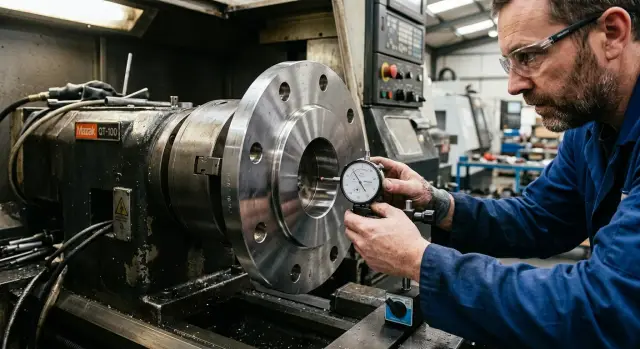
Where the shift appears
The shift usually doesn’t start in the drilling itself, but at the moment the part loses the axis established during the turning operation. On the lathe, the seating face, end face, and outside diameter are finished in one setup and share the same geometry. Then the flange is removed, moved to drilling, and set up again. If the second setup uses the wrong surfaces, the holes move relative to the seating face, even though the machine performs each individual action accurately.
Most often, the error appears at the transition between the two operations. A typical situation looks like this: after turning, the operator uses the outside diameter or an unfinished end face as the datum because it is faster to clamp the part that way. But the working surface in assembly is different, usually the seating face and the sealing face. If those datums do not match the way the part was held on the lathe, the flange hole concentricity is already lost. Sometimes just a few hundredths of runout are enough for a noticeable shift on the bolt circle.
The problem gets worse because of small things that are often dismissed as minor: chips under the support, a burr left after facing, misalignment in a V-block, weak clamping, or worn drill tooling. Even if the holes are drilled to the correct pitch circle, their center can still shift. On the drawing this looks like a small defect, but in assembly it quickly becomes real.
For valve parts, even a small shift is unpleasant. Bolts go in with force, flanges have to be pulled together, and the gasket seats unevenly. Sometimes the joint still gets assembled, but the body takes on extra stress and the seal works worse. On serial parts, this defect is even more dangerous: part of the batch assembles, part starts to bind during installation, and the cause takes longer to find.
Before drilling, this error is often invisible. After turning, the seating face looks correct, and the end face is also within size. The mistake only shows up when a second group of features appears, the holes, and they can be compared with the seating axis. That is why measuring only the diameters of the first part is not enough. You need to check the relationship between the seating face and the holes right away, otherwise the shift is discovered only during assembly, after time and material have already been spent.
Which surfaces to use as the datum
For a flange, the datum should repeat the geometry that actually works in the assembly. If the holes must align with the seating face, the axis should be taken from that face or from the internal bore linked to it in the same turning setup. Then flange hole concentricity does not depend on how straight the outside diameter looks.
The outside diameter and the seating face often give different results. The reason is simple: the outer contour is often left with allowance, cleaned up in another setup, or not held to a tight runout requirement at all. The seating face usually has a tighter tolerance because the flange is centered by it during assembly. If drilling is set up from the outside diameter, the holes can shift by several tenths relative to the working axis, even though the part looks fine from the outside.
The end face helps when you need to control height, depth, or perpendicularity. But it can also pull the part out of position if that face has a burr, chuck mark, or slight taper after turning. Then the clamp sits on a single point instead of a flat surface. The part tilts slightly, and the axis is no longer correct.
In general, flange fixturing looks like this:
- radial datum - seating face or a precise bore;
- axial datum - a finished end face, if its flatness has already been checked;
- clamping - without skew and without resting on burrs.
It is better to choose one axis for all operations and stay with it to the end of the route. If the turner established the axis from the bore, but on drilling the part is set by the outside diameter, you are no longer continuing the process, you are creating a new geometry. After that, you need not ordinary post-turning inspection, but a new setup and a first-part check.
On parts for pipeline valves, this shows up quickly. The seating face fits the mating part without complaint, but the bolt holes do not match the template. The reason is often not the drill or the program, but the fact that the datum changed between operations.
If you did have to change the datum, do not trust the old dimensions automatically. First check the runout of the new datum relative to the working axis, then measure the coordinates of the first hole, and only after that start the flange drilling series.
What gets lost after turning
After turning, the part does not keep its axis on its own. As soon as the operator removes the flange from the chuck, it loses the position in which the seating face, end face, and outside diameter were machined. This is exactly where flange hole concentricity most often goes off.
Re-clamping changes the center of the part even when the shift seems tiny. On the lathe, the axis is set by the jaws, the chuck, and the clamping method. On drilling, the part sits in a different fixture and rests on different surfaces. If the new datum does not repeat the turning datum, the hole circle can move relative to the seating face by several hundredths or more. For a valve flange, that is already enough to make assembly tight.
The repeatability of the tooling also adds its own contribution. Soft bored jaws usually hold the part more accurately if they were prepared for a specific size. A standard chuck repeats the position less well, especially on a thin blank or after several re-clamps. A V-block is convenient for drilling, but it references the part by the outside diameter. If that diameter was not the clean datum during turning, the center shifts again.
Small defects can shift the part just as much as poor clamping. A burr on the end face, chips under the support surface, or a dirty face change the seating immediately. After removing the part, runout is often not caught because everything looks straight to the eye. But the drill then follows the new, shifted axis. In the end, the pitch between holes is correct, but the holes themselves are not where the center should be.
Right after removing the part, it is worth checking the datum while the operator still remembers the clamping scheme and can quickly find the cause:
- remove chips and burrs from the face and seating surface
- check that the end face sits fully and evenly
- measure runout on the seating diameter
- mark the surface that will be used for the next operation
- set the part aside if the datum seems questionable
This post-turning inspection takes only a few minutes, but it prevents the error from moving downstream. Once the flange has been drilled, bringing the holes back to the axis is almost always harder and more expensive than catching the shift right away.
How to move the part to drilling without losing the axis
Most often, the axis is lost not during drilling, but at the moment of the new setup. After turning, the part already has its own geometry, and any chip, burr, or oil film between the datum and the stop immediately causes a shift. For a flange, that is enough for the holes to move relative to the seating face.
First, the operator cleans the seating face, the end face, and the clamping area. This has to be done carefully, not in a hurry. One small chip under the end face can easily create noticeable face runout, and dirt on the seating face changes the fit and moves the center.
Next, the part is placed on the same surfaces that held the axis during turning. If the turning operation used the seating face and support face to establish the axis, then drilling should reference those same surfaces. Do not switch to the outside diameter, a cast surface, or a conveniently placed stop. Once the datum changes, you are working in a different coordinate system.
What to check before starting
Before drilling, it is useful to do a short check:
- sweep the seating face with an indicator and make sure radial runout is within limits;
- check the end face and see whether the part rocks during clamping;
- confirm that the clamp is not pulling the flange sideways;
- compare the setup with the operation sheet instead of placing the part from memory.
The indicator should be used before the first hole, not after. Check the seating face first, then the end face. If the seating face runs true but the end face shows deviation, the problem is often not in the part, but in dirt on the support or a skewed clamp. It is cheaper to fix that immediately than to later figure out why flange hole concentricity is not holding.
The setup scheme is best written down once in the operation sheet. It is enough to state the main datum, the stop, the clamping point, and the indicator check location. Then on the next shift or for a repeat batch, the part will be set up the same way as in the proven first setup.
After the first part, the check is repeated. A correct first part does not mean the series will behave the same way. In practice, when machining flanges for pipeline valves, the shift often appears on the second or third setup, when the operator stops rechecking the datum.
How to inspect the first part and the batch
Flange hole concentricity is best seen not on the drawing, but on the first finished part after the two operations. If you only check the hole diameter and pitch, you can easily miss a center shift. That is why inspection always links the seating face and the bolt hole circle.
First part
On the first part, three things are usually measured: runout of the seating face, the position of the reference bore or outside diameter, and the center shift of the hole circle. The part is placed on the same datum that will be used for acceptance in assembly. If the datum is different, the numbers may look fine, and the flange still will not seat properly.
The indicator is mounted on a stand so the tip moves across the working surface without skew. First, the seating face is checked around the full circumference. Then the tip is moved to the bore or to the outside diameter if that is the chosen datum. The indicator should not show a new noticeable shift after re-clamping. If the seating face is already "running", it is too early to judge drilling - first you need to remove the loss of axis.
The hole circle is checked from the true center of the part. It is convenient to set the flange by the bore or by the seating face, and then check the distance from the center to several holes at equal angles. If the error repeats on opposite holes, the circle center is shifted. If the deviations are different, the problem is more likely in indexing, tooling, or the program.
For the first part, it is usually worth recording:
- seating-face runout
- runout of the reference surface
- actual hole-circle diameter
- center shift of the hole circle relative to the seating face
Inspection does not end after the first piece is accepted. After 5–10 parts, it is worth repeating a quick measurement. This is especially important if the flange is thin, the clamping is strong, or the fixture has just been set up.
When to stop the series
Stop the series immediately if the shift grows from part to part, if one hole keeps moving in the same direction, or if after a tool change the indicator shows a different runout on the seating face. There is no point waiting in that situation. Re-setup takes less time than reworking a batch that will later not match the valve during assembly.
Common mistakes between the two operations
The shift most often appears not during drilling, but earlier - at the moment the part is transferred after turning and the datum is changed. If the turner sized the part from the seating face and the drilling setup uses the outside diameter, the axis already moves away. The outside diameter often has its own tolerance, runout, or marks from previous passes, so it is not suitable as the main reference for accurate hole location.
The second common mistake is very simple: the part is placed on the end face without removing chips, burrs, or a small nick. Sometimes one stuck chip is enough to make the flange sit skewed by several hundredths, and the holes then move even more. On paper, all dimensions are correct, but flange hole concentricity has already been lost.
A lot of scrap also comes from unstable clamping. One part is set with a long overhang, another is clamped closer. The vise pulls harder in one case and softer in another. For a thin or medium flange, that is enough for the part to warp slightly and for the axis to shift relative to the seating face. The operator then sees the shift and thinks the problem is the tool, when the cause is the setup.
It is even worse when someone tries to "catch" the shift with layout marks, adjust feed, or slightly shift the coordinate only for that one part. That may save a single piece, but it destroys batch repeatability. If the datum is wrong, a manual correction only hides the error.
Another issue is inspecting the wrong thing. People often check only the hole diameter: if the gauge passes, everything must be fine. But for a flange, that is not enough. You need to check the position of the holes relative to the seating face and end face, because that is how the part actually works in the assembly.
In practice, it helps to follow one simple order. First clean the end face and remove burrs. Then set up the part according to the same datum logic used in turning. After that, check not only the hole size, but also how the holes relate to the seating surfaces. This takes only a few minutes, but it keeps scrap out of the series.
Example with a valve flange
On one batch of flanges for pipeline valves, the problem did not show up on the machine, but only during assembly. The bolts went in, but the gasket seated unevenly, and the end face made it clear: the hole circle had shifted slightly relative to the seating face.
On the lathe, the operator first finished the gasket seating face and the end face cleanly. These surfaces came out accurate, with no noticeable runout. After that, the part was sent to drilling, and there it was set up by the raw outside diameter because it was faster and more familiar.
From the outside, the solution seemed fine. The outside diameter was round, the jaws held firmly, and the part did not wobble. But the raw diameter did not match the axis of the already machined seating face. The blank still had a small offset of about 0.3–0.4 mm, and that was enough for flange hole concentricity to go out of tolerance.
The problem showed up simply. If you measured only the distance between the holes, everything looked acceptable. The error was in a different place: the hole circle itself had shifted relative to the gasket seating surface. For a valve part, that is an unpleasant defect. The fasteners can still be tightened, but the gasket is no longer compressed the way it should be.
After reviewing the cause, the setup was changed. On drilling, the part was no longer set by the outer diameter, but on an arbor referencing the already machined seating face. The end face was also used as a support so the part would not tilt.
Setup time increased by a few minutes, but the cause of the shift disappeared. On the very first part, the difference was obvious. The indicator showed a true seating face, and the hole check relative to the center gave a stable result. Then a small series was run, and the shift did not return.
This case shows a simple truth: a convenient datum is not always the right one. If the turning operation has already created an accurate axis, the next operation must reference that axis. Otherwise, flange drilling follows its own axis and valve turning follows another one, and the parts start arguing with each other during assembly.
Short checklist before starting
Before the series, do a short check. It takes 10 minutes and can sometimes save the whole batch if flange hole concentricity drifts by just a few tenths of a millimeter.
If after turning the part was referenced from the seating face and end face, drilling should use the same scheme. When one operation establishes the axis from one surface and the next operation sets the part "by feel", shift is almost inevitable.
- Match the datum between operations. The same end face and the same seating face should locate the part in both turning and drilling.
- Clean the face, seating surface, and clamping areas. Chips, burrs, or a small dent can easily create skew.
- Check the arbor, chuck, and jaws. If the tooling already introduces excess runout, the holes will shift even with a correct program and layout.
- Measure the first part on the seating face and around the hole circle. Look not only at the sizes, but also at the position of the holes relative to the axis.
The problem often starts with something small. The operator did not wipe the part clean enough, a chip stayed under the end face, the flange sat skewed, and the shift was noticed only after drilling. By eye, that setup can look perfectly normal.
Another common cause is tooling that holds the part firmly but does not repeat the same position. The first part passes, the third one too, and then the hole circle starts to drift. That is why before starting the series, it helps to run an indicator over the arbor and the part, and write the result down right away in the setup sheet or work notes.
For a pipeline valve flange, the main control reference is not the appearance of the end face, but the seating face. That is what sets the center in assembly. If the first part matches in the seating face, axis, and hole circle, you can start the series with more confidence.
What to do next
After this kind of review, do not change the whole route all at once. Take one flange type and map its path between turning and drilling: which surfaces the part is set on, where it is clamped, and what is measured after each step. This work map quickly shows where flange fixturing stops holding the axis.
Then compare the actual runout in two states: right after turning and after drilling. If after turning the seating face holds, for example, 0.02 mm, but after drilling the shift grows to 0.10–0.12 mm, the cause is most often in re-clamping, the fixture, or the clamp. That is much more useful than discussing the problem in general terms.
Where to start in the shop
First, check a few simple things on the same batch, without changing the operator or the tooling.
- Review the fixturing map for each flange type. The same setup rarely works equally well for every part.
- Measure runout after turning and after drilling on at least 3–5 parts in a row. One good result does not show the full picture.
- Check whether the machine holds repeatability in the series. If size and hole position vary with the same setup, look at rigidity, backlash, and tooling condition.
- Define a clear first-part inspection and a rule for stopping the series if the holes begin to drift relative to the seating face.
If flange hole concentricity still does not hold, do not try to solve it only by adjusting the flange drilling operation. Often the problem starts earlier: in the way the turner passes the datum to the next operation and in how the inspector confirms the result after turning.
When it becomes clear that the issue is no longer setup, but the machine’s capability, then it makes sense to discuss the equipment itself. At EAST CNC, we can review this kind of case using your own part and help you choose a CNC lathe or machining center for the job, with delivery, commissioning, and service support.