
Fixtures or a New Machine: What’s Slowing Down the Job Shop
Fixtures or a new machine: let’s look at the signs of a bottleneck, a simple loss calculation, and what to check before buying another machining center.
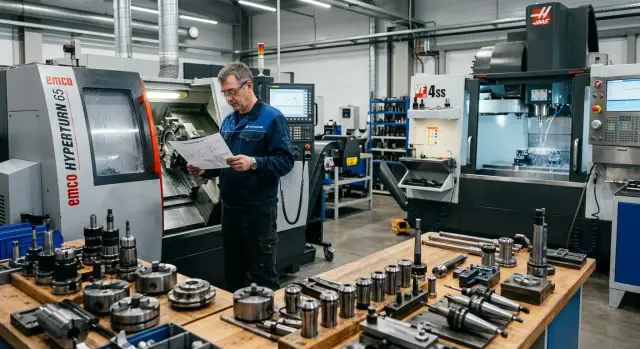
Why a new center doesn’t always relieve the load
A new machine seems like the obvious answer: more power, faster feed, more automation. But a shop rarely loses a shift only in cutting. Much more often, the bottleneck sits next to the spindle — in clamping the part, finding the datum, changing jaws, and making small adjustments before a batch starts.
If a part takes a long time to set up, an expensive center waits just as expensively. It may machine the part in 6 minutes instead of 9, but before that the operator spends 25 minutes setting up the blank and another 10 minutes checking the first pass. In a setup like that, only a short part of the whole cycle gets faster.
This is especially clear in job-shop metalworking, where batches keep changing. In the morning it’s a run of flanges, after lunch a shaft, in the evening a housing part. When changeover takes a long time, the shop lives not by cutting speed, but by how fast it can get ready for the next order.
Small downtime losses are often underestimated. For one operation, the numbers may look tolerable: 7 minutes to replace soft jaws, 5 minutes with a dial indicator, 8 minutes for a test part, another 6 minutes of tightening because the blank shifts slightly. Over a shift, that easily turns into an hour and a half.
Usually, the time is lost in the same places: the operator looks for a stable way to clamp a difficult part, the datum is found from scratch every time, the first part takes a long time to dial in after changeover, and a short batch doesn’t have enough volume to pay back the long setup.
That’s why the question “fixtures or a new machine” often doesn’t favor the new center. If the part takes a long time to set up, CNC fixtures often deliver a bigger effect than extra kilowatts and a faster spindle. Good tooling removes manual movements, makes setup repeatable, and shortens the pause between batches.
A simple example. An old machine machines a part in 12 minutes, while a new one would do it in 8. The difference looks significant. But if setup currently takes 40 minutes, and a proper fixture can cut that to 12, the fixture delivers the bigger gain in the first week.
Look not at the machine’s brochure specs, but at where the minutes actually disappear. If the spindle cuts reliably, but people spend a long time preparing the part for that cutting, the problem is not the center. The problem is that the shop still hasn’t learned how to hold the part quickly, accurately, and the same way every time.
Signs that the department is hitting a tooling limit
Usually, this conversation starts too late. The shop is already looking for another center, even though part of the shift is spent just waiting on the current machine. It’s not the tool that’s cutting metal — it’s people changing jaws, adjusting stops, checking stick-out, and finding the datum all over again.
The first sign is simple: preparation takes longer than the machining itself. If the setup technician spends 30-40 minutes changing clamping for a short batch, a new machine won’t remove that loss. It will just add one more place where the same long changeover has to happen.
The second sign shows up in dimensions. After every batch change, the operator makes several test parts, adjusts the offset, and only then reaches a stable result. That usually means the fixture is not holding repeatability. The datum is slightly different each time, and the machine isn’t to blame.
It gets worse when the part shifts after a second clamping. While it sits in the machine the first time, everything is fine. As soon as it’s removed and set up again, the size drifts, runout increases, and the face is no longer where the drawing calls for it. Most often the cause is old jaws, a weak stop, an awkward locating scheme, or a fixture that was once built for one part and later forced to handle ten.
In a job shop with small and medium batches, these losses are especially visible. The schedule doesn’t fall apart on big orders, but on ordinary daily work. Five batches of 50 parts can create more trouble than one batch of 1,000.
There’s also a human marker. The same order runs steadily only with the strongest setup technician. He knows where to place a shim, how tight to pull the jaws, and on which pass to check the size. Another employee takes longer and produces more scrap. If the result depends on one person’s experience rather than a clear method, the department is already hitting a tooling limit.
Good tooling makes the process repeatable. If the machine is often idle and people keep finishing the process by hand, that’s what needs to be fixed first.
Where the shop loses time between batches
Most of the losses are hidden not during cutting, but in the pause between orders. Look at the stretch from the last good part of the old batch to the first good part of the new one. That is usually where the bottleneck is hiding.
It helps to break that stretch into parts:
- removing the previous fixture and preparing the new batch;
- clamping the part and reclamping it if it doesn’t seat correctly the first time;
- finding the datum, checking stick-out, setting and correcting zeros;
- bringing the first part to size and correcting deviations.
When everything is reduced to one overall number, the cause gets lost. When there is a breakdown, it becomes obvious where people are spending the most time: setup, locating, or finishing the first part.
It is useful to compare downtime across different part types. On one product, changeover takes 10 minutes; on another, nearly an hour. The machine is the same. That means the issue is often not the center, but tooling that holds repeatability poorly or requires too many manual actions.
Also count scrap after changeover separately. Two ruined parts a day may seem minor, but over a month they consume both material and setup hours. If the first part after a batch change regularly goes out of size, the cutting mode is not the only thing at fault. Often the datum shifts, the clamp pulls the part off, or the operator has to find the position again from scratch.
There’s another useful signal: repeated returns to the same setup during the shift. The operator checks zero again, tightens the jaws, moves a stop, checks the datum after a few parts. It barely shows up in reports, but those return trips break the time into small losses.
In an ordinary job shop, the picture is simple: the spindle cuts fast, but between batches the machine sits silent for 30-40 minutes. Those measurements are eye-opening. A new center won’t remove extra touches, datum searches, or repeated tightening. First those pauses need to go, and only then should you think about buying a new machine.
How to check the department in one week
To understand what is slowing the shop down, you don’t need a long audit. Five working days are enough if you focus not on the machine’s rated speed, but on what happens between batches.
On the first day, choose 5-7 of the most common changeovers from the last month. Not rare complex jobs, but the ones that repeat all the time. Those are the ones eating the shift through short but frequent stops.
On the second day, break each changeover into simple actions and record the actual time. Write down separately the removal of the previous fixture, installation of the new one, part locating, tool approach, test run, and the moment the first good part is produced. Don’t round it off. The difference between “about 15 minutes” and a real 23 minutes will strongly affect the calculation later.
The third day is for finding manual fitting. If the setup technician grinds a stop, slips in a shim, moves the part by eye, or chases the size through a series of test runs, the problem is usually not the machine. It sits in the CNC fixtures, in the part datum, or in setup repeatability.
On the fourth day, count how many times the operator performs re-measurements and how many parts become scrap after changeover. Even a small issue matters. If after every second fixture change you lose 1-2 parts and another 10 minutes on inspection, a new center won’t remove that.
The fifth day turns everything into money. Suppose the department spends 18 extra minutes on one changeover, and there are 35 such transitions a month. That’s more than 10 hours of lost time. If a simple fixture or a set of сменable jaws costs less than a month of those losses, the answer is usually obvious.
Look not only at minutes, but also at the type of losses. Long datum searching, unstable clamping, extra measurements after the first part, manual stop adjustments, and variation during reinstallation are usually easier to fix than they seem. A week of checking is enough to separate lack of capacity from poor process preparation.
How to calculate what pays off right now
It’s better to solve this based on lost money over a normal month, not on gut feeling. If the shop often waits between batches, a new center will not remove that loss by itself. It will just add another machine that also needs to be set up quickly and accurately.
First, calculate the net downtime hours. Don’t count only the time when the spindle is silent. Add the time spent finding and changing jaws, positioning the part, making the test part, reclamping after movement, checking the first pass, and making urgent corrections if the fixture is unstable.
A convenient calculation looks like this:
- downtime hours per month = number of changeovers × average time per changeover;
- missed parts = downtime hours × usual output per hour;
- lost revenue = missed parts × revenue per part after subtracting material and consumables;
- total loss = lost revenue + scrap + rush rework + overtime.
A small example. The shop makes short batches and performs 36 changeovers a month. Each one takes 1.5 hours on average. That’s 54 hours. If the department normally makes 7 parts per hour, 378 parts are lost. At 3,200 tenge of revenue per part, that’s 1,209,600 tenge. Add 140,000 tenge in scrap and another 90,000 tenge in rush rework, and the monthly loss rises to 1,439,600 tenge.
Now compare that amount with the cost of a fixture set. If a new set costs 2.3 million tenge and reduces changeover time by at least 60%, the savings would be about 860,000 tenge a month even without new orders. In that case, the tooling pays for itself in less than three months.
Check the calculation without optimistic assumptions. Don’t include future large orders, a second shift, or perfect discipline. Look only at the current flow of work. If the tooling pays off with today’s load, the decision is already clear.
If the numbers still don’t add up, calculate again for one product type. Often one troublesome part family eats so much time that it is exactly for that family that you need to buy a fixture, not a whole new center.
An example from a typical job shop
A small job shop was taking short runs of different flanges: today 30 pieces for a pump assembly, tomorrow 50 for construction equipment, then another small batch with a different mounting face. The problem was not scrap or accuracy. The old center held size just fine. The losses were sitting between batches.
With each part change, the operator almost rebuilt the workstation from scratch. He machined the jaws, found the datum, checked runout, ran a test piece, and only then removed the first good part. Cutting took 12-15 minutes, but changeover took up to 1 hour 40 minutes. If two different batches came through in one shift, the machine waited more than it worked.
The shop didn’t buy a new center right away. First, they made simple tooling for the parts that repeated most often: soft jaws for several flange families, adjustable stops for quick locating, base plates for repeated setups, and a separate kit for the most common batch.
The setup looked modest, but it worked quickly. The operator no longer started from zero every time. He installed the prepared kit, did a short check, and started the first part. The time to the first good part dropped from about 90 minutes to 25 minutes. On small batches, that gave more than another machine without well-thought-out tooling.
After a few weeks, the order queue got shorter. Earlier, an urgent order could easily sit for two or three days because there was nowhere to fit it between long changeovers. After buying the jaws, stops, and bases, the shop was able to fit those batches into the same schedule. They didn’t change the machine — they simply removed unnecessary motions.
They didn’t cancel the purchase of a new center entirely. They moved it to a later date, once the load became steady for at least several months in a row. That was the sensible move: if the old machine holds accuracy and the time is being lost in preparation, you should fix the tooling first. Otherwise, the new center inherits the same long changeover, only at a much higher price.
The mistakes that happen most often
The most expensive mistake is simple: the shop buys a new center without measuring where the shift is going. If the operator spends 35 minutes on setup, finding zero, alignment, and a test run, while machining itself takes 12 minutes, a new machine won’t remove the bottleneck. It will just wait faster for the next part.
People often look at rated throughput and barely count the time between batches. For job-shop metalworking, that’s a common trap: the mix changes, batches are short, and setup losses eat more than the monthly report shows.
Another mistake is using universal tooling where repeatability is needed. Universal vises and modular clamps are convenient when there are few parts and the geometry keeps changing. But if the same series comes back every week, it is usually more profitable to make simple CNC fixtures for locating and fast clamping. That tooling is less flexible, but the operator places the part the same way every time, and the process engineer doesn’t have to guess why dimensions drift from batch to batch.
Another misstep is not counting time to the first good part. Many people only count pure machine time. But money is also lost on the first setup, the test part, the corrections, and inspection. If the first good part comes out 50 minutes after the start, that is the time you need to compare with the price of new tooling.
The old locating scheme is also often kept for too long. The part has changed, the batch has grown, tolerances have tightened, but it is still located the same way as last year on a trial run. Then the shop blames the machine, even though the problem is in the supports, stops, and setup sequence.
And the last common mistake: the tooling was bought or made, but people were never trained to work the same way. One operator tightens harder, another changes the locating order, a third sets tool stick-out differently. In the end, the tooling exists, but repeatability doesn’t. A one-page instruction and a short on-floor practice session can sometimes do more than another expensive center.
What to check before requesting a new center
If the machine cuts fast but the department still can’t keep up, the problem often sits between batches. The shop loses hours not in cutting, but in finding the datum, reclamping, test fitting, and waiting for the setup technician.
Before requesting a new center, it helps to keep a simple log for a week. Record not only machine time, but also how long it takes to change the fixture, dial in the first part, reclamp, and correct scrap after that.
Check a few things. How many minutes the machine really cuts during a shift, and how long it sits between short runs. How many parts become scrap or need touch-up after the second and third clamping. Whether any setup technician can repeat the installation, or whether the whole department waits for one person. How often the product mix changes and disrupts the usual changeover routine. And whether these losses can be closed with new jaws, base plates, a template, or a more convenient fixture.
Usually, the picture becomes clear in numbers very quickly. If a 20-part batch takes 25 minutes of cutting and 70 minutes of setup, a new center changes almost nothing. It will just wait faster for the next setup.
Another clear signal is scrap after reclamping. When the operator finds the datum from scratch every time, dimensions start to drift. In that situation, a new machine does not fix the cause, because the error lives in the tooling and in the way the part is set up.
Also check how dependent the shop is on one strong setup technician. While he is on shift, everything runs smoothly. As soon as he’s not there, the department slows down and the first part takes too long. That is a direct sign that the process depends on personal experience, not on a clear and repeatable method.
If the current machines are not yet loaded to the limit for cutting, the answer is often in favor of tooling. A good test is simple: if another employee cannot place the part, hit the size, and move quickly to the next run without help, the bottleneck is already visible.
What to do next
Start with the numbers from the last 30 days. If people in the shop say a lot of time is going into changeovers, that has to be confirmed with measurements, not impressions. Otherwise, it’s easy to buy a new center and, a month later, see the same downtime — only on more expensive equipment.
For each repeating part, gather a short data set: how many minutes it takes to remove the old fixture and install the new one, how much time the operator spends searching and dialing in, how many test parts are needed before size stabilizes, how often the machine waits for the chuck, jaws, or arbor, and how many batches a month are affected by those delays.
After that, choose the parts where new tooling will have the fastest effect. Usually, these are not the most complex jobs, but the ones that return to the plan often, have similar datums, and require the same manual effort at startup. If a part comes in small batches but returns every week, a good fixture often pays back sooner than a new machine.
The plan is best split into two horizons. Near-term purchases include what removes losses right away: a set of jaws for a part family, changeable holders, ready-made bases, separate fixtures for several repeating operations. Leave for later the things that are useful but don’t affect daily load.
If the calculations still show that a new center is needed, choose it together with basic tooling. Otherwise, the bottleneck just moves to the new area. The machine itself may be faster, but batch startup will remain slow if the operator again has to find a solution for each part from scratch.
That order is usually the smartest: first remove losses on repetitive work, then buy capacity where it is truly needed. If it then becomes clear that the department needs both tooling and the machine itself, EAST CNC can help you choose the machine, tooling, delivery, commissioning, and service as one project. For shops in Kazakhstan and other CIS countries, this approach is often more convenient than buying the machine separately and dealing with start-up issues only after delivery.