
Fixtures for short runs: what pays off faster
Short-run fixtures shouldn’t eat your margin. We compare modular systems, soft jaws and simple jigs to see which pays back faster.
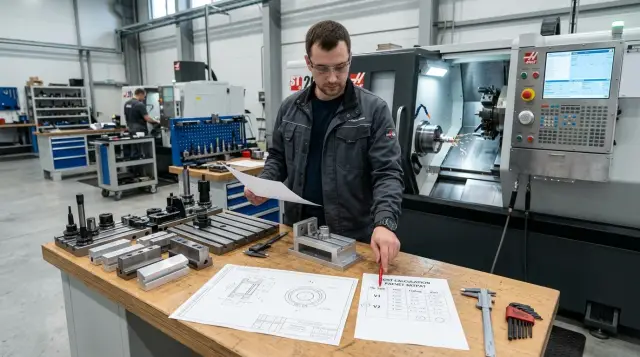
Why short runs become expensive quickly
Small series almost always look cheaper on paper than they really are on the shop floor. The reason is simple: for 20–30 parts you spend almost as much time on setup as for a large order. While the operator installs tooling, aligns the datum, makes corrections and gets the first good part, the machine isn’t earning.
Because of this, a short run often eats profit before production even begins. If machining one part takes 6 minutes and the changeover takes 70 minutes, the setup itself already represents a noticeable share of the entire run. The smaller the batch, the heavier this share pushes on unit cost.
Most money is lost not in the main cycle but at the start of the job. The first part rarely comes out perfect on the first try. You need to check dimensions, correct tool overhang, tighten the workpiece, sometimes change a stop or even the clamping scheme. Each small thing takes operator and machine time.
Hidden losses are almost always the same: a trial part and sizing adjustments, fitting the fixture to the specific geometry, start-up scrap while the process is not yet stable.
There’s another trap. In many shops a new fixture is made for every new part because it feels safer. For complex geometry this is sometimes justified. For short runs — far from always. You pay for design, manufacture, storage and future repair of a jig that may then sit idle for months.
For small series a fixture should save not metal but changeover time. If a jig cuts setup by 15–20 minutes and can be quickly reconfigured for similar blanks, it often beats a one-off design. If each item needs a new set, a short run quickly becomes expensive even with good cycle time.
This is especially visible on CNC lathes where an hour of machine time is costly. When the machine stands idle because of changeover, you lose direct money, not abstract minutes.
What actually affects payback
Payback almost never depends only on purchase price. A cheap solution can consume hours in changeovers, while a pricier one can quickly recoup the difference through stable production. So it’s better to compare cost per part in a run and on repeat starts rather than the purchase price alone.
The first factor is obvious: manufacture or purchase price. If a jig is made for one part, its cost largely falls on a small batch. For short series this hurts more than it seems at first.
The second often underestimated factor is setup and alignment time. If the setter spends two hours before each run, those hours cost as much as metal and tooling. On a turning section the difference between 20 minutes and two hours quickly outweighs the price gap between a simple and a more convenient option.
The third is repeatability. If a part is run once, an expensive fixture is rarely justified. If the same order returns monthly, a costlier solution can pay off quickly.
There are less visible costs too: risk of scrap at first launch, unstable clamping, extra tool wear, machine downtime in a scheduled window. For serial metalworking that’s particularly unpleasant.
Finally, it’s important to know whether the fixture can be reused for similar parts. If a modular system, soft jaws or a simple jig fit several sizes and shapes, the price spreads over a group of parts instead of a single position.
Before choosing, answer five questions: how much the fixture itself costs; how many minutes each setup takes; how often the part returns in a year; how many parts you risk spoiling on the first run; and whether this solution applies to similar orders.
In practice the winner is not the cheapest option but the one that slows production least and does not create extra scrap.
When modular fixturing is justified
Modular fixtures pay off where parts are similar to each other. If a run has close diameters, similar clamp lengths and the same installation logic, one set of plates, supports, clamps and adapters often covers several tasks.
This is especially noticeable where the part mix changes almost weekly. Today bushings, in two days housings, then a small series of flanges. Making a separate jig for each position is slow and expensive. The modular approach reduces losses because the operator changes not the whole kit but only a few elements.
Savings appear not on the set price but in time. If changeover took two hours and modular drops it to 30–40 minutes, the difference quickly adds up. On busy machines this matters more than price differences between fixture options.
Such a solution works well when parts share datums and sizes, many small repeat orders run monthly, machine downtime between runs costs more than a small tweak, and the shop frequently returns to familiar positions.
A good example is a turning section processing several families of parts for different customers. Geometry is not identical but the clamping scheme is similar. The foreman keeps a base assembly ready and swaps only clamps, stops or spacers. Over a month this often saves not minutes but a whole shift.
But modular systems have weaknesses. They are almost always pricier at the start than a simple single-part jig. Also they may lose stiffness if the part is heavy, the stock is large or cutting conditions are harsh. For one stable high-volume position a dedicated jig is usually cheaper and calmer to use.
On lathes for round parts modular solutions sometimes lose out to soft jaws. The latter are easier to bore for a specific size and frequently provide more predictable clamping. So modular makes sense where quick changeovers and frequent part changes matter more than maximal stiffness for a single part.
When soft jaws pay off
Soft jaws pay off where the turned part has a clear clamping scheme. Diameter is known, datum doesn’t change and the run repeats at least occasionally. In that situation the operator bores the jaws to the required size quickly and gets a stable clamp almost immediately.
For short runs this is often better than making a dedicated jig. A set of jaws costs much less, preparation time is shorter and storage is simpler. If the part returns in a month or two, the jaws can be reused after a light rework or another boring.
Soft jaws are especially good when you need to start a run quickly without long fixture manufacture, part sizes vary in a narrow range, repeat orders come regularly and a dedicated jig gives no obvious cycle-time benefit.
In practice the difference is clear on a simple bushing or a housing with external datums. Jaws are bored quickly and provide even contact over the surface. This reduces the risk of crushing and often gives better repeatability than a universal clamp without fitting.
But soft jaws have limits. If the order is rare and won’t repeat, even a low-cost boring may not pay back. The same applies where clamping schemes change every time: today by outer diameter, tomorrow by flange, then by a thin collar. In that case a modular fixture or a simple jig can create less extra work.
For thin-walled and long parts look beyond jaw price. It’s more important to see how the clamp behaves under load. Thin walls easily go oval, and a long blank can deflect and vibrate. Check tool overhang, contact area, clamping force and whether tailstock or steady rest support is needed.
Put simply: soft jaws are good where you need to launch repeat turning parts quickly without extra expense on a dedicated assembly.
When a simple jig is enough
A simple jig is often the best choice when the run is one-off or comes back only a couple of times a year. If the part has a simple shape, clear datums and no awkward tool access, there’s no point spending on a modular system or a complex special unit.
In many cases a base plate, a stop and one or two clamps suffice. Such a set is made quickly in the shop, costs little and solves the task without extra mechanics. The fewer the moving parts in the jig, the easier it is to check, clean and remount on the machine.
A good simple solution looks very ordinary. That is its plus. The operator must be able to place the blank, butt it to the datum, tighten the clamp and start the cycle without long shimming or fitting.
To avoid inflating cost, stick to simple rules: use standard material and standard fasteners, don’t add adjustments unless needed, keep tool access and chip removal clear, and make replaceable only the elements that truly wear out.
This approach works well when the shop needs to cover an urgent order for 20–50 parts. For example, a simple steel plate with several holes doesn’t need a complex assembly if it can be reliably clamped to a plate and repeated without extra steps.
But a simple jig has limits. If the run starts repeating every month, manual setup and datum checks quickly eat up the savings. The same happens when a family of similar parts appears: today one length, tomorrow another, then tool overhang changes. At that point the simple solution slows repeat starts, and soft jaws or modular fixtures pay back faster due to shorter setup time.
How to calculate payback step by step
Payback is counted not by fixture price but by the sum of all losses on each start. A cheap purchase often loses to a pricier option if setup takes longer, the first good part is delayed, and the operator has to adjust datum at the machine.
It’s most convenient to compare options in a single table. Otherwise numbers get mixed and decisions are made by feel.
- List the price of each option. Put modular fixturing, soft jaws and simple jig on separate lines.
- Measure setup time and time to the first good part. Use real minutes, not the setter’s memory.
- Convert lost time to money by multiplying extra minutes by the machine hourly rate.
- Add often-forgotten items: adjustments, start-up scrap, tool wear and fixture storage.
- Compare how many runs it takes for the expensive option to cover the price difference.
The formula is simple:
Окупаемость в запусках =
(цена дорогого варианта - цена дешевого варианта) /
(затраты на один запуск у дешевого варианта - затраты на один запуск у дорогого варианта)
A small example. Soft jaws cost 120 000 тг more than a simple jig. But they save 25 minutes of setup per run and reduce the risk of the first-part scrap. If machine and setup cost 24 000 тг per hour, 25 minutes alone save 10 000 тг per run. Add another 5 000 тг for less adjustment and fewer rejects, and the difference is 15 000 тг. So the jaws pay back in about 8 runs.
If the run repeats monthly, that’s a fast return. If the part is made twice a year, the numbers look different. Storage also matters: a large fixture takes space, needs labeling, retrieval and occasional maintenance.
The most common mistake is simple — count only the purchase price. For CNC lathes this almost always leads to the wrong conclusion. In short runs money is lost not on hardware but on minutes, trial parts and extra setup actions.
Example for a single repeatable part
Suppose the lathe section makes a run of 80 bushings. The order has already returned this month and looks likely to come back monthly. The choice depends not on the initial price but on two sums: how much preparation costs and how long each repeat start takes.
Take a sample calculation. Machine and setup cost 25 000 тг per hour. Bushing dimensions don’t change, and a quick start without long fitting is needed.
| Variant | Initial cost | Setup time | Total for 2 runs | Total for 12 runs |
|---|---|---|---|---|
| Simple jig | 45 000 тг | 2 hours | 145 000 тг | 645 000 тг |
| Soft jaws | 35 000 тг | 1 hour for boring and setup | 85 000 тг | 335 000 тг |
| Modular fixture | 110 000 тг | 20 minutes | 126 000 тг | 210 000 тг |
A simple jig is convenient for a first uncertain order. It’s quick and avoids overinvestment. But you pay in time on every new start.
Soft jaws often become the calm choice for the second or third run. They’re noticeably cheaper than modular systems, give reliable repeatability and require boring to size. If the run returns only two or three times, money usually favors the jaws.
Modular fixtures look expensive at first. If the bushing returns monthly, the picture changes fast. Repeat starts are noticeably quicker: less manual fitting, fewer trial parts, less machine idle. Over a year it beats the other two options despite the higher purchase price.
Choice logic is simple: first uncertain order — simple jig; 2–3 repeats — soft jaws often win; 12 repeats a year — modular fixture usually pays back faster.
If the part is similar but sizes change often, soft jaws lead again. If geometry is stable and the order returns on a schedule, modular usually saves more than it seems at purchase.
Mistakes that make fixtures more expensive
The most common error is looking only at purchase price. For short runs that’s almost always a trap. A cheap option stops being cheap if the setter spends an extra 20 minutes on setup and the operator chases the first-part size.
At a CNC lathe this is clear. Suppose soft jaws cost more than a temporary option. If they allow quick repeat setup and less scrap, they repay the difference in several runs.
Another extreme is building an overcomplicated jig for a rare order. For 30–50 parts this is often unnecessary. If the order comes once a year, it’s simpler to accept a slightly longer first setup than to amortize a complex fixture for months.
A costly mistake is not checking tool access and part removal before manufacturing. On paper everything looks neat. On the machine the cutter can’t reach, a wrench jams, or the part must be removed awkwardly. Result: longer cycle, higher risk of hitting tooling and extra stress for the operator.
Hidden costs are often forgotten: time for the first setup and each repeat, storage space, labeling kits, finding parts and losses from first-run scrap.
Another subtle problem: universality where stiffness is needed. Modular fixturing is convenient with many similar parts, but if a single part has large stock and heavy cutting, extra universality becomes a liability. Stiffness drops, cutting must be softened and cycle time increases.
Rule of thumb: if the fixture will be frequently reconfigured, count minutes on changeover. If the part is heavy or cutting is rough, favor stiffness over universality. If the order is rare, don’t complicate the design without a clear reason.
A quick check before choosing
Before purchase, count not the kit price but the cost of the second and third run. For short series that often changes the decision. What seems cheap today may cost more after two repeat runs because of extra changeover and trial passes.
Check a few things:
- How often this part or a similar order will return during the year.
- How many minutes the machine currently stands idle during tooling changes.
- Whether existing bases, plates, holders or jaws can be reused.
- Who will set the kit on the floor and how many trial parts are usually needed until stable results.
- What reduces costs not at purchase but on subsequent starts.
If the order is one-off, a simple jig usually wins. If the part returns a few times a year, the picture changes. Saving 10–15 minutes on each changeover quickly eats the price difference.
The soft-jaw logic is clear too. They’re good where you need fast, accurate clamping of repeat turned parts. If the operator can bore and fit them quickly, payback is often shorter than for a more complex modular scheme.
Modular fixtures are justified when part shapes change but the process base is similar. Then you don’t build a new jig from scratch but rearrange ready elements. For sections with small runs and wide nomenclature this is often more convenient for production.
What to do next
If you’ve narrowed the choice to two or three options, don’t delay. The best test for a short run is a real trial on the next batch.
Take one option and run it under normal shop conditions, not an ideal scenario. Look not only at purchase price but at actual setup time, number of adjustments, extra stops and first-run scrap.
Then: install the chosen fixture on the next repeatable run, record time from first setup to the stable first good part, count adjustments and repositions, and revisit the calculation after 2–3 launches. Numbers usually speak for themselves.
Keep a very simple table. Four rows already show the picture: setup time, number of adjustments, start-up scrap and machine idle. Even crude records quickly show where money is lost each time.
If the same datum, clamping scheme or size set appears regularly, standardize it — not everything at once, only what truly repeats. That way you don’t freeze money in fixtures that then lie idle.
If you need an outsider’s view, EAST CNC can discuss the task and check your fixture choice against machine type, loading schedule and order repeatability. For these decisions a practical review is more useful than general advice.
A good next step is simple: take the nearest run and calculate everything by fact. After two or three repeats the right solution usually becomes obvious.
FAQ
Why do short runs often become expensive?
Because setup time doesn’t shrink with the run. For 20–30 parts you still spend time installing tooling, aligning the datum, making adjustments and getting the first good part — and those minutes are distributed over a small number of pieces.
When is a simple jig enough?
Usually yes, if the order is one-off or rare and the part is simple. In that case it’s better to make a clear clamping scheme quickly and avoid investing in a complex unit that will then sit idle.
In which cases are soft jaws the better choice?
Soft jaws pay off for repeatable turned parts with a clear clamping scheme. If diameter and datum hardly change, the operator can bore the jaws to size quickly and get a stable grip without long preparation.
When is modular fixturing truly justified?
Modular fixtures pay off where the shop frequently changes parts but the datums and clamping logic remain similar. If you swap only a few elements instead of the whole setup, the machine spends less time idle and the price difference is recovered faster.
How to calculate payback without a complex spreadsheet?
Compare not only the purchase price but all costs per run. A handy formula is: `price difference / savings per run`. If the expensive option saves setup time, reduces scrap and cuts adjustments, it can pay back after a few repeats.
What hits the budget hardest on the first run?
Most is spent getting the first good part. At that moment the operator adjusts sizes, checks the clamp, tweaks tool overhang and hunts stable process — while the machine produces no acceptable parts.
The order comes every month. What is usually more profitable?
If geometry is stable, a modular fixture often wins over the long run. If the part is the same but is clamped faster with soft jaws, they frequently offer the best balance between price and setup time.
What to do if the part is heavy, long or thin-walled?
Start with rigidity and clamping behavior. For heavy blanks and hard cutting take a stiffer scheme; for thin- walled or long parts check contact area, clamping force and whether tailstock or steady rest are needed.
Do I need a new fixture for every single part?
Most often no. For short runs, making a dedicated fixture for each position quickly inflates costs for manufacture, storage and later preparation, especially if parts are similar and a reconfigurable solution can be used.
What data should I collect on a trial run?
Record actual setup time, how many adjustments until the first good part, whether there was start-up scrap and how many minutes the machine stood idle between runs. After two or three launches you’ll see which option really saves money.