
First Production Cell Automation: Which Operation to Start With
The first automation of a production cell starts with choosing a stable operation. Let’s look at the signs of a process that can handle a robot, automatic feeding, or pallets.
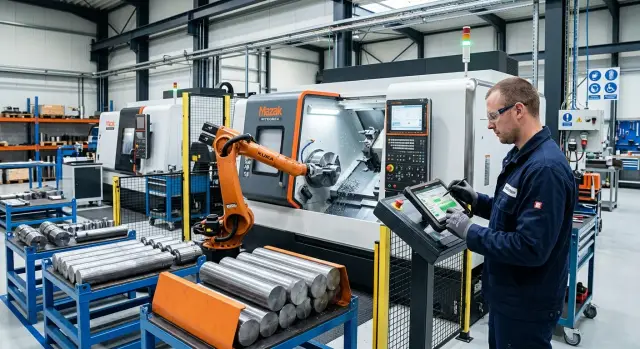
Why the first attempt often stalls
The problem is usually not the robot or the pallets. The first automation of a production cell stalls when you automate an operation that already depends on constant manual adjustments.
Automation does not fix failures. It repeats the cycle exactly as it is. If the operator changes the offset every half hour, repositions the blank in the chuck, clears chips with a hook, or chases size variation, the equipment will run into the same instability.
That is why expectations and reality often diverge. A manager expects smooth output and less manual work, but gets the same operation, only more expensive and harder to maintain.
A good starting point looks boring, and that is normal. The operation should deliver the same result batch after batch: the same blank, the same locating method, a clear cycle, and predictable machining time. In such a process, the operator mostly loads the part and takes the finished one out, rather than rescuing the job every few parts.
There is a simple sign of a stable process: if you remove the operator for 20 minutes, the work should not fall apart. If the moment they step away causes poor clamping, size drift, or a chip-related stop, it is too early to automate.
The same few things usually get in the way: noticeable blank variation, unstable clamping, fast tool wear, and manual compensations that the process cannot survive without.
That is why you should not chase full autonomy at the start. It is much smarter to remove one unnecessary manual action: automate blank feeding, install pallets for repeat jobs, or add a simple loader for a straightforward part. This kind of step gives a clear result. The cycle becomes steadier, the operator spends less effort on repetitive work, and the shop gains experience without an expensive mistake on a project that is too complex.
Which operation to start with
For the first automation project, choose an operation with few surprises. The best option is a part made in a large series that barely changes from batch to batch. When a shop turns or mills the same item for weeks, the system is easier to set up once and then leave alone.
The blank matters a lot. If the size varies, the material changes, and the allowance is different every time, automation will quickly start to fail. A better candidate looks calmer: the blank is uniform, the material is known, the clamping repeats without shims or corrections. Then the machine holds its mode and the fixture does not need constant adjustment.
It is just as important how the part enters the machine. If the operator picks it up and places it into the chuck or fixture without long alignment, that is a good sign. If they have to find the correct side every time, align it by hand, and correct the seating, the start is better postponed. A robot would also face extra challenges there: sensors, a more complex gripper, or a separate position check would be needed.
Another sign is steady cycle time. If the operation takes 2 minutes 40 seconds during the day and almost the same at night, the process is already in shape. If the spread is large, you need to find the cause first. It is usually the blank, the fixture, the tool, or the fact that different operators work differently.
The same logic applies to quality control. For a first project, it is better to choose an operation where only a few clear dimensions need to be checked, not a long list of conditions that depends on one person’s experience. When quality depends on “feel” or on a long visual inspection, CNC machining automation becomes much more complicated.
In practice, a small shop often starts with a simple turned part: bushings, pins, or fittings. The blank is standard, setup is straightforward, the cycle repeats, and inspection is short. For jobs like that, the first automation step usually goes the smoothest.
What not to choose for the start
The first project is a poor fit for an operation that survives only through constant manual tweaks. If an experienced operator has to keep tightening something, turning something, or catching size “by ear” every time, a robot will not solve it.
A weak candidate is a part whose drawing or tolerances change often. One version today, another next week, then the locating changes or a new cut is added. In that mode, you are not automating anything — you are endlessly reconfiguring the cell, the fixture, and the feed logic.
Another warning sign is tooling that has to be adjusted on nearly every batch. That means the clamping is unstable or the blank itself varies more than it seems. Automatic feeding and pallets handle surprises poorly: they repeat the same motion instead of adapting on the fly.
Chip evacuation is the same story. If chips wrap around, block feeding, clog the work area, or get into the clamp, it is better not to start with that operation. On a manual job, a person can still stop, clear the chips, and continue. In an automated cycle, the problem builds up fast and after a few parts leads to downtime or scrap.
The same applies to tools. If tool wear is rapid and size drifts halfway through the batch, automation will only speed up scrap production. It is even worse when the tool breaks without a clear reason. First you need to understand what is causing the failure: cutting conditions, setup rigidity, cooling, blank quality, or the tool itself.
The riskiest case is when defects appear in bursts and nobody can clearly say why. Five parts are good, the sixth goes out of tolerance, then everything is fine again. In that kind of process, automation does not remove the chaos — it just makes it less visible until an entire batch has piled up.
How to choose the first operation
Do not choose the most complex or the most visible operation. It is better to start where the cycle repeats often and the result changes little from part to part. If the process follows clear rules, a robot, automatic feeder, or pallets usually settle in without a fight.
First, put together a simple list of operations for a normal week or month. You do not need a large report. Just note which parts run in series, how often the same cycle repeats, and where the operator keeps doing the same actions over and over.
Then look at where the person most often вмешается in the machine’s work. If the operator is almost always adjusting the blank, changing the part position, removing chips by hand, or tuning the mode, it is better to postpone that operation. Manual “fixes” almost always ruin a nice plan on paper.
For comparing operations, five questions are usually enough:
- How consistently the size is held from batch to batch.
- How long the cycle takes and whether it changes during the shift.
- How many manual actions the operator performs before and after machining.
- How often the machine stops because of small faults.
- Whether the blank can be fed the same way every time.
After that screening, one or two candidates usually remain. It is better to choose not the one that looks the most interesting, but the one where the effect can be calculated quickly. If the operator opens the machine door 60 times per shift, loads the same blank, and presses start, the economics are obvious right away. If the process changes with every batch, the benefit disappears quickly.
Another useful filter is whether a pilot can be launched without rebuilding the whole cell. For a first step, it is better to automate one operation on one machine, not a chain of three machines, a blank warehouse, and a new logic for the entire shift.
What to check before a robot, automatic feeder, or pallets
A robot likes steady work. If the process changes every hour, the first automation will quickly run into small faults that the operator used to fix on the fly.
Start with the blank. If the batch arrives with noticeable variation in length, diameter, or allowance, automatic loading will start causing misalignment, missed cycles, and extra stops. For a first project, it is better to use a part where the raw material dimensions vary only a little and the shape repeats from shift to shift.
Then check the fixture. A good sign is when the part clamps the same way every time, does not rotate, and does not need retightening every few cycles. If the jaws, chuck, or fixture behave unpredictably, a robot will only speed up scrap production.
The machine itself should also run calmly. If it completes a full shift without random alarms, does not need constant zero-point correction, and stays stable on a simple cycle, that is a solid base for automatic feeding or pallets. Automation does not cure a tired machine.
Also evaluate part inspection. When the operator spends 20–30 seconds measuring and rarely makes corrections, the process is already close to automation. If they spend a long time measuring after each part, turning offsets, and adjusting size by hand, the automatic mode will sit idle more than it works.
There is also a very practical question: where will everything else go? One machine is not enough for a robot. You need space for bins, access for a cart or forklift, a buffer area, convenient blank supply, and proper guarding. On a cramped line, even a good project often gets stuck because of logistics.
For a quick check, this short list is enough:
- The blanks in the batch are similar to each other.
- The fixture holds the part steadily.
- The machine runs a shift without constant small interventions.
- Size inspection is short and clear.
- There is space on the floor for safe loading and bins.
What to choose for the first step
Start not with the trendy solution, but with the biggest time loss in the cell. If the operator spends most of the day loading and unloading parts, the first step is often not a pallet system but simple automatic feeding. If the machine cuts for a long time without a person and downtime happens between batches, then pallets make sense.
For the first project, three scenarios usually fit best. A robot works well where gripping, transfer, and placement are the same from cycle to cycle. Automatic feeding is ideal for bar stock or a standard blank with a clear shape. Pallets are effective when machining is long and batches change often.
A robot is good not by itself, but in a predictable process. If the part always sits in the same position, the jaws do not change every hour, and the cycle repeats hundreds of times, the robot removes routine work without much tuning. But if blanks arrive with different allowances and the operator keeps adjusting things by hand, that kind of start is almost always stressful and expensive.
Automatic feeding is usually simpler. On a turning cell, it is often the calmest way to start: the bar feeds the same way every time, the operator spends less time at the machine, and night shifts become more realistic. For a small shop making series shafts or bushings, this is often more useful than a robot in the first cell.
Pallets are useful where the machining cycle is already long. If a machining center cuts a housing for 25–40 minutes and the operator spends 3–4 minutes on unloading, loading, and finding the next blank, pallets reduce machine waiting time and make batch changes easier.
A bad way to start is to put a robot, automatic feeder, and pallets into one cell all at once. If something goes wrong, it will be hard to tell where the failure is: in gripping, in feed logic, or in changeover. It is much smarter to take one source of loss and solve only that.
Example for a small shop
A small shop turns bushings in batches of 400. The part is simple, the blank repeats, and the size stays steady from batch to batch. The tool also behaves predictably, without random wear on every tenth part.
The problem here is not the machining itself. Time is lost on the same action over and over: open the door, remove the finished bushing, load a new blank, close it, and start the cycle again. If that cycle takes less than a minute, loading and unloading quickly take up a noticeable part of the shift.
This is a good place to start automation. The process is already stable, so the shop is automating a repeatable operation, not chaos. In such a case, automatic feeding or a simple robot often delivers a fast and understandable result.
If the operator spends even 15–20 seconds on each part, a batch of 400 parts adds up to about 1.5–2 hours of manual actions alone. That time does not improve quality. It just keeps a person at the machine door.
Usually two options fit here: automatic feeding, if the blanks are uniform and easy to feed without complex orientation, or a simple robot, if the part needs to be picked one by one and placed in a clear position.
A housing part looks different. If the shop turns or mills a housing with frequent changeovers, different datums, jaw changes, and corrections after the first parts, that scenario is much weaker. Robots or pallets do not like it when the process is changed by hand on the spot.
Where people most often make mistakes
The first automation project often goes wrong right from the start. A manager looks at the most expensive operation and assumes that is where the biggest savings will be. In practice, a different approach works better: start not with the most expensive operation, but with the steadiest one, where size is stable, the cycle is clear, and changeovers do not change every hour.
Another mistake is in the budget. People include the price of the robot, automatic feeder, or pallet system, but forget everything needed around it. And that is what later eats up the schedule and the money: fixtures and grippers for a specific part, bins for blanks and finished parts, floor space near the machine, walkways, guarding, sensors, and small process modifications.
The next mistake appears after the first night shift. During the day, the cell works acceptably because a setup technician is nearby. At night, it stops over something small: the blank is not seated right, a sensor gets dirty, chips block part removal, or the tool triggers an alarm. If nobody clears those signals quickly, the plan falls apart by morning.
Many try to remove the operator too early. That is a poor goal for the start. First, the process must become steady without constant human prompts. In the initial stage, the operator does not block automation — they support it: they watch the start, monitor tool wear, and notice deviations in time.
Scrap is also often underestimated. If a part sometimes passes tolerance and sometimes does not, a robot will not solve that problem. It will just repeat an unstable process faster. The same goes for downtime: if the machine already waits often for tools, setup, or material, new equipment alone will not create a good result.
Quick check before making a decision
Automation should go where the process already follows clear rules. For the first project, choose not the most complex operation, but the most predictable one.
Before deciding, it helps to run through a short checklist:
- The part or family of parts repeats regularly, instead of appearing by chance from one order to the next.
- During a normal cycle, the operator almost never has to save the process manually.
- The machine holds nearly the same machining time from part to part.
- The fixture and tool run calmly, without frequent manual correction.
- The shop already knows who will monitor the cell, who will change tools, and who will handle simple faults.
You can test yourself with a simple example. If you turn the same shaft in batches, the program has long been proven, size drifts rarely, and the operator mainly just loads the blank and removes the part, that is a good candidate. If every second start requires a new setup, manual fitting, and a long search for the cause of scrap, you should not start with that operation.
A good first project really does look boring. That is more of a benefit than a drawback. A steady process is easier to automate than a flashy but nervous operation full of surprises.
What to do next
Do not try to automate the entire cell at once. Choose one operation where parts come in regularly and people spend most of their time loading, unloading, and handling small stops.
Then collect real working data for that operation over 2–4 weeks. You do not need a polished report, just an honest picture: how many parts were made per shift, when the machine stopped, why the operator stepped in, and what scrap rate came from the series.
If you are not collecting numbers yet, start with a simple log. It is enough to record downtime duration, the reason for each intervention, the scrap and rework rate, and the time needed to load and unload the part.
After that, compare three scenarios with the current process: do nothing, add automatic feeding, or install a robot or pallets. Look not only at speed, but also at how often the process still needs manual correction. If the part behaves differently every hour, automation will not save it.
The next sensible step is a pilot on one cell, not a big launch across the whole shop. Use a real batch, not a demo run of ten blanks. That makes it faster to see whether the process holds the pace, where time is lost, and how many interventions remained after launch.
A small shop often gets more value not from the most advanced solution, but from the most predictable one. Sometimes automatic feeding solves the problem more cheaply and calmly than a robot. Sometimes pallets deliver the better result if the main time loss sits in changeovers.
If the pilot shows a stable rhythm, calculate the economics based on facts: how many minutes you saved per shift, how much scrap you reduced, and how long it will take to recover the investment.
If you want an outside perspective, EAST CNC usually starts not with choosing a robot, but with evaluating the operation itself: how stable it is, which CNC machine fits it best, and where automation can deliver value without unnecessary complexity. This approach often helps avoid an expensive start on the wrong operation.
FAQ
Where should I start with the first automation of a production cell?
Start with a repeatable operation where the part runs in series, cycle time hardly fluctuates, and the operator mainly loads and unloads the blank. If the process already holds size without constant adjustments, automation will deliver a clear result instead of becoming an expensive experiment.
How do I know if an operation is ready for automation?
Use a simple rule: if the operator steps away for 20 minutes, the process should not fall apart right away. If the size drifts without manual correction, the workpiece has to be constantly adjusted, or chips quickly stop the machine, the process needs to be stabilized first.
Which parts are usually best for the first project?
The best candidates are usually simple serial parts with straightforward setup: bushings, shafts, pins, and fittings. The blank repeats consistently, clamping does not require tricky adjustments, and inspection takes little time.
What should not be automated first?
Don’t start with an operation where people are constantly chasing size by hand, changing the reference setup often, or fighting chip buildup. Parts with frequent drawing changes and processes where defects appear in unpredictable bursts are also poor first choices.
What should come first: a robot, automatic feeding, or pallets?
Look at the biggest time loss. If the operator spends most of the day opening the machine door and loading identical blanks, a simple automatic feeder or a basic robot often brings the fastest gain. If the cycle itself is long and most of the waiting happens between batches, pallets make more sense.
Do we need to remove the operator from the process right away?
No. First remove the most unnecessary and repetitive manual actions, not everything at once. That is enough for the initial step: the process becomes steadier, and the shop gains experience without a complicated cell or long debugging.
What should be checked in the machine and tooling before launch?
Check three things: the blank, the fixture, and the machine itself. The blanks should be similar to each other, clamping should repeat without tightening, and the machine should run through a shift without small failures or constant correction.
Is a pilot needed before launching automation?
A pilot is almost always better than a full launch. Take one operation on one machine and run a real batch, not a test of ten parts. That way you’ll quickly see where the process holds up and where people are still saving it by hand.
How do I calculate whether the first automation will pay off?
Look at more than speed: count the manual time around the cycle too. If the operator spends 15–20 seconds on each load, that adds up to hours over a large batch. Add downtime, scrap, and rework, and the picture becomes honest.
Who should monitor the cell after launch?
Even after launch, someone should still watch tool wear, clear simple faults, and notice deviations in time. In the early stage, automation works best when an operator or setter backs up the process instead of disappearing from it completely.