
First-piece inspection at the machine without a QC queue
Inspecting the first part at the machine helps catch dimensional drift quickly, confirm the setup and avoid running the whole batch blindly.
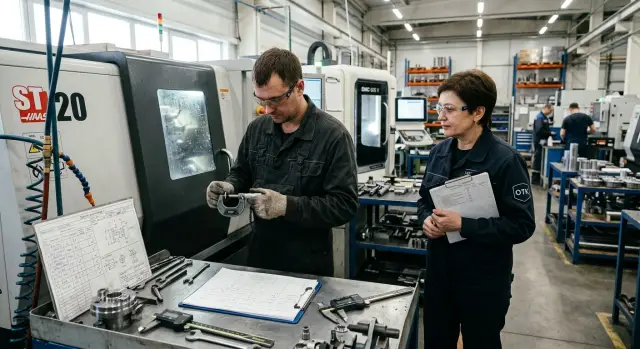
Why a batch becomes risky when the first part waits for QC
The problem starts before scrap appears — when the operator has already taken the first part off the machine but hasn’t yet received a size confirmation. Often the machine isn’t stopped. It makes the next part, then another, and the batch moves on without confirmation that the basic dimensions are within tolerance.
This routine feels normal, but it creates a blind spot at the start of the run. Even a small mistake in the setup rarely stays small. On a CNC lathe a few hundredths of a millimeter drift in diameter quickly becomes a series of parts with the same deviation.
Usually it happens the same way:
- the operator makes the first part and sets it aside to wait for inspection;
- the machine wasn’t stopped, so no time was lost;
- no one confirmed the dimensions yet, but parts are already piling up;
- 20–30 minutes later it turns out the correction should have been changed immediately.
The worst thing is that the error grows quietly. While the inspector is busy elsewhere, the operator works almost blind. The cutting looks even, the sound seems normal, the chip flow is steady. But that doesn’t mean the size stays within tolerance. In metalworking the outward appearance easily masks dimensional drift.
Late feedback hits more than quality. It quickly ruins the shift’s workflow. The operator says they were waiting for inspection. The setter says the run should have been stopped. QC reminds that they have a queue and can’t come right away. As a result, the argument becomes about who’s to blame rather than the real reason.
The cost of that delay is higher than it seems. The shop loses not only metal and machine time, but also a confident batch launch. If the first part is confirmed immediately at the machine, the operator quickly adjusts and continues calmly. If the answer comes late, extra sorting, rechecks and end-of-shift investigations begin.
The risk doesn’t come from a single measurement error. It comes from the pause between making the first part and taking a simple decision: continue the run or correct the process now.
What to check right at the machine
You don’t need to measure everything at the machine. Start with the dimensions that most often drift immediately after setup and in the first parts of a batch. Usually these depend on tool overhang, clamping, insert wear and component heating.
For a turned part the checklist is typically short. Check the working diameter, the length from the datum to the critical face, the groove for a ring or seal, the assembly chamfer and runout if the part will be used in a rotating assembly. This is often enough to decide whether to proceed.
If a dimension affects fit or assembly, measure it immediately instead of sending it into the general QC queue. That’s the point of first-piece control at the machine: the operator sees the problem before launching the batch, not after dozens of blanks.
In practice a failure often looks simple. The diameter may still be within tolerance, while the groove is already off by a couple of hundredths due to a correction on another tool. If the operator notices this at the machine, they adjust one correction and don’t spoil the next pack of parts.
Surface condition is checked separately. After the first cut you can see how the tool behaves: are there scoring marks, torn finishes, vibration, or burrs on the edge. After an insert change check the surface again, even if the size on screen looks the same. A new insert often produces a different finish and a different actual size.
It helps to mark the actual first checked part and write the time and correction number next to the measurement. That’s enough later to avoid arguments about which part was measured and after which adjustment the result was obtained. That record should take less than a minute, otherwise people stop keeping it.
A simple rule beats long instructions: check what most quickly breaks assembly or drifts after setup. Everything else can be confirmed later, once the first part shows the process is stable.
Who gives feedback and when
Feedback shouldn’t wait until the first part has gone through the QC queue — it should come at the machine. As soon as the trial cycle is finished, the operator measures the agreed dimensions and records the actual values. Not a pass/fail mark, but numbers. That shows where the size drifted and how much margin remains to the tolerance limit.
If a dimension is out of tolerance, the run doesn’t start. If a dimension is formally within tolerance but very close to the limit, continuing at random is also not acceptable. At that point the operator calls the setter and shows the measurements.
The setter is needed where the cause must be found, not guessed. They check the tool correction, wear, part datum, clamping and the trial cycle itself. Then they decide: apply a correction and repeat the first part, or stop the run until the cause is clarified.
A typical case: the operator measures diameter 40.01 with an upper limit of 40.02. Formally the part passes, but the margin is almost gone. If a series is started immediately, the size will likely drift into scrap after a few pieces. Quick reaction saves both time and material in such moments.
QC’s role should also be clear. The inspector doesn’t have to measure the first part with a full inspection sheet if the task is only to authorize the run. They confirm the first good part against a short, pre-agreed list of dimensions and signs: the most sensitive sizes, surface and what affects assembly. After that the operator gets a clear answer — the series can start or another correction is needed.
This scheme works only if roles are assigned in advance. Before the batch starts the shop must know who can stop the run, who can order a repeat trial cycle and who authorizes the series. Without that, people wait for each other and the machine either idles or cuts the batch blindly.
How to build the control scheme step by step
A practical scheme doesn’t start with a long measurement card. It starts with a small set of dimensions that drift most often after setup. For most operations 3–5 positions are enough: diameter, length, fit, thread or a size highly affected by tool wear.
Measuring everything wastes the operator’s time and still risks missing what drifts most often. It’s far more useful to agree in advance which sizes create risk for this operation and keep them on a short list by the machine.
- Before starting a batch the process engineer, setter or foreman marks 3–5 dimensions for the first check.
- The operator makes the first part, measures those dimensions at the machine and records the results immediately.
- If a size has drifted, make the correction before the next part, not after ten blanks.
- Measure the second part at the same points. After that the setter or QC confirms that the run can begin.
- Repeat this short cycle after an insert change, a doubtful measurement or a pause in work.
One sheet by the machine solves more than a thick folder on the foreman’s desk. It should include only necessary fields: part number, date, tool, nominal, tolerance, actual for the first and second parts, the correction applied and the signature of the person who authorized the start.
On a CNC lathe this is particularly noticeable. If the operator sees the diameter is 0.03 mm high after the first part, they apply a correction, turn the second part and immediately get confirmation. The problem stops at two parts instead of filling a bin.
The idea is simple: the first check stays at the machine, and QC or the setter joins at confirmation time, not at the end of the finished batch. If the cycle takes 5–7 minutes the shop usually loses less time and sends fewer parts for rework.
Which records save time rather than paper
Excessive logs get in the way as much as no logs. If the operator must fill half a page for one first part, the record is almost always postponed. First-piece control needs a short form that immediately answers one question: is the part good or is the machine already drifting?
Keep only what helps decide at the machine: which dimension was checked, the tolerance, the measured value and what correction was applied after the measurement. That’s enough to avoid guessing why the batch shifted up or down. If the form has ten more columns, time is spent on paperwork instead of on the part.
Next to the measurement it helps to record who measured and the exact time. It seems small, but it often resolves disputes. If at 10:15 the size was within tolerance, and at 10:47 it has drifted, the foreman immediately sees where to look.
Record insert changes and repeat starts as separate lines. After a new insert the old entry no longer tells the whole story. It’s clearer to write: “lathe tool, insert change, 11:20” and then list the first measurement after the restart and the new correction.
A good record stays at the machine: on a magnetic sheet, in a folder on a bracket or on a simple clipboard at the workstation. If the form goes to the foreman, QC or a common cabinet, its purpose is lost. The operator needs quick feedback, not a hunt for paperwork across the shop.
A common example shows this well. The operator measured diameter 40 ±0.02 and got 40.03. They recorded the value, wrote the time, applied a correction on the axis and signed. A few minutes later the repeat measurement was 40.01. From that short record the foreman immediately understands what happened and doesn’t send the whole batch to guessing.
The shorter and clearer the form, the more often it’s kept without reminders. For the first part that’s perfectly sufficient.
Example of a run without a QC queue
At the start of a shift a CNC lathe begins work on a batch of 200 shafts. The operator doesn’t rush to run the series. They turn the first part, take it off the machine and immediately measure the fit diameter with a micrometer.
The instrument shows +0.03 mm to nominal. For the batch that’s already a bad sign: if the run continues without checking, in half an hour there could be dozens of identical wrong parts.
In the working scheme the operator doesn’t go looking for QC across the shop or put the part in a general queue. They call the setter immediately while the machine hasn’t started the run. The setter checks the size, reviews the correction and applies an axial adjustment.
A few minutes later the machine makes the second part. The operator measures the same size with the same micrometer and sees the part is now within tolerance. The problem was found and fixed immediately and the risk didn’t have time to grow.
QC then comes in, but without the usual delay. The inspector approaches the machine or receives the part out of the general queue because this is about authorizing the series, not sampling the batch. They check the first good part, confirm the size and give the go-ahead.
After that the operator works calmly. They don’t guess whether the setup is right and don’t pile up doubtful parts in a tray. The shop benefits too: the machine doesn’t idle, QC doesn’t have to dissect a whole stack of scrap later, and the foreman sees a clear chain of actions.
On paper this routine looks simple. In the shift the difference is immediate. Instead of “made 30 pieces then found a drift” you get: the first part showed a deviation, the second part came into size, QC confirmed the start, and the batch proceeded without a lottery.
Where the scheme breaks down in practice
A quick check alone doesn’t save anything. It works only where the shop agreed on one routine at the machine and everyone measures the same way. Without that, first-piece control quickly becomes a formality.
A common mistake starts with measurement. The operator grabs the tool that’s closest and gets a “good” size, while this operation actually needs a different method. A caliper where a micrometer is required gives false confidence. Later QC measures more precisely and the batch has already moved on.
Confusion about which dimension decides the start causes problems too. One person checks outer diameter, another waits for length confirmation, a third wants runout checked. While people argue, the first part is no longer first. If you haven’t designated one main dimension and one or two controls, everyone will have their own version of “in spec.”
Organization issues also hide failures. The machine keeps cycling while the foreman calls the inspector or searches the shop floor. The operator then acts by sight: the part looks normal, so continue. That’s how extra parts with the same error appear.
After an insert change, a tool correction or re-fixturing the scheme often collapses. People assume that because the first part was accepted in the morning, it doesn’t need to be checked again. On a CNC lathe that’s enough for the size to drift 0.02–0.05 mm and send scrap in series.
Another issue is backdated records. When the operator makes parts first and tries to remember later what and when they measured, the chain is lost. You can’t tell after which correction the size drifted and who authorized the run.
You can usually spot the scheme’s breakdown by several signs: operator and QC get different results on the same part, nobody repeats the first check after an insert change, the machine runs without confirmation to start, and times and sizes appear in the card after the parts themselves. If at least two of these signs repeat in the shop, the problem isn’t individual people — the rule simply wasn’t adopted across shifts.
Quick checks before starting a run
It’s better to spend three minutes at the machine than an hour sorting scrap later. First-piece control starts not with measuring but with preparing the workstation. If the operator searches for the drawing in a folder, the gauge is in a nearby cabinet and the tolerance is only in memory, errors are almost inevitable.
One clear kit should be at the machine for the current operation: the latest drawing, the operation card and the measuring tool for the first dimensions. All of this must be nearby. Then after the first part comes off the operator takes the size and gets an answer in minutes, not after extra trips across the shop.
Before the start a short check is enough. The operator opens the drawing, reviews the first dimensions and tolerances, verifies the program number and operation assignment, checks corrections and installed tool, and knows in advance who authorizes the run after the first part.
A second common failure is memory. The operator may remember the previous job and mechanically hold the old size in mind. If on this batch the first controlled diameter is 25.00 ±0.01 mm, that tolerance needs to be visible. The same applies to datum, length, chamfer and any size that affects the series.
Program, corrections and tool should be checked as one set. The correct program with someone else’s correction causes the same problem as the wrong tool. On CNC machines this is a common reason for an extra bad first part: the file is correct but the wrong cutter or yesterday’s offset remains in the pocket.
One more item cannot be left for later. The setter, operator and QC must agree in advance who exactly confirms the start. If the operator thinks they can start after their measurement and QC expects to be called, the run either stalls or, worse, continues without a shared decision.
When documents and gauges are at hand, tolerances are visible, the setup matches the task and the person responsible for the start is known before the first cycle, feedback stops being rare luck and becomes ordinary working practice.
What to do next in your shop
You don’t need to change the whole area at once. Take one machine and one part the shop makes often. With such work it’s easier to see whether first-piece control at the machine helps or if people just added another formal step.
Choose a repetitive part with familiar tooling and clear tolerances. That quickly shows where minutes are lost, who waits for confirmation and how many times the operator adjusts the setup before the run.
Run a short 1–2 week test. That’s enough to collect clear data without fuss. The test’s point is simple: don’t argue about the scheme’s usefulness, measure it by time and scrap.
Record only what helps make decisions later: minutes from the first part to authorization to start, which dimensions the operator checked at the machine, which dimensions QC confirmed and how many adjustments were needed before stability.
Keep the first-measure list short. Leave only dimensions that truly affect part acceptability, fit and process repeatability. If scrap is usually caused by diameter, length and datum, don’t waste the first minutes on secondary chamfers and sizes that rarely drift.
A single simple example quickly clarifies things: if the operator makes the first part in 12 minutes and then waits 35 minutes for QC, the problem isn’t measurement. Feedback is too late. After the pilot you should have one clear number — how long from first part to confirmation of the run.
If that time is reduced by 10–15 minutes without an increase in scrap, the scheme can be extended to neighboring machines. If nothing changes, find the bottleneck in the routine: who confirms the size, what gauge is used and when the operator has the right to start the run.
If you’re also selecting a CNC lathe, discuss these questions in advance. EAST CNC handles selection, supply, commissioning and service for metalworking machines, so it makes sense to tie the first-piece start scheme not only to the shop’s regulations but also to the equipment you will work with every day.
FAQ
What is first-piece inspection at the machine?
This is a short check of the first, and if needed the second, part right at the machine. The operator immediately measures the agreed dimensions, records the actual values and shows the results to the setter or QC before starting the run.
Do you need to stop the machine after the first part?
Yes — if the basic dimensions haven’t been confirmed yet. A pause of a few minutes is almost always cheaper than sorting dozens of parts with the same deviation.
Which dimensions should be checked first?
Start with 3–5 dimensions that most often drift after setup: diameter, length from the datum, fit, groove, thread or runout. Check what immediately breaks assembly or quickly changes due to tool wear or clamping.
Who should authorize the start of the run?
The shop should agree this in advance. Typically the operator measures and records, the setter investigates and adjusts, and the person assigned — the setter, foreman or QC — gives permission to start the series.
What if the part is still within tolerance but very close to the limit?
Don’t start the series. If the margin is almost gone, the setter should check corrections, the tool and datum, then make another part and remeasure it.
What is best to measure the first part with?
Use the measuring instrument that provides the required accuracy for the operation. A caliper is fine for rough checks, but mating diameters and similar critical sizes are better measured with a micrometer or another agreed method.
What should be recorded after the first measurement?
Keep a short form by the machine: part number, time, which dimension was checked, nominal, tolerance, the measured value, what correction was made and who authorized the start. This takes less than a minute and quickly avoids disputes.
Should the check be repeated after an insert change or correction?
Yes. A new insert, a correction or a re-fixturing often changes the actual size even if the program is the same, so repeat the check.
How to act if QC can’t come immediately?
Don’t send the first part into the general queue if it determines the start of the series. Agree a short routine in advance: the operator measures at the machine, the setter quickly reviews the deviation, and QC confirms only a few sensitive dimensions.
How to start this scheme in my shop?
Start with one machine and one frequently produced part. Run a 1–2 week pilot measuring the time from the first part to permission to start, how many corrections were made, and whether scrap decreased. Record only what helps decide: minutes to authorization, which dimensions the operator checked, which QC confirmed and how many adjustments were needed.