
First-piece control in a production run: measurement sequence and roles
First-piece control helps detect setup shifts, setup errors and defects in time. We explain the measurement sequence, releasing the run and the roles of QC, the operator and the setup technician.
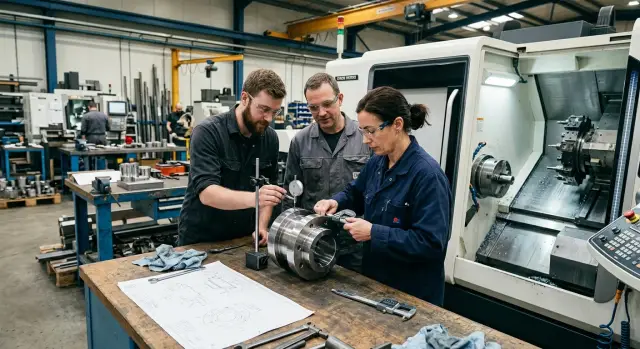
Why the first part is checked
One setup mistake can ruin an entire batch in half an hour. On a CNC machine this happens fast: the operator starts the cycle, the machine repeats the program exactly, and the defect becomes repeatable. So first-piece control is not for paperwork, it's to stop the problem before it turns into dozens or hundreds of scrap parts.
Most often the failure starts with a small thing: the wrong tool offset, a shifted zero, a swapped insert, a different blank allowance. For example, the drawing calls for a 30.00 mm diameter, but after setup the machine gives 29.92 mm. The difference seems small, but the part already fails. If this is noticed after 120 pieces, the shop ends up with a whole batch to sort, not just one bad part.
You can't see such a size drift by eye. The surface may look fine, chamfers tidy, cutting marks even. But the size drifts by hundredths or sometimes tenths of a millimeter. In metalworking that's enough for the part not to fit in an assembly, to introduce play, or to fail a fit.
A quick check is almost always cheaper than sorting scrap. Measuring the first part usually takes 10–15 minutes. Sorting a batch takes hours. You must check each piece, separate good parts, document scrap, find the cause and reset the machine. For complex parts the losses grow even more.
The first part is checked every time the process could have changed even slightly. This usually happens after a new setup, tool change, CNC program edit, material or fixture change, and also after stopping a run if there's a risk of a fault.
The effect is especially visible in serial production. The shorter the cycle, the more costly each missed error. One timely-checked part saves not minutes but the entire batch.
Who is responsible for the check
First-piece control doesn't rest on a single person. If you put all responsibility on just the operator or just QC, errors are almost inevitable. The simple rule is: each person is responsible for their area, and the decision to start the run is made after a joint check.
The operator is the first to see how the machine behaves on the trial cut. They run the first part, watch cutting sound, feed, chips, clamp condition, and stop production if they notice a problem. Their task is not to "push through" a doubtful part into the run just because the size almost hit the tolerance.
The setup technician is responsible for the cause of the result. They check the tool, overhang, wear, offsets, blank fixturing, setups and the program. If the size drifted, the setup technician finds the source and makes the correction.
QC checks the finished part against the drawing and records the result. They measure the dimensions that affect fit, coaxiality, runout, depth, threads and surface finish if required. After that they document approval of the first part according to the site's procedure.
The usual scheme looks like this:
- the operator runs the trial and does not continue the run without confirmation;
- the setup technician prepares the machine and removes the causes of deviation;
- QC confirms the part is acceptable by measurement and records it in the documents;
- an authorized person gives permission to start the series according to company rules.
It's better not to blur the boundaries. The operator may notice a suspicious size, but they do not replace the controller. QC may find a deviation, but should not change offsets instead of the setup technician. The setup technician can measure a part after adjustment, but by the adopted order the run doesn't continue without QC's mark.
In practice the best option is simple: check the first part together. The operator shows how the cut went. The setup technician explains what corrections were made. QC verifies the result against the drawing. This short check removes disputes and leaves no room for verbal agreements.
What to prepare before the first start
For first-piece control it's not enough to press "Start" and then grab a caliper. Before starting you need to gather all operation data and make sure the machine, fixtures and measuring tools indicate the same size.
First open the drawing, the routing sheet and the control card. The drawing sets nominal sizes, tolerances and datum surfaces. The routing shows after which operation the part comes to this machine and what is already machined. The control card helps not to miss the dimensions that must be checked immediately after the first cycle.
Then inspect the blank and the setup. It's important to understand which surfaces are used for datums, where stops are placed, how clamping can deform a thin wall and whether the blank can shift under load. If the datum is chosen poorly, an accurate program won't save you.
Check the tool separately. Verify that the correct insert or drill is in position, what the tool overhang is, whether turret stations are swapped, and whether length and radius offsets are entered correctly. On a CNC machine an error in a single offset often produces scrap on the first part even if the toolpath is written correctly.
Prepare measuring tools in advance. The micrometer, caliper, dial indicator and required gauges should be at hand and in working order. If you start looking for a micrometer only after machining, the shift immediately gets unnecessary haste, and haste usually brings errors.
It's useful to mark a few items on the control sheet in advance:
- dimensions with tight tolerances;
- fit diameters and lengths;
- datums from which measurements are taken;
- places where you need an indicator or a gauge, not a universal tool.
This is usually enough to avoid measuring everything. First check what most affects getting the first good part: base dimensions, fits, coaxiality, runout and parameters that are hard to correct with a single offset.
Measurement order step by step
Measure the first part not from memory or convenience, but according to the operation logic and the drawing. Then it's easier to understand where the size drift occurred: in fixturing, tool or program.
First clean the part from chips and coolant. Even a thin film on a datum surface easily gives a false result. Then clean the measuring tool itself. It sounds trivial, but accuracy is often lost here too.
Next check the datums and dimensions that other measurements depend on. For a turned part these are usually mating surfaces, external and internal diameters, and the surfaces that the part will use in the next operation. If the datum is already out of tolerance, there's no point in continuing the long inspection. First find the cause and correct the setup.
Then move on to linear dimensions: lengths, steps, depths, groove widths, chamfers and distances between elements. It's better to proceed top to bottom on the drawing or strictly according to the operation route. When the order is always the same, errors are spotted faster.
Separately check geometry that a caliper won't show. This includes runout, coaxiality and threads. Runout is usually checked with an indicator against the datum surface. Coaxiality is assessed relative to the datum specified on the drawing, not the one that's easiest to clamp. Threads are checked with a gauge or a control part, not "by eye."
A convenient sequence is simple:
- Clean the part and the measuring tool.
- Check datums and main diameters.
- Measure lengths, depths, grooves and chamfers.
- Check runout, coaxiality and threads.
- Record the result for each dimension immediately.
Record immediately, even if the deviation seems small. If you try to remember numbers after ten measurements, confusion almost always starts. In practice it's useful to note not only the existence of a deviation, but its direction: "+0.03" or "-0.02". Such notes help the setup technician understand faster what to correct.
When the first good part can be released
Start the series only after the part has passed all mandatory measurements and there are no remarks. An oral command is not enough. You need an entry in the accepted document: the control card, routing sheet, log or an electronic form.
If the setup technician or operator changed an offset, repeat the check for the area that the correction could have affected. Changed a dimension in X or Z — take another part and measure it again. Otherwise it's easy to get one good piece by feel rather than by fact.
Release the first good part when all conditions are met:
- mandatory dimensions are within tolerance;
- re-measurement after adjustment confirmed the result;
- chamfers, threads, surface and datums have no remarks;
- an entry about approval for the run is made;
- it's clear who made the decision to start.
Most often the procedure breaks in one place: a size was corrected but the repeat check didn't cover all affected points. For turning this is a common mistake. A small offset change can fix a diameter and at the same time shift the length of a step or a fit for the next operation.
After approval record minimal data: part number, machine, check time and the name of the person who checked. If the size "drifts" later, it will be clear from which part the run started.
Decide separately what to do with the first good part. You can mark and keep it as a sample until the end of the batch or the shift. This is convenient: the operator, setup technician and QC compare against the same part instead of arguing from memory.
A shop-floor example
After a turning operation they had a shaft: length 120 mm, fit diameter 30.00 mm and chamfer 1 x 45°. The operator removed the first part, cleaned it from chips and coolant and set it aside. He did not let it into the run until he saw the actual sizes.
First he checked the fit diameter with a micrometer. The measurement showed 30.04 mm. A plus drift of 0.04 mm seems small, but for a fit this can already be scrap if the drawing tolerance is tight. The operator didn't machine the next blank "to check." He stopped the run and called the setup technician.
The setup technician checked which insert was used for the finishing cut and the last pass, verified the tool offset and adjusted it so the machine would take another 0.02 mm from the part. If there was still allowance on the part, he performed another finishing pass. If no allowance remained, he took a new blank.
After correction they produced another part and measured the same diameter again. This time the micrometer read 30.00 mm. But the operator still did not start the run by himself. The part was handed to QC for a repeat measurement.
Then everything was simple: the operator recorded the result, the setup technician eliminated the cause of the size drift, QC confirmed compliance with the drawing. The QC inspector rechecked the fit, measured the length and verified the chamfer was OK. Only after that permission to run the series was granted.
This example shows the point of the procedure. The error was only 0.04 mm, but without stopping it would quickly have become a dozen identical bad parts. One short check cycle saves both material and shift time.
Where mistakes happen most often
In practice scrap usually comes from small things, not complex geometry. First-piece control usually fails where people hurry and assume obvious things are already checked.
The most common mistake is measuring from the wrong datum. On the drawing the dimension is taken from one surface, but the operator uses another because it's easier to reach with a probe or micrometer. The number may look right, but the part later won't assemble.
Measuring a hot part causes no less trouble. After machining the metal still holds heat and the size can shift by a few hundredths. If you measure immediately after removal you may decide to change an offset when the size would return to tolerance after a few minutes.
Another typical mistake is skipping small drawing elements. A groove, chamfer, small radius or undercut depth seem secondary compared to main diameters and length. Yet because of such a small detail the first part is often rejected by QC.
People also confuse machine settings. Work zero and tool offsets are changed in different ways, but in a hurry they are mixed up. After such an adjustment the size can move in two places at once, and the cause becomes harder to find.
Usually the chain looks like this:
- a size deviation is seen;
- a correction is made in the wrong parameter;
- a new deviation appears on another surface;
- they start fixing the consequence instead of the cause.
The problem is amplified by poor recording of corrections. If the setup technician changed tool overhang, the operator shifted the zero, and no one noted it in the control card, the next check becomes guessing. After an hour it's already hard to remember what was changed and by how much.
To avoid this, keep one order: first verify datums against the drawing, then let parts cool a bit, then check not only main sizes but the whole profile. Record every correction immediately: who made it, what changed and which size was rechecked. The approach may be boring, but it works.
Quick checks before starting the run
You don't need a long inspection before starting a run. You need a few short checks right at the machine.
First check the documents. The workstation should have the current drawing and control card. Do not rely on memory or verbal instructions.
Then verify the program and the tools. The tool number in the turret or magazine must match the number called in the program. One error in a position easily ruins not only the first part but several following ones.
A short checklist is useful:
- the machine has the current drawing and control card;
- the tools are in their places and match the program;
- measuring tools are clean, zeroed and at hand;
- the first part can be separated and marked immediately;
- everyone knows who gives the final permission to start the run.
Marking the first part seems trivial, but without it confusion quickly arises. The part should be set aside and labeled so it won't be mixed with regular production. Then the setup technician and QC know exactly which part was checked and approved.
If roles were not discussed in advance, the run often starts by habit. One person thinks the decision is the setup technician's, another waits for QC, and the operator continues processing. It's much simpler to spend a minute before start and name the person who gives the final permission.
What to do next
After the first stable check don't leave the procedure in verbal agreements. Fix it on a single sheet. For first-piece control that's usually enough: measurement sequence, datum, inspection tool, allowable deviations and signatures of those who authorize the run.
Keep on that sheet only what the shift needs every day:
- which dimensions are checked immediately after the first start;
- which dimensions are rechecked after adjustment;
- who confirms the result;
- where the first good part is stored.
If the same dimension causes disputes repeatedly, resolve it before the next series. Don't carry the question to the next start. If the operator measures from one datum and QC from another, the dispute will repeat. If the drawing's radius, groove depth or step length is unclear, clarify it in advance and fix it in the work procedure.
Also agree how to store the first good part. You need a clear answer to three questions: who marks it, where it is kept and who can issue it for comparison. Without such a rule the first part quickly becomes "that one that was somewhere," and the argument starts again.
When choosing a new CNC machine or starting a new area, look not only at the rated accuracy. Equally important are ease of setup, access to the machining zone, space for measuring tools and clear service. These things affect releasing the first good part every day.
Therefore when commissioning new machines it's useful to discuss not only the equipment but also the procedure for bringing it into operation. For example, EAST CNC, the official representative of Taizhou Eastern CNC Technology Co., Ltd. in Kazakhstan, handles not only the supply of CNC lathes and machining centers but also commissioning and service support. For a shop this is practical: fewer uncertainties at startup and a quicker appearance of a stable first good part.
The fewer memories and guesses in the process, the smoother the run. One clear control sheet, defined roles and a storage place for the first good part usually save both time and material.
FAQ
When should the first part be checked?
Check it after a new setup, tool change, program edit, material or fixture change. If the run was stopped and there is a risk of a fault, take the first part again and don't continue production without measuring.
What should be measured first?
Start with the bases and the dimensions that affect the rest of the checks. For a turned part this is usually the mating diameters, reference surfaces and lengths that affect the next operation or assembly.
Can you start the run without QC confirmation?
No. If the site requires QC approval, you cannot start the run without it. The operator and setup technician can remeasure after adjustment, but the run starts only after confirmation according to your procedure and a recorded entry in the document.
Who stops production if the first part is suspicious?
The operator should stop the machine as soon as they see a doubtful size, an unusual cutting sound, poor chips or a clamping issue. The setup technician finds the cause and corrects the process, and QC confirms the result against the drawing.
Should you wait for the part to cool down?
Don't rush. A hot part can shift size by a few hundredths, and you risk making an unnecessary correction. Let the part cool a bit, clean it and then take the measurement.
Is one caliper enough to check the first part?
No. A caliper covers only part of the checks. Fits are better checked with a micrometer, runout with an indicator, and threads with a gauge or a control part.
What if one dimension was fixed but another shifted after the correction?
Take another part and repeat measurements for all points that the adjustment could have affected. Corrections in X or Z often change more than one dimension, so don't limit yourself to the area where you first noticed the deviation.
Why keep the first good part as a sample?
It helps everyone check against the same sample instead of arguing from memory. If a size drifts later, you can quickly see from which part the run was OK and where the deviation started.
What should be recorded after approving the first part?
Record the part number, the machine, the time of check, who measured, which corrections were made and who authorized the run. That entry is usually enough to quickly find the cause if the size drifts again.
What are the most common causes of rejection for the first part?
Most often the mistake is using the wrong measurement reference, measuring a hot part, missing a chamfer, groove or radius, or confusing the work zero with the tool offset. Another frequent cause is making corrections without recording them so no one remembers what was changed.