
Finish Pass After an Inspection Pause: When to Move It
The finish pass after an inspection pause is not always placed immediately. We explain how part and spindle heat changes size in a long cycle.
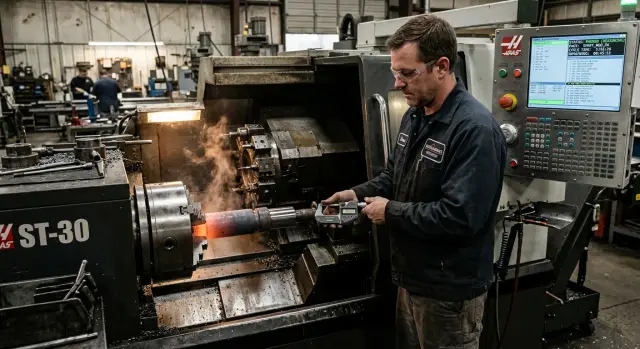
Why an inspection pause throws off size
A pause feels safe: you stop the cycle, measure, and make sure the size is close to tolerance. In a long cycle, that often gives a false picture. By that point, the part, the spindle, and the cutting zone are already warm, but not by the same amount.
During turning, the metal does not heat evenly along its full length or through its full thickness right away. The area where the insert has been under load for a long time gets the most heat. If the cycle runs 12–20 minutes, one section of the part can expand more than another, and measuring at that moment shows the size of a part that will no longer exist a few minutes later.
The machine behaves the same way. At the start of the shift, the spindle and feed units are still "cold," and by the end of the cycle they are in a different state. Not only temperature changes, but also the actual position of the tool relative to the part. That is why the size at the end of a long pass and the size after a short stop are not the same number.
After a pause, the part usually cools faster than the spindle, chuck, and heavy machine components. The part wall is thinner, and air removes heat quickly, especially if coolant flow has been stopped. The machine stays warm longer. That creates a shift: the part has already "settled" in size, while the cutting system geometry is still in the old thermal state.
Because of that, two measurements can disagree with each other. Right after stopping, the operator sees one diameter; two minutes later, another; and after the next part, the picture changes again. If you adjust the offset based on a single reading, it is easy to overshoot in the other direction.
In practice, it looks simple. Suppose the part is coming in at its finish size near the end of a long cycle. The operator pauses, measures, sees plus 6 µm, and removes it with a correction. The next part comes out undersize because the first one had time to cool, but the spindle did not.
That is why a finish pass after an inspection pause often disrupts control logic. The pause does not "show the truth"; it changes the conditions under which you are looking for it. The longer the cycle and the tighter the tolerance, the more visible the error becomes.
What changes with part and spindle temperature
In a long cycle, size changes not only because of the tool. While the machine cuts, the metal heats up, the spindle reaches its working temperature, and the clamping force no longer behaves exactly as it did in the first minute. Because of this, the same inspection pause at the start of the shift and two hours later means something different.
The part itself often expands before the finish pass. If you turn a diameter, then stop the cycle and measure right away, the gauge sees the size of hot metal. A few minutes later, the part cools and the size changes. On a short, thick workpiece, this may be barely noticeable. On a long, thin-walled part or one with a flexible section, the difference shows up faster and more clearly.
The spindle does not stand still either. As it warms up, its thermal position changes, and the actual cutting point shifts slightly with it. A machine right after startup and the same machine after a run of ten parts are not the same in how they hold size. If the finish pass after an inspection pause stays in the same place in the cycle, but the thermal state has already changed, the final size starts to drift.
The chuck and jaws add their own effect. As the clamping system warms up, it seats the blank a little differently and holds a thin wall a little differently. If the jaws pull harder, the part may compress during machining and then spring back after unclamping. Then the in-machine measurement and the out-of-machine size differ more than the operator expects.
These cases react fastest:
- long sections with low rigidity
- thin walls and rings
- parts with deep internal bores
- blanks where a lot of material is removed in one cycle
A simple example: a shaft or bushing comes close to size after roughing, then the operator pauses, measures, and applies the finish pass. If the outer layer has cooled by then, but the spindle has continued to warm up, the finish cut removes metal under different conditions. On paper, the cycle is the same. In the metal, it is not.
That is why part temperature during turning and spindle heating should be considered together. When they move in different directions, the pause stops being a neutral operation and starts affecting the result itself.
When the pause works against you
An inspection pause often shifts size more than feed or depth of cut. Right after cutting, the part is still warm, and the spindle and slide are not in the same state they were at the start of the cycle. Because of this, the size you see immediately after stopping and the size a minute later can differ noticeably.
On a turned part, it looks straightforward. The machine finishes the pass, the operator checks the size, and everything seems in tolerance. But the part sits in air, heat escapes, the metal contracts a little, and that same diameter becomes different. If the stock allowance for the finish cut is small, the difference is no longer a minor detail.
The problem gets worse when measuring takes time. During that pause, not only does the part temperature change. The machine units also move into a different state: the spindle slows down, the cutting zone cools, and the ballscrew and guides are no longer as warm as they were a second ago. Then you start the cycle again, but the restart happens with different unit temperatures. The tool enters the metal under different conditions, and the finish pass after an inspection pause gives a new result even though the program did not change.
It is most obvious in a series. The first part comes out after a still-cold start. The fifth and tenth parts run on a warmed-up machine. If you make the same inspection pause every time, the shift starts building from part to part. The operator feels like the size is acting on its own, although the reason is very down to earth: temperature is constantly moving around.
A pause usually works against you in these cases:
- the cycle is long, and the part heats up noticeably during turning;
- the tolerance is tight and the finish allowance is small;
- measurement is done outside the machine and takes at least a minute;
- the batch is short, but stops and restarts are frequent.
Thin or long parts are especially tricky. They change size faster than a heavy blank. So one good measurement proves nothing by itself. If you measured a warm part and made the decision for the next cut on one that had already cooled, the error is almost built in.
How to decide where the finish pass should go
Look at repeatability, not one good measurement. If the part sometimes lands in tolerance after the inspection and sometimes does not, the issue is usually not the pause itself, but the way it changes part and spindle temperature in the same spot of the cycle.
A simple test is enough. Keep one tool, one material, one feed, and one coolant setup. Change only the location of the finish pass relative to the inspection pause.
A simple three-part test
First, machine the first part with no pause. Record the size at a fixed point, for example 20 seconds after stopping. Do not change that moment later, or the comparison will lose meaning.
Then run the same cycle with an identical pause length. If you stop for 40 seconds, keep those exact 40 seconds on the second and third parts too. Measure again at the same moment after stopping as with the first part.
It helps to keep a short table:
- part 1 - no pause
- part 2 - with the same pause length
- part 3 - again with the same pause
- for all parts - the same measurement moment
- separately - the finish pass location in the program
Usually the pattern becomes clear quickly. If the first part is fine, but the second and third drift to the same side, the pause is changing the thermal state more than it seems. If the spread wanders without a clear direction, look not only at the pause, but also at backlash, clamping force, tool condition, or differences in stock allowance.
Next, move the finish pass and repeat the same test. On a long cycle, one of two options often helps: either do the finish pass after the pause, when the part and machine units have had time to settle a little, or move it before the pause if the stop cools the cutting zone and breaks size control.
The best place for the finish pass is not the one that gives the nicest first part, but the one that holds the second and third better. Repeatability, not a one-time success, shows where the pass truly belongs.
When moving the finish pass gives better results
If the part changes temperature noticeably during the cycle, the location of the finish pass affects size more than the pause itself. The idea behind moving it is simple: the finish cut should be placed where the thermal state of the part and spindle is closer to the real size check.
If most of the heat comes from roughing and the part quickly "drifts" afterward, the finish pass is better placed right after roughing. That way you cut while the state has not yet changed much. This often helps on heavy blanks, where the outer layer cools in a few minutes while the core still holds heat.
A different situation appears on a long cycle when the spindle itself has already reached its working temperature. In that case, moving the finish pass after the pause can be better. By then the machine runs more steadily, the thermal shift along the axis is less jumpy, and the size after inspection is easier to correct with a small offset.
Thin sections follow their own rules. If a wall or neck changes shape noticeably because of time, clamping, or nearby operations, the finish pass is better kept closer to the end. Otherwise the part may change shape after you have already gotten a nice number on the screen. On such areas, an extra 3–5 minutes between the finish cut and the end of the cycle can spoil everything.
When it is better to split the finish into a separate cycle
For a small batch, it can be handy to divide the program into two short parts. First you rough the part, stop, measure it, and see how it behaves after a minute or two. Then you run a separate short cycle with the finish pass.
This helps the operator spot the pattern faster and avoids spending half a day hunting for an offset inside a long program. It is especially useful when batches are small, the material changes, and there is not yet stable heating data.
A good sign that the move worked is simple: size no longer drifts the same way on the first, third, and tenth part. If the spread changes sign after the pause, move the finish pass not by habit, but by heat.
Example with a long bushing
A bushing takes about 12 minutes to machine. During that time, the outer diameter is cut several times, and the finish pass is left almost at the end of the cycle. The part is long and the material removal is significant, so by the time the machine stops it is no longer in the same thermal state as at the start.
The operator measures right after the spindle stops and sees a normal diameter. In the job record, everything looks calm: size is in tolerance, and there is margin. But after a 2–3 minute pause, the picture changes. The same bushing reads a few microns smaller on the micrometer.
That is not unusual. The part cools and contracts a little. At the same time, the cutting system changes state too: the spindle, chuck, and tool holder are no longer the same as at the last touch of the insert.
If the finish pass is before the inspection pause, the operator is effectively checking the part in one state but handing it over in another. On a long bushing, this is especially obvious. The longer the cycle and the higher the heat, the worse this setup holds repeatability.
Usually the spread looks like this: the first part after adjustment lands almost in the middle of tolerance, the next one moves closer to the lower limit, and then size starts drifting again depending on how long the stop was and how quickly it was measured. The machine may be perfectly fine, and the cause sits in the pause.
When the finish pass is moved to after a short pause, the situation often evens out. The part and the cutting unit have a moment to settle thermally, and the final pass runs under more similar conditions from part to part. Size then holds more consistently, even if the cycle itself stays the same.
In practice, this is checked simply. Take 5–6 bushings in a row and compare two setups:
- finish pass before the inspection stop
- pause, then finish pass
- same feed, allowance, and tool
- same time to measurement
If the second setup shows less spread, the move is justified. For a long bushing, that often gives a truer size than trying to tweak the correction after every hot measurement.
Mistakes that ruin the conclusion
Even a good measurement can lead you in the wrong direction if you change the conditions while testing. Then it seems like the finish pass after an inspection pause should be moved, when the real problem is not the pass location but the way you are checking the size.
The most common mistake is simple: the operator measures one part, sees a deviation, and immediately changes the offset. That is almost always too early. One part can drift because of local heating, a different pause length, or normal batch variation. If you adjust after the first reading, you start chasing noise instead of the cause.
Where the comparison breaks down
- You change the pause length from one cycle to the next. In one case the part sat for 40 seconds, in another for 3 minutes. The sizes can no longer be compared directly.
- You take measurements at a different moment each time. One part is still warm, another has already cooled. For turning, that is not a small detail but a different reference point.
- You judge the first parts of the shift the same way you judge parts after an hour of running. The spindle, guides, and cutting zone behave differently in the morning.
- You mix parts from different cutting regimes. If feed, depth, speed, or even insert life changed, part temperature during turning changes too.
- You draw a conclusion from one good or bad part. A proper comparison needs at least a short series under the same conditions.
A good example is a long bushing on a long cycle. In the morning, the first part after a pause came out on size, the second drifted by several hundredths, and the operator decided to move the finish pass. But the pause on the second part was shorter, and the machine had not fully warmed up yet. The conclusion was false.
If you want to understand where spindle heating and part cooling are really affecting things, keep three things constant: the cutting regime, the pause length, and the measurement moment. Only then compare the result before and after moving the pass.
The most practical approach is to keep a short note right by the machine: part number, pause time, time to measurement, shop temperature, and offset adjustment. Five lines often help more than ten disputed parts in a row.
A quick check before production
Before starting a batch, ten parts are enough if you measure them the same way and record the time right away. Without that, it is easy to mistake normal heating for random variation and move the process in the wrong direction.
If you are deciding whether you need a finish pass after an inspection pause, do not start with the operator’s feeling. First check how the size behaves at the same work rhythm. On a long cycle, even half a minute changes the picture.
For the first ten parts, write down just a few things:
- how many minutes of cutting happen before measurement;
- how many seconds after stopping you take the size;
- what size the first, fifth, and tenth part gave;
- whether the size moves only positive or only negative;
- whether you keep the same pause before measurement each time.
That is already enough to see a pattern. Suppose the first part is 40.012 mm, the fifth is 40.006 mm, and the tenth is 40.001 mm. If you measure every time 20 seconds after stopping, the size drifting one way is no coincidence. Usually it means the part temperature during turning, the spindle temperature, or both are changing as the cycle goes on.
There is a common mistake here. People compare parts but do not notice that the first was measured after 15 seconds, the fifth after 40, and the tenth after a minute because they got distracted by setup work. Then the numbers cannot be lined up in one row. You are comparing not parts, but different stages of cooling.
If size moves both ways, first check whether the pause is repeatable. If size drifts only one way, look at heating and the sequence of operations. In that case, it is better not to argue about the cause, but to repeat the short test once more and keep the same rhythm: same cutting time, same stop, same measurement moment.
A good pre-production check does not take long. But it quickly shows whether it makes sense to move the finish pass or whether the problem lies in the measurement discipline itself.
What to do next on your shop floor
Do not change the measurement scheme in the middle of a batch. If you measured the first part right after stopping, do the same for the next ones. If you let the part cool for 2 minutes, keep that same pause for the whole batch. Otherwise, you are comparing different part states and drawing a false conclusion about where the size is drifting.
The most useful step is to write two things right into the setup sheet or a regular log by the machine: how long the inspection pause lasts and where the finish pass sits relative to that pause. A couple of lines save a lot of time. After a few shifts, you start seeing a repeatable picture instead of guesses.
Minimum check plan
Do a short check on one and the same operation:
- choose one order: pause before the finish pass or after it
- set a fixed pause, for example 60 or 120 seconds
- measure the same way, with the same tool and at the same point
- run at least 5 parts in a row
- record the size, cycle time, and the part temperature by touch or with a gauge if you have one
One part is not enough. It may come out "pretty" by chance. You need at least a small series in a row to see whether the setup holds size or only looks good.
If the spread gets smaller after moving the finish pass, keep that setup and do not touch it without a reason. If size still drifts, check not only the part but also the work rhythm itself: how long the chuck stays open, how long the spindle sits before measurement, and whether there is extra delay between passes.
A good practice is to tie the decision to the part type. For a short, heavy blank, one setup may work well, while for a long bushing it may not. Do not look for one universal answer for every case.
If you are choosing a CNC lathe for long cycles and want to account for these factors in advance, it is better to discuss that before production starts. At EAST CNC, we can review the part, machine selection, commissioning, and service. That kind of conversation is useful when the goal is not just to buy a machine, but to hold size consistently on real production.