
Expanding Mandrel or Outer-Diameter Jaws for Thin Rings
We compare when an expanding mandrel or outer-diameter jaws create less ovality, change over faster, and are easier to inspect.
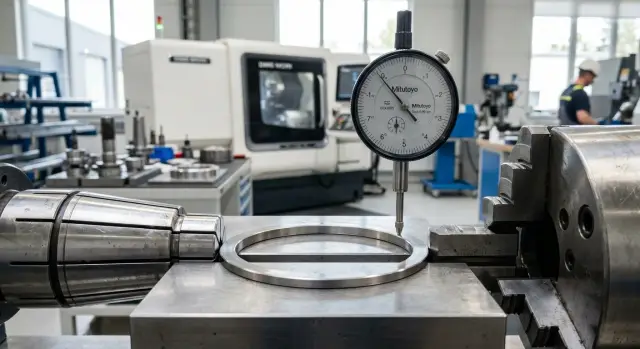
Why a thin ring changes shape
A thin ring springs easily. Even a small clamping force changes its shape by fractions of a millimeter, and that is already enough for the part to come out oval after removal. While the ring is in the chuck, everything may look fine: the clamping force temporarily holds it in the "right" geometry.
After unclamping, things change. The metal releases internal stress, and the part takes on a shape no longer supported by jaws or mandrel. If the wall is thin and the ring is narrow, this shows up especially fast.
Error often starts not with the cutting tool, feed, or spindle runout, but with locating and clamping. If the part is held poorly from the start, the rest of the setup does little to help. The operator sees an almost perfect size in the setup, removes the ring for inspection, and gets ovality above tolerance. That is not always a machining problem. Often it is the trace of clamping.
What matters most: wall thickness, ring width, where the force is applied, and the shape tolerance after removal. The thinner the wall, the easier the ring loses roundness. The narrower the part, the easier it is to skew with the same force. And if the tolerance is tight, the problem shows up even with slight deformation.
So the debate "expanding mandrel or outer-diameter jaws" should not be decided by habit. For one part, external clamping gives a good result and a fast start. For another, it immediately creates hidden distortion that will only show up at final inspection.
Simple example: the ring is held in the chuck with no visible crushing, size on the machine looks good, surface is clean. After removal, the outer diameter changes in two directions, and the part becomes oval. It seems like the machine is "drifting", even though the cause was clamping.
For thin rings, first assess not the cutting regime but the part's rigidity. That usually gives a more accurate answer than arguing about tool brand or cutting speed.
What an expanding mandrel gives you
An expanding mandrel holds the ring from the inside. Because of that, the outer wall does not get the same side pressure as with outer-diameter jaws. For a thin part, that often solves half the problem before the first pass.
The main advantage is clear after removal. If the outside diameter needs to stay round and on size, internal expansion often gives a calmer result. The ring "breathes" less under load, and it is easier for the operator to understand what he got on the part, rather than under the pressure of the chuck.
This is especially noticeable on thin-walled rings. Jaws can hold securely, but still slightly crush the outer contour. The mandrel moves the force inward, and the outer surface remains freer for finishing and later inspection.
Usually the choice comes down to one question: which size must be honest after removal. If the outside diameter is critical, the mandrel often wins.
But this method does not like dirt or hurry. A batch runs smoothly only when the inner reference is stable and the fit is clean. A little chip, burr, or oil spot is enough for the ring to seat slightly differently. On the first part this is easy to miss, but by the twentieth the size may start to drift.
There is another risk: too little expansion. If the mandrel opens insufficiently, the ring may slip during cutting. Then both size and surface are damaged.
In practice, an expanding mandrel has four clear advantages: less pressure on the outer wall, a more truthful outside diameter after removal, more stable repeatability in a series, and easier shape inspection if the internal seating is done carefully.
For a shop, that matters. On a CNC lathe, even a good program will not help if the clamping itself changes the ring's shape. That is why a mandrel is usually chosen where the cost of an error is higher than the extra minutes needed to prepare the seat and check the expansion force.
When outer-diameter jaws are more convenient
Outer-diameter jaws are often chosen not because they are more accurate for a thin ring, but because they are easier to start with. For a one-off batch or a trial run, this is often the fastest option. There is no need to wait for a special mandrel, match a fit, or check how the part seats on the inside diameter.
This is handy when you need to load the first part quickly and see how the material behaves. If the ring is simple, the batch is small, and the shape tolerance is not extreme, jaws save time at the start. Less preparation, less tooling, fewer pauses between receiving the drawing and the first cut.
But that convenience has a price. Strong clamping on the outer diameter can easily pull a thin ring out of shape before cutting begins. On the machine, the part may look fine, and after removal it may relax a little and show ovality. That is why the operator sees a good size in the chuck, while the inspector gets a different picture on the measuring table.
Soft jaws noticeably improve the situation. If they are bored accurately to the part size, the contact is more even and local pressure is lower. The risk of distortion drops, especially if you do not try to "tighten it for safety." But this does not eliminate the problem completely. A thin wall is still sensitive to clamping force, stock allowance, and even small variation in thickness.
Jaws are especially suitable in four cases: when you need to machine a small or one-off batch quickly, when the goal is to get a trial part without making a mandrel, when the inner diameter may still change, and when the ovality tolerance after removal is not very strict.
If the batch grows, the calculation often changes. What was convenient for the first 10 parts starts causing extra scrap or too much inspection on 200 pieces. So outer-diameter jaws are good as a fast start, but for thin rings they are better treated as a temporary solution until the shape requirements are fully clear.
Where ovality appears after removal
Ovality is usually visible not during machining, but after the ring is removed from the clamping device. While the part sits in the jaws or on the mandrel, the clamping force keeps it under stress. The cutter follows a shape that this clamping has partly created.
With outer-diameter clamping, the jaws slightly crush the wall inward. On a thin ring, this is noticeable even with careful force. After removal, the metal springs back, but not always evenly around the circumference. In the end, the size may stay within tolerance, but the shape becomes oval.
With an expanding mandrel, the situation is better, but not always perfect. Internal expansion also changes the geometry if the fit is too tight or the force is too high. Then the ring stretches from the inside, and after removal part of the deformation comes out unevenly. On measurement, this looks deceptive: the inner and outer diameters seem close to the target, but the circle is no longer a circle.
The thinner the wall and the narrower the ring, the bigger the difference between the two methods. A wider and stiffer ring may still forgive a small overclamp. A narrow thin-walled ring forgives almost nothing. Sometimes changing the clamping force by one step is enough for the post-release shape to shift.
Why the size on the machine can be misleading
On a CNC lathe it is convenient to measure the diameter right in the setup, but for thin rings that is not enough. In the clamped state, you are seeing a size under load. Once released, the load disappears and the ring takes a different shape.
A typical mistake is simple: the operator checks only the diameter and does not inspect the part in a free state. Then the batch moves on, and the ovality shows up during assembly or final inspection.
How to check after removal
It is better to check not one point, but the shape as a whole. Let the ring settle for a few seconds, then measure the diameter in at least two or three sections and compare readings at different angles. If it is a series, look not only at the first part, but also at the middle and last ones. Then it becomes clear quickly whether the result changes during the batch.
If you are comparing an expanding mandrel and outer-diameter jaws, evaluate the part after removal. Only then can you see which method distorts the shape less. For thin rings, that is more honest than any measurement while clamped.
How to compare setup time fairly
The argument about time usually starts with one mistake: people count only the moment when the operator removes one part and loads another. For thin rings, that is not enough. A fair comparison starts with preparing the tooling and ends when the first good part has passed inspection after removal.
If you compare an expanding mandrel and outer-diameter jaws, you need to measure the whole startup cycle. Otherwise outer-diameter clamping almost always seems faster, even though on the second and third batches that is no longer true.
It helps to split the startup into five stages: selecting and installing the tooling, boring the jaws or making and fitting the mandrel, trial cutting with program or offset corrections, checking the first part after removal, and the time until stable output without new adjustments.
This approach quickly removes unnecessary arguments. For a small batch of 10-20 rings, outer-diameter jaws often give a faster start. The tooling is already near the machine, there is no need to wait for a mandrel, and the first trial part comes sooner.
But for a repeat part, the picture often changes. If a mandrel is made correctly once and its fit dimensions are preserved, the next setup goes faster. The operator installs the same tooling, gets a familiar reference, and spends less time on fine-tuning. In a series, that can easily outweigh the longer first setup.
It is also worth recording the time for boring the jaws and the time for making the mandrel. These are different jobs. Boring may take 20 minutes, while a good mandrel may take several hours to make and check. But then it can run many setups in a row.
Another common distortion is not counting shape inspection after each trial part. For a thin-walled part, that is not a minor detail. Ovality often appears after removal, when the metal releases stress. So the time sheet should include measurement of the outer diameter, runout, and shape in the free state.
If your shop works on the same orders for months, the mandrel often wins on total time. If the order is one-off and the batch is small, outer clamping is often simpler and faster at the start. It is better to count not by feeling, but by hours and by the number of trial parts needed before the first stable good part.
How to choose the method for a new part
When deciding what is better for a new part, people often look only at how the ring sits in the chuck. For a thin part, that is not enough. The clamping method should be chosen based on what size and shape will remain after removal.
First, look at three numbers: wall thickness, ring width, and ovality tolerance. They immediately narrow the choice. If the wall is thin and the tolerance is tight, any extra pressure on the outer diameter will quickly cause distortion. If the ring is wider and stiffer, jaws can give a perfectly acceptable result without unnecessary effort.
Next, you need to understand which diameter matters most after machining. Sometimes the inner diameter is more important, because the ring later fits onto a shaft or mandrel. Sometimes the key size is the outer diameter, if the part goes into a housing. This affects the choice more than the operator's habit. If the part must hold its shape by the outer diameter after removal, a mandrel often gives a calmer result. If a fast start matters more and the ring is not too soft, jaws may be more convenient.
The best way to check is to make two trial parts. Machine one on a mandrel and the second in jaws. The conditions must be identical: same material, same allowance, same speed, feed, and depth of cut. Otherwise the comparison will not show anything.
Measurement must also be done the same way. Do not inspect one part immediately and the other twenty minutes later. Thin rings sometimes release stress not at the moment they leave the machine. It is better to choose one interval, for example 10-15 minutes after removal, and measure both parts by that standard.
Look not only at scrap, but at the whole cycle: how many minutes were spent on setup and tool approach, how long the first-part check took, how often you had to tighten, adjust, or remeasure, and how steadily the shape holds on the second and third parts.
The winner is not always the method that gave the prettiest first part. Sometimes the mandrel gives the better shape but takes too much time for CNC lathe setup. Sometimes jaws are a little worse in shape, but the batch runs faster and inspection is simpler. It is better to evaluate the full set of factors, not one lucky measurement.
Example for a batch of 200 rings
Imagine a batch of 200 thin steel rings. The outer diameter is 80 mm, wall thickness is 2 mm. The shape tolerance is tight: the ring must stay round not only in the chuck, but also after removal and cooling.
With outer-diameter jaws, the operator starts quickly. He loads the blank, clamps it, makes the first part, and almost immediately gets the required size by the tool setting. At the start this looks convenient, especially if the order is urgent.
The problem appears later. A thin ring may hold size in the chuck, but after removal it can spring back slightly and go out of ovality tolerance. The operator has to adjust the clamping force several times: a little tighter and the part gets crushed; a little looser and the ring may move during cutting.
In a batch like this, the picture is usually typical. The start on jaws takes about 15-20 minutes, but then every 20-30 parts the clamping force has to be checked again. Some rings need to be remeasured after removal, and a few parts go to rework or scrap not because of size, but because of shape.
An expanding mandrel behaves differently. It takes more time at the beginning: you need to match the fit, check the support, and make a trial part. But once set up, the ring sits more steadily and the shape repeats more evenly from part to part.
If you compare the numbers, the difference is clear. With jaws, you can get the first good sample faster, but out of 200 rings some parts will need extra shape inspection, and some will go out of tolerance after removal. On a mandrel, startup may take 45-60 minutes, but the number of parts outside tolerance is usually much lower, and the cause is more often blank variation or cutting conditions than the clamping itself.
There is another difference too: time at the inspection station. After machining on a mandrel, the rings often show a predictable result right after release. With outer-diameter jaws, you have to wait more often, recheck, and figure out what caused the deviation — the cutter, the chuck, or too much clamping force.
So this choice should not be counted only by the minutes of the first startup. For a one-off batch, jaws may be more economical. But if the order returns every month, the mandrel quickly pays back the setup: fewer adjustments, fewer repeat measurements, and a lower risk of ovality after removal.
Mistakes that ruin the comparison
Tooling comparisons often break not on the machine, but in the way they are checked. People change several conditions at once and then get a random result.
The first mistake is comparing two clamping methods with different feed, speed, and depth of cut. Then you are testing not the tooling, but different cutting conditions. If the ring was cut gently on the mandrel and with a heavier pass in the jaws, the conclusion can no longer be called fair.
The second mistake is tightening the jaws harder than needed to hold the part. On thin-walled rings, extra force quickly causes local deformation. While the ring is in the chuck, the size may look fine. After removal, the metal releases stress and the ovality becomes visible.
Measurement is also often rushed. The ring is removed and measured immediately. If the part is still warm, the result drifts. A difference of a few hundredths can easily appear because of temperature, not the clamping method.
Another serious mistake is checking only the diameter. For parts like this, that is not enough. A ring can pass size and still have poor shape. If you do not check ovality in several sections, inspection becomes a formality.
And finally, do not draw conclusions from one part. One good sample proves nothing. For a proper conclusion, you need at least a small series, for example 10-20 rings in a row under the same conditions. Only then can you see repeatability, not a lucky coincidence.
If you need to compare thin-ring clamping fairly, keep the material, allowance, tool, cutting conditions, and measurement point the same. Change only the tooling. Otherwise the argument about setup and machining quality will end not with facts, but with the operator's habits.
Quick check before startup
Before the first part, it helps to pause for a few minutes and check not the machine manual, but the clamping logic itself. On a thin ring, a mistake rarely looks obvious. More often the part comes out "almost right", and the ovality shows up only after removal and cooling.
First, look at the contact area. If the ring is held on a narrow strip, the clamping may be stable only in idle rotation, while under cutting the part will start to move or spring. For thin-walled rings, that is a common reason for disputed results.
Then check where the tooling pushes. If the force lands on the thinnest zone, the shape will shift even with careful feed. This applies to both mandrels and jaws: it only makes sense to compare them when you know where the ring is weakest.
Before startup, a short check is enough. Make sure the contact area is sufficient and the ring does not move in the clamp. See whether the pressure point falls on a thin wall or on a turned groove. Decide right away where and how you will measure the part after removal. And define the number of trial parts in advance: for thin rings, one is usually not enough; it is better to make at least 3-5 pieces.
The last question matters too: what is more important in this batch — a fast start or a more even shape after machining. If the order is urgent and the shape tolerance is not tight, people usually choose the option that is faster to set up and check. If the ring will later go into a precise assembly, it is better to allow more time for trial parts and post-release inspection from the start.
A small rule works almost every time: a good size in the chuck proves nothing yet. Remove the part, let it sit for a few minutes, and check the shape where the assembly will later receive it. That is usually the test that shows whether the clamping was honest.
What to do next
It is better to start not with the tooling, but with the drawing. It should specify the shape tolerance and the point where you will measure the ring after removal. If the measurement location is not defined, a dispute about the result is almost inevitable: one person measures near the edge, another in the middle, and the numbers are already different.
Immediately separate three things: wall thickness, material, and batch size. For a thin aluminum ring in a lot of 20 and for a steel ring in a lot of 200, the solution is often different. Where the material is soft and the wall is thin, a clamping mistake shows up faster.
Next, choose the priority. If minimal ovality after removal matters most, a gentler locating and clamping method usually wins. If the batch is small and changeovers are frequent, CNC lathe setup time may matter more than a few microns that still remain within tolerance.
It helps to note a few items in a short work sheet: the maximum allowable shape tolerance, exactly where to measure the ring, how many parts are in the batch, how much time is acceptable for setup, and which scrap is more expensive — shape or deadline.
After that, make a short trial. Not with one part, but with at least 5-10 pieces in a row. That shows not only the first good result, but also how the clamping behaves in a series. Often the real difference between a mandrel and jaws appears on the fifth or eighth part.
If doubts remain, it is useful to review the whole task: drawing, material, tolerance, batch size, and desired cycle time. EAST CNC specialists can help choose equipment for such jobs, and the east-cnc.kz blog publishes practical materials on metalworking and tooling.
And one more thing: save the results of the first trial. A photo of the part, the measurement scheme, and the actual ovality after removal save a lot of time when the order returns a month later.
FAQ
What should I choose for a thin ring: an expanding mandrel or outer-diameter jaws?
If the part must stay round on the outside diameter after removal, an expanding mandrel is usually the better choice. If the batch is small, you need a fast start, and the shape tolerance is not very tight, outer-diameter jaws are usually more convenient.
When are outer-diameter jaws really more convenient?
Outer-diameter jaws are useful for one-off or small batches when you need the first part quickly. They are also a good option when the inner diameter may still change and it is too early to make a separate mandrel.
Why is the size fine on the machine, but ovality appears after removal?
While the ring is clamped, the tooling holds it under load, so you are seeing a size that is not free state. Once the part is removed, the stress is released, the metal springs back a little, and the circle can easily become oval.
How can I tell whether the problem comes from clamping and not the machine itself?
First check the part after removal, not only in the setup. If the size and shape look good in the chuck but the ring goes out of shape on the table, the clamping is usually the cause, not the spindle or the cutting tool.
Which parameters should I look at before choosing a clamping method?
Look at wall thickness, ring width, and the ovality tolerance after removal. Then decide which diameter matters most for the part: if it is the outside diameter, a mandrel usually gives a calmer result.
Does an expanding mandrel always give a more accurate result?
No, not always. A mandrel often gives a more even shape on thin rings, but a dirty fit, a burr, or too little expansion can quickly spoil both size and surface.
How do I compare the setup time of two options fairly?
Count not only the tooling change, but the whole startup until the first stable good part after removal. For a small batch, jaws are often faster, while for a repeat order a mandrel often makes up for the longer first setup.
How many trial parts should I make before starting a series?
One part is not enough. For a proper check, it is better to make at least 3-5 pieces, and for comparing two methods, a small series of about 10-20 rings under the same conditions.
How should a thin ring be checked after machining?
Let the ring sit for a little while after removal and measure it in a free state. Check the diameter at different angles and in at least two or three sections, otherwise ovality is easy to miss.
What mistakes most often ruin the result on thin rings?
The most common problems are too much clamping force, a dirty fit, rushing the measurement, and comparing parts under different cutting conditions. On a thin ring, even a small chip or extra tightening can quickly distort the shape.