
Expanding Collet for the Internal Datum in the Second Operation
Learn when an expanding collet for the internal datum gives a more accurate second operation, how to choose the expansion range, and how to keep rigidity on the finishing pass.
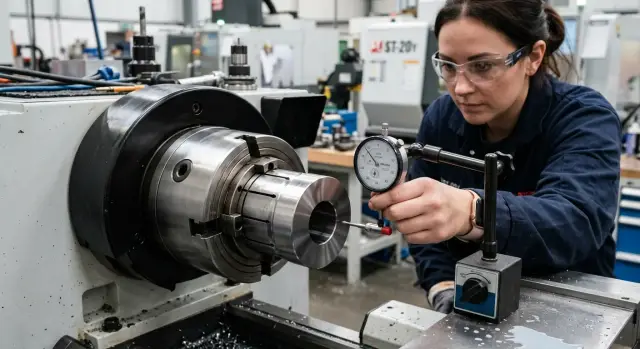
Why the second operation shifts the size
After the part is flipped, it almost always rests on a different geometry. In the first setup, the machine built the size from one axis, and in the second it gets another one, even if it is very close. Those few hundredths are what show up in measurement later.
On the second operation on a lathe, a common mistake is simple: the part is clamped by the outer surface because it is faster. But the outer diameter does not always match the axis of the hole precisely. If the outside was turned with stock left on it, if the blank had runout, or if internal stresses remained after the first setup, the outer datum starts to "lie."
This is especially noticeable on parts where the working dimension is taken from the hole, not the outside contour. From the outside the part may look straight, but the bore already lives on its own axis. When the part is flipped, the machine faithfully follows what you clamp, not what the drawing needs.
There is a second reason as well: deformation from clamping. A thin bushing, sleeve, or ring can easily change shape if the jaws or collet press harder than necessary. While machining, the part sits oval or slightly compressed, and after unclamping it almost returns to its original shape. In the end, the size on the machine was one thing, and on the inspection table you see another.
This is especially clear on the finishing pass. Even small runout changes the actual stock removal: on one side the tool cuts more, on the other less. That is how taper, ovality, unstable diameter, and a "floating" face dimension appear.
A simple example: a bushing has its bore and one face machined first. Then the part is flipped and clamped by the outer diameter. If the outside is offset from the bore by even 0.03 mm, the second face and the outer finish size will already shift relative to the internal datum by the same few hundredths. If the wall is thin and the clamping is strong, the error becomes even larger.
That is why an expanding collet for the internal datum often gives a more predictable result. It brings the part back to the axis of the finished bore instead of the axis of a random outer surface. But this only works when the bore itself is suitable for locating and the expansion force does not distort the part.
When the internal datum gives a better result
Internal locating usually wins when the part already has an accurate bore after the first setup, while the outer contour is not yet finished. The logic is simple: it is better to rely on what has already been machined accurately than to clamp the part by a surface with stock, tool marks, or slight ovality.
An expanding collet is especially useful when you need to keep the bore and outer diameter concentric. If the bore is machined first and the outer portion is cut in the second operation, locating by the inner bore usually gives a more stable runout result. External clamping in this case is more likely to repeat the errors of the rough surface than to correct them.
This is easy to see on short bushings, rings, and stepped parts. They do not have much length for a secure outside clamp, and the jaws can easily seat the part at an angle. Internal expansion holds it closer to the bore axis, so the position is more stable.
Another typical case is when the outer contour after the first operation is still uneven. For example, the part may have a rough diameter, a transition, an interrupted surface, or marks from preliminary machining. If you clamp such a part on the outside, the seating becomes random: one batch sits a little better, another a little worse. If the bore has already been bored to size, the internal datum removes that lottery.
But this setup does not work in every case. The internal datum is good only when the bore is already suitable as a reference: without noticeable taper, burrs, or marks that interfere with seating. If the goal of the second operation is to tie the outer geometry to the bore, and not the other way around, internal expansion is usually the most direct path to accuracy.
On CNC machines, this approach is especially convenient in production runs. If the internal datum is stable, it is easier to get the same result from part to part.
What to check before choosing the collet
Before selecting an expanding collet for the internal datum, look at more than just the nominal hole size. In the second operation, small details often decide everything. If the hole varies by only a few hundredths and the wall near it is thin, the same collet will clamp the part differently from part to part.
First, measure the actual bore diameter and its real variation across the batch. One part is not enough. It is better to take several pieces and write down the minimum, maximum, and drawing tolerance. For tooling selection, you need not the size on paper, but what actually comes out of the first operation.
Then check the contact length between the collet and the bore. A short contact often creates an uneasy clamp: the part is held, but it can shift slightly on the finishing pass. If the collet touches the part over only 2-3 mm, that is already a reason to rethink the setup. A longer support zone works much more calmly if the part geometry allows it.
Wall thickness in the expansion area matters a lot too. A thin wall can be expanded more than it seems. The outside size may still look fine, but after unclamping the bore and seating surfaces behave differently. If there is a thin shoulder, a relief, or a weakened zone nearby, the risk only grows.
Also look closely at chamfers, grooves, and interrupted sections. A collet likes a smooth cylindrical surface. If part of the contact lands on a chamfer or falls into a groove, the force is distributed unevenly. This is where runout appears, and later it is hard to blame it on the machine setup or cutting parameters.
It helps to record four numbers right away: the minimum bore diameter, the maximum bore diameter, the working contact length, and the allowable runout after the second operation. The last point is often left for later, and that is a mistake. If you do not define the runout tolerance in advance, it becomes hard to tell later whether the cause was the collet, the bore size, or the machining scheme itself.
A simple example: the bore holds size, but in the clamping zone the wall is only 2 mm thick and there is a groove nearby. Such a part may look convenient for expansion, but on the finishing pass it will start to spring. In this case, first check the contact-zone geometry, and only then choose the collet expansion range.
How to choose the expansion range
Choose the expansion range not by the nominal bore size, but by the actual part size after the first operation. If the drawing says 20 mm, that still tells you nothing about where the collet will actually work. First collect the real minimum and maximum across the batch, or at least across trial parts.
Then add the process variation. It is often larger than expected: tool wear, different stock allowance, part heating, small machine drift. If the measurements show 20.02-20.05 mm, and the process sometimes drifts another 0.02 mm, you should already calculate a range of 20.02-20.07 mm.
For internal locating, this is especially important because the extreme positions of the stroke are almost always worse in rigidity. When the fingers are opened almost to the limit or, on the contrary, barely come into contact, the part is held less securely. On the finishing pass, that quickly shows up in size, runout, and surface marks.
The practical approach is simple. Take the smallest and largest bore size after the first operation, add the possible process variation, and choose a collet so that the working part size sits closer to the middle of its stroke. After that, check whether the finger length is enough for proper seating, and clamp a trial part while checking runout before starting production.
The middle of the stroke gives you reserve. The collet is not working at the limit, the fingers seat more stably, and the second operation on the lathe becomes calmer. If the working point is shifted toward the edge of the range, it is better to take a neighboring collet size or change the bore diameter after the first operation.
Also check finger length and seating depth. If the fingers are short and the bore is deep or has a pronounced chamfer, the collet may hold the part only on a narrow band. On a dial indicator this may sometimes look acceptable, but on the finishing pass rigidity drops.
A simple example: after the first operation, the bore varies from 29.98 to 30.04 mm. If the collet works confidently in the 29.95-30.15 mm zone, the working point is close to the middle, and that is a good option. If the actual size sits near the upper limit, it is better not to risk it and choose another design.
The final check is simple too: clamp 2-3 parts, measure runout, make a light finishing pass, and measure again. Five minutes spent on a trial often saves a whole batch.
How to keep rigidity on the finishing pass
The finishing pass likes a calm setup: short overhang, firm contact, and a small, predictable allowance. If even one of these points is weak, the part starts to "breathe," and the size drifts exactly in the last few hundredths.
A common mistake is to expand the collet almost to the limit. At that point it still holds the part, but it does so worse: rigidity drops, contact becomes less even, and the risk of micro-shift under the tool rises. For finishing, it is better to leave some expansion reserve. If the part bore varies too much, it is wiser to use another collet size than to try to cover everything with one body.
Support length matters just as much. When the collet touches the part only on a narrow band at the entrance edge, the clamping becomes nervous. On roughing this sometimes passes, on finishing it often does not. It is better when the seating works along the bore length rather than only at its edge. Then the force is distributed more evenly, and the part deflects less while cutting.
Overhang from the chuck also quickly eats rigidity. Even a good collet will not save you if the part is extended farther than necessary for tool access. Leave only the overhang needed for the tool path and a safe exit. An extra 10-15 mm often makes a noticeable difference in surface finish and size repeatability.
The pass itself is also better kept simple. If the finishing allowance is small and even, remove it in one stable pass, without several barely noticeable touches. Repeated passes on an already weakened thin wall often give a worse result than one proper cut.
If the wall is thin, the cutting conditions should be calmer. Usually a lower feed and shallower depth of cut help. Too aggressive a setup bends the part right during machining, and after the force is removed the size changes. Here a simple check helps: turn one part with a softer setup and compare the size at the chuck and at the exit. If the difference disappears, the problem was not the collet geometry, but the lack of rigidity in the whole setup.
A good setup for the second operation looks quite simple: the collet is not at its limit, it supports along the length, the part sits short, and the finishing allowance is removed in one calm pass.
A simple bushing example
Take a standard bushing after the first operation. The bore is already finished to size, for example 30.00 +0.02 mm. The outer diameter is not yet final: there is an uneven 0.2-0.5 mm allowance around the circumference because the blank sat imperfectly or there was a small variation left after roughing.
On the second operation, it is often tempting to clamp such a part from the outside. It is fast, but not always accurate. If the outer surface is still uneven, the jaws will repeat that error. In the end, the outer diameter can be brought to size, but concentricity with the bore will be lost.
Here the expanding collet gives a clear advantage. The part seats by the finished bore, and the outer diameter is then machined relative to the datum that will actually work in the assembly. For a bushing, that is usually more correct than chasing the outer stock.
Let us imagine a simple case. There is a 40 mm long bushing, the 30.01 mm bore is already finished, and the outer diameter needs to be brought to 42.00 mm. If you use a collet with a working range of 29.98-30.08 mm, then at the actual 30.01 mm bore it will open roughly in the middle of its stroke. In this position the fingers hold the part more evenly, and the contact in the bore is calmer and tighter.
If you install a collet that opens almost to the end for this bore, the behavior changes. The fingers are pulled outward more strongly, the support length can become less even, and taper appears on the finishing pass. One side comes in size, the other shifts by several hundredths. The tool marks often get worse too, even though the cutting conditions did not change.
The rule here is simple: do not choose a collet so that the working part size lands at the very end of its stroke. Leave opening reserve in both directions and check whether the contact length in the bore is sufficient. A middle working stroke usually gives a more even size and a cleaner surface. For the second operation on a lathe, that is often enough to hold concentricity and reduce the risk of taper at the finish.
Where mistakes happen most often
Scrap in the second operation often starts not on the finishing pass, but earlier — at the moment the tooling is chosen "with reserve." The most common mistake is simple: one collet is chosen for too wide an expansion range, and precise size repeatability is expected from it. In practice, that does not work. The wider the working range, the harder it is to get the same part position and proper rigidity.
Another typical problem is that the part is held not along the full seating length, but on a narrow band near the bore edge. The machine may run smoothly, but the part itself is already seated unstably. On roughing this is sometimes invisible, but on finishing runout, taper, or a drifting size appears right away.
People often look only at the bore nominal after the first operation and do not check the actual variation. But it is almost always there. If the bore varies by even a few hundredths, the expanding collet starts seating the part slightly differently each time. As a result, the outer diameter can shift even though the tool, the cycle, and the program did not change.
Many problems also come from clamping force. The logic is understandable: if the part moves, clamp harder. But extra force does not fix a poor overhang, short support, or an unsuitable contact-zone geometry. On the contrary, it can crush the thin wall, distort the bore, and create a new drift after unclamping.
There is also a quieter mistake: the operator sees that the size is holding and decides the setup is good. But if radial and face runout are not checked, the problem remains. The part may stay within tolerance on one dimension and still lose concentricity.
A good check sequence is usually this: first look at the bore variation after the first operation, then the contact length, then the part overhang, and only after that change the clamping force. That order saves both time and parts.
Quick check before production
Before starting production, do not guess from the drawing. It is better to clamp 3-5 parts from the trial batch and check the setup directly on the machine. In the second operation, small details matter: where the collet holds, where it works in its stroke, and how the part behaves on the finishing pass.
First look at the bore size. If it lands close to the edge of the stroke, the collet holds less well and is more likely to shift the size. The normal working zone is the middle of the range. There the fingers open without distortion, and the clamping is more even.
Then check the contact length. The fingers should support the full length that actually locates the part. If the contact goes only on a narrow band at the bore entrance, the part can tilt easily even with good clamping force. You will not always see this by eye, so after the first clamp it is useful to remove the part and inspect the contact mark.
Then check the indicator and the surface after the pass. If the first part runs true but the third one already starts to drift, the problem is usually not the tool, but the seating in the bore or the collet range being too wide. This kind of check takes only a few minutes, but later you will not have to chase the size across the whole batch.
There is also a very simple sign. If after the finishing pass you see crushing marks on the locating bore or nearby, you have almost certainly overtightened the clamp or chosen a support setup that is too soft. At that point it is better to stop and adjust the setup than to hope the marks disappear on the next parts.
A good start is boringly consistent: the part seats the same way, runout repeats, and the surface after the finishing cut stays clean. For the second operation, that is already enough.
What to do next
Do not choose a collet from the catalog without looking at the part. For the second operation, it is more useful to take several real blanks with different actual bore sizes and see how they behave in the clamp. A variation of only a few hundredths already shows where internal locating holds securely and where support starts to fade.
The trial is better when it is short but honest. First remove a small allowance in a rougher mode, then immediately make the finishing pass with the same datums. That shows not only the final size, but also how the clamp holds the part under load.
Watch several signs at once: runout after repositioning, taper on the machined surface, clamp marks inside the bore, and size repeatability on the first and last trial part. If you are choosing between two tooling setups, compare them on the same program and the same allowance. That makes the difference visible faster than any parameter table.
After the trial, it is useful to record three things in the setup sheet: the working bore range, clamping force, and part seating length on the collet. When the operator changes, these notes noticeably reduce the risk of scrap.
If you are selecting the machine itself for such operations, it is better to discuss it in advance. EAST CNC, the official representative of Taizhou Eastern CNC Technology Co., Ltd. in Kazakhstan, works specifically with CNC lathes for metalworking and covers the full cycle - from selection to commissioning and service. For parts where the second operation depends heavily on locating, that conversation is usually more useful than reworking the chosen setup later.
FAQ
Why does the size shift after the second operation?
The size usually shifts because the reference changes. In the first setup, the machine builds the geometry from one axis, and after the part is flipped it rests on another surface. If you clamp the part by the outside diameter while the working size is taken from the bore, the machine follows the outer surface. If that outer surface is off by even a few hundredths, the second face and the finish diameter will already move away from the bore.
When is it better to locate from the bore instead of the outer diameter?
Use the internal datum when the hole has already been machined accurately and the outer surface is still rough or uneven. That way, the second operation is tied to the axis required by the drawing. This works especially well for bushings, rings, and short parts where outside clamping easily creates a tilt. If the hole is straight and free of burrs, an expanding collet usually gives more stable concentricity.
How do I know whether the bore is suitable for an expanding collet?
First, check the actual hole size on several parts, not just one. Then look at taper, burrs, chamfers, and grooves in the contact area. A collet needs a straight cylindrical surface and enough support length. If the contact falls on a chamfer, a short band, or near a thin wall, the part may seat differently from part to part.
How do I choose the expansion range of the collet?
Focus on the actual minimum and maximum hole size after the first operation. Then add the process variation: tool wear, heat, and small size drift. The working size should sit closer to the middle of the collet’s stroke. That is where it holds more evenly and handles the finishing pass more calmly.
Why not work almost at the limit of expansion?
At the edge of the stroke, the collet holds less securely. The fingers are already near their limit, the contact becomes less even, and stiffness drops. On roughing, this is not always obvious right away. On finishing, the problem quickly shows up as taper, runout, and a drifting size.
How important is the contact length between the collet and the bore?
A longer support is almost always better than a short one. When the collet grips only near the entrance edge, the cutter can tilt the blank more easily during the pass. If the part geometry allows it, let the collet work along a noticeable length of the bore. That spreads the force more evenly and improves size repeatability.
What should I do if a thin wall gets crushed during expansion?
Reduce the clamping force and check whether the expansion zone falls into a weakened area. A thin wall, a shoulder, or a nearby groove can deform easily, and the size changes after unclamping. Sometimes it is better to change the locating zone a little or choose another collet than simply tightening harder. Extra force rarely solves this kind of problem.
How do I avoid losing rigidity on the finishing pass?
Keep the part overhang minimal, leave a small and even finishing allowance, and remove it in one calm pass. Several light touches on a thin wall often give worse results than one proper cut. If the part still moves, try a softer setup: lower feed and shallower depth of cut. That makes it easier to see whether the problem is the clamp or the cutting load.
What mistakes most often cause runout in the second operation?
Usually the runout is caused not by the cutter, but by the part seating itself. The most common mistakes are these: choosing too wide a collet range, gripping the part on a narrow band, and ignoring the actual hole variation after the first operation. Another common cause is trying to fix everything with more clamping force. If the support setup is weak, extra expansion only adds deformation.
What should I check before starting production?
Before the batch, clamp a few parts from the trial lot and check runout before and after the cut. You will quickly see where the collet holds evenly and where the size already sits near the edge of the stroke. Then look at the contact mark, traces inside the hole, and size repeatability on the first and last trial parts. A five-minute check like this usually saves an entire batch.